Bench Degree·LASERSchapter

Chapter 14: The Biggest Ones
A hundred and ninety-two beams, two megajoules, three billionths of a second, onto a target the size of a peppercorn. It has now got more energy out than the beams put in, eleven times. And it is still nowhere near making electricity, for a reason worth understanding properly.
Chapter 9 established the idea this chapter is built on: peak power is cheap and energy is expensive. A tabletop femtosecond system reaches tens of terawatts of peak power on a few joules. Getting megajoules into a target takes a building.
The National Ignition Facility at Lawrence Livermore is that building. It occupies about the footprint of three football pitches, and almost all of it is laser.
Section 1: What It Is
One pulse becomes 192. A single small pulse of infrared is split and fed into 192 separate amplifier chains, each a series of slabs of neodymium-doped glass pumped by banks of flashlamps. Each chain amplifies its share by an enormous factor.
Then the colour is changed twice. The neodymium light comes out at 1053 nm, and crystals convert it to 351 nm ultraviolet by the frequency-doubling process of Chapter 8, applied twice over. Shorter wavelength couples into the target far better, for the absorption reasons of Chapter 10.
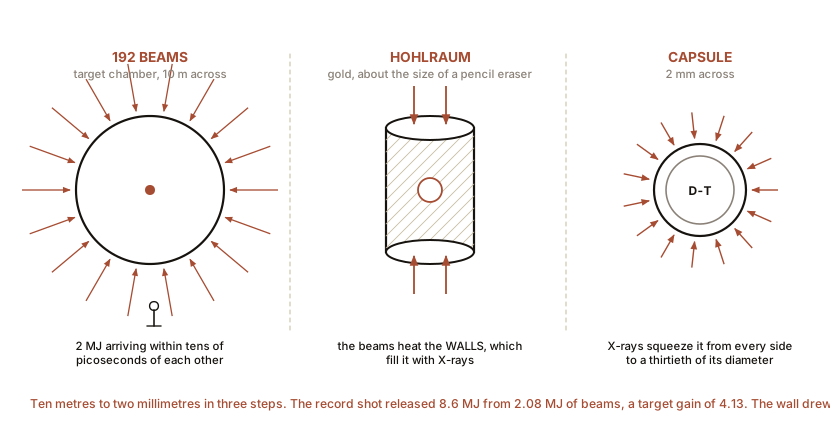
Then all 192 arrive at the same place at the same time. They converge on a target chamber 10 m (33 ft) across, and their arrival must be simultaneous to within a few tens of picoseconds after travelling hundreds of metres by separate routes.
And the target is tiny. A capsule about 2 mm (0.08 in) across, holding a frozen layer of deuterium and tritium, sitting inside a small gold cylinder called a hohlraum about the size of a pencil eraser.
The beams do not hit the fuel. They hit the inside of the gold cylinder, which becomes hot enough to fill with X-rays, and the X-rays compress the capsule from all sides at once. That indirection is called indirect drive, and it is used because a bath of X-rays squeezes far more evenly than 192 individual beams could.
The capsule implodes to about a thirtieth of its diameter, the fuel in the centre reaches conditions where deuterium and tritium fuse, and the reaction burns outward through the compressed fuel faster than it can fly apart.
The whole event lasts a few billionths of a second. The facility fires a few times a day.
Section 2: The Lawson Criterion, Which Is Just a Trade
Fusion needs three things at once, and there is no way to be generous with one and mean with another. You must get the fuel hot enough that nuclei collide hard enough to fuse, dense enough that they collide often, and hold it long enough for the reaction to release more than it cost.
That is the Lawson criterion, and it is a trade rather than a threshold: the product of density and confinement time must exceed a value that depends on temperature.
And it splits fusion research into two camps that are the same physics answered oppositely.
Magnetic confinement, the tokamak, chooses long time and low density. A dilute plasma held by magnetic fields for seconds. The Plasma volume’s Chapter 12 covers it.
Inertial confinement, this chapter, chooses enormous density and almost no time. Compress the fuel to many times the density of lead and let its own inertia hold it together for the nanosecond it takes to burn. There is no field and no bottle. The confinement is simply that matter cannot get out of its own way instantly, which is what inertial means and why the name is honest.
Section 3: Ignition, and What the Number Means
On 5 December 2022 NIF delivered 2.05 MJ of laser energy to a target and the fusion reactions released 3.15 MJ. More energy came out than the beams put in, for the first time in a laboratory.
That is ignition, and it was a real scientific milestone: the reaction was heating itself enough to keep going rather than merely responding to the drive.
It has since been repeated and improved on, which matters more than the first shot did. Eleven ignition events by mid-2026. The record as of writing was 7 April 2025: 2.08 MJ delivered, 8.6 MJ released, a target gain of 4.13, at a peak power of 456 terawatts. February 2025 gave 5.0 MJ at gain 2.44. June 2026 gave 7.9 MJ at gain about 3.8.
So the effect is real, reproducible, and getting better. All three of those are worth saying, because each was doubted after the first shot.
Section 4: And Now the Honest Accounting
Here is the paragraph that most coverage of this leaves out, and the reason this book exists.
That gain of 4.13 is a target gain. It compares the energy the fusion released against the energy in the laser beams.
It does not count what it took to make the beams.
NIF’s amplifiers are flashlamp-pumped neodymium glass, which Chapter 7 lists at around one percent efficient for exactly this configuration. To put 2 MJ of ultraviolet on target, the facility draws something in the region of 400 MJ from the wall.
So the real ledger on the record shot is roughly 400 MJ in, 8.6 MJ out. About two percent.
That is not a criticism of the result and it is not a hidden failure. Target gain is the right number for the physics question, which was whether a self-sustaining fusion burn could be achieved at all, and the answer is now yes. It is simply not the number for the electricity question, and the two get conflated constantly.
Three further things stand between this and a power station, and none of them is small.
Repetition rate. NIF fires a few times per day. A power plant would need something like ten times a second, which is a factor of about a million. The flashlamp architecture cannot do that at all; it would need diode pumping throughout, which is Chapter 7’s efficiency argument applied at enormous scale.
Targets. Each shot consumes a precision-machined capsule inside a gold hohlraum, currently costing thousands of dollars and made largely by hand. At ten a second you need about a million a day, for pennies.
And the facility was not built for electricity. NIF’s primary mission is stockpile stewardship: studying the physics of nuclear weapons without testing them. Energy research is a genuine secondary use, and reporting that treats it as a power-generation programme that is behind schedule has misunderstood what it is.
SLOW DOWN. Check Your Understanding: If NIF’s laser is only about one percent efficient, and a diode-pumped laser can reach thirty percent, why was NIF not simply built with diodes? Think about when it was built before reading on.
Because the diodes did not exist at the required scale or price when it was designed. NIF was authorised in the 1990s and completed in 2009, using flashlamp technology that was mature and could be scaled to megajoules with confidence. High-power diode arrays capable of pumping a megajoule-class system are a much more recent and still very expensive proposition. This is the ordinary condition of large scientific instruments: they are built with the technology that exists when the money is committed, and they outlive it. Which is why the interesting inertial-fusion energy proposals are all new-build diode-pumped designs rather than modifications of NIF, and why a demonstration of ignition at NIF is best read as physics validated on the wrong machine.
Section 5: OMEGA, and the Other Approach
The other large laser worth naming is OMEGA, at the Laboratory for Laser Energetics at the University of Rochester, which is where Theodore Maiman did his doctoral work and is on the cover of this book.
OMEGA is smaller, 60 beams and about 30 kJ, and it uses direct drive: the beams hit the fuel capsule itself rather than heating a hohlraum to make X-rays.
The trade is efficiency against uniformity. Direct drive wastes less energy, because the X-ray conversion step in a hohlraum throws away a large fraction. But it demands that the beams illuminate the capsule far more evenly, because any hot spot grows into an instability that spoils the implosion. That is a hard optical problem and it is the reason both approaches are still being pursued.
Section 6: What Is Actually in the Building
Some numbers, because the scale of it is the thing people find hardest to picture and it is all made of the components in Chapter 7.
Around 7,700 large optics and roughly 30,000 smaller ones, many of them metre-scale slabs of laser glass, each of which must be finished to a fraction of a wavelength, which is Chapter 11’s interferometry doing quality control.
About 3,000 tonnes, or 3,300 US tons, of concrete and steel in the target bay alone.
Ten metres of target chamber diameter, aluminium, 10 cm (4 in) thick, with 192 ports.
A few billionths of a second of useful output per shot.
And the physics is Chapter 3 and Chapter 4. Stimulated emission in a doped glass, a population inversion held by a metastable level, and Chapter 9’s trick of banking energy slowly and spending it fast. Everything in this building is the pointer in your pocket, made very large and very carefully.
Next: lasers pointed deliberately at people. Corneal surgery, why the wavelength choice is what makes it possible at all, and the uncontrolled devices sold online as medical equipment.

Bench Degree
Get the degree without the diploma.
Learn the material, not how to pass the exam.