Bench Degree·MUSICchapter
Appendix A: The Bench
The whole volume’s kit in one place. Almost all of it is already in your pocket or on a shelf; the one thing you may need to build is a single string on a board.
One string carries the book. A guitar’s G string, or the monochord below, gives you the chord of Chapter 1, the harmonic ladder of Chapter 3, the ratios of Chapter 5, the Pythagorean scale of Chapter 6 and the bugle of Chapter 26. A phone carries most of the rest, on free apps. Everything else is a keyboard you can open in a browser, a notation program that costs nothing, recordings, and your own voice.
Nothing here is specified by brand. Every item and every app is described by what it does, so the list stays usable for as long as the book exists.
Section 1: The kit
| Item | Specification | Rough cost | Chapters |
|---|---|---|---|
| Guitar | Any, steel or nylon strings, tuned normally. A scale length of about 648 mm (25.5 in) matches the tables in the book; other lengths work with the same fractions. | owned, or $50 to $150 used | 1, 3, 4, 5, 7, 10, 11, 26 |
| Ukulele | Optional, instead of or beside the guitar. Scale about 330 mm (13 in). | owned, or $30 | 1 |
| Monochord | One string on a board, built in Section 3. Replaces the guitar in every string experiment. | about $15 | 1, 3, 5, 6, 26 |
| Phone | With the free apps of Section 2. A second phone, tablet or laptop saves juggling when one device plays tones and the other measures. | owned | throughout |
| Headphones or a small speaker | Any. | owned | throughout |
| Ruler or tape measure | Marked in millimeters and inches, at least 700 mm (28 in) long for the monochord. | $3 | 5, 6, 26 |
| Rubber band and an open box or jar | For watching a string swing in slow motion. | owned | 2 |
| Pencil, tape, paper | A pencil doubles as the monochord’s movable bridge. Staff paper can be printed free. | owned | 5, 6, 17, 18, 23, 24, 25 |
| Recordings | Every piece named in the book is public domain as music; recordings are free from a public library or a free streaming service. | free | 14, 17 to 19, 22 to 25, 27 |
| Friends | Two to four, for rounds, organum and canons. A recording app can stand in for one. | free | 15, 16, 18 |
Total: nothing, if you own a guitar and a phone. About $15 if you build the monochord instead.
Section 2: The free apps, by function
| App or function | What it must do | Chapters |
|---|---|---|
| Tuner | Show the note name and its frequency in Hz; a reading in cents is a bonus. | 1, 3, 7, 26 |
| Tone generator | Set frequency to 0.1 Hz or finer (0.01 Hz for Chapter 9); play two to four tones at once; offer sine, square and sawtooth waves. Several copies of a free online tone generator in browser tabs will do. | 2, 4, 5, 8, 9, 20, 26, 27 |
| Spectrum analyzer | Show the harmonics of a sound as peaks against frequency. | 3, 26 |
| Metronome | Set beats per minute; click audibly. | 14, 18, 23 |
| Online keyboard | Play from a computer keyboard, mouse or touch screen, with piano, organ and harpsichord sounds. Some offer historical temperaments (Chapter 9) and respond to how hard you press (Chapter 26); both are useful, neither essential. | 9 to 13, 16 to 22, 25 to 27 |
| Notation program | MuseScore, free, writes a score and plays it back. Staff paper and the online keyboard do the same job more slowly. | 17, 18, 21, 22, 25, 27 |
| Slow-motion camera | 240 frames per second; built into most recent phones. | 2 |
| Voice recorder | To record one voice and sing the other against it. | 16 |
| Stopwatch or timer | Built in. | 23, 24, 25, 26 |
| Ear-training app | Optional, for after the book: drills in naming intervals and chords by ear. | 27 |
Volume. A pure sine tone in headphones is more harmful than it sounds, because it lacks the harshness that warns you to turn it down. Square and sawtooth waves sound much louder than a sine at the same setting. Start every experiment quiet and turn up.
Section 3: Building a monochord
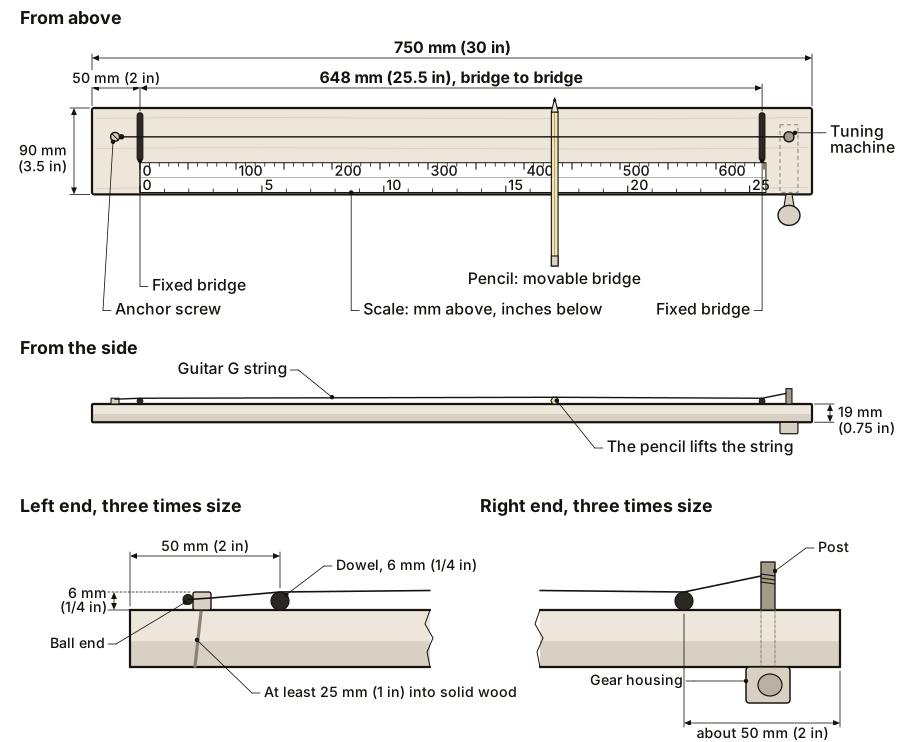
A monochord is one string stretched between two fixed bridges over a board, with a movable bridge to divide it (Chapter 5). This one is built to the same 648 mm (25.5 in) vibrating length as a standard steel-string guitar, so every table in the book applies to it unchanged.
| Part | Specification | Rough cost |
|---|---|---|
| Board | Straight, knot-free wood, about 750 mm (30 in) long, 90 mm (3.5 in) wide and 19 mm (0.75 in) thick. Hardwood bows less; softwood will do if it is straight. | $5 |
| Anchor | One round-head wood screw 40 mm (1.5 in) long, or a small screw eye. | $1 |
| Tuning | Best: one replacement guitar tuning machine, sold singly. Cheaper: an eye bolt 6 mm (1/4 in) across, about 75 mm (3 in) long, passed through a hole in a small wooden block glued and screwed to the board’s end, with a washer and wing nut; tightening the nut draws the bolt back and raises the pitch. | $1 to $6 |
| String | One guitar third string (G), plain or wound, with a ball end. | $2 to $5 |
| Fixed bridges | Two pieces of hardwood dowel 6 mm (1/4 in) across and 50 mm (2 in) long, or two bolts of that size laid flat. | $1 |
| Movable bridge | A six-sided pencil, about 7 mm (0.28 in) across, a little taller than the fixed bridges. Or a small hardwood wedge. | owned |
| Scale | A paper strip or a cheap tape measure, glued along the board beside the string. | $1 |
| Tools | Drill with a 3 mm (1/8 in) bit for pilot holes, screwdriver, wood glue, a tuner app, safety glasses. | owned |
Steps:
- Mark the two fixed-bridge positions 648 mm (25.5 in) apart, each about 50 mm (2 in) from an end of the board.
- At the left end, drill a pilot hole and drive the anchor screw at a slight backward angle, leaving its head standing about 6 mm (1/4 in) proud. Drive it at least 25 mm (1 in) into solid wood. A screw in a shallow hole or near a split will pull out under load.
- At the right end, fit the tuning machine with its own screws, or build the eye-bolt block and fit the bolt, washer and wing nut.
- Glue the two dowels across the board at the marks, or simply let the string’s tension hold them in place.
- Glue the scale beside the string, its zero exactly at the left bridge.
- Hook the string’s ball end over the anchor, lay it over both bridges, and wind it onto the tuning post or thread it through the eye bolt.
- Put on safety glasses. Tighten slowly, checking the tuner, until the open string reads G at 196 Hz, the guitar’s third string and the note of Chapter 1. Go no higher than A at 220 Hz. Tension rises with the square of the frequency, so that small step adds a quarter more pull.
- Slide the pencil under the string. The two lengths either side of it now sound separately; the scale tells you the fraction.
Set the board on a table, or across an open cardboard box, and it will sound louder.
Hazards. A guitar string at pitch pulls with roughly 7 to 14 kg (15 to 30 lb), depending on the string. If it breaks or a screw lets go, the free end whips. Wear safety glasses whenever you tune it up, keep faces away from the string’s line, and do not let a child tighten it. The cut end of a steel string is sharp: bend it back on itself or cover it with tape. If the board visibly bows, it is too thin; the pitch will drift and the screws are under more strain than they should be. The pencil raises the string’s tension a little as it is pushed under, so notes on the monochord can read a few cents sharp of the tables. That is a property of the instrument, not a mistake in your measuring.
Section 4: Every experiment in the book
| Chapter | Experiment | Needs |
|---|---|---|
| 1 | The chord in the string | guitar or monochord, tuner |
| 1 | The same thing on a ukulele | ukulele |
| 2 | Watch a note happen slowly | rubber band, box, slow-motion camera |
| 2 | Find your own resolution | tone generator, two tones |
| 3 | Change the timbre of one string | guitar or monochord; spectrum app optional |
| 4 | Hear two tones beat | tone generator, two tones |
| 4 | Tune a guitar by beats | guitar |
| 5 | Measure the intervals | guitar or monochord, ruler |
| 5 | Rank the intervals by ear | tone generator, two tones, square or sawtooth |
| 6 | Mark out a Pythagorean scale | monochord or guitar, ruler, pencil |
| 7 | Find the pattern on one string | guitar, tuner |
| 8 | The comma, out loud | tone generator, two tones |
| 8 | Hear the price of equal temperament | tone generator, two tones |
| 9 | The same chord in three tunings | tone generator, three tones, or a keyboard with historical tunings |
| 10 | Play the modes | keyboard or guitar |
| 11 | Feel the pull | keyboard or guitar |
| 11 | Major to parallel minor | keyboard |
| 12 | Transpose a tune | keyboard |
| 13 | Sing from a staff | keyboard, your voice |
| 14 | Find the pulse and its speed | metronome, recordings |
| 14 | Conduct it | recordings |
| 14 | Hear the grid by breaking it | metronome |
| 15 | Sing without bar lines | a friend |
| 16 | Sing parallel organum | keyboard, a friend or a voice recorder |
| 17 | Write first-species counterpoint | MuseScore or staff paper, keyboard |
| 17 | Listen for suspensions | recording of Victoria |
| 18 | Sing a round, and listen from inside it | two to four friends; metronome optional |
| 18 | Write a two-voice canon at the octave | MuseScore or staff paper, keyboard |
| 18 | Hunt the subject in a Bach fugue | recording of Bach, BWV 847 |
| 19 | Realise a figured bass | keyboard |
| 19 | Find the continuo | recordings of Corelli and Bach |
| 20 | The seven triads of C | keyboard |
| 20 | Same chord, different floor | keyboard |
| 20 | Nature’s seventh chord | tone generator, four tones |
| 21 | The pull, with two notes | keyboard |
| 21 | The deception | keyboard |
| 21 | Find the cadences in a hymn tune | score of Old Hundredth, keyboard |
| 22 | Modulate from C to G | keyboard |
| 22 | Follow a key change by ear | recording of Bach, BWV 846 |
| 23 | Clap the dances | metronome, recordings of Bach suites |
| 23 | Find the halves in a sarabande | recording of Bach, BWV 1008, timer |
| 24 | Chart the ritornello in “Spring” | recording of Vivaldi, timer, paper |
| 24 | Hear the transcription | recordings of Vivaldi and Bach |
| 25 | Make it Classical | keyboard or MuseScore |
| 25 | Map a sonata form with a timer | recording of Mozart, K. 525, timer |
| 26 | Sustained against plucked | keyboard with organ and harpsichord sounds, guitar, stopwatch |
| 26 | A clarinet in a tone generator | tone generator with square and sawtooth; spectrum app optional |
| 26 | A natural horn on one string | guitar or monochord |
| 27 | Sit the examination | keyboard, tone generator, MuseScore, recordings |
| 27 | One evening, three pieces | recordings of Victoria, Vivaldi and Mozart |
Section 5: A sample answer to the Chapter 17 exercise
The cantus firmus is D F E D G F E D in whole notes, starting on the D just above middle C. Here is one counterpoint above it that obeys every rule of Chapter 17. It is not the only right answer; there are dozens.
Upper voice: D C E F E D C sharp D, starting on the D an octave above the cantus firmus.
| Note | Cantus firmus | Counterpoint | Half steps apart | Interval | Motion into it |
|---|---|---|---|---|---|
| 1 | D | D | 12 | octave | (start) |
| 2 | F | C | 7 | perfect fifth | contrary: lower up, upper down |
| 3 | E | E | 12 | octave | contrary: lower down, upper up |
| 4 | D | F | 15 | minor tenth (a minor third plus an octave) | contrary: lower down, upper up |
| 5 | G | E | 9 | major sixth | contrary: lower up, upper down |
| 6 | F | D | 9 | major sixth | similar: both down a step |
| 7 | E | C sharp | 9 | major sixth | similar: both down a step |
| 8 | D | D | 12 | octave | contrary: lower down, upper up a half step |
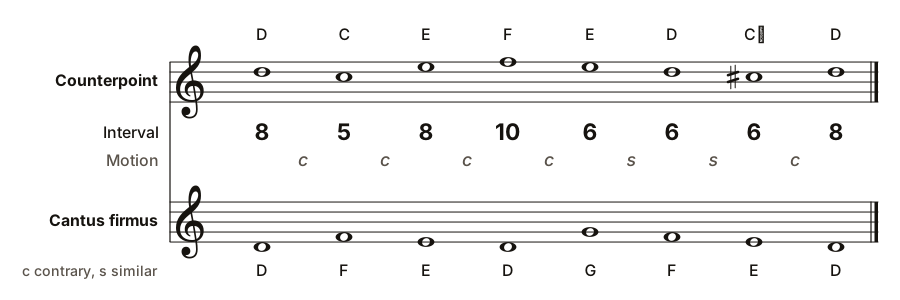
Check it against the rules, one at a time.
- Start on a perfect consonance. It opens on an octave. End on the octave, approached by step. It closes on an octave, and the upper voice arrives from C sharp, a half step below.
- Only consonances. Every interval in the table is an octave, a fifth, a tenth (a compound third) or a sixth. No seconds, fourths or sevenths.
- No parallel fifths or octaves. There is only one fifth, at note 2, so no two fifths can follow each other. The octaves at notes 1, 3 and 8 are each reached by contrary motion, and none follows another directly. The only parallel motion is the run of sixths at notes 5 to 7, and parallel sixths are allowed: they are imperfect consonances, which do not fuse the voices.
- Contrary motion preferred. Five of the seven moves are contrary. Steps preferred. The upper voice moves by step everywhere except one leap of a third, C up to E, and its single high point, F, comes once.
Why C sharp. The written mode is Dorian on D, which has C natural. With C natural at note 7, the interval over E would be a minor sixth, still a consonance, and the exercise would still pass rule 2. But a sixteenth-century singer would have raised it by musica ficta (Chapter 11), so that the upper voice leans a half step into the final, and the major sixth opens outward to the octave. That move, a major sixth expanding to an octave as one voice rises a half step and the other falls a step, is the standard two-voice cadence of Renaissance polyphony. A teacher would mark the C natural as a missed cadence, not an error.
Play the two lines together on the online keyboard or in MuseScore. If you wrote your own answer first, run it through the same four checks. If it passes all of them and sounds calm and singable, it is as right as this one.

Bench Degree
Get the degree without the diploma.
Learn the material, not how to pass the exam.