Bench Degree·MUSICchapter
Chapter 27: What You Now Know
Chapter 1 set seven tests at a keyboard. Here they are again, with the chapters that pass them, and an honest account of what no book can do.
Put a fingertip on the G string of a guitar, over the twelfth fret, then the seventh, the fifth and just short of the fourth. Four bells, and together a G major chord. That was the whole of Chapter 1.
Everything since has been those four bells, followed. The ratios between them became intervals, the intervals became a scale, the scale’s leftover comma became three centuries of tuning, and the voices that sang the scale learned to sing against one another. Chapter 1 promised that by the end you could sit at a keyboard and pass seven tests. Here they are.
The seven tests
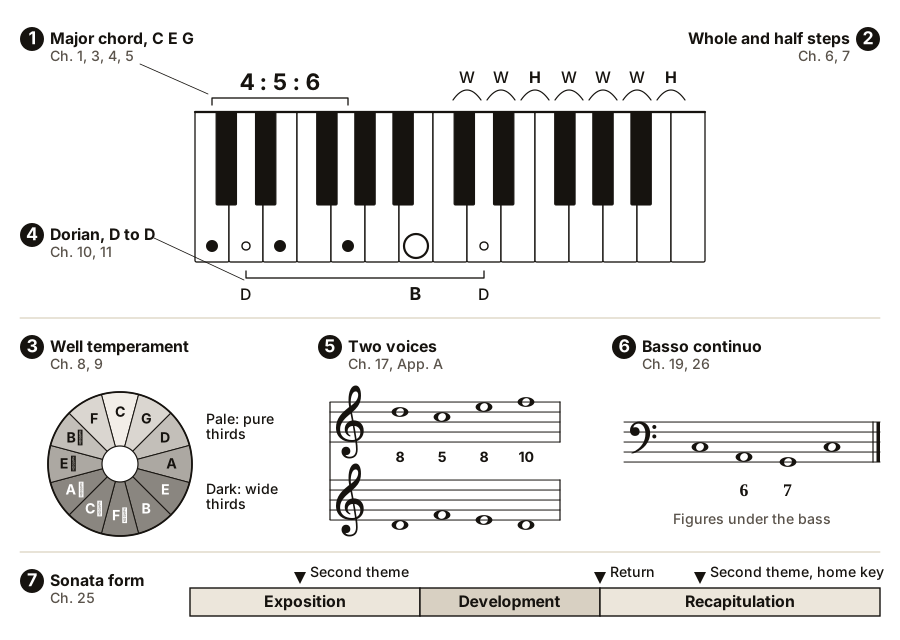
1. Play a major chord and say, in whole numbers, why it is smooth and a tritone is not. C, E and G stand in the ratios 4 : 5 : 6, the fourth, fifth and sixth harmonics of one note (Chapters 1, 3 and 5). Their harmonics either coincide exactly or stand well apart, so nothing grates (Chapter 4). The tritone, C to F sharp, is 45 : 32 in pure tuning and an irrational ratio on a piano; its harmonics keep landing just beside one another, which is the roughness your ear calls dissonance (Chapters 4 and 5).
2. Build a major scale from fifths, and say why its steps are uneven. Climb seven pure fifths, F C G D A E B, and fold them into one octave (Chapter 6). Two fifths up and an octave down make a whole step of 9 : 8. Five of those fill most of the octave, and what is left over, twice, is a smaller half step. That gives the pattern whole, whole, half, whole, whole, whole, half, and puts the half steps at E to F and B to C (Chapter 7).
3. Explain what Bach’s clavier was tempered to, and why it was not equal temperament. Twelve pure fifths overshoot seven octaves by the Pythagorean comma, 23.5 cents (Chapter 8). A well temperament shares that comma unevenly, so every key is playable and each has its own colour. That is what Bach’s twenty-four preludes and fugues of 1722 were written to show: every key usable, every key different. Equal temperament would have made them identical (Chapter 9).
4. Sing or play a Dorian scale and say how it differs from minor. White keys from D to D. Its sixth note, B, is a whole step above the fifth; in D minor it would be B flat, a half step above. That raised sixth is the ray of light in the Dorian sound (Chapter 10). Minor, which won, kept the lowered sixth and borrowed a leading tone at its endings (Chapter 11).
5. Write eight bars of two-voice counterpoint that a sixteenth-century teacher would pass. Take a cantus firmus of eight whole notes and write one note against each: start and end on a perfect consonance, use only consonances, avoid parallel fifths and octaves, prefer contrary motion, approach the last note by step (Chapter 17). Appendix A gives a worked answer for the cantus firmus D F E D G F E D, interval by interval.
6. Hear a basso continuo, name it, and date its arrival within twenty years. A bass line that never stops, played by a cello or bassoon, with a harpsichord or organ filling in chords above it from figures written under the notes. It arrived in Italy within a few years either side of 1600, so if you hear one, the music was written after about 1600 (Chapter 19). The harpsichord’s crisp, even chords made it the natural instrument for the job (Chapter 26).
7. Follow a sonata-form movement and say where the second theme and the return begin. The exposition states a first theme in the home key, moves away, and brings a second theme in a new key, usually a fifth above in a major-key piece. The development wanders. The recapitulation begins where the first theme returns in the home key, and this time the second theme stays home too. Chapter 25 maps it, with a timer, in Mozart’s Eine kleine Nachtmusik.
ON THE BENCH: Sit the examination
You need: a keyboard, real or a free online one; a free tone-generator app; MuseScore or staff paper; recordings for tests 6 and 7.
Cost: nothing. Time: about an hour and a half, in one sitting or several.
Hazards: none.
Steps: take the seven tests in order, aloud, as if a teacher were sitting beside you. For test 1, play the chord and give the ratio; then play C with F sharp and say why it grates. For test 3, play a C major chord in just and equal tuning on the tone generator, as in Chapter 9, and describe what you hear. For test 5, write your counterpoint before you look at Appendix A, and check every vertical interval and every move between them. For tests 6 and 7, use the listening session below.
What you should find: which of the seven you can already do without looking back. A test you cannot pass names its own chapters; go back to the bench in that chapter, not to the prose.
Listening for all of it
Three pieces, all public domain and all widely recorded, will put most of this book in your ears in an evening.
ON THE BENCH: One evening, three pieces
You need: recordings, and a pencil.
Cost: nothing, from a library or a free streaming service. Time: about forty-five minutes. Hazards: none.
Steps:
- Victoria, O magnum mysterium. Follow one voice for a minute, then another. Mark each moment where the sound aches and relaxes. Those are suspensions (Chapter 17).
- Vivaldi, any concerto from The Four Seasons. Listen under the violins for the bass that never stops and the harpsichord chords above it. Note the returning full-band passage that frames the soloist (Chapters 19 and 24).
- Mozart, Piano Sonata in C, K. 545, first movement. Write down the moment the second theme arrives, the moment the music starts to wander, and the moment the opening tune comes back.
What you should find: the Victoria has no steady harmonic floor; its chords come from the lines. The Vivaldi has one, laid down by the continuo. The Mozart needs no continuo at all: the piano’s left hand carries the harmony, and the form is built from keys. Three centuries, three ways of holding voices together.
SLOW DOWN. Check Your Understanding: In the Mozart sonata, the opening tune comes back, but not in C. It returns in F major and only finds its way home later. Is that still a recapitulation?
Answer: Yes. The return of the first theme marks the recapitulation whatever key it is in; what defines the section is that it resolves the exposition’s journey, bringing the second theme back in the home key. Mozart starts the return a fifth below home, so that the same music he used in the exposition to travel from C to G now travels from F to C, and lands. The textbook pattern is a habit, not a law, and the great composers bent it on purpose. Hearing the bend is a sign you have learned the habit.
The honest ledger
A book is good at one half of music and helpless at the other.
What a book can teach. Why things sound as they do: the ratios, the harmonic series, the comma and what tuners did about it. Where the rules came from and what they protect. The names, so that a teacher, a score or a program note makes sense. The history that explains why a mode sounds old and a continuo sounds Baroque. And the habit of testing a claim at the bench, which this book has tried to give you in every chapter.
What only an instrument and a teacher can. An ear that names a fifth or a minor sixth the instant it hears one, which comes from thousands of short daily repetitions and from nothing else. Hands that find the notes. A voice that sings a pure third and knows it. Reading a staff at the speed of the music, as you read this sentence, instead of counting lines and spaces. And judgement: a teacher looking at your counterpoint will pass lines that obey every rule and still send them back, because they are dull. The rules of Chapter 17 are the floor of style. A good teacher shows you the rest of the house.
IN PLAIN ENGLISH: This book can tell you why music works and how it came to work that way. It cannot train your ear, your hands or your voice. Only regular practice on an instrument, ideally with a teacher, does that.
What this book left out
Plainly, these:
- Tuning systems outside Europe. Indian classical music divides the octave with finer distinctions than twelve half steps; Arabic music uses intervals between the half step and the whole step; Javanese gamelan ensembles are tuned to scales that differ from one set of instruments to the next. Each is a complete system, with its own answers to the comma problem, and none fits on a piano keyboard.
- Music after 1800. Beethoven’s late works, the Romantic century’s chromatic harmony, Wagner, Debussy, and the twelve-tone method of the 1920s all build on the material here and then break it in ways that need their own book.
- Jazz and popular music. Swing rhythm, the blues, chords stacked to the ninth and thirteenth, and improvisation over a repeating harmony. The modes of Chapter 10 come back there, by name.
- Fluent reading. This book taught notation where it was invented, and only as far as each example needed. Reading at speed is a skill of practice.
- Orchestration, singing technique and the full rhythmic vocabulary.
Where to go next
Find a teacher, for whichever instrument you already reach for. Even six months of weekly lessons will turn the facts of this book into skills.
Sing in a choir. It is the oldest school of counterpoint there is. Singing one line of a Victoria motet while three others move around you teaches more about contrary motion and suspensions in an evening than Chapter 17 can in a week.
Keep the bench going. A free ear-training app, ten minutes a day, will teach you to name intervals by ear within a few months. Free online keyboards that play historical temperaments let you hear Chapter 9 in every key. MuseScore will play back anything you write, and free online libraries of public-domain scores hold almost every piece named in this book.
Read Fux. Gradus ad Parnassum, in Alfred Mann’s English translation, The Study of Counterpoint, takes the pupil of Chapter 17 through all five species. Haydn worked through it. So can you.
Listen with the score. Pick one Bach fugue, one Vivaldi concerto and one Mozart sonata, find the public-domain score of each, and follow along until the page and the sound become one thing.
Then go back to the beginning. Pick up the guitar, put a fingertip over the twelfth fret, and let the first bell out. You know now what it is, why it sounds the way it does, and what a thousand years of musicians built from it. The kit for every experiment in the book is in Appendix A.
Bench Degree
Get the degree without the diploma.
Learn the material, not how to pass the exam.