Bench Degree·MUSICchapter
Chapter 26: What the Instruments Allowed
The piano’s real name describes the one thing the harpsichord could not do. Every instrument here changed a rule of music.
The word piano is a nickname. The man who built the first one, in Florence around 1700, called it a gravicembalo col piano e forte: a harpsichord with soft and loud.1 The whole invention is in that phrase. Before it, a harpsichordist could press a key gently or hard and get exactly the same sound.
Composers write what their instruments can play. This chapter asks each instrument one question: what did it make possible?
The organ: a note that does not die
The organ is the oldest keyboard. Ctesibius, an engineer in Alexandria in the third century BC, built a hydraulis, pipes sounded by air held at steady pressure by water.2 By the later Middle Ages it stood in the great churches of the West.
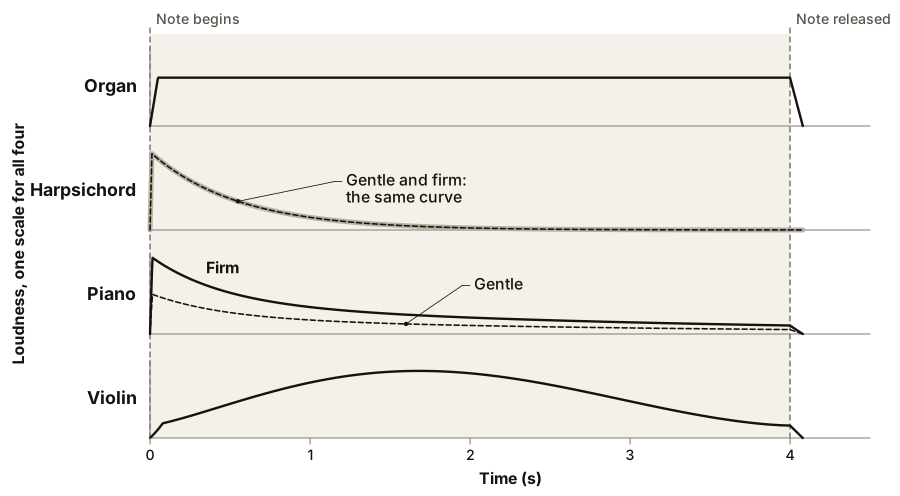
A pipe sounds as long as wind flows through it. Hold a key and the note stays, at one loudness, for as long as you like. The organ could hold the long tenor notes of Chapter 16 without running out of breath. It could sound a drone, one note held under a moving melody, the clearest way to hear a mode against its final, as you did in Chapter 10. And it could hold a chord still while the ear examined it, which is exactly when the wolf of Chapter 8 and the wide thirds of Chapter 9 become impossible to ignore. It is no accident that organists, Werckmeister among them, wrote the tuning treatises.
What it could not do was shade a note. Its loudness changes in steps, as the knobs called stops add or remove whole ranks of pipes.
Frets: equal steps before the keyboard had them
A lute or guitar has frets, strips across the neck where the string is stopped. A fret runs under every string at once. A keyboard tuner can set each key alone. A fret cannot choose: the fret that gives G sharp on one string gives a different note on the next, and must serve them all. The only placement that works on every string is the one in which every fret is the same distance in pitch from the last: equal half steps.
In 1581 Vincenzo Galilei, lutenist and father of the astronomer, gave a fretting rule: each fret cuts one eighteenth off the length still free to vibrate, raising the pitch by 18 to 17.3 That ratio is about 99 cents, within one cent of an equal-tempered half step. Chapter 9 said keyboards did not widely adopt equal temperament until the nineteenth century. The fretted lute had it, or nearly, in the sixteenth.
That is why the fourth fret of Chapter 1 sat 4 mm (0.16 in) past the string’s own fifth harmonic. The fret serves every key equally and pays with a third about 14 cents wide.
The harpsichord: one loudness, so many notes
The harpsichord plucks. Each key lifts a strip of wood called a jack, which carries a small plectrum cut from a bird’s quill. As the jack rises the quill catches the string and snaps past it. When the key is released the jack drops, the quill slips back on a hinge, and a felt damper silences the string.
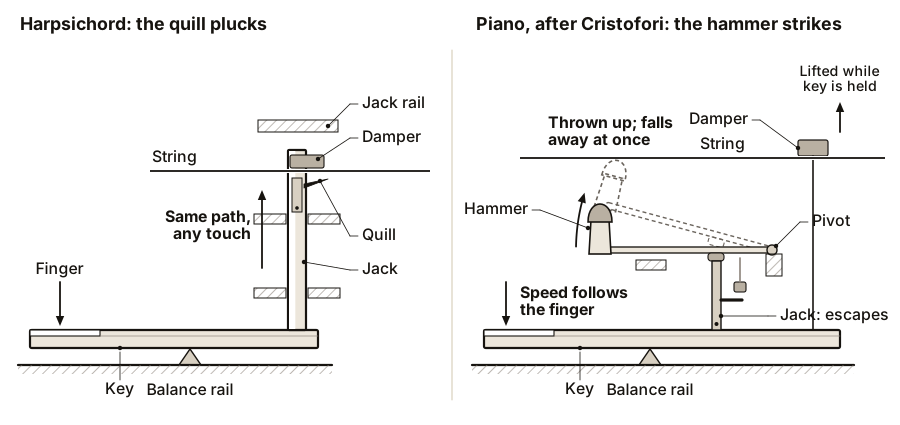
The quill travels the same path however the key is pressed, so the string is plucked the same way every time, and a plucked note starts loud and fades.
Since one note cannot grow louder, loudness comes in blocks. A large harpsichord had two keyboards, called manuals, voiced differently, and a player could answer a loud phrase on one with a soft echo on the other. Music that changes level in steps, like terraces cut into a hillside, has terraced dynamics.
Since each note fades, the music keeps moving. A melody in long notes dies between them, so players filled the time with trills, broken chords and running figures. A trill is, among other things, a way of keeping a plucked note alive.
And since it sounds a full chord instantly, with a crisp attack that marks the beat, the harpsichord was the natural instrument to play chords above a written bass line: the basso continuo of Chapter 19, the harmonic floor of nearly every Baroque ensemble.
ON THE BENCH: Sustained against plucked
You need: a free online keyboard or keyboard app with an organ sound and a harpsichord or other plucked sound; a guitar; your phone’s stopwatch.
Cost: nothing. Time: fifteen minutes. Hazards: keep the volume moderate in headphones.
Steps:
- On the organ sound, hold middle C, E and G together for ten seconds.
- Switch to the harpsichord sound, hold the same chord, and time how long until you can no longer hear it.
- With each sound, play a slow tune you know, such as the first line of a hymn, holding each note two full seconds.
- Pluck the guitar’s G string very gently, then hard. Then press a harpsichord key gently, then hard. If your app responds to how hard you press, try the piano sound too.
What you should hear: the organ chord holds one loudness until you let go. The harpsichord chord clicks and fades within seconds, and the slow tune breaks into separate dots that you will want to fill, as Baroque players did. The finger-plucked guitar follows your touch; the harpsichord sound does not.
The violin: a line that sings
In the middle of the sixteenth century Andrea Amati, in Cremona in northern Italy, was making violins in very nearly their modern form. The oldest that survive date from the 1560s.4
A bow is a ribbon of horsehair coated in rosin, a sticky tree resin. Drawn across a string, it grips the string, drags it aside until it slips, and grips again, hundreds of times a second. As long as the bow moves, the note sounds, and the player can swell or soften it during the note. A violin does what a singer does: begins a note softly, grows it, lets it fade.
The violin also has no frets. The finger can stop the string anywhere, so every pitch is chosen afresh, as a singer chooses. Of the instruments here, only the bowed strings keep the freedom that Chapter 9 said every fixed-pitch instrument loses.
The sonatas of Corelli and the concertos of Vivaldi (Chapter 24) were built around that singing line: the harpsichord accompanied, the violin sang.
IN PLAIN ENGLISH: The organ holds a note forever but cannot shade it. The harpsichord plucks every note alike and each one fades, so its music moves in many notes and in blocks of loud and soft. The violin’s bow keeps a note going and can swell it, so its music sings. Frets make every half step equal; a fretless violin tunes each note by ear.
The pianoforte: loud and soft from the finger
Bartolomeo Cristofori, keeper of instruments to Prince Ferdinando de’ Medici, solved the harpsichord’s problem by striking the string instead of plucking it. Three of his pianos survive, dated 1720, 1722 and 1726.5
The hard part was getting the hammer out of the way, since a hammer resting on a string silences it. Cristofori’s answer was the escapement: the key throws the hammer toward the string and lets go just before contact, so the hammer flies the last distance alone, strikes, and falls straight back. The damper stays lifted while the key is held, and the string rings.
The faster the hammer, the louder the note, and the finger sets the speed. A keyboard could at last swell a phrase gradually.
Haydn and Mozart began on the harpsichord and wrote their later keyboard music for the piano. By about 1800 the harpsichord had all but vanished from new music, and the swells marked crescendo fill the Classical scores of Chapter 25. The piano, built for music that moved freely through every key, also carried equal temperament into every home.
Winds and brass: playing the ladder
Woodwinds
A flute, an oboe and a clarinet are tubes of air with holes in the side. Close every hole and the whole tube sounds. Open one near the bottom and the air column effectively ends there, shorter and higher. A finger hole is a fret for a column of air. Blow harder and the column jumps to a higher harmonic, so the same fingerings serve again further up. Keys, hinged pads that close holes beyond the reach of ten fingers, added the missing half steps.
The clarinet has a twist, and Chapter 3 gave it away. Its tube is a cylinder closed at one end by the mouthpiece and reed, and a tube closed at one end sounds only the odd harmonics: 1, 3, 5, 7. Blow harder and it jumps not to harmonic 2, the octave, but to harmonic 3, an octave and a fifth, called a twelfth. The missing even harmonics give its low notes their hollow colour. The clarinet was developed around 1700, traditionally by Johann Christoph Denner of Nuremberg.6
ON THE BENCH: A clarinet in a tone generator
You need: a free tone-generator app offering sine, square and sawtooth waves; optionally a free spectrum-analyzer app on a second device.
Cost: nothing. Time: ten minutes. Hazards: square and sawtooth waves sound much louder than a sine at the same setting. Start quiet.
Steps: at 220 Hz, play a sine, then a square, then a sawtooth, a few seconds each. Watch the spectrum if you can.
What you should hear: the sine is pure and plain, the sawtooth bright and buzzy, the square hollow and reedy, like a cheap electronic clarinet. What you should find: the sawtooth has peaks at 220, 440, 660, 880 Hz and upward. The square has peaks only at 220, 660, 1,100 and 1,540 Hz: harmonics 1, 3, 5 and 7. Same pitch, every second rung missing.
Brass
A trumpet or horn without valves is the bugle of Chapter 3: a fixed tube that sounds only its own harmonic series, the rung chosen by the lips.
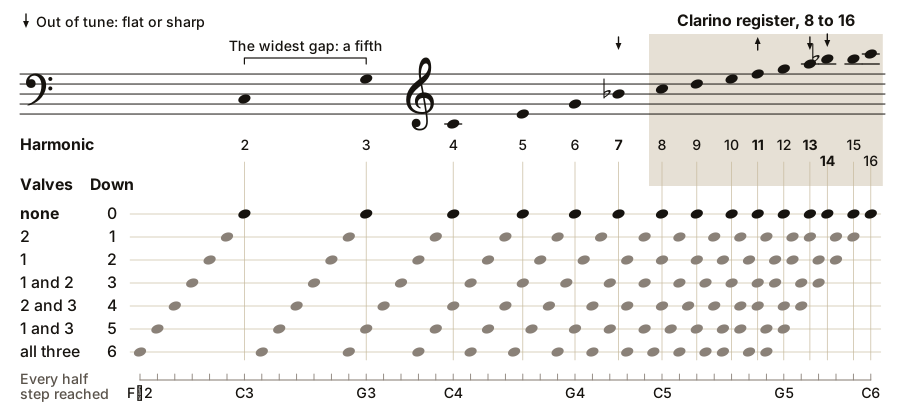
Low in the series the rungs are far apart, good for bugle calls and little else. From the 8th harmonic up they crowd into something near a scale: on a trumpet in C, the 8th to the 16th give C, D, E, a note between F and F sharp, G, a note between A flat and A, a flat B flat, B and C. Baroque trumpeters specialised in that high clarino register, which is why the trumpet part of Bach’s second Brandenburg Concerto sits so brilliantly and dangerously high.
Horn players pushed a hand into the bell to lower a note, filling many gaps with a muffled colour. Mozart’s horn concertos were written for this hand horn.7
Valves broke the cage. Patented in Prussia by Heinrich Stölzel and Friedrich Blühmel in 1818, after Stölzel had shown a valved horn a few years earlier, a valve routes the air through an extra loop of tubing, and a longer tube has a lower series.8 Three valves add one, two or three half steps of tubing, alone or together, lowering the series by anything from one half step to six. Six is just enough to fill the widest gap a trumpet normally plays across, the fifth between harmonics 2 and 3, and every narrower gap above it.
ON THE BENCH: A natural horn on one string
You need: a guitar, or the monochord of Appendix A.
Cost: nothing. Time: twenty minutes. Hazards: none.
Steps: on the low E string, touch lightly, as in Chapter 1, at four points:
Harmonic Touch at From the nut, 648 mm (25.5 in) string Note 3 1/3, over the 7th fret wire 216 mm (8.5 in) B 4 1/4, over the 5th fret wire 162 mm (6.4 in) E 5 1/5, just short of the 4th fret wire 130 mm (5.1 in) G sharp 6 1/6, just past the 3rd fret wire 108 mm (4.25 in) B Play this call, invented for the book, by harmonic number: 3 4 5 6, 5 4 5 3, 3 4 5 6, 6 5 4.
What you should hear: a fanfare on a natural horn made of one string. If you know Taps, the American bugle call of 1862, pick it out by ear: it uses these four notes and no others. Then try the first five notes of the major scale, E, F sharp, G sharp, A, B. You cannot. F sharp and A are not on the ladder at this height. That is the cage every trumpeter lived in until the valve.
Better, if you have one: touch at 1/7, about 93 mm (3.65 in) from the nut. A tuner reads the 7th harmonic about a third of a half step flat of D: the note a Baroque trumpeter had to lip into tune.
What the instruments allowed
SLOW DOWN. Check Your Understanding: A violinist and a pianist end a piece in C major, both holding the E of the final chord. The violinist plays the E wherever it sounds smoothest. Are the two Es the same pitch?
Answer: Not quite. A violinist listening to a held chord tends to settle the third near a pure 5:4, about 386 cents above C, where it stops beating. The piano’s E is fixed at 400 cents. The two differ by about 14 cents and beat against each other, so string players who work with pianists learn to play their thirds a little wider than their ears would choose. The comma of Chapter 8 is still being paid, nightly, by whoever is free to move.
None of these instruments changed the ratios of Chapter 5 or the harmonic series of Chapter 3. They changed which of those facts a composer could reach. The last chapter asks what you can now do with all of it: it checks the promise made in Chapter 1, item by item, and says plainly what a book cannot teach.
Source to pull before print: Scipione Maffei’s description of Cristofori’s instrument in the Giornale de’ letterati d’Italia (Venice, 1711).↩︎
Source to pull before print: Vitruvius, De architectura book 10, on the hydraulis of Ctesibius.↩︎
Source to pull before print: Vincenzo Galilei, Dialogo della musica antica et della moderna (Florence, 1581), on the 18:17 fret rule.↩︎
Source to pull before print: a standard reference on Andrea Amati and the earliest surviving dated Cremonese violins.↩︎
Source to pull before print: the surviving Cristofori pianos (New York, 1720; Rome, 1722; Leipzig, 1726) and the 1700 Medici inventory entry for his arpicembalo.↩︎
Source to pull before print: a standard history of the clarinet, for Denner and the date.↩︎
Source to pull before print: a standard history of the horn, for hand-stopping in the mid-eighteenth century and Mozart’s horn concertos.↩︎
See the source note in Chapter 3.↩︎
Bench Degree
Get the degree without the diploma.
Learn the material, not how to pass the exam.