Bench Degree·MUSICchapter
Chapter 25: Sonata Form and the Classical Turn
Two themes, two keys, a quarrel and a homecoming. Once you can hear where the second theme starts and where the first one returns, you can follow a symphony.
On 10 August 1787, in Vienna, Wolfgang Amadeus Mozart wrote a new entry in the little catalogue he kept of his own works: Eine kleine Nachtmusik, “a little night music”, a serenade for strings in G major.1 He was in the middle of writing the opera Don Giovanni. Nobody knows who the serenade was for, or whether it was played in his lifetime.
His catalogue lists five movements. Only four survive; the pages holding a minuet are missing from the manuscript, and that movement is lost. The first of the four is perhaps the best-known movement of classical music ever written. It is also a textbook, and by the end of this chapter you will be able to read it.
The Classical turn
Bach died in 1750. Within a few years, the music he had perfected sounded old.
Baroque music, the music of Chapters 18 to 24, is continuous. A fugue or a Vivaldi episode spins one idea onward without stopping, every voice busy, the continuo churning underneath, the phrases running into each other. The texture is dense and the motion relentless.
The new style that grew up from the 1740s to the 1770s, in Italy, in Mannheim, in Vienna, and in the music of Bach’s own son Carl Philipp Emanuel, went the other way. Its features are easy to hear:
- Melody and accompaniment. One clear tune on top; underneath, simple chords that support it and stay out of its way. The equal voices of counterpoint give way to a singer and a band.
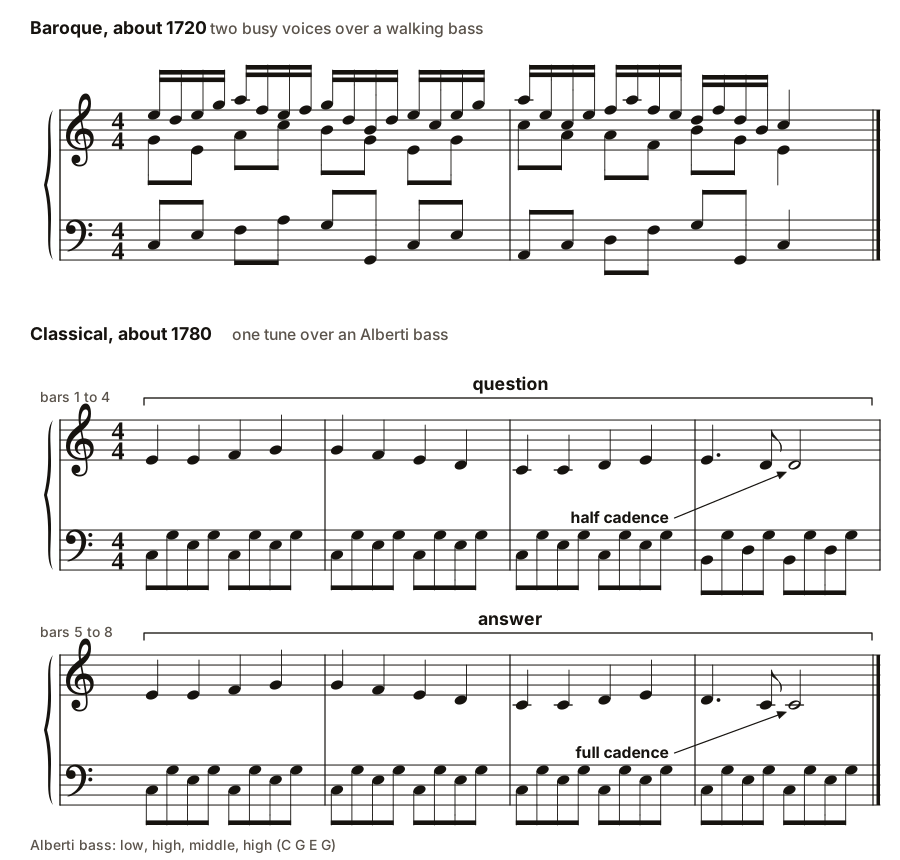
- Balanced phrases. Melodies fall into units of two, four and eight bars, usually in pairs: a four-bar phrase that ends on an open, questioning half cadence (Chapter 21), answered by a four-bar phrase that ends on a closed, full cadence. A pair like that is called a period: question, then answer.
- Slower harmony. A Baroque bass may change chord on every beat. A Classical accompaniment may sit on one chord for a whole bar or two, which makes each change of chord an event.
- Contrast inside a movement. Loud against soft, busy against calm, one theme against another, within a single movement. A Baroque movement usually keeps one mood throughout.
The most famous accompaniment of the new style is the Alberti bass, named for the Venetian keyboard player Domenico Alberti: the notes of a chord played one at a time in the order low, high, middle, high, over and over. Under a melody in C it goes C G E G, C G E G.
The basso continuo faded out over the same decades. With the harmony written out in the accompaniment, there was nothing left for a harpsichord to fill in.
ON THE BENCH: Make it Classical
You need: a free online keyboard or MuseScore.
Cost: nothing. Time: fifteen minutes. Hazards: none.
Steps:
- In the left hand, or on the lower staff in MuseScore, play an Alberti bass in steady eighth notes: C G E G, C G E G, the C major chord, for three bars. In the fourth bar play B G D G, B G D G, a G major chord with B at the bottom.
- Over it, play or enter this four-bar tune in quarter notes: E E F G | G F E D | C C D E | E, D, D (hold). That last D, over the G chord, is a half cadence: it asks a question.
- Play the first three bars of both hands again. For the eighth bar, play the tune D, C, C (hold) over C G E G, C G E G. That ends on C over C: the answer.
What you should hear: eight bars that sound unmistakably like the late eighteenth century. You may recognise the tune: it is the opening of the “Ode to Joy” melody from Beethoven’s Ninth Symphony of 1824, long in the public domain. With the Alberti bass under it, it sounds like a Classical sonata for beginners. The fourth bar hangs in the air; the eighth closes. That is a period.
Sonata form, from binary form
Chapter 23 ended with a hint. In rounded binary, the first half of a dance moves from the home key to the dominant, and the second half, after wandering, brings the opening melody back in the home key.
Make every part of that bigger, and give it more contrast, and you have sonata form: the plan of the first movement of nearly every symphony, string quartet, sonata and concerto written between about 1770 and 1830, and of many movements after.
It has three main sections and usually a fourth.
1. Exposition. The themes are set out.
- First theme, in the home key. Often bold and definite.
- Transition, sometimes called the bridge. Busy, often loud, and its job is to modulate: to move the music to a new key. By its end the music stops, or nearly stops, on the doorstep of that key.
- Second theme, in the new key: the dominant if the movement is in major, the relative major if it is in minor. Often gentler and more lyrical than the first, a contrast in character as well as key.
- Closing theme, or several, still in the new key, ending with firm cadences that confirm it.
The exposition is normally repeated, which is the composer’s way of making sure you know the themes before he starts to take them apart.
2. Development. The themes are worked. Fragments of them are broken off, combined, passed between instruments and moved rapidly through several keys, often minor ones. It is the least stable part of the movement, and it ends by building tension on the dominant of the home key, so that the return is expected and wanted.
3. Recapitulation. The first theme returns in the home key. Then the transition, rewritten so that this time it does not leave home. Then the second theme, also in the home key. Then the closing themes, also home. The conflict of the exposition, two themes in two keys, is resolved: both themes now live in one key.
4. Coda, “tail”. An ending added after the recapitulation, short in Haydn and Mozart, sometimes enormous in Beethoven, confirming the home key.
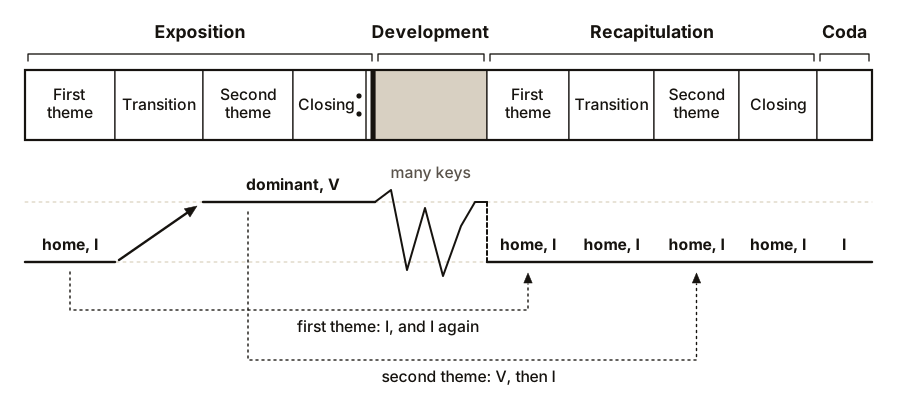
IN PLAIN ENGLISH: A sonata-form movement introduces two tunes, the second one in a different key from the first. Then it takes them apart and moves restlessly through other keys. Then it plays both tunes again, this time both in the home key, so the difference that was set up at the start is settled by the end.
The name came late. Haydn and Mozart never used the term “sonata form”; they simply wrote movements this way. Theorists of the nineteenth century, Adolf Bernhard Marx among them, looked back at those movements and described the pattern as a rule.2 That is worth knowing, because real movements bend the rule constantly. Haydn often makes his second theme out of his first. Mozart sometimes has three or four themes in the second key. The plan is a map of the usual road, and the composers took plenty of side streets.
Haydn and Mozart
Joseph Haydn (1732 to 1809) spent nearly thirty years, from 1761 to 1790, as music director to the Esterházy princes, at their palaces in Austria and Hungary. He had an orchestra at his disposal, an employer who wanted new music constantly, and very little contact with other composers. He later said that being cut off from the world had forced him to become original.3 He wrote 104 numbered symphonies and about seventy string quartets, and in them more than anyone he worked out what sonata form could do.
Mozart (1756 to 1791) was twenty-four years younger, and the two became friends in Vienna in the 1780s. Mozart dedicated six string quartets to Haydn in 1785. Where Haydn liked to build a whole movement out of one small idea, Mozart tended to pour out melodies, several to a section, and his second themes are often the most singable thing in the movement.
Between them, in the last thirty years of the eighteenth century, they made sonata form the way serious instrumental music was built. Beethoven, who took lessons from Haydn in 1792, inherited it complete.
SLOW DOWN. Check Your Understanding: In a sonata-form movement in G major, the second theme is in D major in the exposition. In the recapitulation it comes back in G major. But the first theme came back in G major too, so why does the composer need a transition in the recapitulation at all? There is no new key to reach.
Answer: Because the ear expects one. In the exposition the transition was the passage of rising energy that delivered the second theme, and the listener has learned that shape. Cut it, and the second theme would arrive too soon and sound like an afterthought. So the composer keeps the transition but rewrites it so that it ends back in G instead of moving to D. Comparing the two transitions bar by bar is one of the best ways to watch a composer think: the first part is usually the same, and at one particular chord the path quietly bends back home. That bend is where a recapitulation does its real work.
Following Eine kleine Nachtmusik
The first movement of Eine kleine Nachtmusik (K. 525) is a sonata form as clear as any ever written, and short enough to follow in one sitting. It is in G major, marked Allegro, in 4/4.
What to listen for:
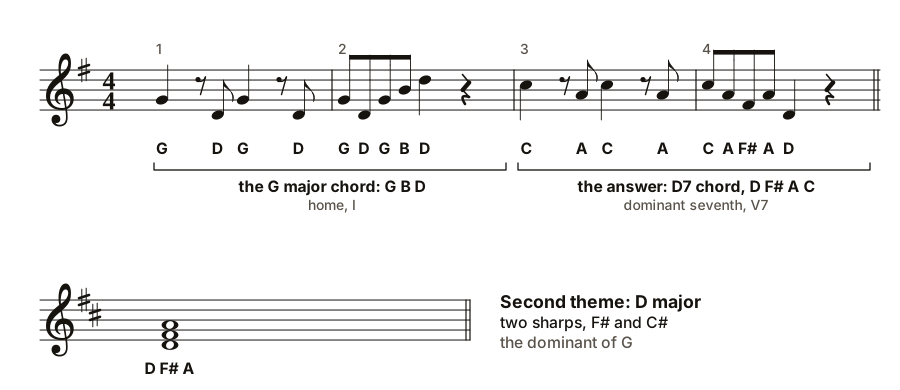
- First theme (G major). All the strings together, loud, playing the same notes in octaves: a figure that leaps up the G major chord, G D G, D G B D, answered by the same kind of figure on the dominant seventh chord. Then the melody moves to the first violins with a busy accompaniment. Unmistakable.
- Transition. Loud, with fast repeated notes in the accompaniment, moving toward D major. It comes to a clear stop.
- Second theme (D major). Soft, graceful, falling gently, in the first violins. This is the first moment to mark.
- Closing themes (D major). A cheerful tune with repeated notes, then firm cadences in D. Then the whole exposition is played again.
- Development. Short, well under a minute in most performances. It starts with the opening figure in D major, then moves through other keys, some of them minor, and gathers toward a pause on the dominant of G.
- Recapitulation (G major). The leaping opening figure returns, loud, in G. This is the second moment to mark. Then the second theme, now in G major.
- Coda. A few bars of cadences in G, loud, and the movement ends.
ON THE BENCH: Map a sonata form with a timer
You need: a recording of the first movement of Mozart’s Eine kleine Nachtmusik, K. 525. A stopwatch or phone timer. A sheet of paper with seven rows: First theme, Transition, Second theme, Closing, Development, Recapitulation, Coda.
Cost: nothing. Time: forty minutes, for three or four listenings. Hazards: none.
Steps:
- Listen once all the way through with the list above in front of you. Do not time anything yet.
- Start the timer with the first note. Write down the time at which each section begins. Do this only for the first time through the exposition; when you hear the opening again soon after the closing theme, that is the repeat, and you can note its time and just listen.
- Keep timing through the development, the recapitulation and the coda.
- Check yourself: hum the second theme as it sounds in the exposition. Now find it in the recapitulation and hum it again. It should sound the same shape, but start on a lower or higher note.
What you should find: the whole movement runs about five and a half to six minutes with the exposition repeat, and about four without. The second theme arrives well under a minute in. The development is by far the shortest section, often around half a minute, and the moment the loud opening figure crashes back in G is the easiest landmark in the movement. The recapitulation is close to a copy of the exposition, with the second theme moved from D into G. When you can point to those two moments, the start of the second theme and the return of the first, without looking at your notes, you can follow a sonata form.
If it does not work: if the repeat confuses you, look for a recording labelled “without repeats”, or simply notice that the leaping opening is heard three times: at the start, at the repeat of the exposition, and at the recapitulation.
Why sonata form won
The ritornello of Chapter 24 put one theme at the centre and let a soloist wander around it. Sonata form put two keys in tension at the centre, and made the whole movement a story about resolving them. The themes give the listener characters to follow. The keys give the story its plot.
That plot needs something Baroque music had rarely asked for: sharp, sudden contrast. Loud against soft, one character against another, a calm second theme after a stormy transition. Strings and voices could do that easily. A harpsichord could not. It plays every note at the same strength no matter how hard you strike the key, and it can only change volume by changing stops or keyboards.
The instrument that let a keyboard player do it with the fingers alone was invented in Florence around 1700 and spent most of the eighteenth century catching on. By the time Mozart died, it had replaced the harpsichord. It was called the pianoforte, “soft-loud”, and it is one of the instruments that changed the rules. What the instruments allowed, from the organ to the valveless horn, is Chapter 26.
Mozart’s own thematic catalogue, the Verzeichnüss aller meiner Werke, entry for 10 August 1787. Source to pull before print: the facsimile of the catalogue, now in the British Library.↩︎
Adolf Bernhard Marx, Die Lehre von der musikalischen Komposition, vol. 3 (Leipzig, 1845). Source to pull before print: the passage naming and describing sonata form.↩︎
Source to pull before print: Georg August Griesinger, Biographische Notizen über Joseph Haydn (Leipzig, 1810), for Haydn’s remark on his isolation at Esterháza.↩︎
Bench Degree
Get the degree without the diploma.
Learn the material, not how to pass the exam.