Bench Degree·MUSICchapter
Chapter 24: Ritornello and the Concerto
A tune comes back, and between its returns a single violin wanders off on its own. Vivaldi built hundreds of movements that way, and taught Bach how.
In 1725 a publisher in Amsterdam, Michel-Charles Le Cène, printed a set of twelve violin concertos by a Venetian priest named Antonio Vivaldi. The set was called Il cimento dell’armonia e dell’inventione, “the contest between harmony and invention”. The first four concertos had names: Spring, Summer, Autumn and Winter.1
Printed with each one was a sonnet, fourteen lines describing the season. And printed in the music itself, above particular bars, were letters and short captions keyed to lines of the poem: here the birds sing, here a dog barks, here the ice cracks. It is one of the earliest pieces of music to come with its own map.
Strip away the birds and the storms, though, and each of those movements is built on a plan that has nothing to do with seasons. A tune comes back, and between its returns a single violin goes exploring. The returning tune is the ritornello, and it was the most powerful way of building a long movement that the Baroque found.
Many against one
A concerto sets one player, or a small group, against a larger band. The large group is the tutti, Italian for “all”: everyone plays. The single player is the soloist.
The idea came out of the Italian string band of the later seventeenth century. In Rome, Arcangelo Corelli wrote concerti grossi, “big concertos”, in which a small group of three soloists, two violins and a cello, alternated with the full string band.2 Under both groups, as in all music of the period, ran the basso continuo of Chapter 19: a cello or bass on the bass line and a harpsichord or organ filling in the harmony.
Vivaldi took the next step. He made the solo group a single violin, and he made it a star. Of the roughly five hundred concertos he left, the great majority are for one solo instrument and strings, and most of those for his own instrument, the violin.3
Vivaldi was a professional violinist and an ordained priest, nicknamed il prete rosso, “the red priest”, for his hair. For most of his career he taught at the Ospedale della Pietà in Venice, a home for abandoned girls whose orchestra and choir, made up entirely of its young women, were among the sights of the city. Many of his concertos were written for them to play.
The ritornello
Chapter 23 ended with a problem. A dance in binary form is a few dozen bars long. How do you build a movement that lasts four or five minutes and holds together?
Vivaldi’s answer was the ritornello, Italian for “little return”. It works like this:
- The tutti plays a theme, usually loud, rhythmic and easy to remember, firmly in the home key. This is the ritornello.
- The soloist plays an episode: new, freer material, often fast and showy, while the band drops to a quiet accompaniment or falls silent. During the episode the music changes key.
- The tutti comes back with the ritornello, or part of it, in the new key.
- Another solo episode moves to another key.
- Another return. And so on, until a final ritornello brings the whole theme back in the home key to close the movement.
The returns are the pillars. The episodes are the arches between them. The ear always knows where it is, because the ritornello is so recognisable, and it always knows when it has left home, because the returns come in other keys. That is Chapter 22’s modulation turned into a building plan.
Usually only the first and last ritornellos are complete. The middle returns are often fragments, the opening bar or the closing phrase, just enough to say “we are back” before the soloist is off again.
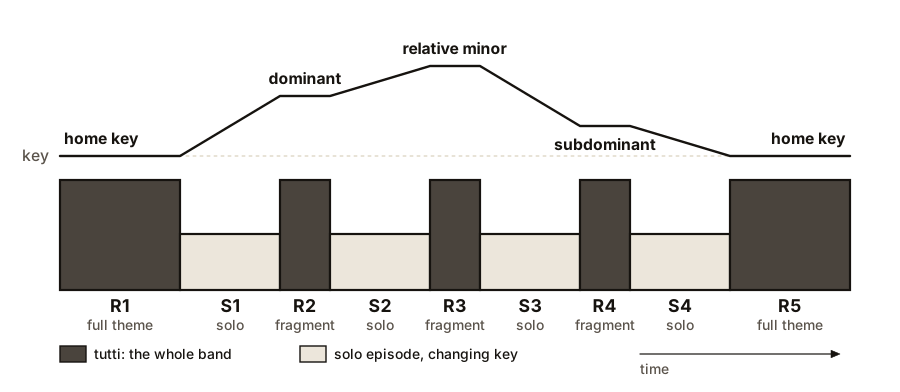
IN PLAIN ENGLISH: A concerto movement in ritornello form is like a walk with a refrain. The whole band plays a tune you will remember. The soloist wanders off. The band comes back with a piece of the tune, in a new key. The soloist wanders again. At the end the band plays the whole tune in the home key, and you are home.
Fast, slow, fast
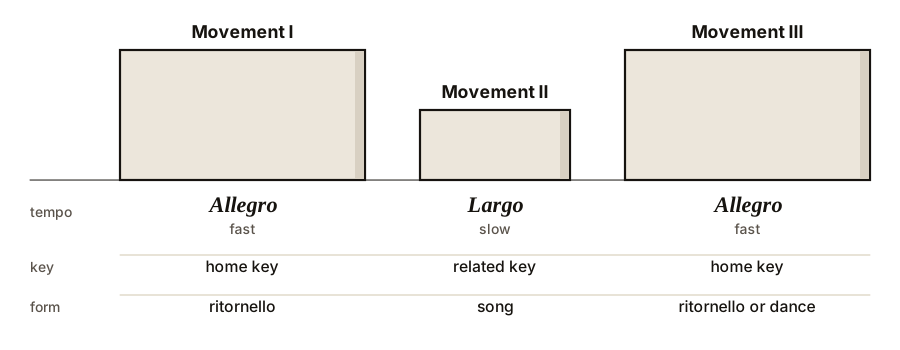
Vivaldi also fixed the shape of the whole concerto. Nearly all of his concertos have three movements:
- Fast, in ritornello form, in the home key.
- Slow, often in a related key, usually short and lyrical: a song for the soloist over a quiet accompaniment.
- Fast again, back in the home key, often lighter and more dancelike than the first, and often in ritornello form too.
This fast-slow-fast plan was taken up across Europe. It was still the shape of the concertos of Mozart, Beethoven and Brahms, a century and more later.
The Four Seasons as a map
Spring is the place to hear all of this at once, because Vivaldi labelled it.
The sonnet for Spring runs, in outline: spring has come, and the birds greet it with song; streams run, murmuring under gentle breezes; then black clouds, thunder and lightning; when the storm passes, the birds sing again. That is the first movement. In the slow second movement, a goatherd sleeps in a flowering meadow while his faithful dog stands guard. In the third, nymphs and shepherds dance to the sound of a country bagpipe.4
Now look at how the first movement is built. The cheerful opening theme is the ritornello, and it stands for spring itself. Each scene of the poem is a solo episode. The birds are the solo violin, joined by two violins from the band, trilling and chirping high above an empty bass. The streams are a soft murmur in the whole band. The storm is the band’s rushing scales and the soloist’s lightning flashes. And between every scene, back comes a piece of the spring theme.
The programme does not replace the form. It rides on it. Vivaldi placed each picture inside an episode, so that the ritornello could hold the whole movement together no matter how far the pictures roamed.
In the slow movement, listen to the violas. They play the same two notes, over and over, rough and accented, for the whole movement. That is the dog. The caption over the viola part says so.
ON THE BENCH: Chart the ritornello in “Spring”
You need: a recording of the first movement (Allegro) of Vivaldi’s Spring (Op. 8, No. 1, RV 269), a stopwatch or phone timer, and a sheet of paper ruled into three columns: Time, Tutti or solo, What you hear.
Cost: nothing. Time: thirty minutes, including three or four listenings. Hazards: none.
Steps:
- Listen once to learn the ritornello. It is the very first music you hear: a bright, bouncing tune in E major, played loud, then echoed soft.
- Start the timer with the first note. Every time the band plays all or part of that tune, write the time and “R”. Every time it gives way to something else, write the time and what you hear: birds, streams, storm.
- On a later listening, mark each R as “complete” or “fragment”, and as “major” or “minor” (bright or dark).
- Draw your results as a timeline, the way the ritornello map above does.
What you should find: the movement lasts about three and a half minutes in most recordings. The ritornello appears five or six times. The first and last appearances are complete; the ones in between are shorter, usually the tune’s closing phrase. At least one return, just after the storm, sounds darker: it is in a minor key, because the storm episode carried the music away from E major. The birdsong comes twice, once near the start and again after the storm, exactly as the sonnet says.
If it does not work: if every passage sounds like a return, you are hearing the echo inside the ritornello itself. The echo is part of the tune. Count a return only when the tune comes back after something different.
Bach learns from Vivaldi
Vivaldi’s concertos travelled fast. His Opus 3, L’estro armonico, “the harmonic inspiration”, twelve concertos printed in Amsterdam in 1711, was played across Europe within a few years.
One of the musicians who studied it was a young court organist at Weimar named Johann Sebastian Bach. Around 1713 and 1714, Bach arranged concertos by Vivaldi for solo organ and for solo harpsichord, writing every part of the string band into his own two hands and feet.5 Among them is the organ concerto in A minor, BWV 593, from Vivaldi’s concerto for two violins in A minor, Op. 3 No. 8. Years later in Leipzig he turned Vivaldi’s concerto for four violins, Op. 3 No. 10, into a concerto for four harpsichords, BWV 1065.
Bach’s first biographer, Johann Nikolaus Forkel, wrote in 1802 that these arrangements taught Bach to think musically: to build ideas in an order, to connect them, to make each passage follow from the last.6 Copying out someone else’s music, note by note, is still one of the best ways to learn how it works.
ON THE BENCH: Hear the transcription
You need: recordings of Vivaldi’s concerto for two violins in A minor, Op. 3 No. 8 (RV 522), and Bach’s organ concerto in A minor, BWV 593. Both are easy to find.
Cost: nothing. Time: twenty minutes. Hazards: none.
Steps: play the first thirty seconds of Vivaldi’s first movement, then the first thirty seconds of Bach’s. Then do the same with each of their slow movements. Listen for which instrument takes the ritornello and which takes the solo episodes in the organ version.
What you should hear: the same music, note for note in most places. On the organ, Bach has to show tutti and solo with nothing but changes of keyboard and stop: the ritornello on a full, loud registration, the solo episodes on a lighter one. Listen for the places where he fills a texture Vivaldi left bare. Those small additions are Bach thinking aloud.
The Brandenburg Concertos
On 24 March 1721, Bach signed a dedication to Christian Ludwig, Margrave of Brandenburg, and sent him a fair copy of six concertos.7 Nobody in Bach’s time called them the Brandenburg Concertos; the name was given in the nineteenth century. They are the summit of the Baroque concerto, and they show what Bach did with what he learned.
He kept Vivaldi’s ritornello and Vivaldi’s fast-slow-fast plan. He changed almost everything else. No two of the six use the same instruments. The second puts a high trumpet, a recorder, an oboe and a violin in the solo group. The third has no soloists at all: three violins, three violas and three cellos toss the ideas between them, and its slow movement is just two chords, a cadence, to be decorated by the players as they wish. And in the first movement of the fifth, the harpsichord, normally the humble continuo, slowly takes over as soloist, until near the end it plays a long passage alone while the whole band falls silent.
That moment in the Fifth Brandenburg is the harmonic floor of Chapter 19 standing up and taking the stage. A continuo instrument becomes the star. It is often called the first great keyboard concerto.
SLOW DOWN. Check Your Understanding: In a ritornello movement in C major, the second return of the ritornello comes in G major and the third in A minor. A listener says, “The ritornello is just a refrain, like the chorus of a song.” What does that comparison miss?
Answer: A song’s chorus usually comes back in the same key every time. The ritornello comes back in different keys, and that is its main job. Each return confirms the key the solo episode has just reached, so the returns mark the route of the movement’s journey: home, the dominant, the relative minor, and finally home again. A refrain tells you that you are back where you were. A ritornello tells you where you have got to. That is why only the last return, in the home key, sounds like an ending.
What the ritornello could not do
The ritornello gave the Baroque a way to build long movements, and Bach and Vivaldi between them built hundreds. But the form has one tune at its centre. Everything else is episode, and episodes are spun out of the ritornello’s motives or invented on the spot.
Within thirty years of Bach’s death in 1750, composers wanted something else: a movement with two main themes, of different character, in different keys, set against each other like characters in a play, and then reconciled. The building plan for that is sonata form, and it is Chapter 25.
Antonio Vivaldi, Il cimento dell’armonia e dell’inventione, Op. 8 (Amsterdam: Le Cène, 1725). Source to pull before print: a facsimile of the first edition, for the sonnets and the captions printed in the parts.↩︎
Arcangelo Corelli, Concerti grossi, Op. 6 (Amsterdam: Roger, 1714), published the year after his death.↩︎
Source to pull before print: the count of Vivaldi’s concertos in the Ryom catalogue (RV), which numbers about five hundred.↩︎
The authorship of the four sonnets is not known. Source to pull before print: the standard view that they may be Vivaldi’s own.↩︎
Source to pull before print: the dating of Bach’s Weimar concerto transcriptions, BWV 592 to 596 for organ and BWV 972 to 987 for harpsichord, several of them after Vivaldi.↩︎
Johann Nikolaus Forkel, Über Johann Sebastian Bachs Leben, Kunst und Kunstwerke (Leipzig, 1802). Source to pull before print: the passage on Vivaldi, in a standard English translation.↩︎
Source to pull before print: the dedication score of the Brandenburg Concertos, BWV 1046 to 1051, in the Staatsbibliothek zu Berlin.↩︎
Bench Degree
Get the degree without the diploma.
Learn the material, not how to pass the exam.