Bench Degree·MUSICchapter
Chapter 23: Dances and Suites
The sarabande was once banned in Spain as indecent. A century and a half later it was the slowest, gravest music Bach wrote for the cello.
In 1583, the story goes, the sarabande was forbidden in Spain. Anyone caught dancing it could be whipped, and its singers could be sent to the galleys. It had come from the Spanish colonies in the New World, it was fast, and its movements were thought to be obscene.1
By 1720 the same dance, slowed down and made stately at the French court, sat at the centre of each of Bach’s six suites for unaccompanied cello. It was the movement where the music stopped running and began to think.
The dance had not kept its steps. It had kept its rhythm. That is what a Baroque suite is: a set of rhythms, each one the fingerprint of a dance that people once actually danced, collected into a sequence and played to be listened to.
A suite is a set of rhythms
A suite in Bach’s time was a group of short pieces, all in the same key, each one bearing the name of a dance. The core was four dances, nearly always in this order:
- Allemande, “the German dance”: moderate, in four.
- Courante, “the running dance”: quicker, in three.
- Sarabande: slow, in three.
- Gigue, from the English and Irish jig: fast, in a lilting compound meter.
Between the sarabande and the gigue a composer could add one or two lighter dances from the fashionable French ballroom: a minuet, a gavotte, a bourrée. These were called galanteries, the gallant pieces. Bach usually put them in pairs, the first dance played again after the second, so that the pair runs Minuet I, Minuet II, Minuet I.
A suite might also open with a prelude, a free piece that is no dance at all. It warms up the key and the player’s fingers before the dances begin.
The order is a plan of contrasts. Moderate, then quicker, then slow, then something light, then fast. Four in a bar, three in a bar, three again but heavy, then the skipping sixes of the gigue. The ear never hears the same rhythm twice running.
IN PLAIN ENGLISH: A Baroque suite is a playlist of dances in one key. Each dance has its own beat: the allemande walks, the courante runs, the sarabande pauses, the gigue skips. Nobody danced to Bach’s suites. The dances gave him a set of contrasting rhythms to write within.
Each dance, by its pulse
Chapter 14 taught the time signature. Here each dance is described by that and by its typical speed. The speeds are approximate; players differ, and the courts of 1700 left no metronome markings, because the metronome did not exist until 1815.
| Dance | Usual meter | Feel | Rough tempo | Tell-tale sign |
|---|---|---|---|---|
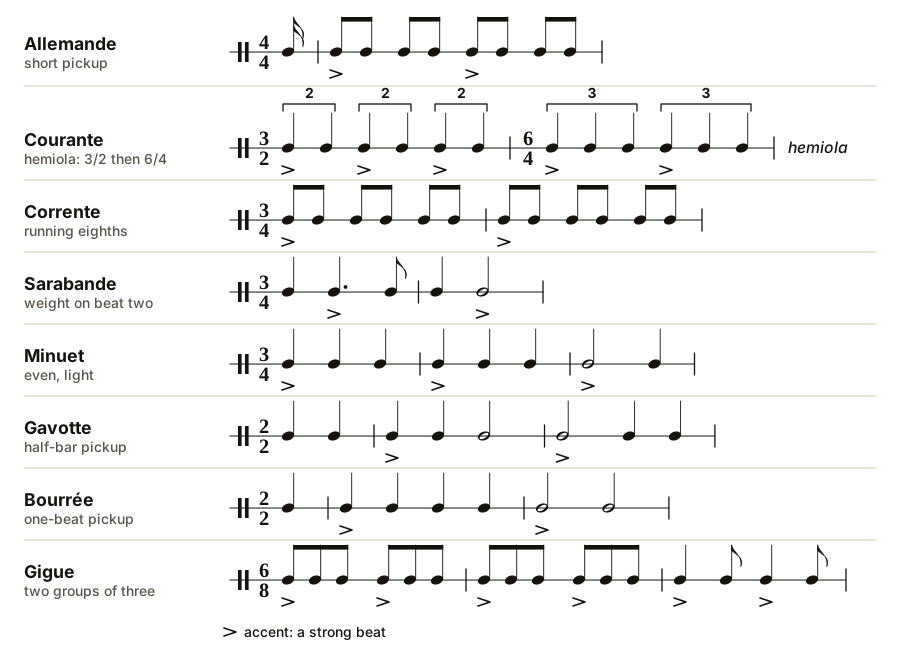
| Allemande | 4/4 | moderate, flowing | 60 to 80 quarter notes a minute | starts with a short pickup note or three |
| Courante (French) | 3/2, shifting to 6/4 | grave, ambiguous | 50 to 70 half notes | the beat seems to change from three to two |
| Corrente (Italian) | 3/4 | quick, running | 100 to 140 quarter notes | unbroken runs of eighths |
| Sarabande | 3/4 | slow, weighty | 50 to 70 quarter notes | a long note on the second beat |
| Minuet | 3/4 | moderate, elegant | 100 to 130 quarter notes | short, even phrases |
| Gavotte | 2/2 | moderate, poised | 60 to 80 half notes | starts in the middle of the bar, with two quarter notes |
| Bourrée | 2/2 | quick, sturdy | 80 to 110 half notes | starts with one quarter note before the bar |
| Gigue | 6/8 or 12/8 | fast, leaping | 90 to 120 dotted quarters | groups of three eighths; often in imitation |
A pickup, or upbeat, is a note or two that come before the first full bar, leading into the first strong beat. Many dances are recognised by their pickup alone. A gavotte always begins halfway through a bar; a bourrée a quarter of a bar before it.
Two of these need a closer look.
The sarabande leans on beat two. In most music in three, the first beat is the strong one: ONE two three. The sarabande very often puts its longest note on beat two, so that the bar goes ONE TWO-oo three, with the weight landing late and lingering. That delayed stress is what gives the dance its stately, almost hesitant step.
The French courante plays a trick with three and two. Six quarter notes can be grouped as three pairs (3/2) or as two threes (6/4). The courante switches between the two, sometimes within a phrase. That switch has a name, hemiola: the momentary regrouping of a triple pulse so that two bars of three are heard as three bars of two. It is the reason a French courante sounds slippery, and it returns at the cadences of countless Baroque pieces in three.
ON THE BENCH: Clap the dances
You need: a phone metronome app, your hands, and recordings of any of Bach’s six cello suites or his six French Suites for keyboard.
Cost: nothing. Time: thirty minutes. Hazards: none.
Steps:
- Set the metronome to 66 beats per minute. Clap three beats a bar, accenting the first: CLAP clap clap. Now accent the second and hold it: clap CLAP (hold) clap. That is the sarabande step.
- Set it to 100, and let each click be a dotted quarter, two to a bar. Say three quick, even syllables to every click, ONE-two-three FOUR-five-six, and clap on ONE and FOUR. That is the gigue: six fast eighths in two groups of three.
- Set it to 104 and clap once on every click, six to a bar, as three groups of two: CLAP clap CLAP clap CLAP clap. Then clap the same six as two groups of three: CLAP clap clap CLAP clap clap. Alternate one bar of each, several times. That alternation is the courante’s hemiola.
- Set it to 140 and clap four to a bar, but begin on beat three: clap clap | CLAP clap clap clap |. That is the gavotte’s half-bar pickup.
- Now play the allemande, courante, sarabande and gigue of one suite. For each, start the metronome and adjust the speed until it locks with the recording, then clap along.
What you should find: each dance has a pulse you can clap within a few bars, and the speeds you settle on fall roughly within the table above. The sarabande will be the slowest, often under 60, and the place where your claps want to linger on the second beat. If you cannot find the sarabande’s stress, listen for the longest note in the bar: in most of Bach’s sarabandes it sits on beat two.
Binary form, the shape of every dance
Every dance in a suite has the same architecture, and it is simple enough to hear on a first listening.
The dance is in two halves. Each half is played twice. On the page, each half ends with a repeat sign, a double bar with two dots that tells the player to go back and play the half again. So the whole dance runs: first half, first half again, second half, second half again. Musicians write this as AABB. It is called binary form, from the Latin for “in two parts”.
The halves are not just two melodies. They make a journey in key, the journey of Chapter 22:
- The first half starts in the home key and ends away from it. In a major key, it ends in the key a fifth above, the dominant of Chapter 21: a suite in G major has its dances’ first halves end in D major. In a minor key, the first half usually ends in the relative major of Chapter 11: a dance in D minor ends its first half in F major.
- The second half starts away and comes home. It often begins with the opening idea, now in the new key, wanders a little further, and works its way back to end in the home key with a full cadence.
So the double bar in the middle is a resting place, but not a home. The ear hears it as a comma: something has been said, and it is not finished. The end of the second half is the full stop.
Often the second half is longer than the first, because it has more distance to cover. And often, near its end, the opening melody comes back in the home key, so that the listener hears a return as well as an arrival. That variant is called rounded binary, and you should remember it. Within a few decades of Bach’s death it would grow into the most important form of the Classical period, the subject of Chapter 25.
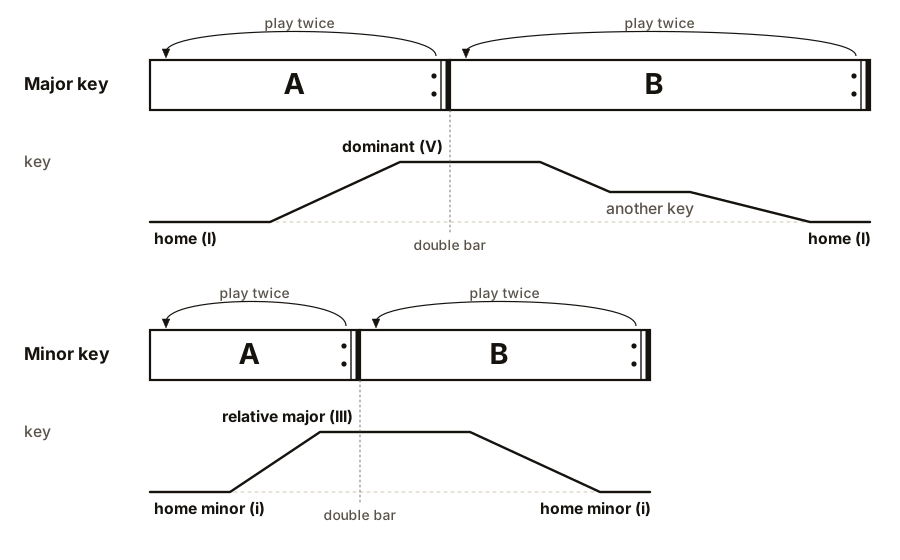
IN PLAIN ENGLISH: A Baroque dance is two halves, each played twice. The first half travels from home to a nearby key and stops there. The second half comes back. The middle of the piece feels like a pause for breath, and the end feels like arriving.
Bach’s suites
Bach wrote suites all his working life. The ones most often played today are:
- The six cello suites (BWV 1007 to 1012), for cello alone, written about 1720 when Bach was at the court of Köthen. Bach’s own manuscript is lost. They survive in copies, the most important made by his second wife, Anna Magdalena. Each follows the plan exactly: prelude, allemande, courante, sarabande, a pair of galanteries (minuets in the first two suites, bourrées in the next two, gavottes in the last two), and a gigue.
- The French Suites (BWV 812 to 817) and English Suites (BWV 806 to 811), for keyboard. Neither name is Bach’s; both were attached later.
- The six keyboard partitas (BWV 825 to 830), which Bach issued one at a time from 1726 and collected in 1731 as the first part of his Clavier-Übung, “keyboard practice”.
The cello suites show something remarkable. A cello mostly plays one note at a time, so it cannot play the chords of Chapter 20 in the ordinary way. Yet in the sarabandes you hear harmony and a bass line moving underneath. Bach does it by implied harmony: the line touches the bass note, then a note of the chord, then another, quickly enough and in a clear enough pattern that the ear assembles the chord from notes heard one after another. One voice plays the counterpoint of two or three.
For a long time the cello suites were treated as exercises. The Catalan cellist Pablo Casals came across an edition of them in a second-hand music shop in Barcelona as a boy, in about 1890, practised them privately for years, and later recorded them complete in the late 1930s. It is largely through him that they became concert music.2
ON THE BENCH: Find the halves in a sarabande
You need: a recording of the Sarabande from Bach’s Cello Suite No. 2 in D minor (BWV 1008), and a stopwatch or the timer on your phone. Paper and pencil.
Cost: nothing. Time: twenty minutes. Hazards: none.
Steps:
- Listen once all the way through without timing anything. Just notice where the music seems to stop and start over.
- Play it again with the timer running from the first note. Write down the time each time you hear the opening melody begin again, and each time you hear a clear stopping place.
- You should have four sections. Label them A, A, B, B. For each, note whether it ends sounding settled or unsettled.
- Sing or hum the last note of the first A. Now sing the very first note of the piece. Are they the same note?
What you should find: the opening melody starts twice near the beginning, and a different melody, a little longer, starts twice after that: AABB. The first half ends sounding open, on a different note from the one the piece began on; this is the move to F major, the relative major of D minor. The second half ends settled, on D. If the performer has added ornaments the second time through each half, as Baroque players were expected to, the repeat will sound slightly different. It is still the same music.
If it does not work: some performers skip the repeats, especially of the second half. If you hear only three sections, try another recording.
SLOW DOWN. Check Your Understanding: A dance in A major ends its first half on a chord of E major. Is that a cadence in E major, or a half cadence in A major, the “question” of Chapter 21? How would you tell?
Answer: It can be either, and the difference is the whole point of binary form. If the last bars before the double bar use a D sharp, the note that leads up to E, then the music has truly modulated: E has become the temporary home, and the double bar is a cadence in E major. If the D stays natural, E is just the dominant of A, and the half ends on a question. In Bach’s dances the first half nearly always does the former. The key really moves, which is why the second half has real work to do to bring it back. Listen for that one raised note; it is the sound of leaving home.
From the ballroom to the concert room
By 1720 hardly anyone danced an allemande. The courante had faded from the ballroom. The minuet was still danced, and would be for another century. But Bach was not writing for dancers. He was writing music that remembered dancing, as a sonnet remembers a song.
That memory is what holds a suite together. Without words and without a story, a set of instrumental pieces needs some reason to be shaped one way and not another. The dances supplied it: a known pulse, a known length of phrase, a known character. A listener in 1720 heard “sarabande” in the title and knew to expect something grave in three, with the weight on two.
The dance gave each movement a rhythm and binary form gave it a shape. What neither gave was a way to build a long movement, one that could last five or ten minutes without falling apart. Venice had already found one, and it was built on a tune that kept coming back. That tune is the ritornello, and it is Chapter 24.
Source to pull before print: the 1583 prohibition of the zarabanda in Spain, and the contemporary complaints against it, in a standard dance history.↩︎
Source to pull before print: a standard biography of Pablo Casals, for the date of his finding the edition and the dates of his recordings (made between 1936 and 1939).↩︎
Bench Degree
Get the degree without the diploma.
Learn the material, not how to pass the exam.