Bench Degree·MUSICchapter
Chapter 22: Modulation
Most of the music you know changes its home note while you listen, and you never notice the move. The few times you do notice, it is usually on purpose.
Play the first half of almost any Baroque dance in a major key, and it will end in a different key from the one it began in. A minuet that opens in G major closes its first half firmly in D major. Nobody in the audience gasps. Most listeners could not tell you it happened. But stop the music at that point, and they will tell you it is not over.
That move is called modulation: changing key in the middle of a piece. It is how a few minutes of music become a journey instead of a single place, and it is the reason Chapter 9’s argument about tuning mattered so much.
What changes when the key changes
Chapter 12 defined a key as a scale with a home, the tonic. Chapter 21 showed how a cadence confirms that home: V to I, the leading tone rising, the tritone collapsing. A modulation is a cadence on a different home. The music introduces the notes of a new key, then closes with an authentic cadence on a new tonic, and the ear accepts the new tonic as home for a while.
Take C major to G major. The two scales differ in one note: G major has F sharp where C major has F. F sharp is the leading tone of G. So the moment F sharps start appearing, and a D major chord (V of G, with F sharp inside it) moves to G, the ear hears G as the new home. C, which a minute ago was the tonic, now sounds like IV.
A single borrowed note does not make a modulation. Composers often slip one F sharp into a C major phrase, lean toward G for a chord or two, and come straight back. It takes a cadence, and usually a few bars in the new key, to move the floor.
IN PLAIN ENGLISH: To modulate is to move the home note. A piece starts in one key, brings in the notes of another, and ends a phrase with a firm cadence on the new home. For a while, the new note is where the music rests.
Next door on the circle
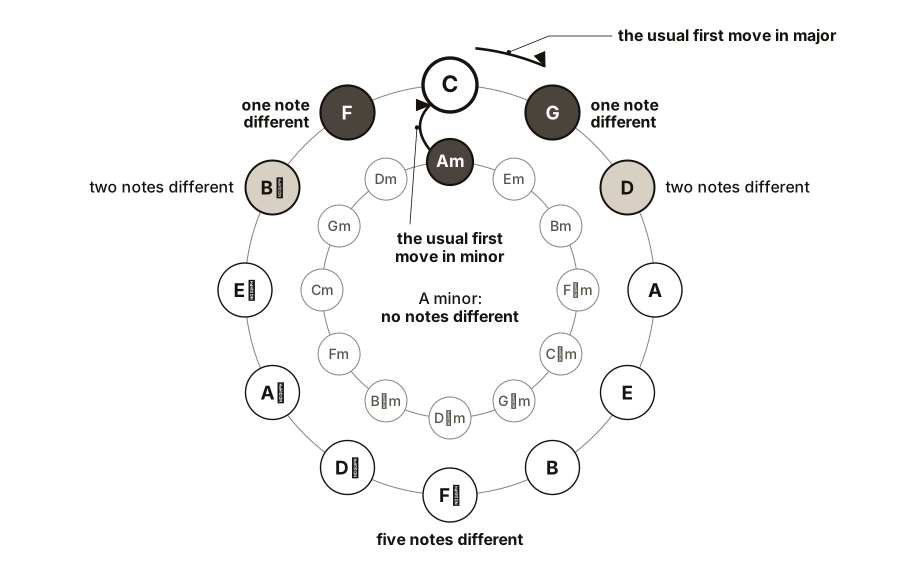
Which keys are easy to move to? The circle of fifths of Chapter 12 answers in one picture. Neighbouring keys on the circle share six of their seven notes. C major and G major differ only in F and F sharp. C major and F major differ only in B and B flat. A move between neighbours changes one note, and the ear barely registers a seam.
The relative minor shares all seven. C major and A minor are the same white keys with a different home, as Chapter 11 found, so a move from one to the other changes no notes at all, only the centre of gravity, and in practice the G sharp that minor borrows for its V chord.
From these facts a Baroque habit grew so regular it is almost a rule:
- A piece in a major key moves first to its dominant, the key a fifth up. C major to G major.
- A piece in a minor key moves first to its relative major. A minor to C major.
Then, after a visit to one or two other nearby keys, it comes home. Ask where the first half of a Bach dance in major ends, and the answer is almost always the dominant. Chapter 23 meets those dances properly.
The pivot chord
The smoothest way to change key is through a chord that belongs to both.
List the triads of C major and of G major side by side:
| C major | C | Dm | Em | F | G | Am | B dim |
|---|---|---|---|---|---|---|---|
| G major | G | Am | Bm | C | D | Em | F sharp dim |
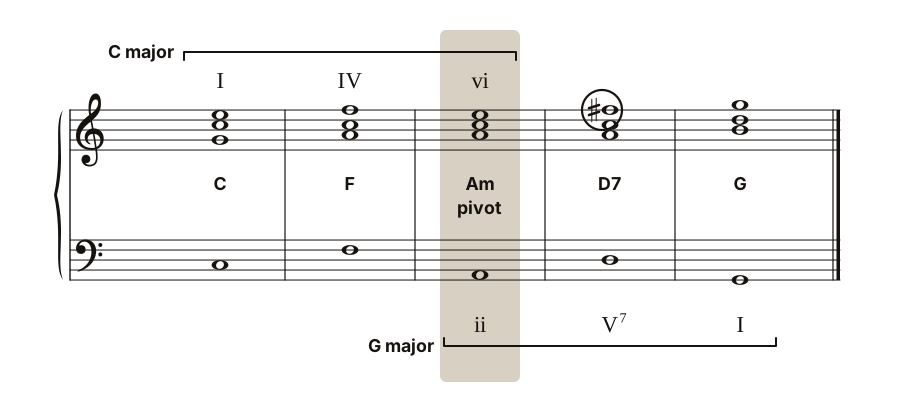
Four chords appear in both lists: C, E minor, G and A minor. Any of them can serve as a pivot chord, heard one way on arrival and the other way on departure. A minor is the favourite. In C major it is vi; in G major it is ii, and ii leads naturally to V. So a phrase can go C, F, A minor, and the ear still hears C major. Then, after A minor, comes D major with its F sharp, and then G. Heard backward, the A minor was ii of G all along.
The pivot works because the ear reinterprets the chord after the fact. At the moment it sounds, nothing has changed. Only the next chord tells you which key it belonged to.
ON THE BENCH: Modulate from C to G
You need: a keyboard, real or online.
Time: fifteen minutes. Hazards: none.
Steps: play each chord with its root in the left hand and the rest of the chord in the right, one chord per slow beat.
- Establish C: C, F, G7, C. You are home.
- Now the modulation: C, F, A minor, D7 (D F sharp A C), G. Hold the G.
- Confirm the new key with a cadence in G: C, D7, G.
- Play the C major chord again on its own, then a G chord, and ask which sounds like home now.
- To come back, use the same pivot in reverse. G major’s C chord is IV; play G, C, then G7 (G B D F), C. The F natural in G7 cancels the F sharp and leads home.
What you should hear: at step 2, the A minor chord sounds like an ordinary move within C. The D7 is the surprise: the F sharp turns the floor. By step 3, G is home, and at step 4 a plain C major chord sounds like a step away, not like home. The keys did not change; your sense of where home is did.
Far away, on purpose
Keys far apart on the circle share few notes. C major and F sharp major, on opposite sides, have only two in common, B and F (spelled E sharp in F sharp major). There is no shared triad to pivot on. A move between them cannot be smooth, and that is exactly why composers make it: a far modulation is heard, and it is meant to be.
Early in the eighteenth century, far modulations were mostly reserved for the middles of pieces and for moments of drama. Later composers made them structural. In his “Waldstein” Sonata of 1804, Beethoven sets the first movement in C major and brings in its second main tune not in G, the expected dominant, but in E major, four steps round the circle: a sudden brightening that every listener feels. In his last piano sonata, in B flat major, written in 1828, Schubert moves within the first page to G flat major, a key with six flats, and the music seems to step into another room. Neither piece uses a gentle pivot. Both use the distance itself as the effect.
SLOW DOWN. Check Your Understanding: Which is the bigger journey: C major to A minor, or C major to C minor?
Answer: C major to C minor, though it keeps the same home note. C major and A minor share all seven notes; the move changes no notes, only the home. C minor has E flat, A flat and B flat, three notes different from C major. On the circle, C minor is the relative minor of E flat major, three steps round from C. Keeping the same tonic is not the same as staying near. That is why a switch to the parallel minor, which Chapter 11 called a change of colour, can sound so dark: it keeps the home and changes nearly half the furniture.
Why only a tempered keyboard could go everywhere
On paper, every key is reachable from every other. On a keyboard, it depends on the tuning.
Recall Chapter 9. In just intonation, tuned purely to C, even the chord on D was sour; a modulation to G, which needs a good D major chord as its V, would fall apart within a few bars. In meantone, keys within two or three sharps or flats of C sounded glorious, but each black key had only one identity. With the black key tuned as G sharp, there was no usable A flat, and a modulation toward the flat keys walked straight into the wolf. Composers for meantone keyboards stayed close to home, or had to.
A well temperament or equal temperament removes the walls. Every major and minor triad on every note is usable. G sharp and A flat are one key, and a composer may call it either.
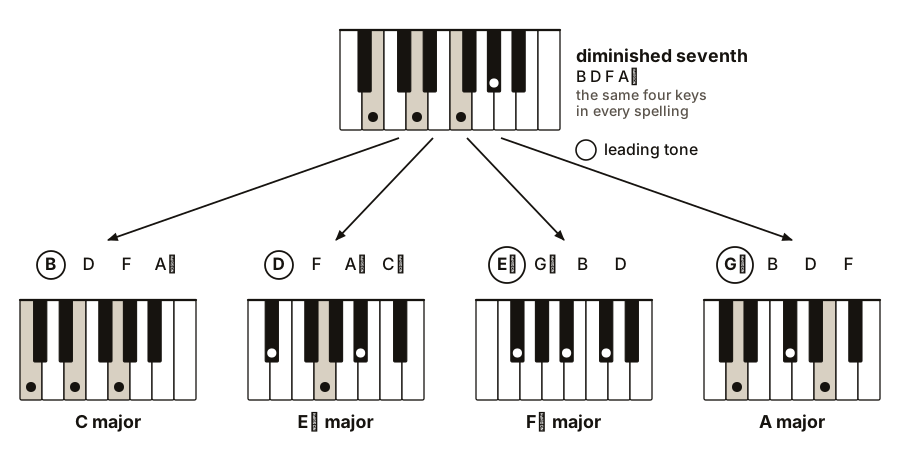
That last point opens a trapdoor. The diminished seventh chord of Chapter 20, three minor thirds stacked, B, D, F, A flat, divides the octave into four equal parts on a tempered keyboard. Each of its four notes can be heard as a leading tone, depending on how it is spelled:
- B, D, F, A flat: B leads to C.
- D, F, A flat, C flat: D leads to E flat.
- E sharp, G sharp, B, D: E sharp (the F key) leads to F sharp.
- G sharp, B, D, F: G sharp (the A flat key) leads to A.
One chord, four destinations, three of them far from C. On a meantone keyboard, with G sharp and A flat 41 cents apart, the trick fails: the chord is in tune for one spelling only. On a tempered keyboard the same four keys serve every spelling, so one chord can turn the music toward any of four keys. Composers of Bach’s generation and after used it constantly for sudden turns.
Bach’s Well-Tempered Clavier (Book I, 1722; Book II about twenty years later) made the point in the plainest possible way: a prelude and fugue in every one of the twenty-four keys, in order up the keyboard, on one instrument with one tuning. The individual pieces modulate too, mostly to near keys, but the book as a whole is a tour of the entire circle. On a meantone harpsichord, much of the book could not have been played.
ON THE BENCH: Follow a key change by ear
You need: a recording of the Prelude in C major that opens Book I of the Well-Tempered Clavier (BWV 846), on harpsichord or piano. A free public-domain score helps; MuseScore can play one.
Time: twenty minutes. Hazards: none.
Steps:
- Listen once all the way through. The piece is one broken-chord pattern repeated, one chord per bar, so the harmony is unusually easy to follow.
- Listen again with a keyboard beside you. Every few bars, stop the recording and try to find the home note: play notes on the keyboard until one sounds like rest.
- With the score, look for the first F sharp. Then look for the first bar whose chord is a plain G major, and play a C major chord just after it.
- Keep going, and find where the F naturals come back.
What you should find: within the first dozen bars, F sharps appear and the music settles on G major. At that point, a C major chord sounds like a step away, not like home. Later the F naturals return and C becomes home again, confirmed by a long final stretch over a held low C in the bass. The whole piece is the journey of this chapter in miniature: home, the dominant, and back. Then try the first half of any Bach minuet or gavotte in a major key, and listen for the cadence in the dominant at its halfway point.
From keys to forms
A modulation gives a piece a geography: a home, a place away from home, and a road back. Once composers could count on that, they could build whole movements around it. The plainest of them, the dances of the Baroque suite, go out to a new key in the first half and come home in the second, and they do it in rhythms the listener’s feet recognise. What those dances were, and how a set of them became a suite, is Chapter 23.
Bench Degree
Get the degree without the diploma.
Learn the material, not how to pass the exam.