Bench Degree·MUSICchapter
Chapter 21: Cadence and Tension
Two notes a tritone apart, each one half step from home, are enough to make an entire concert hall wait for the last chord.
Play G, B, D and F together on a keyboard and take your hands away. Most listeners cannot leave it there. They hum the next chord, or shift in their seats, or reach over and play C, E and G themselves.
Nobody taught them that. Or rather, three centuries of music taught them, so thoroughly that the pull feels like gravity. This chapter is about that pull: where it comes from, how composers used it to mark the ends of phrases, and how they learned to cheat it.
Home, away and the pull back
Chapter 20 built seven triads on the notes of a key and named them with Roman numerals. Three of them, I, IV and V, carry so much of the work that they have names of their own.
- Tonic (I). The chord on the home note. C E G in C major. Rest, arrival.
- Dominant (V). The chord on the fifth note, a fifth above home. G B D. Tension, the strongest pull back to I.
- Subdominant (IV). The chord on the fourth note. F A C. Departure, a step away from home that is less urgent than V.
Those three words name functions: jobs that chords do in a phrase. The commonest shape in tonal music, from a hymn to a symphony, is a phrase that starts at home, moves away, builds tension and comes back: I, then IV, then V, then I. The other chords mostly stand in for one of the three. ii and IV share two notes and do much the same job; vi shares two notes with I and can borrow its sense of home, as this chapter will show.
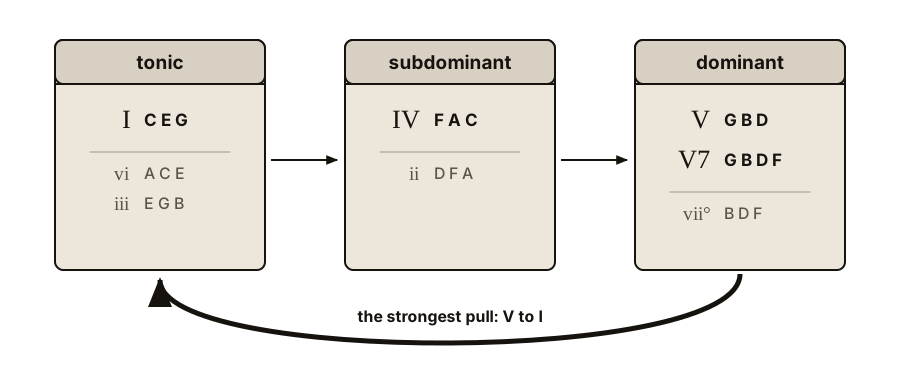
IN PLAIN ENGLISH: In any key, one chord is home (the tonic, I), one is the strongest pull back toward home (the dominant, V), and one is a gentler step away (the subdominant, IV). Most phrases leave home, travel through IV and V, and come back.
The tritone that has to move
Why is V the strongest pull? Part of the answer is in its notes, and most of the answer is in the note added on top.
V contains the leading tone of Chapter 11: B, a half step under C, leaning on it. That alone makes V want to go to I. Now add the seventh, F, to make the dominant seventh chord, V7: G B D F. The F sits a half step above E, the third of the tonic chord. So the chord now holds two notes that lean on home, one from below and one from above.
And those two notes, B and F, are a tritone apart: the interval that Chapter 5 put at the restless end of the list, 45:32, made of large numbers and full of beating. The tritone is the engine of V7. Each of its two notes is a half step from a note of the tonic chord. When the chord resolves, B rises to C and F falls to E. The two notes move inward, toward each other, and the jangling tritone collapses into a sweet major third, C and E, one of the smoothest intervals there is.
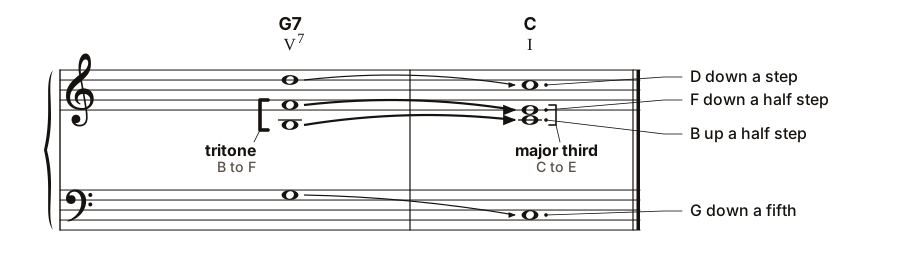
Turn the tritone over, with F below B, and it becomes an augmented fourth. Now the same moves, F down and B up, push the two notes outward, to E below and C above: a sixth. Either way, inward or outward, the tritone resolves by both notes moving a half step, into a consonance.
ON THE BENCH: The pull, with two notes
You need: a keyboard, real or online.
Time: five minutes. Hazards: none.
Steps:
- Play B and the F above it together. Hold them. Then play C and E.
- Play the tritone again, and this time move only one note: B to C, keeping F. Then try keeping B and moving F to E.
- Now play the full V7, with a low G in the left hand and B, D, F in the right, and resolve it to C, with a low C and C, E, C above.
What you should hear: two notes alone, B and F, already ask for C and E. Moving only one of them leaves the job half done; the remaining dissonance still wants to move. With the whole chord, the bass falling from G to C adds weight to an arrival the tritone was already demanding.
The bass adds the rest. In V to I, the bass falls a fifth, G to C, or rises a fourth, which is the same note name. Chapter 3 gives a reason to hear that as arrival: G is the 3rd harmonic of C. The note the bass falls to contains, in its own harmonic ladder, the note the bass came from. It is the closest relation two different notes can have after the octave.
Four kinds of ending
A cadence is the end of a phrase: the two chords where music comes to rest, or pauses, like a full stop or a comma. The word comes from the Latin cadere, to fall. Four kinds are worth knowing by ear.
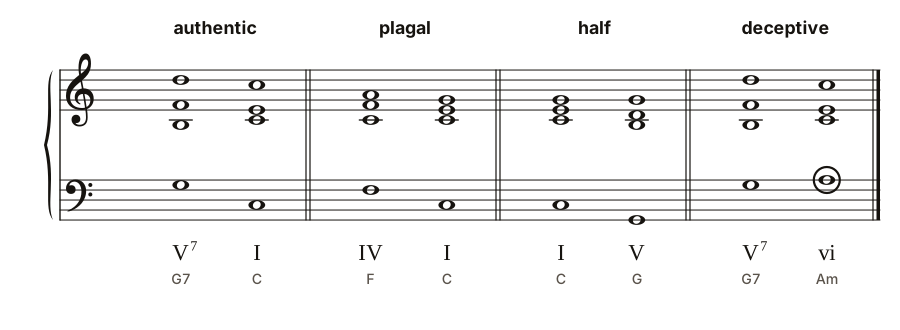
Authentic cadence: V to I. The full stop. G (or G7) to C. When both chords are in root position and the tonic note is on top in the last chord, it is called a perfect authentic cadence, and nothing in the language of the period sounds more final. Nearly every piece by Bach, Handel, Haydn and Mozart ends this way.
Plagal cadence: IV to I. F to C. Softer, without a leading tone. It is the sound of the sung “Amen” that many hymnals add at the end of a hymn, which is why musicians nickname it the Amen cadence. Handel closes the “Hallelujah” chorus from Messiah (1742) with one, after the authentic cadences have already done the work.
Half cadence: anything to V. The phrase stops on the dominant, unresolved. A comma, or a question. The listener knows more is coming. Many tunes put a half cadence at the end of the first phrase and an authentic cadence at the end of the second, a question and its answer.
Deceptive cadence: V to vi. The trick. Everything points to I: the dominant, the leading tone, the tritone. Then the bass steps up from G to A instead of falling to C, and the chord is A minor. The tritone still resolves, B to C and F to E, so the upper voices do exactly what they promised. Only the floor has moved. A minor shares two notes with C major, C and E, so it is close enough to answer and different enough to surprise. The deceptive cadence works only because the authentic one is so strongly expected, and composers use it to delay an ending, so that when the real one arrives, it lands harder.
ON THE BENCH: The deception
You need: a keyboard, real or online.
Time: ten minutes. Hazards: none.
Steps:
- Play this phrase slowly, one chord per beat, bass in the left hand and the rest in the right: C (C; E G C), F (F; F A C), G7 (G; F G B), C (C; E G C). That ends with an authentic cadence.
- Play it again exactly, but change the last bass note from C to A, and the right hand to E A C. That is V7 to vi.
- Play the deceptive version, then continue: F, G7, C. Notice how the second try at the ending feels.
- Finally, play C, F, C: a plagal cadence. Then C, F, G and stop: a half cadence.
What you should hear: the authentic cadence closes the door. The deceptive one opens it again: the right hand moves almost the same way, but the floor shifts and the phrase cannot end. When you go round again and land on C, the arrival feels earned. The plagal ending sounds gentle and churchly. The half cadence leaves you waiting.
Why an ending sounds like an ending
Put the pieces together and an ending has several things going for it at once.
- The tonic chord is the most settled chord in the key: a major triad, the 4:5:6 slice of Chapter 20, built on the note that the whole scale is organised around.
- The leading tone resolves, closing the smallest gap in the scale.
- The tritone of V7 resolves, both notes moving by half step into a consonance.
- The bass falls a fifth to the note whose harmonic ladder contains the note it left.
- It comes at the right moment. Endings fall on strong beats, at the end of a phrase of a familiar length, usually four or eight bars (Chapter 14).
None of these is a law of nature. Medieval cadences, as Chapters 10 and 16 heard, ended on open fifths and octaves and often had no leading tone in the written notes, and they sounded final to the people who sang them. The pull of V7 to I rests on real acoustics, the tritone and the 3:2 bass, but also on habit: three hundred years of music that ended this way, heard by every listener raised on hymns, folk songs and film scores. The physics makes the authentic cadence a strong candidate for an ending; history made it the ending. Which part is which is still argued, and the honest answer is that both are needed.
SLOW DOWN. Check Your Understanding: The subdominant, F in C major, sits one step below the dominant, G. Is that why it is called the subdominant?
Answer: No, though nearly everyone guesses so. The dominant is a fifth above the tonic. The subdominant is a fifth below it: F up to C is a fifth. It is the dominant’s mirror, the “under-dominant”, at the same distance on the other side of home. That is why IV to I, the plagal cadence, is the dominant’s move reversed, and why it sounds so different. In V to I, the bass falls to the note whose ladder contains it. In IV to I, the bass falls to C, which is itself the 3rd harmonic of F. The plagal cadence lands on a note that belongs to the chord it left, so it settles without the same sense of arrival.
Rameau and the bass beneath the bass
In 1722 Jean-Philippe Rameau, the French composer and theorist met in Chapter 11, published his Traité de l’harmonie. It made two claims that every harmony textbook since has taken for granted.1
The first was that an inverted chord is the same chord. C E G, E G C and G C E all have one root, C. Continuo players had treated them as three different figures over three different bass notes. Rameau said they were one harmony, standing on three different feet.
The second followed from it. Under the bass line that is actually played, Rameau said, runs another one that is not played: the line of the chords’ roots. He called it the fundamental bass, basse fondamentale. A real bass line might wander by step through inversions; the fundamental bass beneath it shows the true motion of the harmony. And when Rameau wrote out the fundamental bass of good music, he found that it moved most often by fifths, above all by a fifth down, as in V to I.
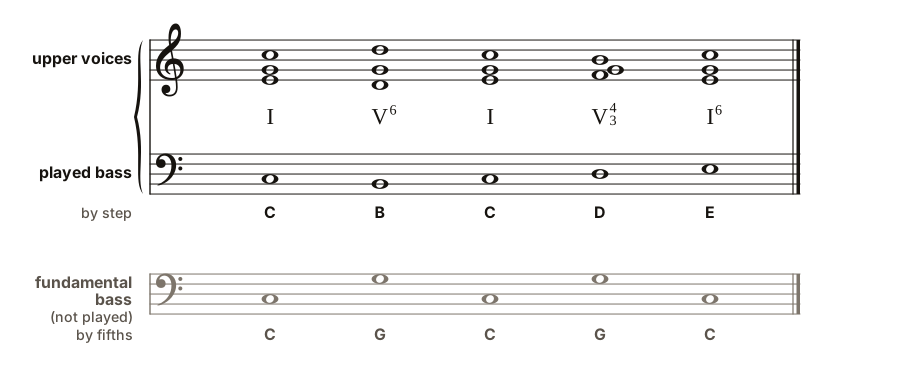
Not everything Rameau argued has survived. He never found as neat a natural origin for the minor chord as for the major, and he revised his theory for the rest of his life. But the fundamental bass gave musicians a way to see through the surface of a piece to the chords underneath, and it is the reason Roman numerals work.
ON THE BENCH: Find the cadences in a hymn tune
You need: a hymnal or a free public-domain score of the tune Old Hundredth (from the Genevan Psalter of 1551) in four-part harmony, a keyboard, real or online, and optionally a recording. MuseScore can play a score if you find one in its format.
Time: thirty minutes. Hazards: none.
Steps:
- The tune has four phrases. Play or listen to each one, and stop at its last chord.
- For each phrase ending, ask: does it sound finished, or does it wait? Write “stop” or “comma”.
- Look at the last two chords of each phrase. Name the bass notes. Is the last chord built on the home note? On the fifth note? Does the bass fall a fifth into it?
- If the hymnal adds an “Amen”, name its two chords.
What you should find: every “stop” ends on the tonic chord, and most arrive from V with the bass falling a fifth or rising a fourth: authentic cadences. Any “comma” ends on a chord other than the tonic, often V: a half cadence, or an ending in a nearby key. An added Amen will almost always be IV to I. Harmonizations differ from hymnal to hymnal, so two books may give you two different answers for the same phrase, and both will be correct.
Leaving home for good
A cadence returns to the tonic, and the tonic is fixed by the key. But some of the phrase endings in a hymn sound finished on a chord that is not the home chord at all, as if, for a moment, the key itself had moved. Composers learned to do that deliberately: to make a new note into the tonic, confirm it with a cadence, and then find a way back. Changing key in the middle of a piece is Chapter 22.
Jean-Philippe Rameau, Traité de l’harmonie réduite à ses principes naturels (Paris, 1722). Source to pull before print: the passages on the basse fondamentale and on chord inversion, in Philip Gossett’s English translation (1971).↩︎
Bench Degree
Get the degree without the diploma.
Learn the material, not how to pass the exam.