Bench Degree·MUSICchapter
Chapter 20: Chords
Three notes, each a third above the last, made the sound of Western music for four hundred years. The string in Chapter 1 had already played it.
Put a thumb on C, a middle finger on E and a little finger on G, and press. Now slide the whole hand up one white key, to D, F and A, and press again. The first sound is bright and settled. The second, made with exactly the same hand shape, is darker, as if a cloud had crossed it.
Your hand did not change. The thirds it caught did, and that is the subject of this chapter: what the continuo player of Chapter 19 was filling in.
A stack of thirds
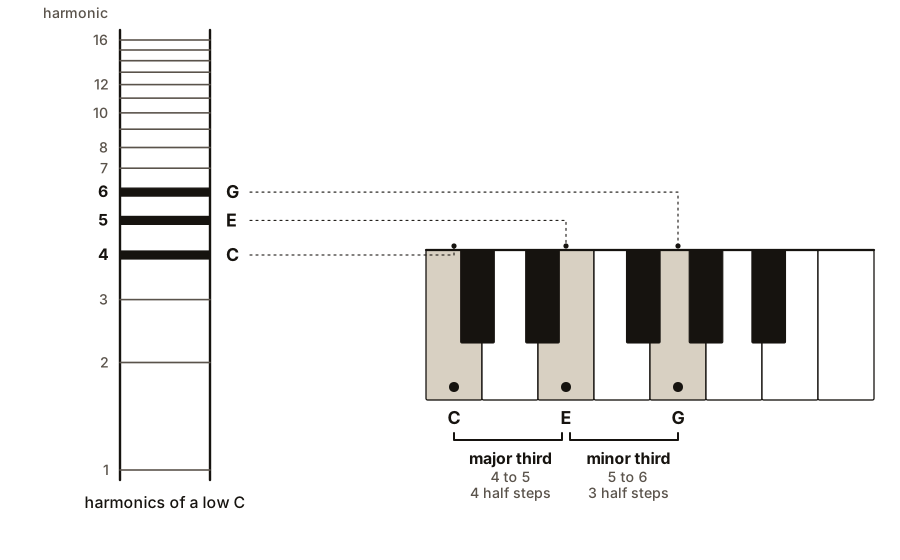
A chord is three or more different notes sounded together. The chord that Western harmony is built on has three notes, each a third above the one below: C, E, G. That stack is called a triad. Its lowest note, the one the stack is built up from, is its root; the next is its third; the top is its fifth, because it lies a fifth above the root.
You have met this chord three times already. Chapter 1 pulled it out of one string. Chapter 3 found it in harmonics 4, 5 and 6 of a low C. Chapter 5 measured its intervals: C to E a major third, 5:4; E to G a minor third, 6:5; C to G a perfect fifth, 3:2. Put together, the three notes stand in the ratio 4 : 5 : 6, three neighbouring rungs of one ladder.
That is why a major triad sounds so settled: it is a slice of a single harmonic series. Its harmonics agree, so there is little to beat (Chapter 4), and the three notes seem to share one fundamental, two octaves below the root.
Minor: the major chord turned upside down
Now the darker chord. D, F and A is also a stack of two thirds, but in the other order: a minor third on the bottom (D to F, three half steps) and a major third on top (F to A, four). The outer notes still make a perfect fifth.
Tuned purely, a minor triad stands in the ratio 10 : 12 : 15. Check it on A minor, A, C and E: 12 to 10 is 6:5, the minor third; 15 to 12 is 5:4, the major third; 15 to 10 is 3:2, the fifth.
Those numbers are bigger than 4, 5 and 6, and that matters. The three notes of A minor (A at 220 Hz, C at 264, E at 330) are harmonics 10, 12 and 15 of an F far below, at 22 Hz, too low to be heard as a note at all. A minor triad is a slice of a harmonic series too, but from much higher up the ladder, where the rungs are crowded and the shared fundamental is remote. Every pair of its notes is a consonance, but the three never fuse the way major does, and many listeners hear that remoteness as shadow. Major puts the major third below and the minor third above; minor reverses them. The SLOW DOWN box at the end of this chapter shows the same mirror on a monochord.
IN PLAIN ENGLISH: A triad is three notes stacked in thirds. Major puts the bigger third at the bottom and matches harmonics 4, 5 and 6 of one note, so it blends almost into one sound. Minor puts the smaller third at the bottom and matches harmonics 10, 12 and 15, further up the ladder, so it blends less.
Four kinds of triad
Two kinds of third, stacked two at a time, give four possible triads.
| Triad | Lower third | Upper third | Outer interval | Example | Pure ratio |
|---|---|---|---|---|---|
| major | major (4) | minor (3) | perfect fifth | C E G | 4 : 5 : 6 |
| minor | minor (3) | major (4) | perfect fifth | A C E | 10 : 12 : 15 |
| diminished | minor (3) | minor (3) | tritone | B D F | 5 : 6 : 7 (nearest) |
| augmented | major (4) | major (4) | augmented fifth | C E G sharp | 16 : 20 : 25 |
The numbers in brackets are half steps.
The diminished triad squeezes two minor thirds together, and its outer notes are a tritone, the restless interval of Chapter 5. It sounds tense and unfinished, the only one of the four whose outer interval is a dissonance.
The augmented triad stacks two major thirds, and sounds glassy and suspended. It hides a neat piece of arithmetic. Three pure major thirds, 5:4 times 5:4 times 5:4, make 125:64, which falls short of an octave (128:64) by about 41 cents. That gap is the same 41 cents that kept G sharp and A flat apart in meantone, in Chapter 9. In equal temperament, three major thirds make exactly an octave, so the augmented triad divides the octave into three equal parts and sounds the same from any of its notes.
The triads of a key
Build a triad on every note of the C major scale, using only white keys, and you get seven chords. Musicians name them by Roman numerals, counting up the scale from the tonic: I on the first note, II on the second, and so on. A capital numeral marks a major triad, a small one a minor triad, and a small one with a little circle marks a diminished one.
| Root | Notes | Kind | Numeral |
|---|---|---|---|
| C | C E G | major | I |
| D | D F A | minor | ii |
| E | E G B | minor | iii |
| F | F A C | major | IV |
| G | G B D | major | V |
| A | A C E | minor | vi |
| B | B D F | diminished | vii° |
The numerals travel. In G major, I is G B D and V is D F sharp A, but V is V in every key, and sounds the same against I in every key, because the ear hears ratios (Chapter 12).
Three of these chords carry most of the weight. I, IV and V are the three major triads, built on the first, fourth and fifth notes, and between them they contain every note of the scale: C E G, F A C, G B D. That is why so many folk songs, hymns and dances can be accompanied with three chords and nothing else. Chapter 21 gives the three their working names.
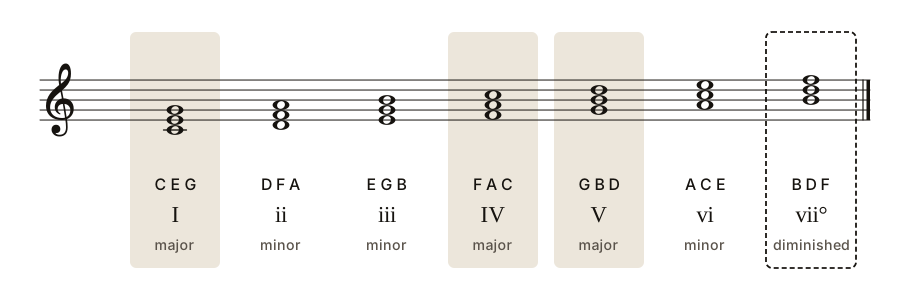
The augmented triad is missing: major keys have none. It turns up in harmonic minor, where the raised seventh makes the chord on the third note, C E G sharp, augmented. That raised seventh, the leading tone of Chapter 11, does a more important job on the fifth note: it turns E G B, a minor chord, into E G sharp B, a major one. Natural minor has a minor v. Raise the seventh and minor gets a major V, with a leading tone inside it pointing at home. That is why harmonic minor is called harmonic: it is the form of the scale that gives minor a proper V chord.
ON THE BENCH: The seven triads of C
You need: a keyboard, real or online.
Time: fifteen minutes. Hazards: none.
Steps:
- Put your right hand on C, E and G with thumb, middle finger and little finger. Play it and say “one, major”.
- Keep the hand shape exactly and move it up one white key at a time, playing each chord and naming it from the table: ii minor, iii minor, IV major, V major, vi minor, vii diminished, then I again an octave up.
- Now play C E G sharp, the augmented triad, and listen to it ring.
What you should hear: the same hand shape sounds bright on C, F and G, and darker on D, E and A. The chord on B sounds pinched, as if stopped mid-sentence. The augmented chord seems to belong to no key at all. The white keys decide which kind of third each finger lands on, and the thirds do all the work.
Inversions, and why the bass decides
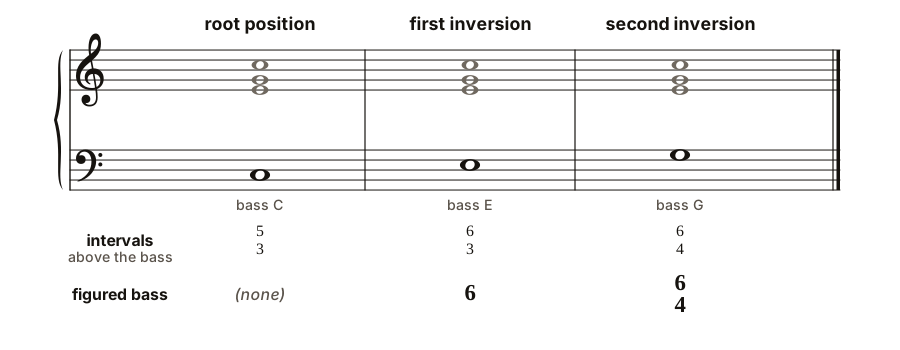
A triad need not sit on its root. Play C E G, then E G C, then G C E: the same three notes, a different one lowest each time.
- Root position: the root in the bass. C under E and G.
- First inversion: the third in the bass. E under G and C.
- Second inversion: the fifth in the bass. G under C and E.
All three are “a C major chord”, yet they do not sound alike, and the reason is the bass. The ear measures a chord upward from its lowest note. In root position, the notes above the bass are a third and a fifth: the 4:5:6 slice, as settled as a chord can be. In first inversion they are a third and a sixth above E. Both are consonances, so the chord is stable but lighter, a chord for the middle of a phrase. In second inversion they are a fourth and a sixth above G, and the counterpoint of Chapter 17 treated a fourth above the bass as a dissonance. A chord in second inversion sounds as if it is waiting, and for three centuries composers used it almost only on the way to somewhere else.
The continuo player of Chapter 19 read this straight from the figures: no figure for root position, a 6 for first inversion, a 6 over a 4 for second. The figures were naming inversions a century before anyone had the word.
ON THE BENCH: Same chord, different floor
You need: a keyboard, real or online.
Time: ten minutes. Hazards: none.
Steps:
- With the left hand, play a low C. With the right, play E, G and C above it. Hold it. That is root position.
- Keep the right hand where it is. Change only the left hand: play a low E instead. First inversion.
- Change the left hand again, to a low G. Second inversion.
- Play the three in a row, then play the second inversion and follow it with a G major chord (G in the bass, B, D and G above), then with C in root position.
What you should hear: the right hand never moved, but the chord changed character three times: a floor, a step, a held breath. Play G and then C after the third, and the breath is let out. That sequence, the 6/4 chord resolving to V and then I, closes thousands of Baroque and Classical pieces.
Seventh chords
Stack one more third on a triad and you get a seventh chord, named for the interval from its root to its new top note. On G, with white keys: G, B, D, F, and G to F is a minor seventh.
Four seventh chords appear on the white keys, and each has a name:
- Dominant seventh: a major triad plus a minor seventh. G B D F, on the fifth note of C major.
- Major seventh: a major triad plus a major seventh. C E G B, or F A C E. Soft and luminous.
- Minor seventh: a minor triad plus a minor seventh. D F A C, E G B D, A C E G. Mellow.
- Half-diminished seventh: a diminished triad plus a minor seventh. B D F A.
Harmonic minor adds a fifth, the diminished seventh: three minor thirds stacked, G sharp, B, D, F in A minor. Chapter 22 will open a door with it.
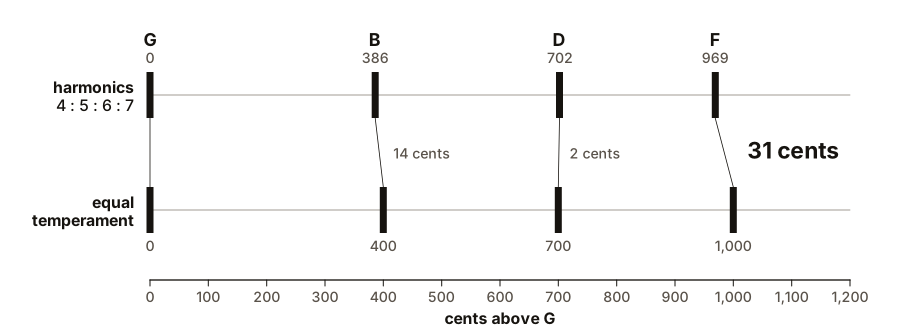
The dominant seventh deserves a closer look, because the harmonic series has a version of its own. Chapter 3 noticed that the 7th harmonic of C was “B flat, but noticeably low”, and promised it would come back in disguise. Here it is. Harmonics 4, 5, 6 and 7 of any note make a major triad with a seventh on top: on G, the notes G, B, D and a low F. That is a dominant seventh chord tuned by nature, in the ratio 4 : 5 : 6 : 7.
The 7th harmonic is 969 cents above the 4th; the keyboard’s minor seventh is 1,000. Nature’s seventh is about 31 cents flat of the piano’s, nearly a third of a half step, and no keyboard has a key for it. But the two are cousins, and the dominant seventh is the one chord with a dissonance in it that most listeners hear as full rather than harsh. Unaccompanied singers who hold a dominant seventh for a long time often drift its top note down toward the natural one.1
ON THE BENCH: Nature’s seventh chord
You need: four tone generators at once (an app that plays several tones, or four browser tabs), set to a sine or soft organ-like timbre.
Time: ten minutes. Hazards: keep the volume moderate; four steady tones add up.
Steps:
- Play 400, 500 and 600 Hz together: a major triad, 4:5:6. Add 700 Hz. That is the harmonic seventh chord, 4:5:6:7.
- Now play the equal-tempered version on the same bottom note: 400, 504, 599 and 713 Hz.
- Go back and forth between the two, listening especially to the top note.
What you should hear: the 4:5:6:7 chord is smooth, almost a single buzzing organ pipe. The tempered chord shimmers, with a sharper edge from the top note. Both are recognisably the same chord: one from the harmonic series, one from every piano.
SLOW DOWN. Check Your Understanding: On a monochord, you stop the string so that three lengths of it, in turn, are in the ratio 4 : 5 : 6, the numbers of the major triad. Play the three lengths together. What chord do you hear?
Answer: A minor chord. Frequency goes as one over length, so lengths of 4, 5 and 6 give frequencies of 1/4, 1/5 and 1/6, which, multiplied by 60, are 15, 12 and 10. That is the minor triad, 10:12:15, upside down. The same three numbers give major when they count frequencies and minor when they count lengths. The Venetian theorist Gioseffo Zarlino built his account of the two chords on exactly this pair of divisions in 1558, and it is why the minor triad is called the mirror of the major.2
From chords to motion
A chord on its own is a colour. Music is what happens between chords: why V wants to go to I, and why one progression sounds like a full stop and another like a question. The dominant seventh holds the restless tritone of Chapter 5, between B and F. What that tritone wants, and how a system of home, away and return grew from the wanting, is Chapter 21.
Source to pull before print: a published acoustical study of tuning in unaccompanied ensemble singing (barbershop quartets are the usual subject) for the drift of the seventh toward 7:4.↩︎
Gioseffo Zarlino, Le istitutioni harmoniche (Venice, 1558). Source to pull before print: the chapters on the harmonic and arithmetic division of the fifth, in a standard translation.↩︎
Bench Degree
Get the degree without the diploma.
Learn the material, not how to pass the exam.