Bench Degree·MUSICchapter
Chapter 19: The Bass Takes Charge
Somewhere in the decade around 1600, music grew a floor. For the next hundred and fifty years almost every ensemble in Europe stood on it.
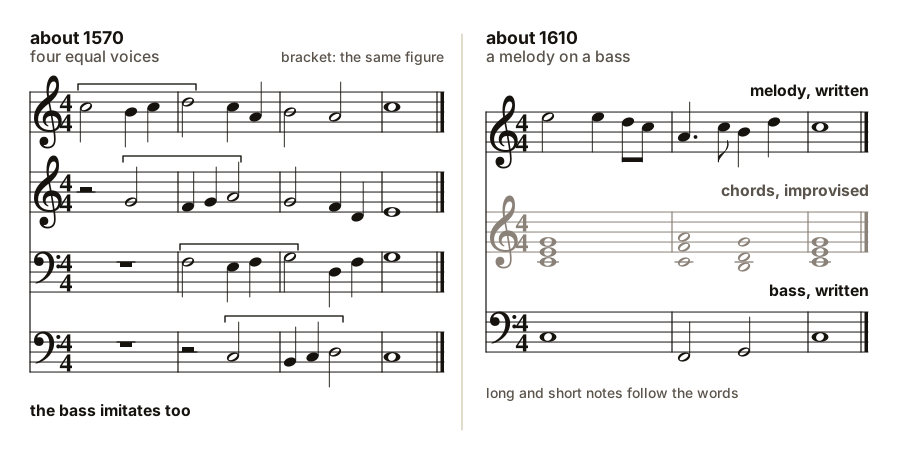
Put on a piece by Palestrina from the 1570s, then a piece by Corelli from the 1680s. Within ten seconds you can tell which is which, and you do not need to know anything about either composer. Listen under the melody. In the Corelli, a harpsichord or a small organ is playing chords, steadily, the whole time, while a cello plays the lowest line beneath it. In the Palestrina there is nothing of the kind: only voices, each with its own melody, none of them in charge.
That steady sound underneath has a name, the basso continuo, Italian for “continuous bass.” It arrived in Italy within a few years either side of 1600, it lasted until the second half of the eighteenth century, and it changed music from many equal voices into a melody standing on a bass.
Before the floor
In the counterpoint of Chapter 17, every voice is a melody. The lowest voice sings a tune like the others; it happens to be lowest, that is all. The chords you hear are the result of the lines meeting, moment by moment, checked against the rules. In 1570, harmony is what happens where melodies meet.
Organists had long helped choirs by playing along. In the later sixteenth century, in Venice and elsewhere, an organist accompanying a motet would often read a single line made by tracing whichever voice was lowest at each moment, and fill in chords above it by ear. That line was called the basso seguente, the “following bass,” because it followed the singers’ music.1 It was a convenience, not yet a new kind of music. The real change came from an argument about words.
The Florentines want the words back
In the 1570s and 1580s a group of musicians, poets and scholars met at the house of Count Giovanni de’ Bardi in Florence. Later writers called them the Camerata, from an Italian word for a circle of companions. They were trying to recover the power of ancient Greek drama, which they believed had been sung, and they had a complaint about the music of their own day. With four or five voices singing different words at different times, nobody could follow the text.
Vincenzo Galilei, a lutenist in the circle and the father of the astronomer Galileo, attacked polyphony in print in 1581 on exactly those grounds.2 What the group wanted instead was one singer delivering the words with the freedom and force of speech, supported by simple chords. They called that style monody, from the Greek for “singing alone.”
A free, speaking voice cannot be accompanied by four more independent melodies. Each of them has its own rhythm and its own demands, and the singer would be trapped among them. What a declaiming voice needs is support that can wait: a bass note and a chord, held while the singer stretches a word, changed when the singer moves on.
Three publications show it arriving. In 1600 Jacopo Peri’s opera Euridice was performed for a Medici wedding, and printed with its accompaniment written as a bass line with figures. The same year, in Rome, Emilio de’ Cavalieri’s sacred drama Rappresentatione di Anima et di Corpo was printed with numbers written over its bass to show the chords, one of the earliest figured basses in print. And Giulio Caccini, a singer in Bardi’s circle, published Le nuove musiche (The New Music), a book of solo songs over a figured bass, with a long preface on how they should be sung. It is usually dated 1602.3
The friar’s organ part
The church, meanwhile, had a more practical problem. A motet for five voices needs five good singers, and a small parish might have two. Organists filled the gaps as best they could.
In 1602 Lodovico Viadana, a Franciscan friar and choirmaster, published in Venice a collection of church pieces called Cento concerti ecclesiastici (A Hundred Church Concertos), for one to four voices with organ. The organ part was a single bass line, written to be played from start to finish, under every bar. A preface told the organist how to play from it.4 Viadana wrote for small forces from the start, so nothing was missing. The bass was no longer a tracing of the singers. It was a part in its own right, and the chords above it were the organist’s to supply.
Five years later, in 1607, Agostino Agazzari published a short treatise on playing over a bass, Del sonare sopra ’l basso. He sorted instruments into two kinds: those that serve as the foundation, holding up the harmony, and those that serve as ornament, decorating it.5 The foundation was now a category. Music had a floor.
Monteverdi takes sides
The great composer of the change was Claudio Monteverdi, choirmaster to the Duke of Mantua. In 1600 the theorist Giovanni Maria Artusi attacked passages from Monteverdi’s madrigals, without naming him, for dissonances that broke the rules of counterpoint. Monteverdi’s answer came in the preface to his Fifth Book of Madrigals in 1605, and was spelled out by his brother two years later. There were now two practices, he said. In the first practice, the old polyphony, the music governs the words. In the second practice, the seconda pratica, the words govern the music, and a dissonance is justified if the text demands it.6 The last pieces in that Fifth Book need a continuo; they cannot be sung without it.
In 1607 his opera Orfeo was performed at Mantua. When it was printed in 1609 the score opened with a list of the instruments, and among them were two harpsichords, two large lutes and two small wooden organs, the continuo of a court orchestra.7
So the dates are tight. Before about 1590, no true continuo. By about 1610, it is normal in Italy, and within a generation it had spread across Europe. If you hear a continuo, the music was written after about 1600.
IN PLAIN ENGLISH: Around 1600, Italian musicians wanted to hear the words of a song clearly, sung by one voice. Four other melodies around it got in the way, so they replaced them with a bass line and simple chords that could wait for the singer. Church musicians found the same arrangement useful for small choirs. Within twenty years, almost all music was written as a tune on top of a bass, with chords between.
Reading the figures
The continuo part was a bass line with small numbers written under or over the notes. Those numbers are the figures, and the whole system is figured bass. Each number names an interval above the bass note, counted by note names as in Chapter 4, within the key signature. The player chose which octave to put those notes in, and how to move from one chord to the next.
The rules fit on a card:
- No figure: play a third and a fifth above the bass.
Under C, that is E and
- 6: a sixth and a third. Under E, that is G and C: the same three note names as the C chord, with E on the bottom. Chapter 20 explains why that counts as the same chord.
- 6 over 4: a sixth and a fourth.
- 7: add a seventh to the third and fifth.
- 4 then 3: a fourth that falls to a third. This is the suspension of Chapter 17, written in two digits.
- A sharp or flat alone: raise or lower the third. A sharp beside a number raises that note.
Figured bass was a shorthand for experts. The composer fixed the bass and the harmony, and left the exact notes to the player. Two good players, reading the same part, would play different notes, and both would be right. A continuo player did all of this at sight, at speed, in any key, and most added small runs and ornaments when the music allowed. It was the basic professional skill of a keyboard player for a century and a half, much as reading a lead sheet of chord names is for a jazz or church pianist now.
ON THE BENCH: Realise a figured bass
You need: a free online keyboard, or any keyboard.
Cost: nothing.
Time: thirty minutes.
Hazards: none, except to your pride.
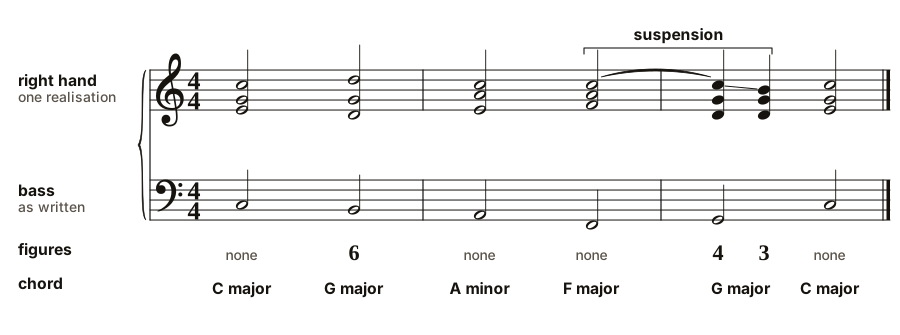
Steps: play this bass with the left hand, one note at a time, starting on the C below middle C and stepping down to the nearest B, A and F, then up to G and C: C, B (6), A, F, G (4 then 3), C. With the right hand, play three notes above each bass note, chosen from the figures.
- First, play the chords anywhere that is comfortable, jumping as you like. Under C: E, G, C. Under B with 6: D, G and another G or D. Under A: C, E, A. Under F: A, C, F. Under G: C and D, then B and D, with a G on top or between. Under the last C: E, G, C.
- Now play it again, but this time keep any note the next chord shares, and move the others to the nearest note available. Start with E, G and C above middle C and let each hand move as little as possible.
- Play the version in the figure above, and compare.
What you should find: the first version works, but sounds like a stack of blocks. The second suddenly sounds like music, because each finger of your right hand has become a small melody moving by step. You have rediscovered the first rule of continuo playing: keep common notes, move the rest the shortest way. The G with 4 then 3 should ache for a moment and then settle. That is a suspension, played from a single digit.
The continuo band
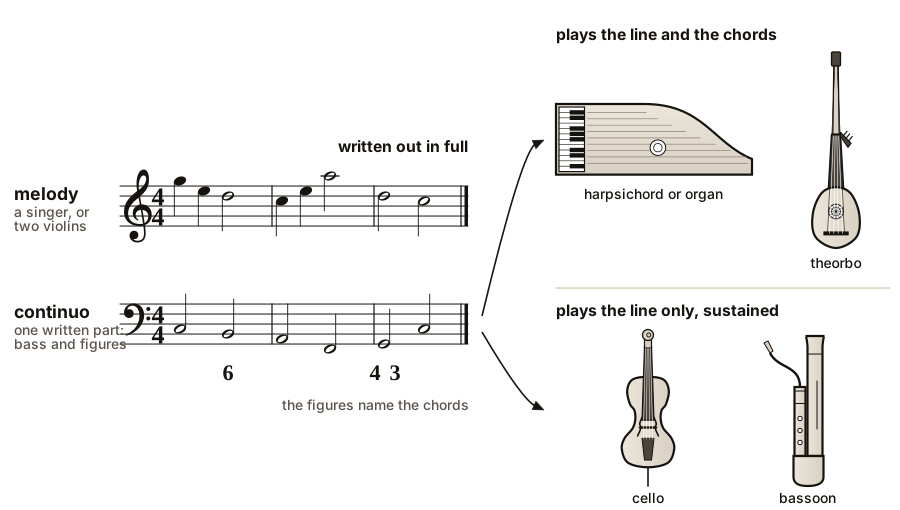
The figures said nothing about which instruments should play them, and in practice the continuo was usually two players reading one line.
One played the line itself, with a sustained, singing bass: a cello, a bass viol, a bassoon, or a larger bass instrument such as the violone. The other played the line and the chords: a harpsichord, an organ, a lute, or a theorbo, a lute with an extra-long neck carrying a set of low open strings. A theorbo is often 1.7 to 1.9 m (5.5 to 6.2 ft) long, as tall as the player.
These were chosen for what they could do. A harpsichord, organ or lute can play many notes at once, so it can supply the chord. But a harpsichord or lute string is plucked, and its sound dies away within a second or two. A cello or bassoon plays one note at a time, and holds it: it can sustain the bass and shape it, swelling or falling away. Together they gave the music a floor that was both full and firm. In church the organ was the usual choice; in the opera house and the drawing room, the harpsichord.
What the floor changed
The continuo did more than add a keyboard. It reorganised music from the bottom up.
The bass became the foundation. In Palestrina, change the lowest voice and you change one melody. In Corelli, change the bass note under the same upper notes and you change the chord. Composers began to think in chords, and to ask which chord should follow which.
The texture became a melody over a bass. The top line sang; the bass moved; the middle was filled in by whoever held the continuo part. The equal voices of Chapters 17 and 18 survived in fugues and in church counterpoint, but they were now the special case.
The beat became steady. An ensemble standing on one bass line has to agree on when the chord changes. The bar line of Chapter 15 spread through the same decades.
The bass could repeat. Once the bass held the harmony, a short bass line could be played over and over, while the parts above changed each time. This is a ground bass. Pachelbel’s Canon, three violins in canon over a bass of eight notes that repeats from the first bar to the last, joins the subject of Chapter 18 to this one.
ON THE BENCH: Find the continuo
You need: recordings of a trio sonata by Corelli (any from his Opus 3, Rome, 1689, a set of church sonatas) and the opening chorus or an aria from a Bach cantata, such as Wachet auf (BWV 140, 1731). For contrast, a Palestrina mass movement or a Victoria motet from Chapter 17.
Cost: nothing.
Time: twenty minutes.
Hazards: none.
Steps:
- Play the Corelli. Ignore the two violins. Listen below them for two sounds: a low, sustained line (cello or violone), and a plucked or piped sound filling in chords (harpsichord or organ).
- Count how often the chord changes. Tap it.
- Play the Bach. In a recitative, the speech-like passages between the arias, the continuo is the only thing under the singer, and easy to hear. In a chorus it is buried, but when the choir stops it is still there.
- Play the Palestrina or Victoria. Listen for the same two sounds.
What you should hear: in the Corelli and the Bach, a floor that never stops, and the chord changing on a regular beat. In the Palestrina or Victoria, no floor at all, unless the performers have added an organ. Some recordings do, following later practice, so if you hear one, it was the performers’ choice.
SLOW DOWN. Check Your Understanding: A trio sonata by Corelli is for two violins and continuo. How many players does it usually take, and why is it called a trio?
Answer: Usually four: two violins, a cello or violone, and a keyboard or theorbo. It is a trio because the composer wrote three parts: two violin lines and one bass. The continuo is one written part that two players share, and the keyboard’s chords were never written at all. The name counts the composer’s lines, and the floor was not one of them. That is the whole continuo idea in a word: the harmony was there in every bar, and it was nobody’s written melody.
When the floor came up
The continuo faded between about 1750 and 1790. Composers began writing the inner parts out in full for the orchestra, and the keyboard’s improvised chords were no longer needed. Many of Haydn’s early symphonies were probably played with a harpsichord in the band; his late London symphonies need none. The presence of a continuo is one of the clearest dividing lines between Baroque and Classical music, and it marks a beginning as sharp as its end: a few years either side of 1600, in Florence, Rome, Venice and Mantua.
The figures under the bass name intervals: a third and a fifth, a sixth and a third. But why do those particular stacks of notes count as chords, and why does a 6 under E give the same chord as no figure under C? That is Chapter 20.
Source to pull before print: a standard reference (for example, the Grove article “Continuo”) on the basso seguente in Venetian practice before 1600.↩︎
Vincenzo Galilei, Dialogo della musica antica, et della moderna (Florence, 1581). Source to pull before print: the relevant passages in a standard translation.↩︎
Source to pull before print: the title pages and prefaces of Peri, Le musiche sopra l’Euridice (Florence, 1600 or 1601); Cavalieri, Rappresentatione di Anima et di Corpo (Rome, 1600); and Caccini, Le nuove musiche (Florence), whose print bears the date 1601 but which is generally dated 1602.↩︎
Lodovico Viadana, Cento concerti ecclesiastici (Venice, 1602). Source to pull before print: the preface’s instructions to the organist, in a standard translation.↩︎
Agostino Agazzari, Del sonare sopra ’l basso con tutti li stromenti (Siena, 1607). Source to pull before print: the passage dividing instruments into fondamento and ornamento.↩︎
Giovanni Maria Artusi, L’Artusi, overo Delle imperfettioni della moderna musica (Venice, 1600); Claudio Monteverdi, Il quinto libro de madrigali (Venice, 1605); Giulio Cesare Monteverdi’s explanation in Claudio Monteverdi, Scherzi musicali (Venice, 1607). Source to pull before print: all three, in a standard translation.↩︎
Claudio Monteverdi, L’Orfeo, favola in musica (Venice, 1609). Source to pull before print: the instrument list on the opening pages.↩︎
Bench Degree
Get the degree without the diploma.
Learn the material, not how to pass the exam.