Bench Degree·MUSICchapter
Chapter 18: Imitation, Canon and Fugue
A king handed Bach a melody and asked for a fugue on the spot. Bach played one, and two months later sent the king a book of musical puzzles built from the same tune.
In May 1747 Johann Sebastian Bach, then sixty-two, visited the court of King Frederick the Great of Prussia at Potsdam. The king, a keen flautist, sat down at one of his new fortepianos, played Bach a theme of his own, and asked him to improvise a fugue on it. Bach did, in three voices, there and then. The king then asked for a fugue in six voices. By the earliest account, Bach answered that not every theme would bear six voices, improvised one on a theme of his own, and promised to work out the royal theme properly on paper. He went home to Leipzig and did.1
That summer he sent the king a printed collection built entirely on the royal theme: a three-voice fugue, a six-voice fugue, a trio sonata, and ten canons, some of them written as riddles for the reader to solve. He called it Musikalisches Opfer, the Musical Offering.2 To understand what was in it, start with something every child can sing.
The round
Chapter 15 asked you to sing “Row, Row, Row Your Boat” as a round. Take any round, “Frère Jacques” will do, and look at what is happening.
One voice starts the tune. Two bars in, a second voice starts the same tune from the beginning. Then a third, then a fourth. Every singer sings the same melody, but because they start at different times, at any moment they are singing different parts of it. When a singer reaches the end, they go back to the start, and the round can turn forever.
That is imitation at its strictest. A melody that is imitated exactly, by every voice, at a fixed distance in time, is a canon, from the Greek for “rule”: the first voice sets the rule, and the others obey it. A round is a canon in which every voice sings at the same pitch and loops back to the beginning.
The oldest round that survives in writing is English. Sumer is icumen in (“Summer has come in”) was copied in the thirteenth century, a four-voice canon over two lower voices repeating a short figure of their own.3 Its singers were doing what a school class does with “Frère Jacques,” seven centuries earlier.
ON THE BENCH: Sing a round, and listen from inside it
You need: two to four friends, and a round everyone knows (“Frère Jacques” or “Row, Row, Row Your Boat”). A phone metronome helps.
Cost: nothing.
Time: fifteen minutes.
Hazards: none.
Steps:
- Set the metronome to about 100 beats per minute. Everyone sings the tune together once, in unison, so the pitch and the speed are agreed.
- Sing it as a round in two voices: the second singer starts when the first has sung two bars (in “Frère Jacques”, as the first singer reaches the third line). Go round three times.
- Add a third voice, then a fourth, each starting two bars after the last.
- Now sing it once more, and while you sing your own part, listen to the voice that is two bars behind you.
What you should hear: at every moment, the parts fit, though each of you is singing something different. Step 4 is harder than it sounds. Most people find they can sing their own line or hear another, but holding both takes practice. That difficulty is the listening skill this chapter is training.
Why a round fits
A round is a small miracle of planning. Every two-bar section of the tune has to sound right against every other, because in a four-voice round all four sound at once.
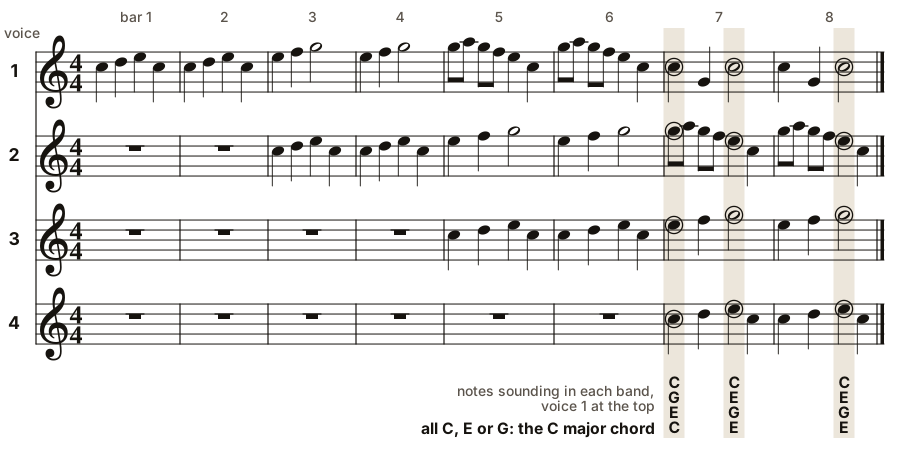
The trick, in “Frère Jacques” and nearly every round a child learns, is that every section outlines the same chord. Look at the notes of each section in C and you find C, E and G, decorated by passing notes. Stack any section on any other and the strong beats land on notes of that one chord. A round fits because its harmony never moves. That is also its limit. A round can turn forever because it never goes anywhere.
Composers wanted canons that went somewhere. They found three freedoms.
The follower can enter at a different pitch: an octave lower (a canon at the octave), a fifth higher (at the fifth), or any other interval. The follower can play the melody upside down, rising wherever the leader falls by the same interval: a canon by inversion. And the follower can play the melody in longer or shorter notes, twice as slow or twice as fast: a canon by augmentation or diminution.
Each of these makes the canon harder to write and more interesting to hear. And none of them requires the harmony to stand still.
ON THE BENCH: Write a two-voice canon at the octave
You need: the free notation program MuseScore, or staff paper and a free online keyboard to check by ear.
Cost: nothing.
Time: forty-five minutes.
Hazards: none, though it is habit-forming.
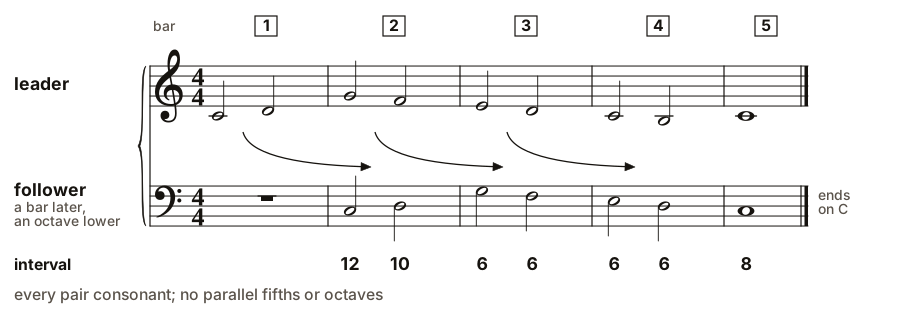
Steps: make a two-staff score in C major, 4/4 time, upper staff in treble clef, lower in bass clef. Write in half notes throughout. The method is called the chain, and it works one bar at a time.
- Write the leader’s first bar on the upper staff. Try C, D, starting on middle C.
- Copy that bar into the lower staff one bar later, an octave lower. The follower now has bar 2 filled in.
- Write the leader’s bar 2 so that it sounds right against what the follower is playing there. Use the rules of Chapter 17: consonances on every note, no parallel fifths or octaves, contrary motion where you can.
- Copy the leader’s new bar into the follower, one bar later, an octave down. Now the follower has bar 3, and you must write the leader’s bar 3 against it.
- Repeat for four bars. In the last bar let the follower break the rule and end on the tonic, under the leader’s final note.
What you should find: each bar you write is immediately a problem for the next, because it will be played again under the bar after it. One sample: leader C D, G F, E D, C B, C; follower, starting a bar later and an octave down, C D, G F, E D, then a final C. Play both. The result is a tiny piece of strict canon, and you will feel why Bach’s canons were admired: the composer’s choices are being made two bars at once.
Bach’s riddles
Now return to Potsdam.
Several of the canons in the Musical Offering are puzzle canons. Bach wrote out only one line, the leader, with a cryptic Latin hint, and left the reader to discover where the follower enters, at what pitch, and in what form. Above one he wrote Quaerendo invenietis: “seek, and you shall find.”
One canon rises. Each time it goes round it has moved up a whole step into a new key, so that after six circuits it arrives back in its starting key an octave higher. Bach’s inscription wished the king’s glory to rise with the modulation. Played in a loop, it climbs and climbs and seems never to arrive anywhere new.
And one is a crab canon. Bach wrote a single line of melody. One player reads it forwards, from left to right. The other reads the same line backwards, from the last note to the first, at the same time. A crab was believed to walk backwards, hence the name; the Latin is cancrizans. Both players play the same notes, one in reverse, and the two lines make good counterpoint against each other from the first bar to the last. Halfway through, the two players pass each other in the middle of the line, and from there each plays what the other has just played, reversed.
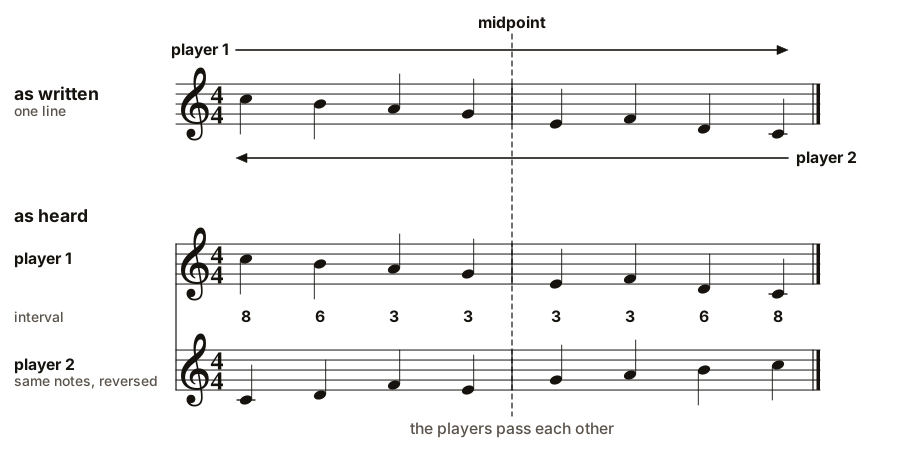
IN PLAIN ENGLISH: A canon is one melody chasing itself. A puzzle canon gives you only the melody and a hint, and you must work out how the chase goes. A crab canon is a melody played forwards and backwards at once, and it sounds good both ways.
The book that made the crab famous
In 1979 the American cognitive scientist Douglas Hofstadter published Gödel, Escher, Bach: an Eternal Golden Braid, a long and playful book about how meaning and self-awareness can arise from systems of rules. It won the Pulitzer Prize for general non-fiction in 1980.4
Hofstadter took Bach’s canons as one of his three models, alongside the mathematician Kurt Gödel’s proof about the limits of logic and the artist M. C. Escher’s impossible drawings. All three, he argued, show the same thing: a system that refers back to itself. The ever-rising canon was his picture of a strange loop, a sequence of steps that climbs and climbs and lands where it began. Between his chapters he wrote dialogues modelled on Bach’s musical forms, and one of them is itself a crab canon: its lines run in one order to the middle, then in the reverse order to the end.
For a generation of readers, many of them programmers and mathematicians, this was the first time anyone had told them that a three-hundred-year-old piece of music could be a logical puzzle. Bach would not have been surprised.
The fugue
A canon is strict. Every note of the follower is fixed by the leader. A fugue keeps the chase and drops the strictness: the voices imitate one theme, but only at its entry, and then go their own ways.
The word is Italian for “flight,” the voices fleeing one another. Fugues grew out of the imitative motets of Chapter 17 and the instrumental pieces modelled on them, and by Bach’s time the form had a vocabulary worth learning.
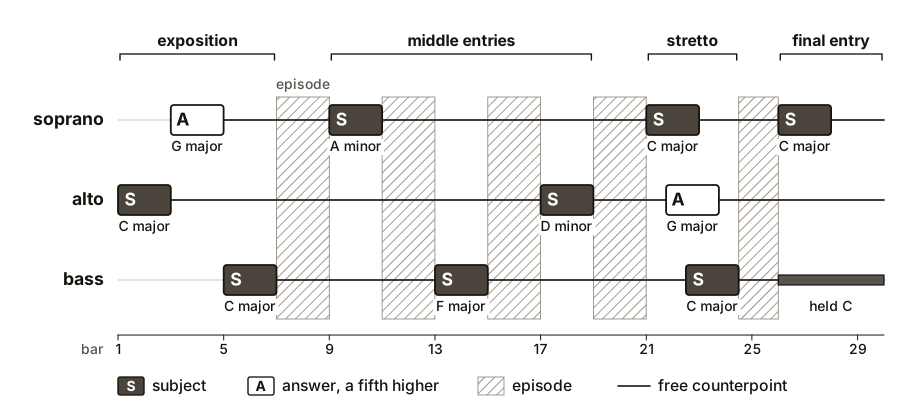
Subject. The theme. One voice states it alone at the start, usually in two to four bars, in the home key.
Answer. The second voice enters with the subject transposed up a fifth (or down a fourth), so it sounds in the key a fifth above the tonic. Sometimes one or two notes are altered so the answer stays in the home key’s orbit; that is a tonal answer. An exact transposition is a real answer.
Countersubject. While the second voice plays the answer, the first voice goes on with a new line against it. If that line comes back each time the subject does, it is a countersubject.
Exposition. The opening section, ending when every voice has entered once, alternately on subject and answer. In a three-voice fugue: subject, answer, subject.
Episode. A passage without the whole subject, usually built from a scrap of it repeated at rising or falling pitches. Episodes give the ear a rest and carry the music into a new key.
Middle entries. The subject returns, in new keys, separated by episodes.
Stretto. From the Italian for “tight.” The voices enter so close together that each begins the subject before the one before it has finished, like a round with the gaps squeezed. Composers save stretto for late in a fugue, as a climax.
The end. The subject comes back in the home key, often over a held bass note.
A fugue is a texture with a plan, not a fixed shape. No two of Bach’s are laid out alike. What they share is the opening exposition, the alternation of entries and episodes, and a final return home.
ON THE BENCH: Hunt the subject in a Bach fugue
You need: a recording of the Fugue in C minor from Book I of the Well-Tempered Clavier (BWV 847), on harpsichord if you can find one. A free public-domain score is useful but not necessary.
Cost: nothing.
Time: twenty minutes.
Hazards: none.
Steps:
- Play the first ten seconds several times, until you can hum the subject. It is short, quick and restless, and it begins in the middle register alone.
- Play the whole fugue, under two minutes, and tap the table every time you hear the subject begin, in any voice.
- Play it again and note which voice has each entry: high, middle or low.
- A third time, listen for the stretches with no complete subject. Those are the episodes.
What you should find: three entries close together at the start, middle, high, then low: the exposition of a three-voice fugue. Then entries spaced out with episodes between them, often in keys that sound brighter or darker than the opening. Expect to miss some the first time, especially in the middle voice, which the ear hears least well. If a score is to hand, mark your taps on it and count how many you caught.
SLOW DOWN. Check Your Understanding: Why does a fugue answer at the fifth, rather than repeat the subject at the same pitch the way a round does?
Answer: A round can enter at the same pitch only because its harmony never moves. A fugue subject usually moves from the tonic toward other notes of the key, and an answer a fifth up is the closest relative it has: the two keys share six of their seven notes, as the circle of fifths showed in Chapter 12. The answer sounds new but still at home. It also puts the voices in different registers, so the ear can tell them apart, and it sets up the first move away from home that the episodes will develop. The fifth answer is where a fugue’s journey begins.
Equal voices
Look back over the chapter and notice one thing that every round, canon and fugue shares. Every voice is equal. The bass in a fugue carries the subject exactly as the soprano does, and none of them is in charge.
That is the world of Chapter 17, carried as far as it would go. Yet by the time Bach wrote his fugues it was already an old-fashioned world. Almost all the other music of his life, his cantatas, his concertos, his Passions, stood on a different foundation: a bass line played without stopping by a keyboard filling in chords, with a melody above it. The voices were no longer equal. The bass had taken charge. When that happened, and why, is Chapter 19.
Johann Nikolaus Forkel, Über Johann Sebastian Bachs Leben, Kunst und Kunstwerke (Leipzig, 1802), chapter 2. Source to pull before print: the passage, in a standard translation.↩︎
Source to pull before print: the 1747 print of the Musical Offering (BWV 1079), with its dedication to Frederick dated July 1747, and the newspaper report of the Potsdam visit.↩︎
Source to pull before print: British Library, Harley MS 978, and a standard account of the disputed date of Sumer is icumen in, usually placed between about 1240 and 1310.↩︎
Douglas R. Hofstadter, Gödel, Escher, Bach: an Eternal Golden Braid (New York: Basic Books, 1979).↩︎

Bench Degree
Get the degree without the diploma.
Learn the material, not how to pass the exam.