Bench Degree·MUSICchapter
Chapter 17: Counterpoint You Can Hear
Six singers, six complete melodies, one sound. The rules that make it work are rules about what the ear notices.
In 1605 Tomás Luis de Victoria, a Spanish priest who had spent most of his life in Rome, published a Requiem for six voices, written for the funeral of the Empress Maria, whom he had served as chaplain.1 Listen to it and you hear six singers each singing a long, unbroken melody of their own, each one complete and beautiful alone, and all six together making a sound as smooth and inevitable as water finding its level.
That is counterpoint: the art of writing several independent melodies that sound right together. The word comes from the Latin punctus contra punctum, “note against note.” The Renaissance was its golden age, and its rules, once you strip them down, are rules about what the ear notices.
Independent and together
Chapter 16 ended with voices that had become free. Freedom created a problem. Two melodies, each fine alone, can sound terrible together, and two melodies that fit perfectly can be dull. Counterpoint asks for both at once: each line must make sense as a melody, and the lines must make sense together.
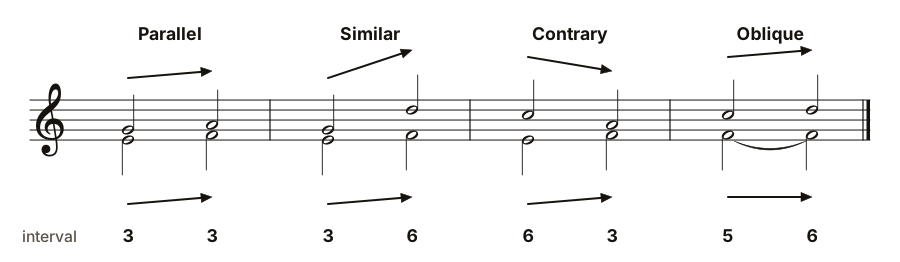
Four kinds of motion between two voices are possible, and they are worth knowing by name:
- Parallel motion: both voices move the same way by the same interval.
- Similar motion: both move the same way, by different intervals.
- Contrary motion: one goes up while the other goes down.
- Oblique motion: one moves while the other stays still.
The rules, reduced to what the ear hears
The teachers of counterpoint wrote many rules. Almost all of them come down to four observations about listening.
1. Parallel fifths and octaves make two voices sound like one. If two voices move in parallel octaves or fifths, the ear fuses them, as you heard in the parallel organum of Chapter 16. The two melodies stop being independent. So counterpoint avoids moving from one perfect fifth to another, or one octave to another, in parallel. This is the most famous rule in music theory, and it is not arbitrary: it protects independence.
2. Contrary motion keeps voices distinct. When one voice rises while another falls, the ear easily hears two lines. Good counterpoint uses a great deal of it.
3. Dissonance must be handled. A dissonance on a weak beat, passing between two consonances, is heard as motion. A dissonance on a strong beat must be prepared (the dissonant note sounds first as a consonance, then the other voice moves against it) and resolved (the dissonant note then moves down by step to a consonance). The prepared and resolved dissonance is called a suspension, and it is the expressive heart of Renaissance polyphony: a held note that suddenly aches, and then gives way.
4. Each line should sing. Mostly stepwise motion, a few leaps, a leap usually followed by a step back the other way, a clear high point, a sensible range. These rules make each part pleasant to sing and easy to hear as a melody.
IN PLAIN ENGLISH: Counterpoint keeps several melodies independent by avoiding parallel fifths and octaves and by moving voices in opposite directions. It lets dissonances pass on weak beats, and on strong beats prepares them and resolves them downward. Each voice has to be a good melody on its own.
Species: learning one step at a time
In 1725 the Austrian composer Johann Joseph Fux published a textbook in Latin called Gradus ad Parnassum, Steps to Parnassus, written as a dialogue between a teacher and a pupil.2 Fux taught counterpoint in five species, each adding one difficulty to a given melody, the cantus firmus:
- First species: one note against one note, all consonant.
- Second species: two notes against one; the second may pass as a dissonance.
- Third species: four notes against one.
- Fourth species: syncopated notes, producing suspensions.
- Fifth species: free mixtures of the others.
Haydn, Mozart and Beethoven all studied from Fux, and his method is still taught.
ON THE BENCH: Write first-species counterpoint
You need: the free notation program MuseScore, or paper with a staff and a keyboard to check your work.
Time: thirty minutes. Hazards: none.
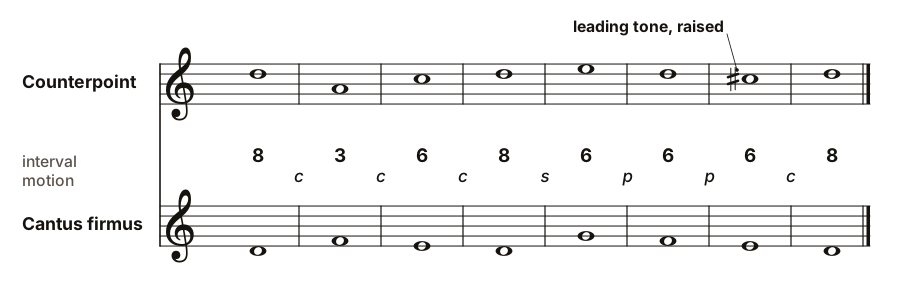
Steps: take this eight-note cantus firmus, in whole notes: D, F, E, D, G, F, E, D. Above it, write one note against each, following these rules:
- Start on a unison, octave or fifth above the first D; end on an octave or unison with the last D, approached by step.
- Every pair of notes must be a consonance: unison, third, fifth, sixth or octave (no seconds, fourths or sevenths).
- Never move into a fifth or an octave by parallel motion.
- Prefer contrary motion; prefer steps to leaps.
Play the two voices together.
What you should find: a two-voice line that sounds calm and old, like the opening of a Renaissance motet. If it sounds hollow somewhere, look for parallel fifths. If it sounds static, look for too much oblique or similar motion. A sample solution is in Appendix A.
Palestrina and Victoria
The style Fux taught was modelled on one composer above all: Giovanni Pierluigi da Palestrina, who worked in Rome in the second half of the sixteenth century. Palestrina’s music became the model of “pure” church counterpoint, so smooth and balanced that later teachers took it as the standard.
Victoria, who was in Rome in the same decades and may have studied with Palestrina, wrote in a closely related style. But many listeners hear in him a greater intensity: sharper suspensions, darker harmonies, a more dramatic use of the words.3 He published almost nothing but sacred music, and he set the texts of Holy Week and the Office for the Dead with a gravity that has rarely been matched. If any music is the summit of the vocal polyphony this chapter describes, many listeners would point to his.
ON THE BENCH: Listen for suspensions
Find a recording of Victoria’s Requiem of 1605 or his O magnum mysterium. Listen to one voice at a time if the recording is clear enough, then to the whole. Wherever the music seems to ache for a moment and then relax, you are almost certainly hearing a suspension: one voice holding a note while another moves against it, and then stepping down to resolve.
Imitation
Renaissance composers had one more technique for binding voices together, and it became the most important of all. One voice begins a short melody; a moment later a second voice enters with the same melody, at the same pitch or a fifth away; then a third, and a fourth. The voices chase one another through the texture.
That is imitation. Taken to its strictest form, it becomes a canon. Taken to its most elaborate, it becomes the fugue. Both are Chapter 18.
Source to pull before print: a standard reference on Victoria’s Officium defunctorum (Madrid, 1605).↩︎
Johann Joseph Fux, Gradus ad Parnassum (Vienna, 1725). Source to pull before print: Alfred Mann’s English translation, The Study of Counterpoint.↩︎
Source to pull before print: a standard reference on Victoria and his relation to Palestrina’s circle.↩︎

Bench Degree
Get the degree without the diploma.
Learn the material, not how to pass the exam.