Bench Degree·MUSICchapter
Chapter 16: The Invention of Simultaneity
At Christmas in 1198 four voices sang four different melodies at once in a Paris cathedral. Nothing like it had been heard before.
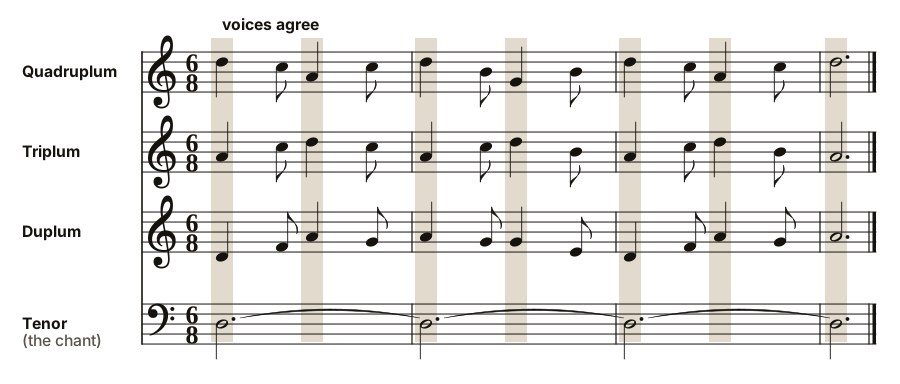
At Christmas in 1198, in the new cathedral of Notre-Dame in Paris, the choir sang a setting of the chant Viderunt omnes in four voices. Below, a few singers held each syllable of the old chant on long, unmoving notes, sometimes for a minute or more. Above them, three more voices wove around one another in quick, interlocking rhythms, all at once.1
Nothing like it had been heard before. Four separate melodies, sounding together, held in order by a clock and a set of rules. Two centuries earlier, Western music had been one line. This chapter is about how the second line arrived.
The first second voice: parallel organum
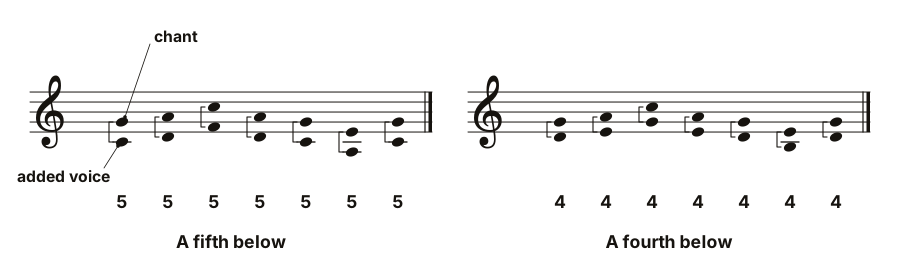
The oldest surviving description of music in two voices is a ninth-century handbook called Musica enchiriadis.2 It describes organum: a chant sung together with a copy of itself, a fourth or a fifth below. Both voices move together, step for step, always the same distance apart.
ON THE BENCH: Sing parallel organum
You need: a keyboard and a friend, or a keyboard and a recording app.
Time: ten minutes. Hazards: none.
Steps: play or sing a simple melody, such as the first line of any hymn you know. Then have a friend sing (or record yourself singing) the same melody starting a fifth lower, moving exactly in parallel. Play both together.
What you should hear: a hollow, solemn, ancient sound, like two voices in a stone church. It is the oldest written harmony in Western music, and it uses only the perfect intervals of Chapter 5.
Parallel organum used fifths and fourths because, to medieval ears, those were the consonances. Thirds were not yet accepted as stable.
Free organum: the voices separate
Within two centuries the added voice began to move on its own. Sometimes it moved in parallel; sometimes it stood still while the chant moved; sometimes it moved the opposite way. Early in the eleventh century a collection of English polyphony, the Winchester Troper, recorded more than a hundred and fifty pieces of this kind.3 By the twelfth century, in the monasteries of southern France, the new voice had grown so free that it sang long, flowing melodies of many notes over each single note of the chant.
IN PLAIN ENGLISH: The first added voice copied the chant a fifth or fourth lower. Over two centuries it gained its own direction: sometimes still, sometimes moving against the chant. That independence is the start of polyphony, music of several melodies at once.
Notre-Dame: Léonin and Pérotin
In Paris in the late twelfth century, two composers at Notre-Dame turned this into a system. We know their names from an English student who wrote about them nearly a century later, and who is known to scholars only as Anonymous IV. He called Léonin the best composer of organum, and Pérotin the best composer of a newer, more rhythmic kind of part-writing called discant.4
Léonin’s organum, in two voices, held the chant in long notes at the bottom, called the tenor, from the Latin for “to hold.” Above it, a solo voice sang elaborate melodies. Pérotin added a third voice, and in his greatest works a fourth, all three upper voices moving in the rhythmic modes of Chapter 15 and fitting together over the held chant.
The name tenor has survived for eight hundred years. In the Middle Ages it meant the voice that held the chant. Today it means a high male voice, because that is the range the chant-holding voice usually occupied.
The rule that held it together
Four independent voices could easily clash. The Notre-Dame composers kept them in order with one simple rule, which every later style kept in some form: at the important moments, the voices must agree. At the start of each rhythmic pattern, and at every cadence, the voices met on a consonance: an octave, a fifth or a fourth against the tenor. Between those points, the upper voices could pass through dissonances freely, as long as they arrived together at the next point of agreement.
SLOW DOWN. Check Your Understanding: Why could the Notre-Dame singers allow dissonances between the strong points but not on them?
Answer: Because the ear judges a passage by where it arrives. Dissonances on weak, passing moments are heard as motion; a consonance on the strong beat is heard as arrival. That idea, dissonance in motion and consonance at rest, is the core of counterpoint, and of harmony after it.
ON THE BENCH: Organum on one guitar
You need: a guitar. Time: ten minutes. Hazards: none.
Steps: the D and G strings of a guitar are tuned a perfect fourth apart. Play a simple melody on the G string, and at the same time play exactly the same frets on the D string below it.
What you should hear: the melody doubled a fourth below, moving in strict parallel: parallel organum, as described in the ninth century. Then try letting the lower voice hold one note while the upper voice moves, and return to the parallel line at the end of the phrase. You have just written free organum.
Thirds come in
Over the next two centuries, the sweet thirds and sixths that Pythagorean theory had called imperfect slowly entered polyphony. English composers used them freely first; a fifteenth-century French poet described English music as having a “contenance angloise,” an English manner, that charmed continental ears.5 By the mid-fifteenth century, chords built on thirds were the normal sound of polyphony, and the tuning arguments of Chapter 9 were about to begin.
Two voices had become three, then four, and the voices had become free. What remained was to learn how to write many free voices so that every one of them was a beautiful melody in its own right, and all of them fitted. That craft is called counterpoint, and its greatest masters, Palestrina and Victoria among them, are Chapter 17.
Source to pull before print: Bishop Odo of Sully’s decrees of 1198 and 1199 on the performance of four-voice organum at Christmas and on St Stephen’s Day, and the attribution of Viderunt omnes to Pérotin.↩︎
Musica enchiriadis (ninth century). Source to pull before print: a standard translation of the passages on organum.↩︎
Source to pull before print: a standard reference on the Winchester Troper (about 1000 to 1050).↩︎
Anonymous IV, treatise (about 1280). Source to pull before print: a standard translation and the modern dating of Léonin and Pérotin.↩︎
Martin le Franc, Le Champion des dames (about 1440). Source to pull before print: the passage and a standard discussion of the “contenance angloise” and John Dunstable.↩︎
Bench Degree
Get the degree without the diploma.
Learn the material, not how to pass the exam.