Bench Degree·MUSICchapter
Chapter 15: Measuring Time
The C at the start of a piece in four-four time is not for common. It is half of a medieval circle.
The large C at the start of a piece in 4/4 time does not stand for “common.” That was a later explanation. It is half of a circle.
In the fourteenth century a full circle at the start of a piece told singers to divide each beat into three: triple time, which theologians of music called “perfect,” after the Trinity. A broken circle, a C, meant dividing into two: “imperfect” time. Seven hundred years later, every 4/4 piece printed with that C is still carrying the medieval sign for “not perfect.”
This chapter tells how music got its clock: from chant with no time, through three centuries of ingenious systems, to the bar line.
Rhythm from patterns: Notre-Dame, about 1200
The first written rhythm in Western music came from the cathedral of Notre-Dame in Paris, in the decades around 1200. Its singers were adding new voices above chant (Chapter 16 tells that story), and the new voices moved in lively, dance-like rhythms.
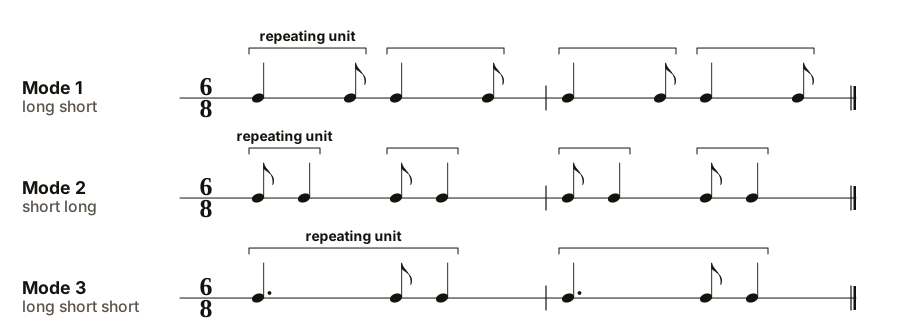
To write those rhythms, the Notre-Dame composers used the same note shapes as chant but grouped them in patterns called rhythmic modes. Each mode was a repeating pattern of long and short values: long-short, long-short; or short-long; or long-long-long. A singer recognised the mode from the way the notes were grouped on the page, and sang the pattern.1 All six modes were built on threes.
A shape for every length: Franco, about 1260
Around 1260 a theorist known as Franco of Cologne set out a new principle in a treatise called Ars cantus mensurabilis, The Art of Measurable Song: the shape of each note shows its length.2 A square note with a tail on the right was a long. A plain square was a breve, a short. A diamond was a semibreve, shorter still.
That is the ancestor of the note-value tree of Chapter 14. The names have survived in Britain: the “semibreve” is the whole note, once the shortest of the short. Over the centuries, as composers wrote faster and faster notes, the old short values became the long ones.
IN PLAIN ENGLISH: The first written rhythms, around 1200, came from recognising repeating patterns. Around 1260, each note shape was given its own length, the principle written music still uses.
Twos and threes: the Ars Nova, about 1320
Franco’s system counted in threes: a long was three breves. Around 1320 the French composer and bishop Philippe de Vitry and his contemporaries allowed twos as well, and gave every level its own choice of twos or threes.3 They called their new music the Ars nova, “the new art.”
Signs at the start of a piece showed the division. A full circle meant each breve divided into three; a broken circle, into two. A dot inside the circle meant each semibreve divided into three; no dot, into two. Those four signs gave the equivalents of 9/8, 3/4, 6/8 and 2/4, and the broken circle without a dot is the C that still marks 4/4 today.
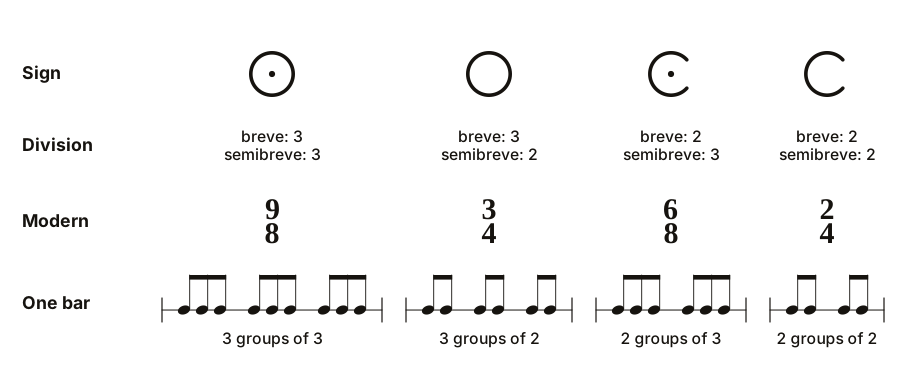
SLOW DOWN. Check Your Understanding: In the Ars nova, a broken circle with a dot means each breve divides into two semibreves and each semibreve into three smaller notes. What modern time signature does that match?
Answer: Two groups of three: 6/8, with each dotted quarter note standing for one semibreve.
Mensural notation, and no bar lines
From the fourteenth to the sixteenth century, singers read mensural notation, “measured” notation, from these principles, refined further. In the fifteenth century the black notes were drawn hollow, giving white notation, whose shapes look much like modern whole and half notes.
What mensural notation did not have was bar lines. Each singer in a choir usually read from a separate part, not a full score, and kept count in their head against a shared, steady beat called the tactus, often shown by a hand moving down and up. A note could last across what we would call a bar line, and the singers simply counted.
ON THE BENCH: Sing without bar lines
You need: a friend, and any simple round you both know (“Row, Row, Row Your Boat” works).
Steps: sing it as a round, one voice starting after the other, while one of you taps a slow, steady beat on the table: that is the tactus. Then sing it again without the tapping.
What you should find: with the shared beat, the round holds together easily. Without it, the two voices drift within a verse or two. The tactus, not the bar line, is what kept Renaissance choirs together.
ON THE BENCH: Hear twos and threes collide
You need: a metronome app. Time: five minutes. Hazards: none.
Steps: set the metronome to 120 and count six clicks over and over. Clap on clicks 1 and 4: that is two groups of three, 6/8. Then clap on 1, 3 and 5: three groups of two, 3/4. Then alternate one bar of each.
What you should hear: the same six clicks feel quite different depending on how they are grouped. Composers from the fourteenth century to Bach exploited exactly this switch between twos and threes, called hemiola, especially just before a cadence.
The bar line arrives
Bar lines first appeared in music for instruments: in lute tablatures and keyboard scores of the sixteenth century, where one player read several voices at once and needed to see where they lined up. In the seventeenth century they spread to all music, and with them came the modern idea of the bar: a group of beats with a strong first beat, repeating.4
That changed more than the look of the page. Once every bar began with a strong beat, composers began to write music that leaned on that beat: dance rhythms, regular phrases, harmonies that changed on the ONE. The metered music of Chapter 14, the music of Bach, Vivaldi and Mozart, grew up with the bar line.
Notation had now solved both of its problems. Pitch was fixed by Guido’s staff; time was fixed by note shapes, meters and bars. With both in place, several voices could sing different melodies at once and arrive together. How that began, long before the bar line, in the stone choir of Notre-Dame, is Chapter 16.
Source to pull before print: a standard reference on the rhythmic modes and the treatise attributed to Johannes de Garlandia (about 1240).↩︎
Franco of Cologne, Ars cantus mensurabilis (about 1260). Source to pull before print: a standard translation.↩︎
Source to pull before print: a standard reference on the Ars nova treatises associated with Philippe de Vitry (about 1320).↩︎
Source to pull before print: a standard history of notation (for example, the Grove article “Notation”) for the spread of the bar line in the sixteenth and seventeenth centuries.↩︎
Bench Degree
Get the degree without the diploma.
Learn the material, not how to pass the exam.