Bench Degree·MUSICchapter
Chapter 14: Pulse, Meter and Rhythm
Your foot finds the beat of a piece within seconds. This chapter writes that beat down.
Put on almost any piece of music written after 1600 and your foot will find the beat within a few seconds, without being asked. Then, without being taught, you will start to feel some beats as stronger than others: ONE two three, ONE two three for a waltz; ONE two, ONE two for a march.
Chapter 13 described music with no beat at all. This chapter is about the clock that Western music built for itself, and the few symbols that write it down.
Pulse
The pulse, or beat, is the steady tick you tap your foot to. It can be fast or slow; its speed is the tempo, measured in beats per minute. A slow funeral march sits near 60, one beat a second. A brisk march is near 120.
ON THE BENCH: Find the pulse and its speed
You need: a free metronome app, and any recordings you like.
Time: fifteen minutes. Hazards: none.
Steps: play a piece and tap along. Then start the metronome and adjust it until its clicks lock onto your taps. Read the number. Try three or four pieces of different kinds.
What you should find: most music you know falls between about 60 and 160 beats per minute, close to the range of a walking pace and a resting heart. Pieces outside that range tend to be felt in half or double time: a very fast piece makes you tap every other beat.
Meter: strong and weak
Beats come in groups, and the first beat of each group is felt as stronger. The grouping is the meter.
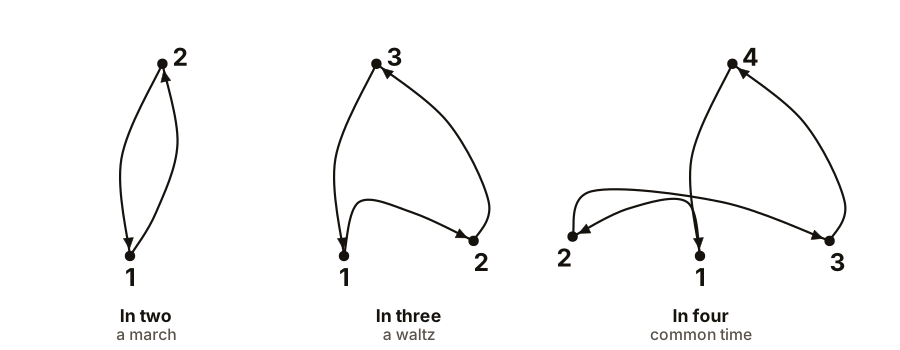
Two beats to a group, ONE two, is duple meter: a march. Three, ONE two three, is triple meter: a waltz or a minuet. Four, ONE two Three four, is quadruple: a stronger ONE and a lesser accent on three. It is the most common meter in popular music.
Each group is called a measure or bar, and in written music a vertical bar line marks the start of each one.
IN PLAIN ENGLISH: The pulse is the steady beat. The meter is how the beats group into strong-weak patterns of two, three or four. Each group is a bar.
ON THE BENCH: Conduct it
Conductors beat time with a pattern for each meter: in two, down and up; in three, down, out to the right, and up; in four, down, left, right, up. The downstroke is always the strong first beat. Conduct along with a march, then a waltz, and feel how your arm finds the strong beat without counting.
Writing time down
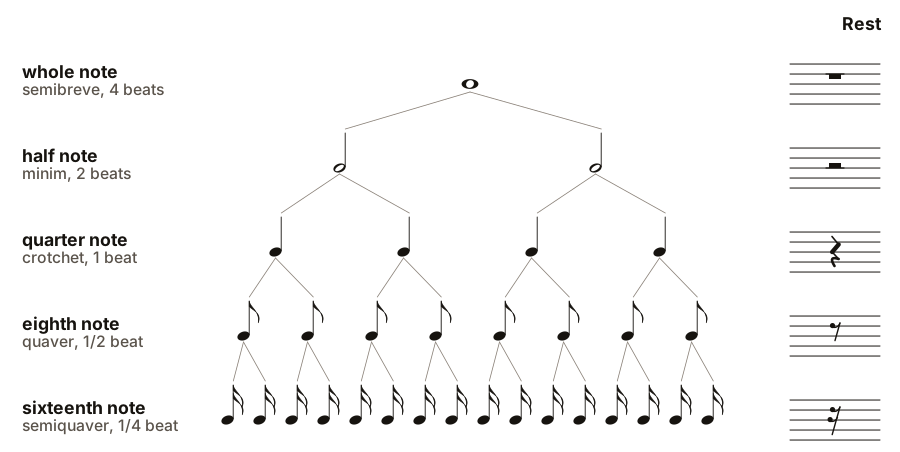
Modern notation shows how long each note lasts by its shape. Each value is half of the one before:
| Note | Name in the United States | Name in Britain | Length in quarter-note beats |
|---|---|---|---|
| hollow, no stem | whole note | semibreve | 4 |
| hollow, with stem | half note | minim | 2 |
| filled, with stem | quarter note | crotchet | 1 |
| filled, stem, one flag | eighth note | quaver | 1/2 |
| filled, stem, two flags | sixteenth note | semiquaver | 1/4 |
A dot after a note adds half its value again: a dotted half note lasts three beats. Every note value has a matching rest, a symbol for silence of the same length.
At the start of a piece, after the key signature, comes the time signature, two numbers stacked. The top number says how many beats are in a bar. The bottom says which note value counts as one beat: 4 for a quarter note, 8 for an eighth. So 3/4 is three quarter-note beats a bar, a waltz. 4/4 is four quarter-note beats, so common it is often written as a large C, for “common time.” 6/8 is six eighth notes a bar, felt as two groups of three: ONE two three FOUR five six.
SLOW DOWN. Check Your Understanding: In 3/4 time, how many eighth notes fill a bar? And what single note fills it?
Answer: Three quarter-note beats, each worth two eighths: six eighth notes. A single note lasting three quarter beats is a dotted half note.
Rhythm: patterns on the grid
The meter is a grid. Rhythm is the pattern of long and short notes laid over it. Two pieces in 4/4 at the same tempo can have utterly different rhythms.
One rhythmic device matters especially: syncopation, putting an accent where the meter does not expect one, on a weak beat or between beats. It works only because the listener feels the meter underneath. Chant, with no meter, cannot be syncopated. A dance by Bach, a ragtime piece or a pop song can, and the tension between the felt grid and the accented off-beat is a large part of what makes them move.
ON THE BENCH: Hear the grid by breaking it
Set the metronome to 100 and clap on every click, counting “one two three four.” Then clap only on “two” and “four.” Then clap between the clicks, on the “and” of each beat. Each time, you are playing the same grid with a different accent, and each time it feels different in the body.
Why music needed a clock
All of this, the steady beat, the bars, the note values, exists because of the problem left at the end of Chapter 13. One singer can follow the words. Two singers singing different lines need a shared clock, or they fall apart.
Western music did not invent its clock all at once. It took three centuries, starting at the cathedral of Notre-Dame in Paris around 1200, and passing through a notation whose rules were so intricate that only specialists could read it. Chapter 15 tells how time was measured before the bar line, and what changed when the bar line arrived.
Bench Degree
Get the degree without the diploma.
Learn the material, not how to pass the exam.