Bench Degree·MUSICchapter
Chapter 13: Chant Without a Clock
For centuries the music of the Church had no beat and no written notes. One monk’s idea let a singer read a melody never heard before.
Listen to Gregorian chant and try to tap your foot. You cannot. There is no beat to find. The melody flows like speech, lingering on one syllable, hurrying over the next, and the only clock it follows is the shape of the words and the breath of the singers.
For most of the history of Western music, this was the music. It was sung every day, from memory, in every monastery and cathedral of Europe. And it was the reason written music was invented.
A thousand melodies, learned by ear
By the ninth century the churches of the Frankish kingdoms sang a vast repertory of chant for the services of the whole year: thousands of melodies, each tied to a particular text and a particular day.1 There was no way to write the tunes down. A young singer learned them the only way possible, by hearing an older singer sing them, again and again, for years.
The modes of Chapter 10 helped. Knowing that a chant ended on D and recited on A told a singer a great deal about how it would go. But a mode is a family of melodies, not a single melody, and the memory had to supply the rest.
Neumes: a reminder, not a map
In the ninth century scribes began to write small signs above the words of a chant: dots, hooks, little rising and falling strokes. These are neumes, from a Greek word for a gesture or nod.2
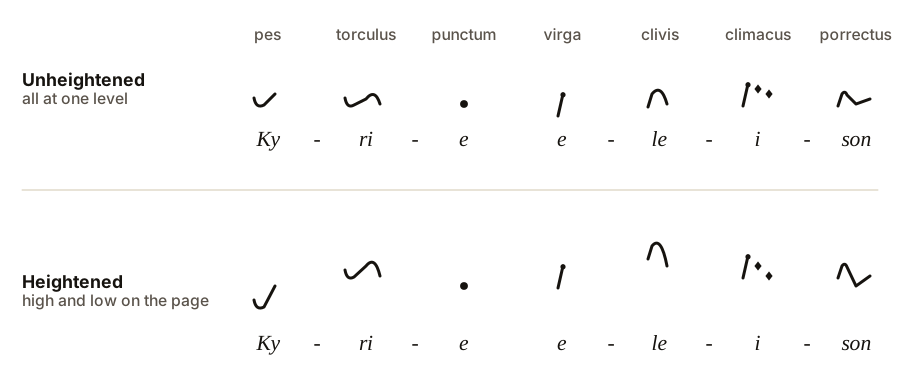
The earliest neumes showed the shape of a melody, up or down, one note or several on a syllable, but not exactly how far up or down. They were a reminder for a singer who already knew the tune, like a few notes scribbled in the margin of a speech. A singer who had never heard the chant could not sing it from them.
Over the next century, scribes began placing the neumes higher or lower on the page to show roughly how high each note was. Some drew a single line across the page, scratched into the parchment, and placed the neumes around it. That line was the beginning of the staff.
Guido and the staff
Around 1025 an Italian monk named Guido of Arezzo described a system that solved the problem. He used lines, three or four of them, each standing for a particular pitch, with notes placed on the lines and in the spaces between. One line was drawn in red for F and another in yellow for C, so a singer could never lose their place.3
With Guido’s staff, for the first time, a singer could read a chant they had never heard. Guido wrote that his method could train a singer in a year or two instead of ten. Pope John XIX, according to Guido’s own account, sang a verse from it correctly at first sight.
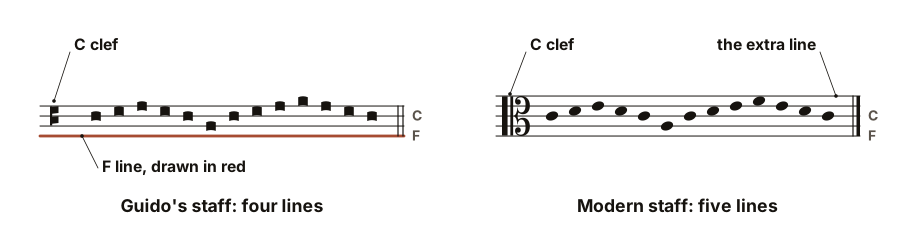
IN PLAIN ENGLISH: For centuries chant was learned only by ear. Neumes recorded the rise and fall of a melody as a memory aid. Guido of Arezzo, around 1025, put notes on lines that each meant one exact pitch, and for the first time music could be sung from the page by someone who had never heard it.
Ut, re, mi
Guido had a second idea. To help singers remember where the half step fell, he used a hymn to St John the Baptist, Ut queant laxis, whose first six lines each began one step higher than the last. The first syllables of those lines were ut, re, mi, fa, sol, la, and each fell on a successive note: C, D, E, F, G, A.
A singer who knew the hymn could find any of those notes by remembering where it fell in the tune. And the half step, the one place where the hymn’s steps narrowed, always came between mi and fa.
Those six syllables became the names of the notes. Later, ut was replaced by do, easier to sing, and si (later ti) was added for the seventh note. “Do, re, mi” is a medieval monk’s memory trick, and you have been singing it since school.
ON THE BENCH: Sing from a staff
You need: the staff in the figure above, a keyboard, real or online, and your voice.
Time: ten minutes. Hazards: none.
Steps: the C clef marks which line is C. Count up and down by lines and spaces, one step each: C on the line, D in the space above, E on the next line. Find the first note on the keyboard, sing it, then step through the melody one note at a time, checking each against the keyboard.
What you should find: within a few minutes you can sing a melody you have never heard, from a page, which is exactly what Guido promised and nobody before him could do.
What chant has that later music lost
Chant has no harmony: it is one line, sung in unison. It has no beat: its rhythm comes from the words. It has no bar lines, no tempo marking, no loud and soft.
What it has is a flexibility of time that later music gave up. A singer can stretch an important syllable, rush a minor one, and breathe where the sense of the words breathes. When choirs today sing chant, they mostly follow a way of singing worked out by the monks of Solesmes in France in the late nineteenth and early twentieth centuries, in an attempt to recover what had been lost.4 How the medieval singers actually timed it is still debated.
SLOW DOWN. Check Your Understanding: Why was it possible to sing chant for centuries without writing it down, and why did writing it down eventually become necessary?
Answer: Because it was learned by ear, from singer to singer, within communities that sang it every day. Writing became necessary as the repertory grew to thousands of melodies and the Church wanted them sung the same way everywhere, which memory alone could not guarantee.
ON THE BENCH: Write neumes, and see why they were not enough
You need: paper, a pencil, and a friend. Time: fifteen minutes. Hazards: none.
Steps: choose a simple tune you know well. Write its words, and above each syllable draw only a dot, or a stroke rising or falling, to show whether the melody goes up, down or stays the same. Give the paper to a friend who does not know the tune, and ask them to sing it.
What you should find: they cannot. Your marks show the direction but not the distance, which is exactly the problem with the earliest neumes. Now give it to someone who already knows the tune: your marks will remind them of it at once. That is what neumes were for.
The next problem
Guido’s staff recorded pitch: how high each note was. It did not record time: how long each note lasted. For chant, which followed the words, that hardly mattered.
It mattered enormously the moment a second voice was added. Two singers singing different melodies at once must know exactly when each note changes, or the result is chaos. Music needed a clock. Chapter 14 builds one: pulse, meter and the rhythm written in notes.
Source to pull before print: a standard history of Gregorian chant (for example, David Hiley, Western Plainchant, 1993) for the size of the repertory and the Carolingian standardisation.↩︎
Same source, on the earliest notated manuscripts.↩︎
Guido of Arezzo, Micrologus (about 1026) and the Epistola de ignoto cantu (letter on singing an unknown chant, about 1030). Source to pull before print: a standard translation of both.↩︎
Source to pull before print: a standard account of the Solesmes restoration and its rhythmic method.↩︎

Bench Degree
Get the degree without the diploma.
Learn the material, not how to pass the exam.