Bench Degree·MUSICchapter
Chapter 12: Keys and Transposition
Sing a tune high or low and it is still the same tune. The ear hears ratios, not frequencies.
Sing “Happy Birthday” starting on any note you like. A child sings it high, a grandfather sings it low, a room full of people sings it in four different places at once and somehow it is still the same song.
Every frequency has changed. Nothing about the tune has. That fact is so ordinary it hides how strange it is, and it is the key, in both senses, to how Western music is organised.
The ear hears ratios
Chapter 5 found that intervals are ratios. A fifth is 3 to 2 whether it runs from 200 Hz to 300 Hz or from 400 Hz to 600 Hz. Multiply every note of a melody by the same number, and every ratio between its notes stays exactly the same.
The ear, it turns out, cares about the ratios far more than the frequencies. Most people cannot name a note they hear on its own; they have no fixed sense of “this is 440 Hz.” But nearly everyone can tell whether a melody is right or wrong, in any key. That is relative pitch: hearing the distances between notes rather than the notes themselves.1
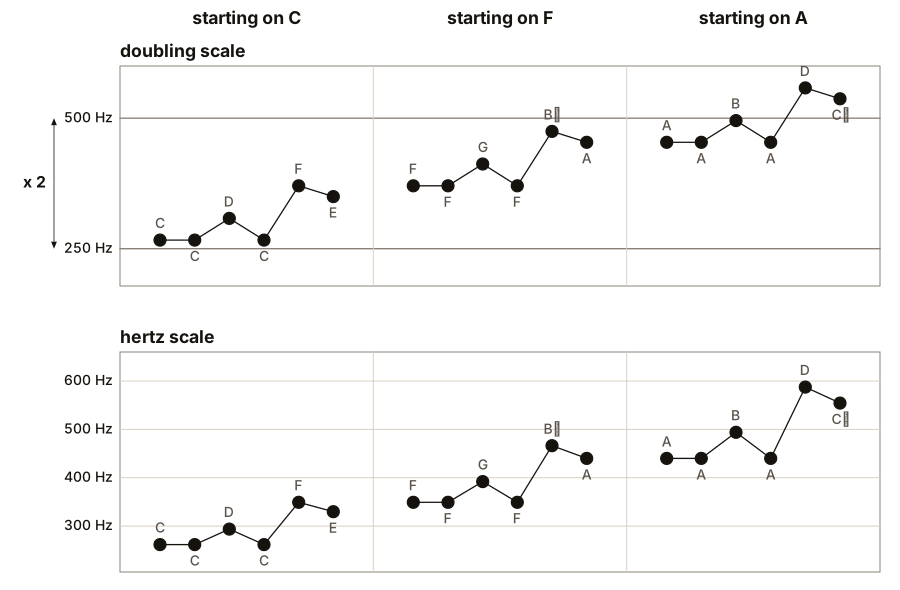
That is why transposing works. Moving a whole piece up or down keeps its shape, and the shape is what you hear.
IN PLAIN ENGLISH: A melody is a pattern of ratios. Move every note by the same ratio and the pattern does not change. The ear follows the pattern, so the melody survives.
ON THE BENCH: Transpose a tune
You need: a keyboard, real or online.
Time: fifteen minutes. Hazards: none.
Steps: find “Happy Birthday” starting on C, with only white keys (the first notes are C, C, D, C, F, E). Now try to start it on D, using only white keys.
What you should hear: on D with only white keys, one note sounds wrong: the F in the tune, which should be a major third above D. Replace it with F sharp and the tune comes right. Start on E and you need two black keys. Each new starting note needs its own set of black keys to keep the pattern of steps the same.
A key is a scale with a home
A key is a major or minor scale on a particular home note, called the tonic. “C major” means the major scale on C: all white keys. “G major” means the same pattern of steps starting on G, which needs one black key, F sharp, as Chapter 7 found.
Rather than write a sharp beside every F in a piece in G major, composers write it once at the start of each line, in a key signature. A piece in G major carries one sharp. D major carries two, F sharp and C sharp. A major, three.
The sequence is not arbitrary. Each key with one more sharp is a fifth above the last: C, G, D, A, E, B. And the new sharp each time is the leading tone of the new key: F sharp leads to G, C sharp leads to D. Going the other way, down in fifths, each new key adds a flat: F major has B flat, B flat major has B flat and E flat, and so on.
The circle of fifths
Put the twelve major keys on a clock face, each a fifth from the next, and you get the circle of fifths.
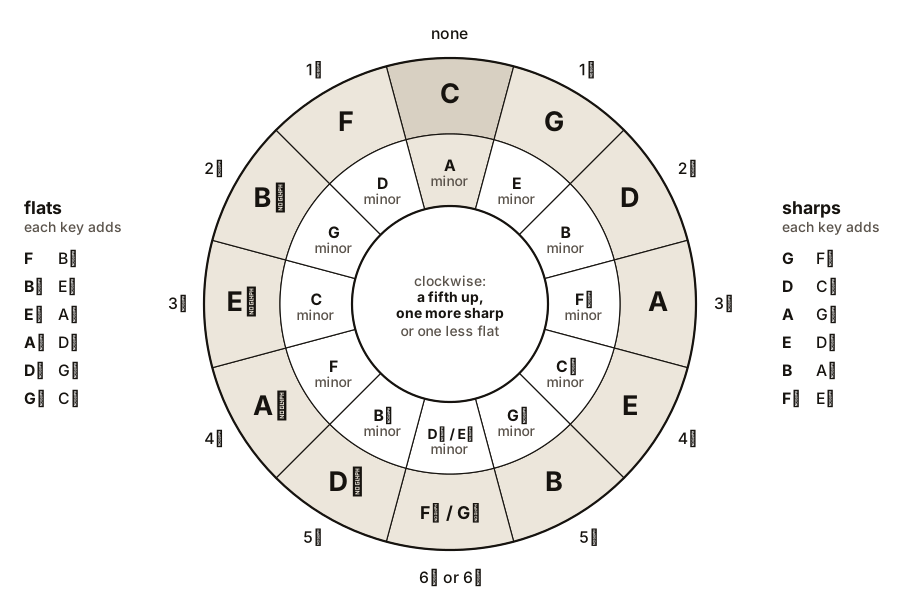
The circle is the chain of fifths of Chapter 7, bent round so that its ends meet. Neighbouring keys on the circle share six of their seven notes, so a piece can move between them smoothly. Keys on opposite sides, like C and F sharp, share almost nothing.
The circle closes because of temperament. With pure fifths, Chapter 8 found, the chain does not close: twelve fifths overshoot. In equal temperament, every fifth is narrowed just enough that twelve of them come back exactly to the start, and F sharp and G flat become the same key. The circle of fifths, drawn as a circle, is a picture of equal temperament.
SLOW DOWN. Check Your Understanding: How many sharps does E major have, and which are they?
Answer: Count round the circle from C: G (1), D (2), A (3), E (4). Four sharps. They are added in the order F sharp, C sharp, G sharp, D sharp, each a fifth above the last. D sharp is the leading tone of E.
Do keys have characters?
Ask musicians and many will tell you that keys have characters: that E flat major is noble, D major brilliant, F minor gloomy. Writers in the eighteenth century compiled long lists of such characters.2
In a well temperament (Chapter 9), that was literally true. Each key had its own mixture of sweeter and wider thirds, and you could hear the difference. In equal temperament, every key is acoustically the same, transposed. What remains is real but different: the way each key lies on particular instruments (open strings ring in D major on a violin; brass is at home in flat keys), the pitch range a key puts the music in, and centuries of associations from pieces written in it.
ON THE BENCH: Transpose with a capo
You need: a guitar and a capo (a clamp that presses all the strings at one fret), about $10. Time: ten minutes. Hazards: none.
Steps: play any simple chord sequence you know. Clamp the capo at the second fret and play exactly the same shapes, now two frets higher.
What you should hear: the same song, a whole step higher. The capo has shortened every string by the same fraction, so it has multiplied every frequency by the same ratio, about 1.12. Every interval is unchanged, and so is the song. Singers use capos for exactly this: to move a song into their range without learning new chord shapes.
What a key makes possible
A key gives a piece a home, and therefore an away. Once there is a tonic, a composer can leave it, move to a neighbouring key on the circle, travel further, and come back, and the listener feels each move. Chapter 22 is about that journey, called modulation.
But a home in pitch is only half of what music needs. A tune also needs a home in time: a beat, a sense of where it is in the bar. Chant, the oldest music in this book, had none. That is Chapter 13.
Source to pull before print: a standard review of absolute (“perfect”) versus relative pitch, for the estimate that absolute pitch is rare, on the order of one person in several thousand in Western populations.↩︎
Source to pull before print: Christian Schubart, Ideen zu einer Ästhetik der Tonkunst (written about 1784, published 1806), the best-known list of key characters.↩︎
Bench Degree
Get the degree without the diploma.
Learn the material, not how to pass the exam.