Bench Degree·MUSICchapter
Chapter 11: Major, Minor and the Leading Tone
Stop a major scale one note short of the top and the last note will pull you home. That pull made two modes into major and minor.
Sing “do, re, mi, fa, sol, la, ti” and stop. Do not sing the last “do.”
It is almost unbearable. The “ti” hangs in the air, a half step below home, leaning on it, and every listener’s ear finishes the scale for you. That pull has a name, the leading tone, and it is the reason two of the seven modes of Chapter 10 conquered Western music.
The note that leans
In the major scale, the seventh note sits a half step below the eighth: B below C. In most of the other modes, it sits a whole step below: in Dorian, C below D; in Mixolydian, F below G; in Aeolian, G below A.
A whole step below home feels like a neighbour. A half step below home feels like a doorstep. The smaller the gap, the stronger the pull to close it, and the half step is the smallest gap in the scale.
ON THE BENCH: Feel the pull
You need: a keyboard, real or online, or a guitar.
Time: ten minutes. Hazards: none.
Steps:
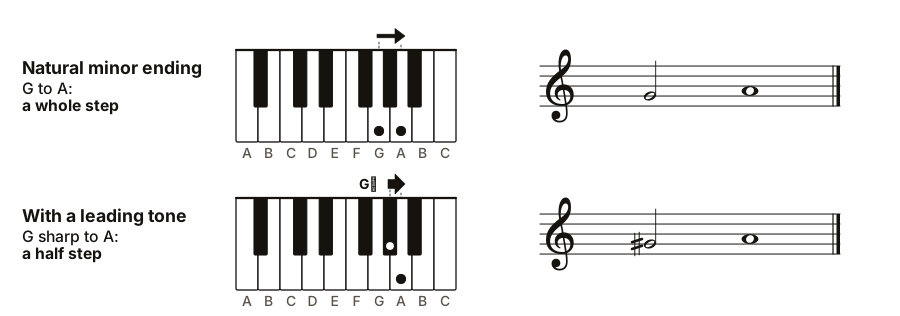
- Play the white-key scale from A up to G, and stop. Then play A. That is the natural minor (Aeolian) ending: G to A, a whole step.
- Now play the same scale, but play G sharp instead of G, and then A.
What you should hear: the first ending arrives gently, almost sideways. The second snaps home. The only change is one note, raised a half step, so that the seventh leans on the final.
Medieval singers felt this pull long before anyone wrote rules about it. At the ends of phrases they routinely raised the note below the final by a half step, even where the written music did not show it. The practice was called musica ficta, “invented music,” because the raised notes were not part of the official scale. The singers knew to supply them.1
IN PLAIN ENGLISH: A seventh note a half step below home pulls hard toward it. That is the leading tone. The major scale has one built in. Medieval singers added one to the other modes at cadences, by ear.
How major won
Once singers routinely raised the seventh at endings, several of the old modes began to blur together. Mixolydian with its seventh raised is simply the major scale. Lydian, with its awkward raised fourth usually lowered in practice, became the major scale too. Over the sixteenth and seventeenth centuries the many modes collapsed into two families: those with a major third above the final, and those with a minor third.
The French composer Jean-Philippe Rameau set out the new system in his Traité de l’harmonie in 1722, the same year as Bach’s first book of the Well-Tempered Clavier.2 By then the major and minor keys were the language of European music, and they remained so for two centuries.
Three minors
Minor kept a problem that major did not have. The natural minor scale, the Aeolian mode, has no leading tone. Raise its seventh to get one, and something else goes wrong.
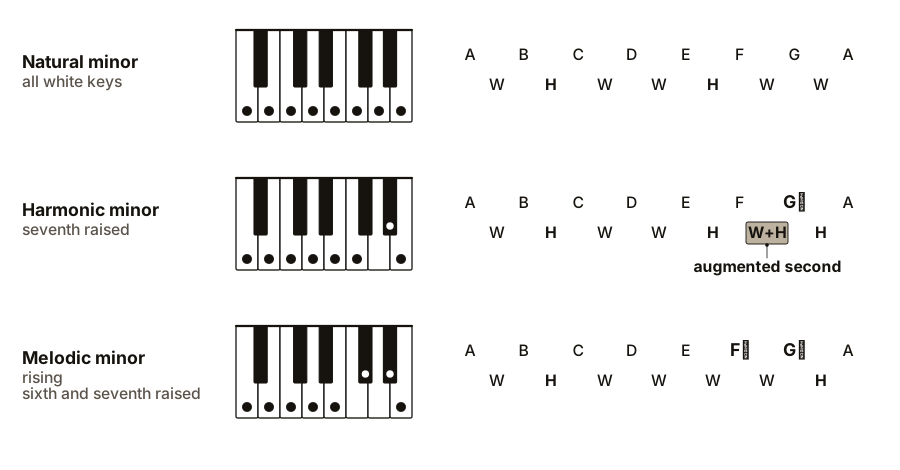
Natural minor. A, B, C, D, E, F, G, A. No leading tone. Gentle endings.
Harmonic minor. Raise the seventh: A, B, C, D, E, F, G sharp, A. Now there is a leading tone. But look at the gap from F to G sharp: a step and a half, three half steps. That wide gap, called an augmented second, gives harmonic minor its exotic, slightly Middle Eastern sound in melodies. It is the scale that makes chords work (Chapter 20 shows why), which is how it got its name.
Melodic minor. For melodies that climb to the top, raise the sixth as well: A, B, C, D, E, F sharp, G sharp, A. The awkward gap is gone and the melody climbs smoothly to the leading tone. On the way down, where no leading tone is needed, composers often went back to the natural minor.
SLOW DOWN. Check Your Understanding: Why did composers not simply make the minor scale permanently A, B, C, D, E, F sharp, G sharp, A?
Answer: Because then it would differ from A major only in its third, C instead of C sharp, and would lose much of its darker colour. The lowered sixth and seventh are part of minor’s character. Composers used the raised forms where melody or harmony needed the pull, and the natural ones everywhere else.
Relative and parallel
Every major scale shares its seven notes with one minor scale, which starts on its sixth note. C major and A minor use the same white keys. They are relative keys: same notes, different home. Pieces move easily between them.
A major scale and a minor scale that share the same home note, C major and C minor, are parallel keys: same home, different notes (C minor has E flat, A flat and B flat). Moving between parallel keys changes the colour of a piece without moving its home, a device composers have used for centuries to darken a tune that has just been heard in major.
ON THE BENCH: Major to parallel minor
Play a simple tune you know in C major on a keyboard, with only white keys. Then play it again, replacing every E with E flat, every A with A flat and every B with B flat. The tune is still recognisable. Its mood is not.
What major and minor gave
Two scales, each with a leading tone, each able to start on any of the twelve notes, and a tuning (Chapter 9) that made all twelve usable: that was the toolkit of Bach, Vivaldi, Haydn and Mozart. With it, a composer could move a melody to any height and still keep it the same melody. Why that works, why “Happy Birthday” is still itself in any key, is Chapter 12.
Bench Degree
Get the degree without the diploma.
Learn the material, not how to pass the exam.