Bench Degree·MUSICchapter
Chapter 10: The Church’s Modes
The same seven white keys, started on a different note, sound like a different century.
Play the white keys of a piano from D up to the next D, and only the white keys: D, E, F, G, A, B, C, D.
It does not sound like a major scale. It does not quite sound like a minor one either. It sounds old, a little grave, a little hopeful, like a melody from a monastery or a ballad sung in a stone hall. You have used exactly the same seven notes as the C major scale. Only the starting point changed.
That sound is a mode, and for a thousand years most of the music of Europe was written in modes like it.
Same notes, different home
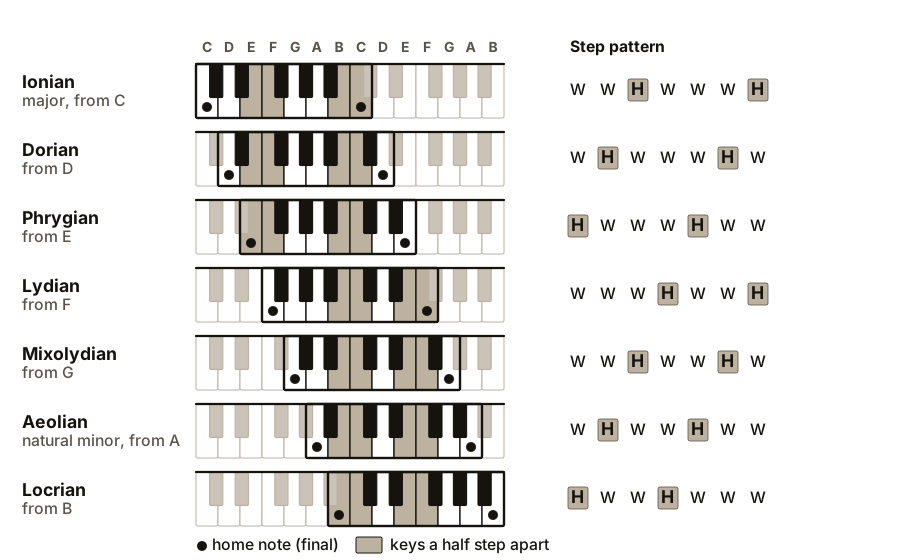
Chapter 7 showed that the scale is a fixed pattern of whole and half steps: whole, whole, half, whole, whole, whole, half, starting from C. The two half steps sit between E and F and between B and C.
Start on a different white key and walk up, and you meet the same seven steps in a different order. The half steps fall in different places relative to the starting note, and that changes everything about how the scale feels.
| Mode | White keys from | Step pattern (W whole, H half) | Character, roughly |
|---|---|---|---|
| Ionian (major) | C | W W H W W W H | bright, settled |
| Dorian | D | W H W W W H W | minor, but with a lifted sixth |
| Phrygian | E | H W W W H W W | dark, with a falling half step to home |
| Lydian | F | W W W H W W H | bright, with a raised fourth |
| Mixolydian | G | W W H W W H W | major, but with a lowered seventh |
| Aeolian (natural minor) | A | W H W W H W W | minor |
| Locrian | B | H W W H W W W | unstable; almost never used |
ON THE BENCH: Play the modes
You need: a keyboard, real or free online, or a guitar.
Time: fifteen minutes. Hazards: none.
Steps: play each white-key mode slowly, up and down, starting and ending on its own note. Then, for each one, hold its starting note down low (or play it as a drone on an open string) while you play the scale above it.
What you should hear: with the drone, each mode takes on a distinct colour, because every note is now heard against the home note. Dorian sounds minor with a ray of light in it; Phrygian, dark and Spanish; Lydian, strange and bright; Mixolydian, like a folk tune or a bagpipe. Without the drone, the ear tends to drift back to C major or A minor, because those are the modes it knows best.
The drone matters. A mode is not just a set of notes; it is a set of notes heard against a final, the home note where a melody comes to rest. The same notes with a different final are a different mode.
IN PLAIN ENGLISH: A mode is a scale defined by where it starts and ends. The seven white keys give seven modes, one for each starting note. Each has its half steps in different places relative to home, so each sounds different.
The modes of chant
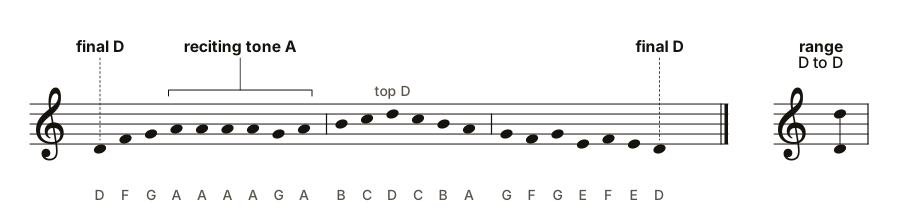
The modes were named and organised to sort the vast body of chant sung in Western churches, the music usually called Gregorian chant. Medieval theorists counted eight modes, in four pairs, by their finals: D, E, F and G.1
Each pair shares a final. The first of the pair, the authentic mode, ranges roughly from the final up an octave. The second, the plagal mode, ranges from about a fourth below the final to a fifth above, so that the melody hovers around home rather than rising from it. Each mode also has a reciting tone, a note on which long passages of text are chanted on one pitch, usually a fifth or so above the final.
The names Dorian, Phrygian, Lydian and Mixolydian were borrowed from ancient Greek music theory, and borrowed imprecisely. The Greek names had referred to different scales altogether.2 The Ionian and Aeolian modes, on C and A, were added by the Swiss theorist Heinrich Glarean in 1547, in a book called Dodecachordon, making twelve modes in all.3
SLOW DOWN. Check Your Understanding: The folk song “Scarborough Fair” is usually sung in Dorian. If you sing it starting from D, which note tells you it is Dorian rather than ordinary minor?
Answer: The sixth note above the final. In D Dorian it is B natural; in D minor it would be B flat. That raised sixth is the ray of light in the Dorian sound, and you can hear it in the song’s melody.
Why it sounds old
When you hear modal music and think “medieval,” you are hearing three things.
First, the lowered seventh of most modes. In Dorian, Phrygian, Mixolydian and Aeolian, the seventh note is a whole step below home, not a half step. Nothing pulls hard toward the final, so melodies settle rather than resolve.
Second, the characteristic notes: the raised sixth of Dorian, the falling half step into home of Phrygian, the raised fourth of Lydian. Major and minor keys smooth these out.
Third, the absence of the strong harmonic pull that Chapter 21 describes. Modal music was mostly a music of lines, not of chords. Its harmonies grew out of voices moving against each other, as Chapters 16 and 17 show.
ON THE BENCH: A mode over a drone on the guitar
You need: a guitar. Time: ten minutes. Hazards: none.
Steps: let the open G string ring as a drone. On the B and high E strings, play the notes G, A, B, C, D, E, F, G slowly, letting each one sound against the drone. Then play the same notes again with F sharp instead of F.
What you should hear: with F natural, the Mixolydian mode: a major scale with a lowered seventh, the sound of many folk tunes and of bagpipes. With F sharp, the ordinary G major scale. One half step changes the whole colour.
The modes today
The modes never went away. Folk music in Britain and Ireland kept them; many traditional tunes are Dorian or Mixolydian. Jazz musicians use them by name. Rock and film music lean on Mixolydian and Dorian for their open, unresolved colour.
But in the art music of Europe, between about 1550 and 1700, two of the modes gradually displaced the others. One was the mode on C, with its leading half step into home. The other was a version of the mode on A, borrowing that same half step. They became major and minor, and how they won is Chapter 11.
Source to pull before print: a standard reference on the medieval modal system (for example, the Grove article “Mode”), and the ninth-century treatises that first describe it.↩︎
Source to pull before print: the same reference, on the medieval misreading of the Greek harmoniai.↩︎
Heinrich Glarean, Dodecachordon (Basel, 1547).↩︎

Bench Degree
Get the degree without the diploma.
Learn the material, not how to pass the exam.