Bench Degree·MUSICchapter
Chapter 9: Temperament
Bach called his book of twenty-four preludes and fugues well tempered. He did not mean the tuning of a modern piano.
In 1722 Johann Sebastian Bach, then music director at the court of Köthen, finished a book of twenty-four preludes and fugues for keyboard, one in every major key and every minor key. He gave it a title that has puzzled players ever since: Das Wohltemperirte Clavier, The Well-Tempered Clavier. Twenty years later he wrote a second book of twenty-four more.
The usual explanation is that Bach was showing off equal temperament, the tuning of the modern piano. That is almost certainly wrong, and the right answer is more interesting.
To temper is to adjust
To temper an interval is to make it slightly impure on purpose: to narrow a fifth or widen a third by a few cents, so that the comma of Chapter 8 is shared out among several intervals instead of landing on one. A temperament is a recipe for doing that across all twelve notes. There are hundreds. Four families matter.
Just intonation
The first idea is not to temper at all: tune every interval to its pure ratio. In C, make C to E a pure 5:4, C to G a pure 3:2, and so on.
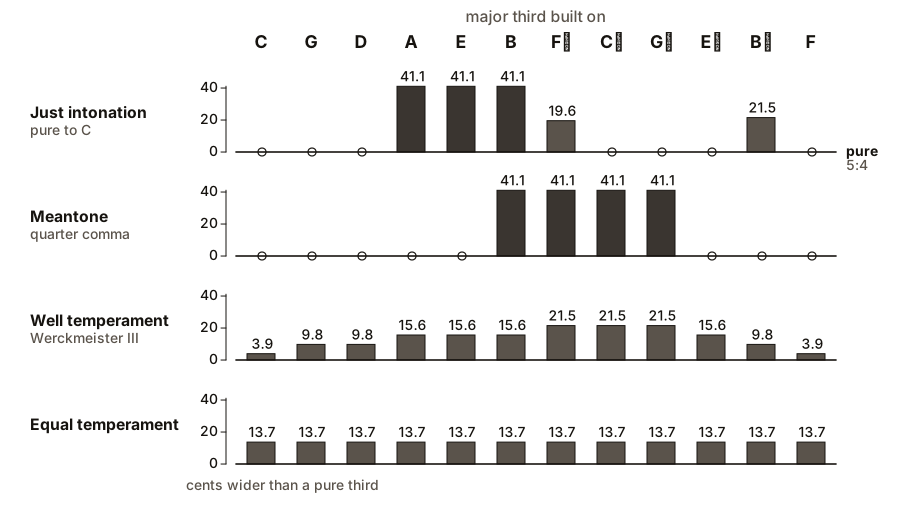
It works beautifully for one chord. A C major chord in just intonation is the calmest sound a keyboard can make. But it fails within a few steps. With the notes tuned purely to C, the fifth from D up to A comes out at 40:27 instead of 3:2, about 680 cents instead of 702, and a D minor chord sounds sour. Just intonation suits voices and string players, who can adjust each note as they go. A keyboard, with every note fixed, cannot.
Meantone
In 1523 the Italian theorist Pietro Aron described a tuning that made the major thirds pure and paid for it with the fifths.1 Each fifth is narrowed by a quarter of the syntonic comma, about 5.4 cents, to about 696.6 cents. Four of those narrowed fifths, up from C to E, land exactly on a pure 5:4 third.
This is quarter-comma meantone, and for two centuries it was the sound of the organ and the harpsichord. Its major thirds are pure and its triads in keys near C are glowing.
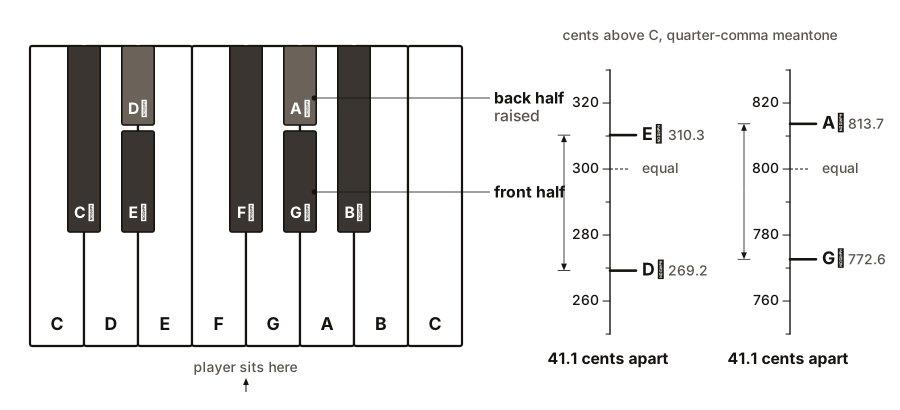
The price is the wolf. Eleven narrowed fifths leave the twelfth far too wide, by about 36 cents, and some keys become unplayable. Meantone also gives each black key one identity only. Tuned as G sharp, it cannot serve as A flat; the two differ by about 41 cents in meantone. Some keyboards were built with split keys, the black key cut in two so that a player could choose G sharp or A flat.
Well temperament
In the later seventeenth century German organists, Andreas Werckmeister among them, published tunings that spread the comma over all the fifths, but unevenly.2 Fifths among the keys most used, near C, were narrowed a lot, so that their thirds came out sweet. Fifths among the remote keys, near F sharp, were left nearly pure, so that their thirds came out wide and bright.
There is no wolf. Every key is playable, which is the whole point. But the keys are not identical. C major is calm. E major is brighter. F sharp major is brilliant, even edgy. Composers of the time wrote about the distinct character of each key, and in a well temperament that character was something you could actually hear.
Equal temperament
Narrow every fifth by exactly one twelfth of the Pythagorean comma, about 2 cents, and every half step becomes exactly 100 cents, the twelfth root of 2. Every key is identical to every other, transposed. No interval except the octave is pure. The fifths are very nearly pure, just 2 cents narrow. The major thirds are 13.7 cents wide.
Equal temperament was not new in Bach’s time. Lute and viol players had used near-equal frets for a long time, because a fret runs across all the strings and has to serve every one of them. The Chinese prince Zhu Zaiyu calculated the exact ratio in 1584, and European mathematicians soon after.3 But keyboards did not widely adopt it until the nineteenth century.
IN PLAIN ENGLISH: Just intonation: perfect in one key, useless in others. Meantone: pure thirds, a few unusable keys. Well temperament: every key usable, each with its own colour. Equal temperament: every key usable and identical, every third a little wide.
What “well tempered” meant
So which did Bach mean?
“Well tempered” (wohltemperirt) was a phrase in use in Bach’s Germany for tunings in which every key could be played. Werckmeister used it. That describes both well temperament and equal temperament. But Bach’s book was written to show something only well temperament could show: twenty-four keys, every one usable, and every one different. Pieces in remote keys like F sharp major and E flat minor would have sounded, on Bach’s harpsichord, not just playable but distinct.
Which well temperament Bach used is not known, and is argued about with some heat. In 2005 the harpsichordist Bradley Lehman proposed that a looping squiggle drawn across the top of Bach’s title page is a coded tuning diagram.4 Others think it is decoration. What most scholars do agree on is that it was not equal temperament.
Hear the difference
ON THE BENCH: The same chord in three tunings
You need: three tone generators at once (a free app that can play a chord of three tones, or three browser tabs), with a timbre that has harmonics. Free online keyboards that offer historical tunings also work: search for “online keyboard meantone” or “historical temperament keyboard”.
Time: fifteen minutes. Hazards: moderate volume.
Steps: play each triad below for five seconds and listen to its upper harmonics.
Chord Tuning C or F sharp E or A sharp G or C sharp C major just 261.63 327.03 392.44 C major equal 261.63 329.63 392.00 F sharp major equal 369.99 466.16 554.37 What you should hear: the just C major chord sounds still, almost transparent. The equal-tempered C major chord has a gentle shimmer: that is its wide third beating. The equal-tempered F sharp chord has exactly the same shimmer, because in equal temperament every key is the same. In a well temperament, it would have more.
SLOW DOWN. Check Your Understanding: Why could a choir sing pure thirds in every key while an organ could not?
Answer: A singer chooses each pitch as the music goes, and can place each third pure against the chord of the moment. An organ’s pipes are fixed. Each pipe has one pitch, which has to serve every chord it appears in, so somewhere the comma has to be paid.
ON THE BENCH: Hear the wolf
You need: two tone generators, with a timbre that has harmonics. Time: five minutes. Hazards: moderate volume.
Steps: play 440 Hz with 660 Hz, a pure fifth. Then play 440 Hz with 651.1 Hz: a fifth short by the whole Pythagorean comma, the wolf of a tuning that keeps the other eleven fifths pure.
What you should hear: the pure fifth is still. The wolf beats fast and sour, about eighteen times a second, and faster still in its upper harmonics. That is why keyboard players avoided the keys that needed it, and why the keyboards of the seventeenth century could not play in every key.
What changed after Bach
Through the eighteenth century, well temperaments of many kinds were used. During the nineteenth century, as the piano took over and as composers moved freely through every key in one piece, keyboards went over to equal temperament. By about 1900 it was standard.5
So the Well-Tempered Clavier we hear today, on a modern piano, is in a tuning Bach probably never used. Every key sounds the same. Hear it on a harpsichord in a well temperament, and the keys change colour as the book goes round them.
Temperament answers how to fit twelve notes into an octave. It does not answer which of those notes a piece of music chooses, and in what order. Music written long before Bach chose differently, in scales that are neither major nor minor. Those are the church modes, and they are Chapter 10.
Pietro Aron, Thoscanello de la musica (1523). Source to pull before print: the passage on tuning, in a standard translation.↩︎
Andreas Werckmeister, Musicalische Temperatur (1691). Source to pull before print: the standard description of his tuning “III”.↩︎
Source to pull before print: Zhu Zaiyu (1584); Simon Stevin (about 1605); Mersenne (1636).↩︎
Bradley Lehman, “Bach’s extraordinary temperament: our Rosetta Stone,” Early Music 33 (2005). Source to pull before print: the article and the published replies.↩︎
Source to pull before print: a standard history of piano tuning practice in the nineteenth century.↩︎
Bench Degree
Get the degree without the diploma.
Learn the material, not how to pass the exam.