Bench Degree·MUSICchapter
Chapter 8: The Comma That Will Not Close
Twelve perfect fifths should come back to where they started. They overshoot, and three centuries of argument followed.
Here is a sum anyone can do on a phone calculator, and it explains three centuries of argument.
Multiply 1.5 by itself twelve times. You get about 129.75.
Multiply 2 by itself seven times. You get 128.
Twelve pure fifths, and seven octaves, ought to be the same distance. Chapter 7 climbed a chain of twelve fifths that should have closed into a circle and come back to its starting note. The calculator says it does not. It overshoots, by 129.75 over 128: about 1.36 percent.
That leftover is called the Pythagorean comma. It cannot be removed. It can only be hidden, and the history of tuning is the history of where to hide it.
Hear it
ON THE BENCH: The comma, out loud
You need: two tone generators, set to a timbre with harmonics if possible.
Time: five minutes. Hazards: moderate volume.
Steps: set one tone to 440 Hz. Set the other to 446.0 Hz, which is 440 times 129.75 over 128: where the twelfth fifth lands when you fold it back to the starting octave.
What you should hear: a fast beating, about six pulses a second, and a faint sourness. Those two tones are supposed to be the same note. They are a chain of twelve perfect fifths apart.
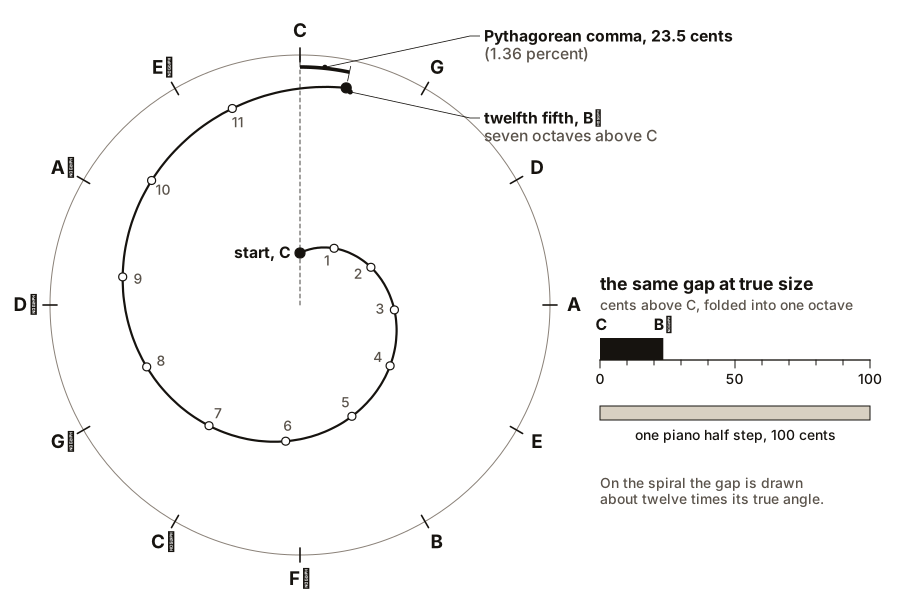
Greek theorists already knew a version of the problem: a treatise attributed to Euclid proves that six whole steps of 9:8 come to more than an octave.1 The ratios that make music simple refuse to add up.
A unit small enough to measure it
Percentages get clumsy for comparing intervals, because intervals multiply rather than add. Musicians and acousticians use a better unit, the cent, introduced by the English phonetician Alexander Ellis in 1885.2
An octave is 1,200 cents. Each of the twelve half steps on a modern piano is exactly 100 cents. Because cents add, a fifth plus a fourth, 702 plus 498 cents, makes 1,200: an octave.
To turn any ratio into cents, take its logarithm in base 2 and multiply by 1,200. On a phone calculator: cents = 1,200 times log(ratio) divided by log(2).
| Interval | Ratio | Cents |
|---|---|---|
| pure fifth | 3/2 | 702.0 |
| pure fourth | 4/3 | 498.0 |
| pure major third | 5/4 | 386.3 |
| pure minor third | 6/5 | 315.6 |
| Pythagorean major third | 81/64 | 407.8 |
| Pythagorean comma | 531441/524288 | 23.5 |
| syntonic comma | 81/80 | 21.5 |
| piano half step | 2^(1/12) | 100.0 |
Read the commas from the table. The Pythagorean comma is 23.5 cents, about a quarter of a half step. The syntonic comma of Chapter 6, the gap between a Pythagorean third and a pure one, is 21.5 cents. They are nearly the same size, and they are different problems. One says that fifths do not close. The other says that fifths and pure thirds do not agree.
IN PLAIN ENGLISH: Twelve pure fifths overshoot seven octaves by about a quarter of a half step, 23.5 cents. And four pure fifths overshoot a pure major third (plus two octaves) by about the same amount, 21.5 cents. Simple ratios cannot all be kept at once.
SLOW DOWN. Check Your Understanding: In Chapter 1 the guitar’s fourth fret sat about 4 mm (0.16 in) past the point that gives a pure 5:4 third. A fret half step is 100 cents. Roughly how many cents sharp of a pure major third is the guitar’s third?
Answer: The guitar’s major third is four half steps: 400 cents. A pure major third is 386.3 cents. The fret is about 13.7 cents sharp. That is the flat B the tuner reported when you played the fifth harmonic: the string gave a pure third, and the tuner was measuring against the fret’s wider one.
Where the comma goes
There are only a few things a tuner can do with the comma.
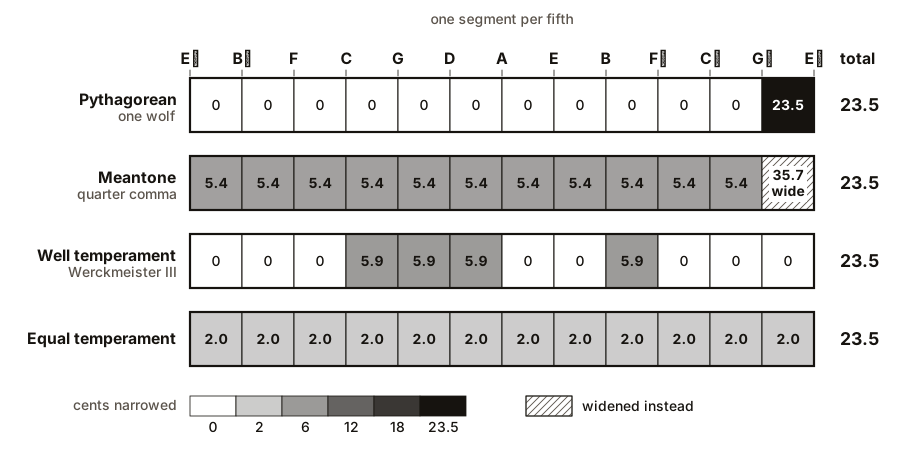
Put it all in one fifth. Tune eleven fifths pure, and let the twelfth absorb the whole 23.5 cents. That twelfth fifth, usually between G sharp and E flat, is then so badly out of tune that it howls when played, a sound musicians nicknamed the wolf. In medieval music, built on fifths and fourths in a few keys near C, nobody needed that fifth, so the wolf could sleep in an unused corner.
Spread it over some fifths. Narrow several fifths slightly, so that the thirds come out closer to pure, and leave the wolf somewhere less used. This is the family of tunings called meantone, and it ruled keyboard music in the sixteenth and seventeenth centuries.
Share it unevenly, with no wolf. Narrow some fifths and leave others pure, so that the comma is fully paid without a wolf anywhere. Every key is usable, but each key keeps a slightly different colour. This is well temperament.
Spread it evenly. Narrow every fifth by one twelfth of the comma, about 2 cents, so that all twelve half steps are exactly 100 cents. No wolf, every key identical, and no third anywhere is pure. This is equal temperament, the tuning of a modern piano and of your guitar’s frets.
ON THE BENCH: Hear the price of equal temperament
Steps: with two tone generators, play 440 Hz with 550 Hz (a pure 5:4 major third). Then play 440 with 554.37 Hz, the equal-tempered major third.
What you should hear: the pure third is calm. The equal-tempered third has a fast shimmer in its upper harmonics, about seventeen beats a second. You have heard that shimmer all your life on every piano, and probably never noticed it.
The choice
Each of those four answers sounds different, and each made a different kind of music possible. Pythagorean tuning suited chant and early polyphony. Meantone gave Renaissance and early Baroque music its sweet thirds, at the price of keys you could not use. Well temperament opened every key, each with its own colour. Equal temperament made every key the same.
Bach wrote one of his greatest collections of keyboard music, almost certainly for the third of those, and called it The Well-Tempered Clavier. What exactly he meant by “well tempered,” and why it was not the tuning of a modern piano, is Chapter 9.
Bench Degree
Get the degree without the diploma.
Learn the material, not how to pass the exam.