Bench Degree·MUSICchapter
Chapter 7: Why the Steps Are Not Even
The black keys of a piano sit in groups of two and three for a reason, and the reason is a chain of fifths.
Look at a piano keyboard. The white keys run in an even row, but the black keys do not. They come in groups of two and three, with gaps between, so that two pairs of white keys, E and F, B and C, have nothing between them.
It looks like a design quirk. It is the scale of Chapter 6, drawn in wood and ivory, and the gaps are exactly where the scale’s small steps fall.
Count the frets
ON THE BENCH: Find the pattern on one string
You need: a guitar, and a tuner app.
Time: ten minutes. Hazards: none.
Steps:
- On the fifth string, the A, press the third fret. The tuner reads C. That is your starting note.
- Sing or hum “do, re, mi, fa, sol, la, ti, do” from that C, and find each note on the same string by moving up the frets until it matches your voice. Write down the fret numbers.
What you should find: 3, 5, 7, 8, 10, 12, 14, 15. Now subtract each from the next: 2, 2, 1, 2, 2, 2, 1.
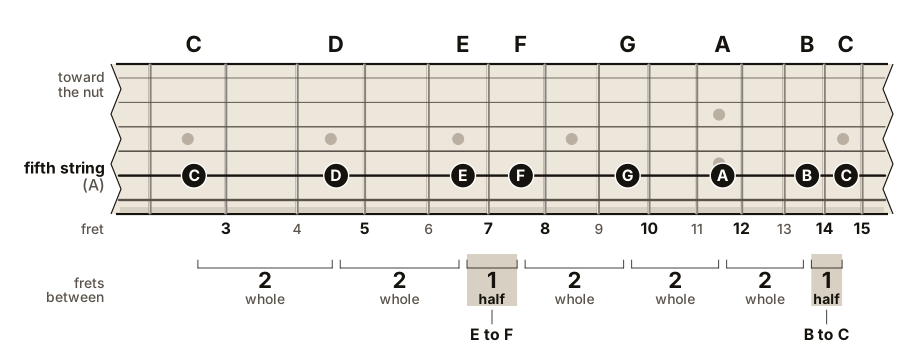
Each fret is a half step. Two frets are a whole step. So the major scale is not a ladder of equal rungs. Its pattern is:
whole, whole, half, whole, whole, whole, half
The half steps fall between the 3rd and 4th notes (mi and fa, E and F in C) and between the 7th and 8th (ti and do, B and C). Those are the two places on a keyboard where white keys sit side by side with no black key between them.
Where the pattern comes from
Chapter 6 built the scale as a chain of fifths: F, C, G, D, A, E, B. In that chain, every note is a fifth from its neighbour. But when the notes are folded into one octave and lined up in order, two kinds of gap appear between neighbours.
A whole step is two fifths up and an octave down: C to G to D, then drop the octave. Its ratio is 3/2 times 3/2, divided by 2: 9/8.
A half step is what is left when the scale has to close. From E up to F, or from B up to C, there is no chain link; the gap is simply whatever remains of the octave. Its Pythagorean ratio is 256/243, which is a bit smaller than half of a whole step.
Five whole steps and two of these small half steps make exactly one octave. Try it: (9/8) multiplied by itself five times, times (256/243) twice, comes to exactly 2. The arithmetic forces the pattern. With seven notes from a chain of fifths, you get five big steps and two small ones, and there is only one way to interleave them that keeps every note a fifth from another: the pattern above, or a rotation of it.
IN PLAIN ENGLISH: The scale has big steps and small steps because it was built from fifths, not by dividing the octave into equal parts. Seven notes from a chain of fifths always give five whole steps and two half steps, and the half steps land between E and F and between B and C.
The black keys
Now keep going up the chain of fifths past B.
A fifth above B is a note between F and G. It is not F, and it is not G; it is a half step above F. Call it F sharp. A fifth above F sharp is C sharp. Then G sharp, D sharp, A sharp. Those five new notes land, one each, in the five big gaps of the scale, the five whole steps. They are the black keys.
Eleven fifths from F give twelve notes: F, C, G, D, A, E, B, F sharp, C sharp, G sharp, D sharp, A sharp. Folded into one octave, they fill it with twelve notes, each a half step apart. That is the full set of notes on a piano, repeated up the keyboard.
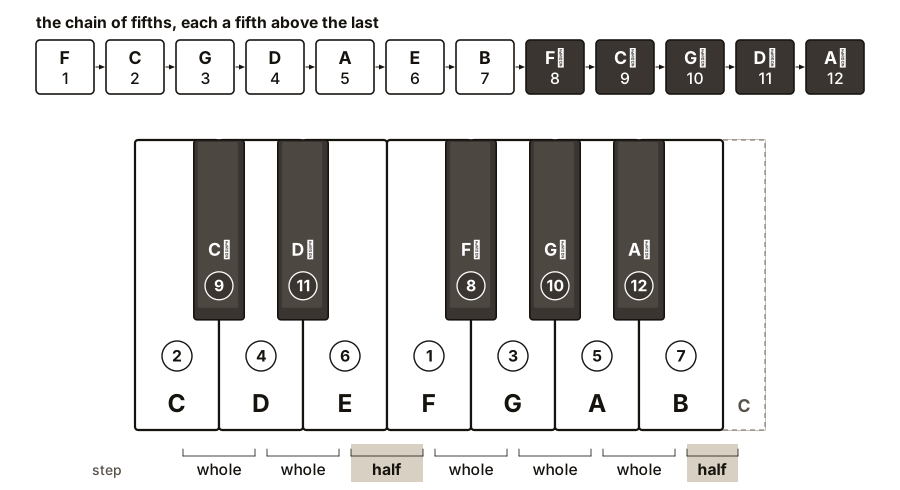
And the black keys on their own? Five notes, from five consecutive fifths. They are the pentatonic scale of Chapter 6, which is why the black keys alone always sound pleasant: there is no half step among them.
SLOW DOWN. Check Your Understanding: Start a major scale on G instead of C, using only white keys: G, A, B, C, D, E, F, G. Which step breaks the pattern, and what fixes it?
Answer: The pattern should end whole, half. From E to F is a half step and from F to G is a whole step: backwards. Raise the F by a half step to F sharp, and the steps become E to F sharp (whole) and F sharp to G (half). The G major scale needs one black key, F sharp. That is why a piece in G major has one sharp in its key signature, as Chapter 12 explains.
Every key, the same shape
That last exercise is the reason the black keys exist.
With only the seven white keys, you can play one major scale with the right pattern: the one starting on C. Start anywhere else and the half steps fall in the wrong places. Add the five black keys, and you can start the pattern on any of the twelve notes and find every step it needs. Twelve notes are what it takes to play the same scale in every key.
The keyboard did not arrive with all twelve. Medieval organs and their keyboards began with the seven naturals plus a B flat, which chant needed, and gained the other black keys over the following centuries, as music moved into keys further from C. By about 1400, keyboards had settled into the familiar pattern of seven white keys and five black in every octave.1
ON THE BENCH: Play the chain
You need: a keyboard, real or online. Time: five minutes. Hazards: none.
Steps: play the chain of fifths slowly, each note a fifth above the last, dropping an octave whenever you run out of keyboard: F, C, G, D, A, E, B. Then carry on: F sharp, C sharp, G sharp, D sharp, A sharp.
What you should hear: the first seven notes use only white keys. The eighth is the first black key, and every note after it is black too. The keyboard is the chain of fifths, folded.
The catch
There is one problem left in that chain of twelve fifths.
The chain began on F and ended, eleven fifths later, on A sharp. One more pure 3:2 fifth above A sharp ought to land back on F, the note where the chain started, some octaves higher. Twelve fifths should close into a circle.
It does not, quite. Twelve pure fifths overshoot seven octaves by a small amount, and that small amount has haunted every keyboard and every tuner since antiquity. You heard a cousin of it as the misplaced fourth fret in Chapter 1. Chapter 8 measures it.
Source to pull before print: a standard history of the keyboard (for example, the Grove article “Keyboard”) for the B flat and the dating of the full chromatic layout.↩︎

Bench Degree
Get the degree without the diploma.
Learn the material, not how to pass the exam.