Bench Degree·MUSICchapter
Chapter 6: Building a Scale from Fifths
Climb from one note in fifths, fold the results into a single octave, and the scale builds itself.
Sit at a piano and play only the black keys, in any order, with any rhythm. Whatever you do, it will sound pleasant, faintly folk-like, and impossible to get wrong. Five notes, repeated up the keyboard, and none of them clash.
That is not a trick of the piano. Those five notes are what you get from the simplest recipe for a scale there is, and peoples on every inhabited continent found it.
The recipe
Chapter 5 found that after the octave, the smoothest interval is the fifth, 3 to 2. Suppose you have one note, and you want more. The simplest thing to do is to go up a fifth from it, and then up a fifth from that, and so on.
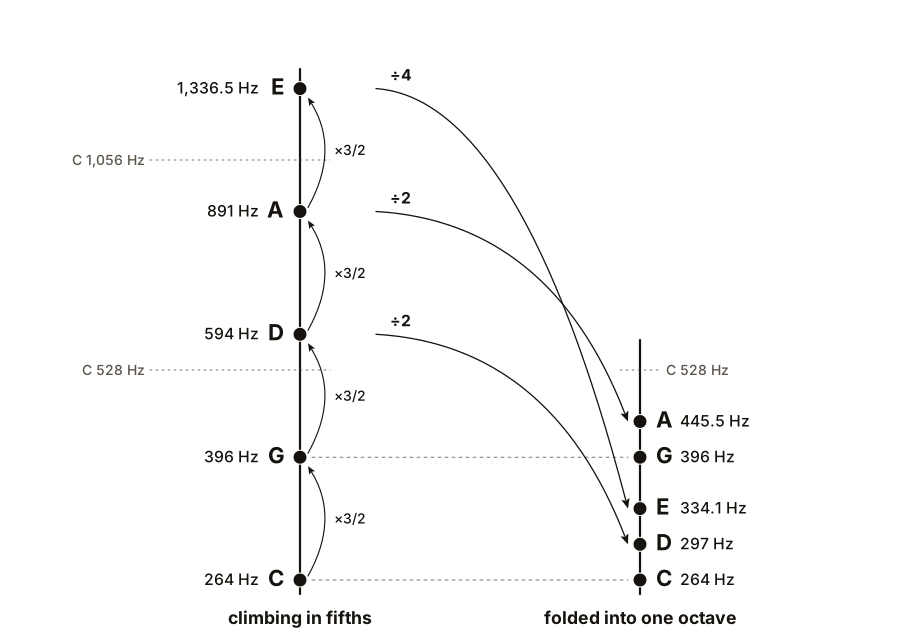
Start on C. A fifth above C is G. A fifth above G is D. Above D, A. Above A, E.
Those notes climb fast: by E you are more than two octaves above where you started. But Chapter 2 said that a note and its octave are “the same note,” so you can drop any of them by an octave, or two, and lose nothing. Fold them all back down into the octave between one C and the next, and put them in order:
C, D, E, G, A
That is a five-note scale: a pentatonic scale, from the Greek for five. Play C, D, E, G, A on the white keys and you hear the same pleasant, unclashing sound as the black keys. The black keys are the same pattern, starting on a different note.
Pentatonic scales of this shape are found in the folk music of Scotland and Ireland, in China and Japan, in West Africa, in the Andes, and in American spirituals and blues.1 They did not copy each other. They followed the same recipe, or the same ear.
Why does the pentatonic scale never clash? Look at what is missing. There is no pair of notes a half step apart. Every gap is either a whole step or a step and a half, and the roughest intervals of Chapter 5, the minor second and the tritone, cannot be made from these five notes at all.
IN PLAIN ENGLISH: Climb in fifths from one note, then drop each new note by octaves until they all sit in one octave. Five fifths give the five-note pentatonic scale. It contains no half steps and no tritones, so nothing in it grates.
Two more fifths
Keep going. A fifth above E is B. And one fifth below the starting C is F. Add those two to the five, fold them into the octave, and line them up:
C, D, E, F, G, A, B
Seven notes: the white keys of the piano, the diatonic scale. Starting on C, it is the major scale, the “do, re, mi” that every school child sings. Six fifths in a row, seven notes from F up to B, give you the whole thing: F, C, G, D, A, E, B.
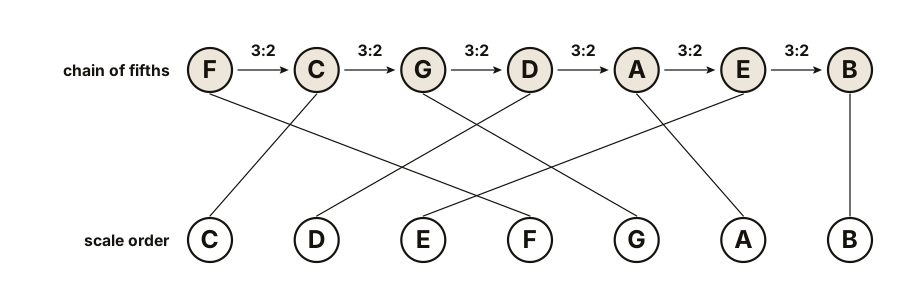
Now the scale contains two half steps, E to F and B to C, and one tritone, F to B, the two ends of the chain. Those three intervals are the source of almost all the tension in Western music, and Chapter 21 shows how composers use them. For the moment, notice that they came for free, the moment the chain reached seven.
The numbers
Because every step in the chain is exactly 3 to 2, and every fold is exactly 2 to 1, each note of the scale has an exact ratio to the C at the bottom. Work them out by multiplying by 3/2 for each fifth up, and by 1/2 for each octave down:
| Note | How you reach it | Ratio to C | Times 264 Hz |
|---|---|---|---|
| C | start | 1 | 264 |
| D | two fifths up, one octave down | 9/8 | 297 |
| E | four fifths up, two octaves down | 81/64 | 334.1 |
| F | one fifth down, one octave up | 4/3 | 352 |
| G | one fifth up | 3/2 | 396 |
| A | three fifths up, one octave down | 27/16 | 445.5 |
| B | five fifths up, two octaves down | 243/128 | 501.2 |
| C | one octave up | 2 | 528 |
This tuning is called Pythagorean, after the tradition that credits Pythagoras’s school with it. Through the Roman writer Boethius, around the year 500, it became the official tuning of medieval European music theory, and it stayed so for nearly a thousand years.2
ON THE BENCH: Mark out a Pythagorean scale
You need: the monochord from Appendix A, or a guitar string you can stop with a finger at marked points, a ruler, and a pencil or tape.
Time: twenty minutes. Hazards: none.
Steps: the vibrating length goes as one over the ratio. On a string 648 mm (25.5 in) long, mark the points where the remaining length is:
Note Fraction of length Length from the far end C (open) 1 648 mm (25.5 in) D 8/9 576 mm (22.7 in) E 64/81 512 mm (20.2 in) F 3/4 486 mm (19.1 in) G 2/3 432 mm (17.0 in) A 16/27 384 mm (15.1 in) B 128/243 341 mm (13.4 in) C 1/2 324 mm (12.75 in) Stop the string at each mark in turn and play up the scale.
What you should hear: an unmistakable “do, re, mi, fa, sol, la, ti, do.” Listen especially to the E and the B. They may strike you as bright, even a little sharp. Hold that thought.
The trouble with the third
There is a flaw in that table, and Chapter 5 already gave you the tools to see it.
The E in the Pythagorean scale is 81/64 of the C. But the sweetest major third, the one the harmonic series hands you as the step from harmonic 4 to harmonic 5, is 5/4, which is 80/64. The Pythagorean E is higher by a ratio of 81 to 80: a little more than one percent.
That small difference has a name, the syntonic comma, and it is not small to the ear. Played together, C and a Pythagorean E beat noticeably and sound restless, while C and a 5:4 E lock into the calm sound of a major third. For a music built mostly on octaves, fifths and fourths, which medieval music was, the Pythagorean scale was perfect. When composers began to want sweet thirds, around the fifteenth century, it no longer was.
SLOW DOWN. Check Your Understanding: With C at 264 Hz, a pure 5:4 major third is 330 Hz and the Pythagorean E is about 334.1 Hz. If you play each E together with the C an octave below (that is, 264 Hz), which pair beats, and about how fast?
Answer: Use the harmonic ladders. The 5th harmonic of the C is 1,320 Hz and the 4th harmonic of a 330 Hz E is also 1,320 Hz: they coincide and do not beat. The 4th harmonic of the Pythagorean E is about 1,336.5 Hz, which beats against the C’s 1,320 Hz at about 16.5 times a second. That is a fast, sour shimmer, close to the roughness of Chapter 4.
ON THE BENCH: Make up a tune that cannot go wrong
You need: a keyboard, real or online. Time: ten minutes. Hazards: none.
Steps: using only C, D, E, G and A, in any octave, improvise for two minutes. Then add F and B and keep going.
What you should hear: with five notes, nothing clashes, however careless you are. With seven, some combinations suddenly sting, especially E against F and B against C held together, and B against F. Those are the half steps and the tritone that the two extra fifths brought in.
The question
So the scale built from pure fifths gives perfect fifths and fourths and imperfect thirds. Could you build a scale from pure thirds instead? You could, and Chapter 9 does. But first there is a plainer question about the scale you have just built. Its steps are not all the same size. There are big steps and small steps, and a pattern to where they fall. Why that pattern, and what are the black keys for? That is Chapter 7.

Bench Degree
Get the degree without the diploma.
Learn the material, not how to pass the exam.