Bench Degree·MUSICchapter
Chapter 5: The Ratios You Can Hear
The intervals of music are whole-number ratios, and a ruler laid along a guitar string will show you every one.
Nearly two thousand years ago a Greek writer named Nicomachus told a story about Pythagoras. Walking past a blacksmith’s shop, the philosopher heard the hammers ringing in harmony. He went in, weighed the hammers, and found their weights in the ratios 12, 9, 8 and 6. Those ratios, the story says, were the secret of music.
The story is a beautiful one, and it is physically wrong. A hammer twice as heavy does not ring an octave lower. But the ratios in it are right, and the idea in it is right: the intervals of music are whole-number ratios. This chapter finds them for itself, with a string and a ruler, the way Pythagoras’s followers actually did.1
The monochord
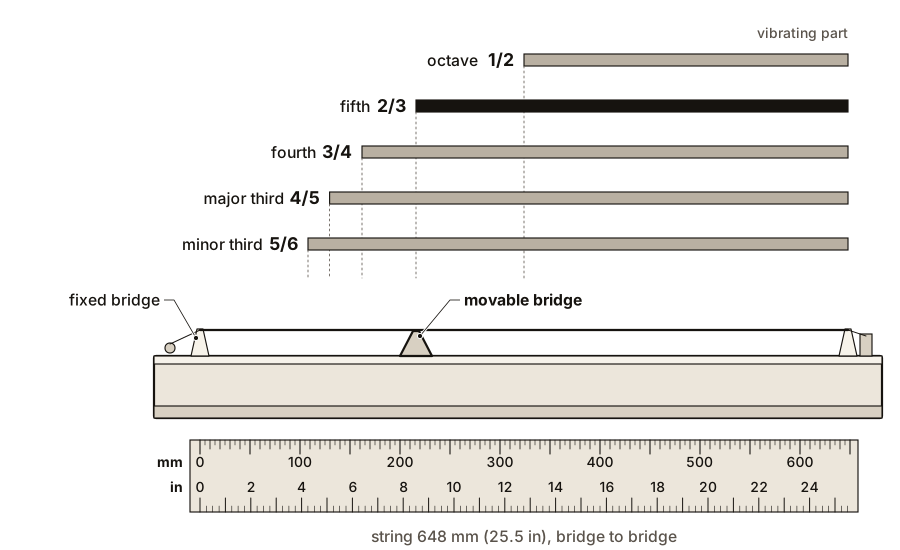
A monochord is one string stretched over a long box, with a movable bridge underneath that divides the string into two parts. It was the laboratory instrument of ancient and medieval music theory, and it is the easiest instrument in this book to build (Appendix A).
A guitar is a monochord with the bridge positions fixed in advance by the frets. Pressing a string at a fret shortens the part that vibrates. And Chapter 2 gave the rule: halve the length, double the frequency. In general, the frequency goes as one over the length, so a string cut to a fraction of its length sounds at the inverse of that fraction. Two thirds of the length sounds at three halves the frequency.
That turns every interval into something you can measure with a ruler.
ON THE BENCH: Measure the intervals
You need: a guitar (or the monochord) and a ruler or tape measure in millimeters or inches.
Cost: nothing. Time: twenty minutes. Hazards: none.
Steps: measure the vibrating length of one string, from the nut to the bridge saddle. On most steel-string guitars it is about 648 mm (25.5 in). Then press the string at each fret below in turn, and measure the length that is still free to vibrate, from the fret to the saddle. Divide by the full length.
What you should find:
Press at Vibrating fraction Closest simple ratio Interval above the open string 12th fret 0.500 1/2 octave 7th fret 0.667 2/3 fifth 5th fret 0.749 3/4 fourth 4th fret 0.794 4/5 major third 3rd fret 0.841 5/6 minor third 9th fret 0.595 3/5 major sixth 8th fret 0.630 5/8 minor sixth The first three agree with the simple fractions almost exactly. The thirds and sixths come close but not quite: the same small disagreement you found at the fourth fret in Chapter 1.
The list
Turn the fractions over, and you have the frequency ratios of the intervals. The string at two thirds of its length sounds at three halves of the frequency: 3 to 2.
| Interval | Example from C | Frequency ratio | Half steps |
|---|---|---|---|
| unison | C to C | 1 : 1 | 0 |
| minor second | C to D flat | 16 : 15 | 1 |
| major second | C to D | 9 : 8 | 2 |
| minor third | C to E flat | 6 : 5 | 3 |
| major third | C to E | 5 : 4 | 4 |
| perfect fourth | C to F | 4 : 3 | 5 |
| tritone | C to F sharp | 45 : 32 | 6 |
| perfect fifth | C to G | 3 : 2 | 7 |
| minor sixth | C to A flat | 8 : 5 | 8 |
| major sixth | C to A | 5 : 3 | 9 |
| minor seventh | C to B flat | 9 : 5 or 16 : 9 | 10 |
| major seventh | C to B | 15 : 8 | 11 |
| octave | C to C | 2 : 1 | 12 |
Every ratio in that table comes from the harmonic series of Chapter 3. The fifth is the step from harmonic 2 to harmonic 3; the fourth, from 3 to 4; the major third, from 4 to 5; the minor third, from 5 to 6. The major second, 9 to 8, is the step from harmonic 8 to harmonic 9. The intervals of music are the distances between rungs of one ladder.
The last column counts half steps, the smallest distance on a piano or guitar: one key to the very next, black or white, or one fret to the next. Chapter 7 is about why there are twelve of them in an octave.
IN PLAIN ENGLISH: Each musical interval is a pair of frequencies in a simple whole-number ratio. The octave is 2 to 1, the fifth 3 to 2, the fourth 4 to 3, the major third 5 to 4. They are the gaps between neighbouring harmonics in a single note’s ladder.
Small numbers sound smooth
Now put Chapter 4 beside the table.
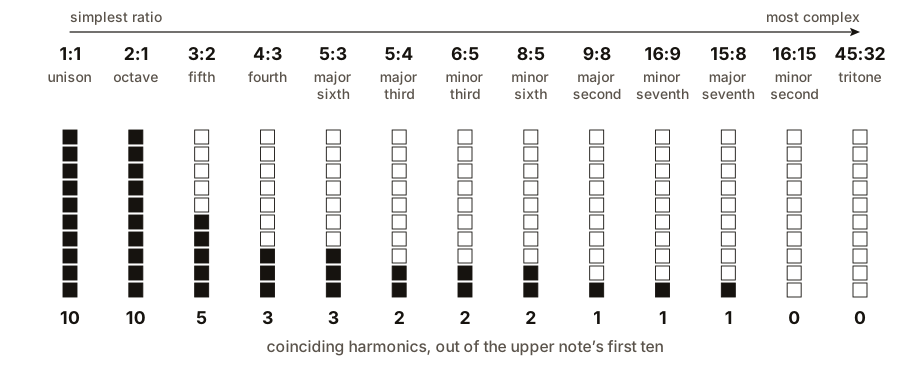
The smaller the numbers in the ratio, the more of the two notes’ harmonics coincide, and the smoother the pair sounds. So the list, read from the simplest ratios to the most complicated, is very nearly a list from the most settled intervals to the most restless:
- Octave (2:1), fifth (3:2), fourth (4:3). The perfect intervals. So smooth that medieval musicians treated them as the only true consonances.
- Major third (5:4), minor third (6:5), major sixth (5:3), minor sixth (8:5). The imperfect consonances: sweet, but with more colour. They were accepted into polyphony gradually, in the later Middle Ages, and Chapter 16 tells that story.
- Seconds, sevenths and the tritone. The dissonances. Their ratios are made of larger numbers (9:8, 16:15, 15:8, 45:32), and they want to move somewhere else.
That is not the whole story of consonance. Culture and training shape what a listener hears as settled, and Chapter 21 shows how the same chord can sound like an ending in one place and a question in another. But the physical floor is here, and you can test it.
ON THE BENCH: Rank the intervals by ear
You need: two tone generators, as in Chapter 4, set to a timbre with harmonics if the app offers one (a “sawtooth” or “square” wave, or a piano sound). Pure sine tones hide the effect.
Steps: keep one tone at 440 Hz. Set the other, in turn, to 880 (2:1), 660 (3:2), 586.7 (4:3), 550 (5:4), 528 (6:5), 495 (9:8) and 618.75 (45:32). Listen to each pair for a few seconds, and write them down in order from smoothest to roughest without looking at the ratios.
What you should find: your order will follow the size of the numbers in the ratio very closely, with the octave and fifth at the smooth end and the 9:8 and 45:32 at the rough end. Now try the same pairs with pure sine tones. The differences shrink, because a sine tone has no ladder of harmonics to clash.
Major and minor, perfect and augmented
Chapter 4 counted note names to name an interval: C to E is a third. But C to E flat is also a third, and it is a different size: three half steps instead of four, 6:5 instead of 5:4. So intervals have a second name, a quality.
- Seconds, thirds, sixths and sevenths come in two sizes, major (the larger) and minor (the smaller by one half step).
- Unisons, fourths, fifths and octaves come in one main size, called perfect.
- An interval stretched one half step beyond major or perfect is augmented; one squeezed a half step below minor or perfect is diminished. The tritone, six half steps, is an augmented fourth (C to F sharp) or a diminished fifth (C to G flat), depending on how it is spelled.
SLOW DOWN. Check Your Understanding: On a guitar tuned normally, the second string (B) is a major third above the third string (G), while every other pair of neighbouring strings is a perfect fourth apart. How many frets apart are the same notes on those two strings?
Answer: A major third is four half steps, so a note on the G string at fret n appears on the B string at fret n minus 4. Between all the other neighbouring strings, a fourth is five half steps, so the difference is five frets. That one odd pair is why chord shapes change as they cross from the G string to the B string, the bane of every beginner.
The question the list raises
The table above has a problem in it, and you may already have seen it.
The ratios are simple, but they do not fit together. Twelve half steps make an octave, and the octave is exactly 2 to 1. But the half steps in the table are not all the same size. Some ratios, like the minor seventh, have two candidates. And the guitar’s frets, which are all spaced by one rule, matched the fifth and fourth almost exactly but missed the thirds.
Where did the notes of the scale come from, and how did anyone choose which ones to keep? The oldest answer, and still the clearest, is to build them out of fifths. That is Chapter 6.
Nicomachus of Gerasa, Manual of Harmonics, chapter 6. Source to pull before print: a standard English translation, and Vincenzo Galilei’s Discorso (1589) showing why the hammer and weight stories fail.↩︎

Bench Degree
Get the degree without the diploma.
Learn the material, not how to pass the exam.