Bench Degree·MUSICchapter
Chapter 4: Beats, Roughness and Why Two Notes Fight
Two notes almost alike will pulse against each other. That pulse explains why some chords sound sweet and others grate.
Guitarists tune by a sound most of them never think about. Play two strings that should be the same note, and if they are slightly off, the sound pulses: wah, wah, wah. Turn the peg, and the pulse slows. When it stops, the strings agree.
That pulse is the most useful sound in music, and it explains why some notes sound sweet together and others grate.
Two notes, almost the same
ON THE BENCH: Hear two tones beat
You need: two tone generators playing at once: a free app with two channels, or a free online tone generator open in two browser tabs.
Cost: nothing. Time: five minutes. Hazards: keep the volume moderate, especially in headphones.
Steps:
- Set both tones to 440 Hz. You hear one steady tone.
- Raise one to 441 Hz. The sound now swells and fades once every second.
- Try 442 Hz: twice a second. Then 444 Hz: four times.
- Keep going: 450, 460, 470, 490, 530 Hz. Listen to what the pulsing turns into.
What you should hear: at a difference of a few hertz, a slow, clean pulsing. Somewhere past about 10 Hz apart the pulse is too fast to count and becomes a buzzing, sour roughness. Past about 80 to 100 Hz apart the roughness fades, and you hear two separate notes.
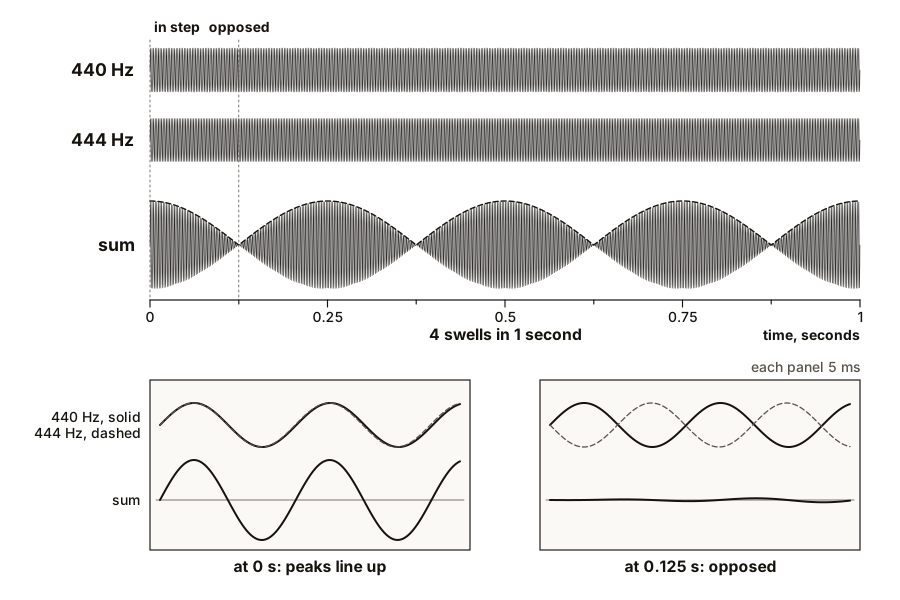
The pulse is called a beat, and its rate is simple: the beat rate is the difference between the two frequencies. 440 and 441 beat once a second. 440 and 444 beat four times. The reason is in the drawing. Two waves at slightly different rates drift in and out of step. When they are in step their swings add up, and the sound is loud. Half a beat later they are out of step, one pushing while the other pulls, and the sound nearly vanishes.
ON THE BENCH: Tune a guitar by beats
Steps: press the low E string at the fifth fret, which should give an A, and pluck it together with the open A string next to it. If you hear a pulse, the two are not the same. Turn the A string’s peg slowly. If the pulse speeds up, turn the other way. When it slows to nothing, the two strings agree to within a fraction of a hertz, better than many cheap tuners.
From pulse to roughness
The second half of that first experiment is the important one.
Slow beats sound like a wobble. Fast beats do not sound like beats at all. They blur into a rasping, unpleasant quality, a kind of acoustic sandpaper, which is called roughness. Roughness is strongest when two tones are a little apart, and it disappears again when they are far enough apart for the ear to hear them as two separate notes.
The German physicist Hermann von Helmholtz proposed in 1863 that this roughness is what musicians mean by dissonance.1 A century later, in 1965, two Dutch researchers, Reinier Plomp and Willem Levelt, measured it with listeners and pure tones. They found that two pure tones grate most when they are about a quarter of a critical band apart, a width that depends on pitch. In the middle of the piano that harshest gap comes to roughly 20 to 30 Hz.2
IN PLAIN ENGLISH: Two tones a few hertz apart pulse at the difference between them. A little further apart, the pulse turns into a harsh buzz. Far enough apart, the buzz goes away and you hear two clean notes. The buzz is what the ear calls dissonance.
So why does a fifth sound sweet?
Here is the puzzle. The G above middle C and middle C itself are far apart, about 130 Hz. By the rule you just found, two pure tones that far apart should not fight at all. And yet some wide pairs of notes, like a C and the F sharp above it, sound tense and sour, while a C and the G above it sound settled and sweet.
The answer is in Chapter 3. Real musical notes are not pure tones. Each one is a ladder of harmonics, and when two notes sound together, every rung of one ladder can beat against every rung of the other.
Take the fifth, C and G, whose frequencies stand in the ratio 2 to 3. Write out their ladders, using the C as 2 and the G as 3 so that everything stays whole:
| C, harmonics | 2 | 4 | 6 | 8 | 10 | 12 |
|---|---|---|---|---|---|---|
| G, harmonics | 3 | 6 | 9 | 12 |
Wherever the two ladders share a rung, at 6 and 12, the rungs are exactly the same frequency and cannot beat. Wherever they do not share one, the nearest rungs are well apart, too far apart to grate. The two ladders mesh.
Now take a pair whose ratio is not simple, such as the C and F sharp of a piano, about 1 to 1.414. Their rungs never coincide. Instead, again and again, a rung of one lands a little to the side of a rung of the other: just the distance that produces roughness. The ladders grind.
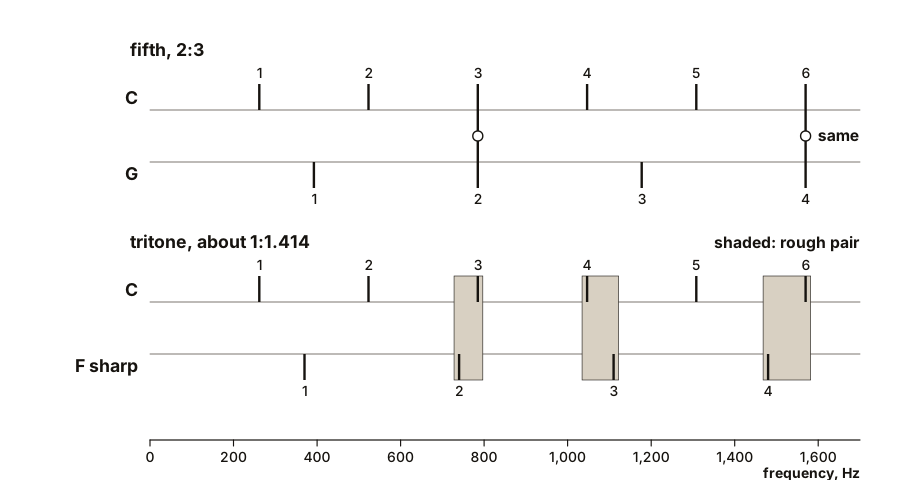
That is the heart of the matter. Notes sound smooth together when their harmonics coincide or stay well apart, and that happens when their frequencies stand in small whole-number ratios. The simpler the ratio, the more rungs coincide and the smoother the sound. The octave, 1 to 2, is smoothest of all, because every rung of the upper note is a rung of the lower. The fifth, 2 to 3, is next. Chapter 5 works down the list.
SLOW DOWN. Check Your Understanding: Why do two notes an octave apart almost never sound rough, even on a cheap instrument?
Answer: Every harmonic of the upper note, at 2, 4, 6… times the lower fundamental, is also a harmonic of the lower note. The ladders share every rung of the upper one, so nothing is left to beat. If the octave is slightly mistuned, those shared rungs beat slowly, and that is exactly how a piano tuner hears an octave that is off.
Counting the distance: thirds, fifths and sevenths
Musicians do not name the distance between two notes in hertz. They count note names, and they count both ends.
From C up to E you pass through C, D and E: three note names, so the distance is a third. From C up to G you pass C, D, E, F, G: five names, a fifth. From C up to B, seven names: a seventh. C up to the next C is eight names, which is why it is called an octave, from the Latin for eight.
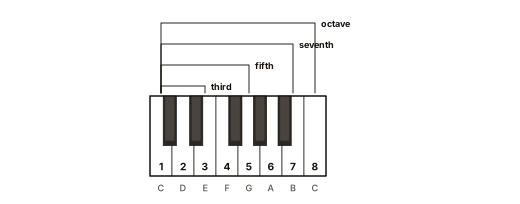
Counting both ends looks odd at first: a fifth plus a fourth makes an octave, though 5 plus 4 is 9. It is the old way, and it has stayed. Chapter 5 sorts out the sizes, because two “thirds” are not always the same distance. For now the names are enough to ask the next question: which ratios do these distances correspond to, and how did anyone find out? That is Chapter 5.

Bench Degree
Get the degree without the diploma.
Learn the material, not how to pass the exam.