Bench Degree·MUSICchapter
Chapter 3: The Harmonic Series
Every steady musical sound is a ladder of notes stacked on one another. A bugle can play nothing else.
In Chapter 1 a fingertip let four bells out of one string. Here is where they were hiding, and why the list does not stop at four.
The string does several things at once
When you pluck a string, it does not simply swing back and forth in one smooth arc like a skipping rope. It does that, and at the same moment it does several other things.
It swings as a whole. That is the slowest motion and usually the strongest, and it sets the note you name.
At the same time it swings in two halves, with a point in the middle that hardly moves. That motion is twice as fast.
At the same time it swings in three parts, with two nearly still points, three times as fast. And in four parts, and five, and six, and on upward, each one fainter than the last, all on one piece of wire.
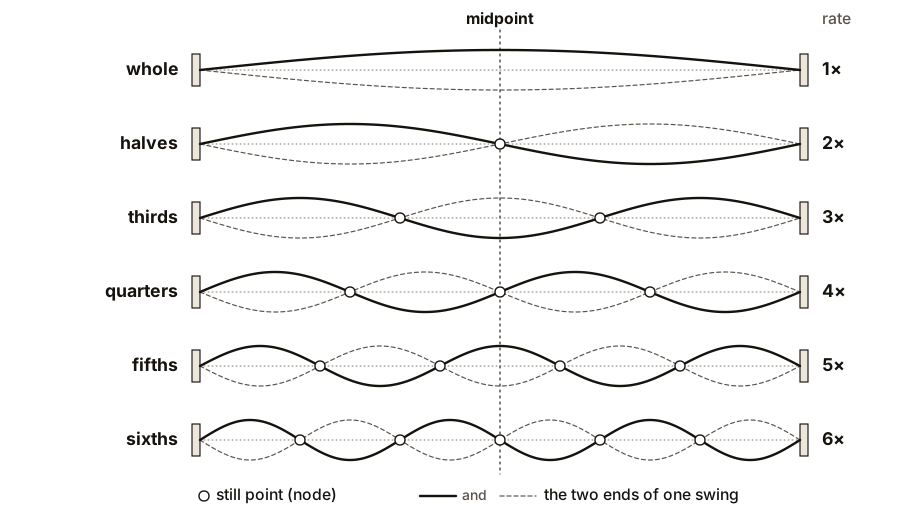
The still points are called nodes. They explain your fingertip.
A light touch at the midpoint can only stop motions that need the midpoint to move. The whole-string swing needs it, so it dies. The swing in halves has a node right there, so it does not care, and it rings on. So does the swing in quarters, and in sixths, and every even division. What you heard over the twelfth fret was all of those together, and the loudest of them is the swing in halves: twice the frequency, the octave.
Touch at a third of the way along, and only motions with a node there survive: the swing in thirds, sixths, ninths. The loudest is the swing in thirds, three times the frequency. And so on down the list.
IN PLAIN ENGLISH: A plucked string swings as a whole and, at the same time, in halves, thirds, quarters and smaller pieces, each at a whole-number multiple of the lowest rate. A light touch silences every motion that needs that spot to move, and lets the rest ring.
The ladder
Each of those motions makes its own note, at a whole-number multiple of the lowest one. The lowest is called the fundamental. The others are the harmonics, or overtones. Together, in order, they form the harmonic series.
Start the series on a low C, at about 65 Hz, and give each member its nearest note name:
| Harmonic | Times the fundamental | About | Nearest note |
|---|---|---|---|
| 1 | 1 | 65 Hz | C |
| 2 | 2 | 131 Hz | C, an octave up |
| 3 | 3 | 196 Hz | G |
| 4 | 4 | 262 Hz | C (middle C) |
| 5 | 5 | 327 Hz | E |
| 6 | 6 | 392 Hz | G |
| 7 | 7 | 458 Hz | B flat, but noticeably low |
| 8 | 8 | 523 Hz | C |
| 9 | 9 | 589 Hz | D |
| 10 | 10 | 654 Hz | E |
| 11 | 11 | 719 Hz | between F and F sharp |
| 12 | 12 | 785 Hz | G |
| 13 | 13 | 850 Hz | between A flat and A |
| 14 | 14 | 916 Hz | B flat, low |
| 15 | 15 | 981 Hz | B |
| 16 | 16 | 1,046 Hz | C |
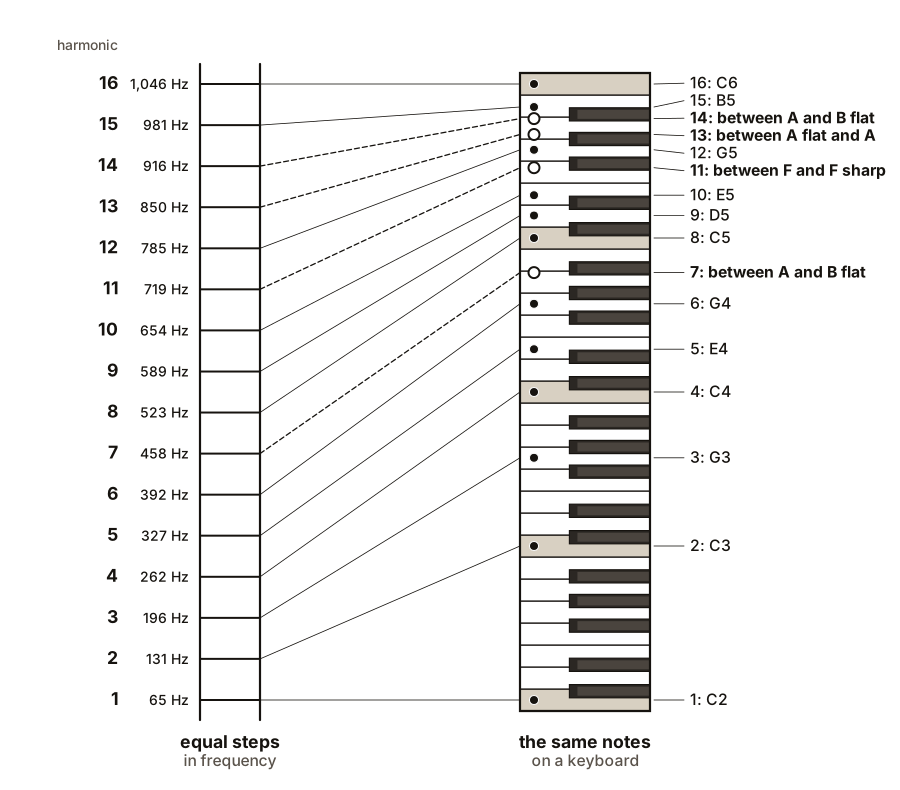
Three things in that table are worth a long look.
The gaps shrink. From harmonic 1 to 2 is an octave. From 2 to 3 is a fifth. From 3 to 4, a fourth. From 4 to 5, a major third; from 5 to 6, a minor third. Higher up the steps become whole steps, then half steps, then smaller still. The series starts with the widest intervals in music and works its way down to the narrowest.
The first six spell a major chord. C, C, G, C, E, G: nothing but C, E and G. That is the chord you found in one string in Chapter 1, and here it is again, written out.
Some harmonics fit no piano key. The 7th lands between A and B flat, the 11th between F and F sharp. They are perfectly real; you can hear them on a string. The keyboard simply does not contain them. Most of Western music has been built from the first six harmonics and their combinations, and has left the 7th and 11th outside. Chapter 20 meets the 7th again, in disguise.
SLOW DOWN. Check Your Understanding: The open D string of a guitar is about 147 Hz. Which harmonic of it is an A, and at what frequency?
Answer: The 3rd harmonic, three times the fundamental, is a fifth above the 2nd: about 441 Hz, the A above middle C. Touch the D string over the seventh fret and check it on a tuner. (The 6th harmonic, about 882 Hz, is the next A.)
Why a flute and a violin differ
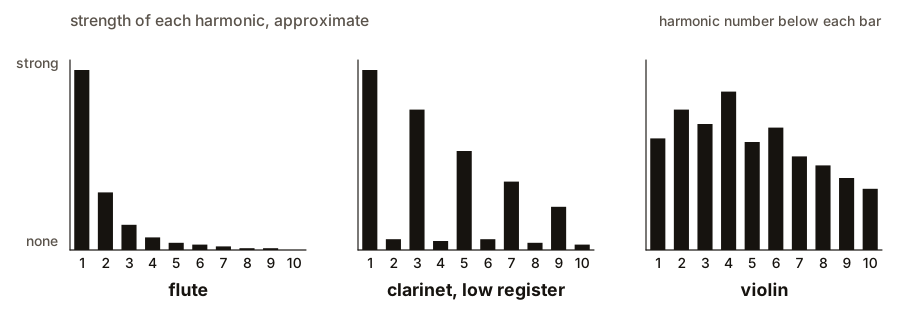
Every instrument that plays a steady pitch makes a harmonic series. What differs is how loud each harmonic is.
A flute’s sound has a strong fundamental and only faint harmonics above it, so it sounds pure and round. A violin has strong harmonics high up the ladder, which give it its bite. An oboe is rich in the middle of the ladder. A clarinet, in its low register, is strong in the odd harmonics, the 1st, 3rd and 5th, and weak in the even ones, which gives it a hollow, woody sound.
That recipe, how much of each harmonic, is called timbre (pronounced “TAM-ber”). It is how you can tell a trumpet from a voice singing exactly the same note at exactly the same loudness. The pitch is the fundamental. The character is the ladder above it.
ON THE BENCH: Change the timbre of one string
You need: a guitar or your monochord; optionally a free spectrum-analyzer app for your phone (search for “spectrum analyzer”; several free ones show the harmonics as peaks).
Cost: nothing. Time: ten minutes. Hazards: none.
Steps:
- Pluck the open G string exactly over the twelfth fret, at the middle of the string. Listen.
- Pluck it again close to the bridge, about 25 mm (1 in) from where it ends. Listen.
- If you have the app, hold the phone near the guitar and watch the peaks for each pluck.
What you should hear: the pluck at the middle sounds soft and round, almost flute-like. The pluck near the bridge sounds bright and thin. Same string, same note, same loudness, different timbre.
Why: plucking at the middle starts the string at the one place where the even harmonics have a node, so they barely get going. Plucking near the end excites the whole ladder. On the app, the middle pluck shows weak peaks at 2, 4 and 6 times the fundamental; the bridge pluck shows a long row of peaks.
The bugle: a series you can play
Some instruments play almost nothing but the harmonic series.
A bugle is a coiled brass tube with a mouthpiece and no valves. The player cannot change the length of the tube, so the player cannot choose any note at will. By tightening the lips, the player can only make the air column in the tube swing at its 2nd, 3rd, 4th, 5th or 6th harmonic. Those are the only notes it has.
That is why every bugle call is built from the same few notes, the notes of a major chord: in C, the G, C, E and G of harmonics 3 to 6. Military calls, hunting calls and the post horn all live inside that ladder. Before valves were added to brass instruments in the early nineteenth century, a trumpet or horn player who wanted more notes had to play very high up the series, where the rungs are close together. That is why Baroque trumpet parts sit so high and sound so brilliant. Chapter 26 returns to it.1
IN PLAIN ENGLISH: Every steady musical sound is a ladder of harmonics: the fundamental, then 2, 3, 4, 5 times it and upward. The fundamental sets the pitch. How strong each rung is sets the timbre. The first six rungs spell a major chord, and a bugle can play nothing else.
ON THE BENCH: Climb higher up the ladder
You need: a guitar and a tuner app. Time: ten minutes. Hazards: none.
Steps: on the open G string (196 Hz), touch lightly at one sixth of the string, about 108 mm (4.25 in) from the nut, just past the third fret wire on the bridge side. Then at one eighth, about 81 mm (3.2 in) from the nut, a little past the second fret.
What you should find: the sixth harmonic, about 1,176 Hz, which the tuner calls D; and the eighth, about 1,568 Hz, a G three octaves above the open string. They are fainter than the first four, because the higher rungs of the ladder carry less energy, and they sit closer together on the string, because the rungs crowd together as they climb.
Who noticed
Mersenne, the friar from Chapter 2, heard the higher notes in a single string in the 1630s and was puzzled by them. In 1701 the French mathematician Joseph Sauveur gave them their names, sons harmoniques, and named the still points nœuds: nodes.2
What none of them could yet say was why some combinations of notes sound smooth and others sound harsh. The harmonic series holds the answer, and it shows up as a sound you can hear wobble. That is Chapter 4.
Source to pull before print: a standard history of brass instruments for the date of valves (about 1814 to 1818, Stölzel and Blühmel) and the clarino register.↩︎
Source to pull before print: Sauveur, Mémoires de l’Académie royale des sciences (1701); Mersenne, Harmonie universelle (1636), on the higher sounds in a single string.↩︎
Bench Degree
Get the degree without the diploma.
Learn the material, not how to pass the exam.