Bench Degree·MUSICchapter
Chapter 2: Pitch and the Octave
Double the speed of a vibrating string and every musician on earth will call it the same note. Nobody can say in one sentence why.
The first bell you let out of the string in Chapter 1 sounded at twice the frequency of the open G, and the tuner still called it G. Every musician alive would agree with the tuner. Nobody can say, in one sentence, why.
This chapter builds the floor the rest of the book stands on: what a note is, what makes it higher or lower, and the strange fact that doubling a note gives you the same note back.
A note is a rate
Pluck a string and it moves away from where it was resting, swings back, overshoots, and swings back again, over and over until friction stops it. Each swing pushes on the air beside it, and that push travels to your ear.
A note is the rate of those swings. Not their size, not their shape: how many complete round trips happen each second. The unit is the hertz, written Hz, and one hertz is one round trip per second.
The open G string of a guitar makes 196 round trips a second. The A string below it makes 110. The A that orchestras tune to makes 440. The lowest note of a large church organ is about 16 Hz, felt in the chest as much as heard. The top note of a piano is 4,186 Hz.
ON THE BENCH: Watch a note happen slowly
You need: a rubber band, an open shoebox or jar, and a phone with a slow-motion camera (most phones from the last ten years have one).
Cost: nothing. Time: five minutes. Hazards: none.
Steps: stretch the band over the open box so it can vibrate freely. Pluck it, and film at the highest frame rate the phone offers, usually 240 frames per second.
What you should see: on playback the band is not a blur but a shape, swinging from one side to the other and back. Pluck it gently and film it; pluck it hard and film it again. The swing gets wider. The rate does not change.
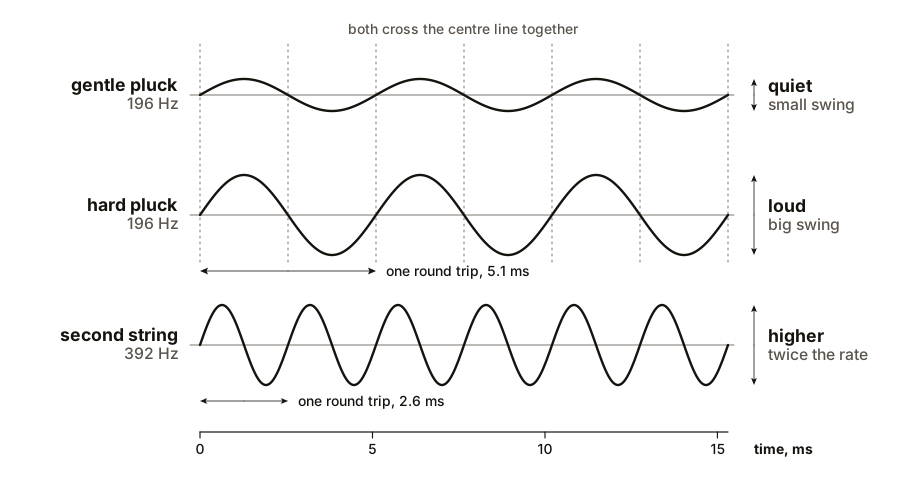
That experiment separates the two things a careless ear runs together. How far the string swings is loudness. How often it swings is pitch. Pluck harder and the note gets louder, not higher. They are independent, and the rest of this book is almost entirely about the second one.
What sets the rate
Three things decide how fast a stretched string swings, and you can feel all three on a guitar.
Length. Halve the vibrating length and the rate doubles. That is what a fret does: pressing a string down shortens the part that is free to swing. It is also why your fingertip at the midpoint in Chapter 1 gave a note at twice the rate.
Tension. Tighten the string and the pitch rises. That is what a tuning peg does.
Weight. A heavier string swings more slowly at the same length and tension. That is why the low strings on a guitar are thick and wound with wire. A plain string long enough to reach the low E would not fit in a room.
The French friar Marin Mersenne set out these three rules in 1636, in a large book called Harmonie universelle, and he went further: he worked out the actual number of swings per second of a real string, which nobody had done.1
IN PLAIN ENGLISH: A note is a number: how many times per second something swings. Shorter, tighter or lighter strings swing faster and sound higher. Plucking harder makes a note louder, never higher.
The strange fact: twice as fast sounds the same
Play a note at 220 Hz. Then play one at 440 Hz, exactly twice as fast. Ask anyone whether these are the same note, and they will say yes, one higher than the other. A musician will call it the same note “an octave up.”
But they are not the same. One swings twice as fast as the other. Nothing else in our senses behaves like this. Light at twice the frequency of red is not “red again, higher”: it lies beyond violet, out of sight altogether.
Yet almost every musical tradition that has been studied treats a doubling of frequency as a kind of sameness. Men and women singing “the same” tune together usually sing an octave apart without noticing. Note names repeat at every doubling. This is called octave equivalence. It is very widespread, though researchers have found listeners in at least one culture who hear it only weakly, which suggests that part of it is learned and part of it is built in.2
Chapter 1 already showed you the reason it is not arbitrary. A note at 220 Hz contains, among the bells hiding inside it, a quieter note at 440. When the two sound together, every bell of the higher note lines up with a bell of the lower one. They agree so completely that the ear hears them as one family. Chapter 4 takes that idea apart and shows why it explains far more than the octave.
Names that repeat
That sameness is why music needs only a handful of note names.
In English the names are seven letters, A B C D E F G, and after G they start again at A, one octave higher. The black keys of a piano fill gaps between some of the letters, and get names like C sharp or B flat; Chapter 7 explains why the gaps fall where they do.
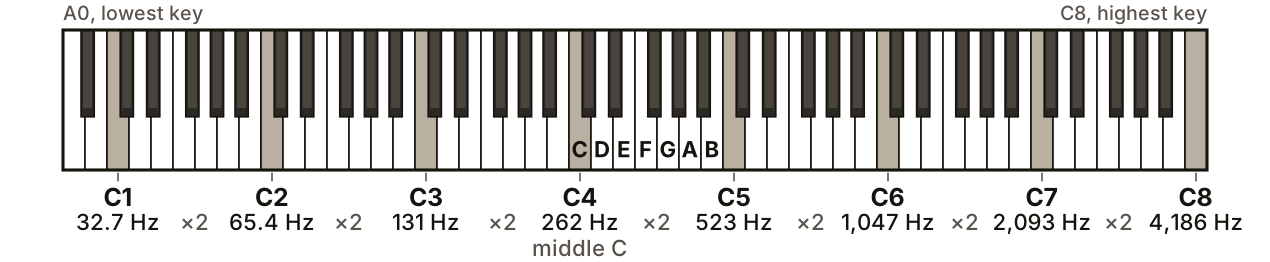
To say which copy of a note you mean, musicians add a number. Middle C, near the centre of the piano, is C4, at about 262 Hz. The A just above it is A4, at 440 Hz. Each step down in number halves the frequency, so A3 is 220 Hz, A2 is 110 Hz (the guitar’s fifth string) and A1 is 55 Hz. Each step up doubles it.
SLOW DOWN. Check Your Understanding: The guitar’s open G string is G3, at 196 Hz. What is G4, and what is G2?
Answer: G4 is double, 392 Hz: the bell over the twelfth fret in Chapter 1. G2 is half, 98 Hz, which is lower than any open string on a standard guitar.
How finely can you hear?
The rest of this book hands you ratios, some of them separated by differences of a percent or less. Before trusting any of them, find out what your own ears can resolve.
ON THE BENCH: Find your own resolution
You need: a phone or computer that can play two tones at once. A free tone-generator app, or two copies of a free online tone generator in two browser tabs, will do.
Cost: nothing. Time: ten minutes.
Hazards: start quiet. A pure tone through headphones is more harmful than it sounds, because it lacks the harshness that normally warns you to turn it down.
Steps: set one tone to 440 Hz and leave it. Set the other to 440 Hz too. Play them one after the other, never together, and raise the second 1 Hz at a time until you are sure the two are different. Then repeat with both starting at 110 Hz, and again at 3,000 Hz.
What you should find: most people hear a difference somewhere between 1 and 3 Hz at 440, about a quarter of one percent. Resolution is best in the middle of the range, near where speech lives, and worse at the extremes.
Write your three numbers in the margin. Chapter 8 asks you to hear a difference of about one and a quarter percent. You will almost certainly be able to.
A word on 440
Why should the A above middle C be 440 Hz and not some other number? Nothing in nature fixes it. It is an agreement, made and remade over two centuries, and argued over loudly today. The history of that agreement, and the claims made for tuning to 432 Hz instead, belong to Cymatics, Chapter 26, which tests them at the bench. For this book only one fact matters: everything that follows works the same at any reference pitch, because music is built from ratios, not from particular numbers. Chapter 12 shows why.
What those ratios are, and why some of them sound smooth and others harsh, begins with the bells inside a single note. That is Chapter 3.

Bench Degree
Get the degree without the diploma.
Learn the material, not how to pass the exam.