Bench Degree·MUSICchapter
Chapter 1: One String Is a Chord
Four bells are hiding in one guitar string, and together they make a chord. Ten minutes and a fingertip will let them out.
Pick up a guitar. Pluck the third string, the G, and let it ring. You hear one note.
Now pluck it again, and while it rings, rest a fingertip on it, barely touching, directly over the twelfth fret. Do not press it down. Lift the finger away almost as soon as it lands. The low note vanishes, and a clear, bell-like tone rings on in its place, higher than the one you started with.
Do it again a little closer to the head of the guitar, over the seventh fret. A different bell, higher still. Over the fifth fret, another, higher again. And just on the head side of the fourth fret, one more.
Four bells came out of one string that was supposed to play one note. Now play them one after another, slowly: twelfth, seventh, fifth, fourth. Then strum an ordinary G major chord, one of the first chords a guitarist learns.
They are the same notes.
The chord you may have strummed a thousand times was inside a single string the whole time, waiting for a fingertip to let it out. Nobody designed that. Nobody voted on it. It is what a stretched string does, and this book exists to follow that fact all the way from one string to a Bach fugue.
ON THE BENCH: The chord in the string
You need: any guitar, steel or nylon strings. A ukulele works too (see below). A phone with a free tuner app.
Cost: nothing, if you own the instrument. About $15 for the homemade monochord in Appendix A if you do not.
Time: ten minutes.
Hazards: none worth the name. Do not tighten a string far past its normal pitch to “get a better harmonic”; a snapping string can cut a fingertip and will sting an eye.
Steps:
- Tune the guitar normally. Open the tuner app and pluck the third string alone. The app should read G, at about 196 Hz.
- Pluck the string firmly near the bridge, close to where the strings leave the body. Harmonics come out best from a pluck near the end of the string.
- Touch the string lightly, exactly above the twelfth fret wire, not between the frets. Touch, then lift within half a second. Read the tuner.
- Repeat over the seventh fret wire, then the fifth, then a few millimeters (about an eighth of an inch) toward the head from the fourth fret wire. Read the tuner each time.
What you should see:
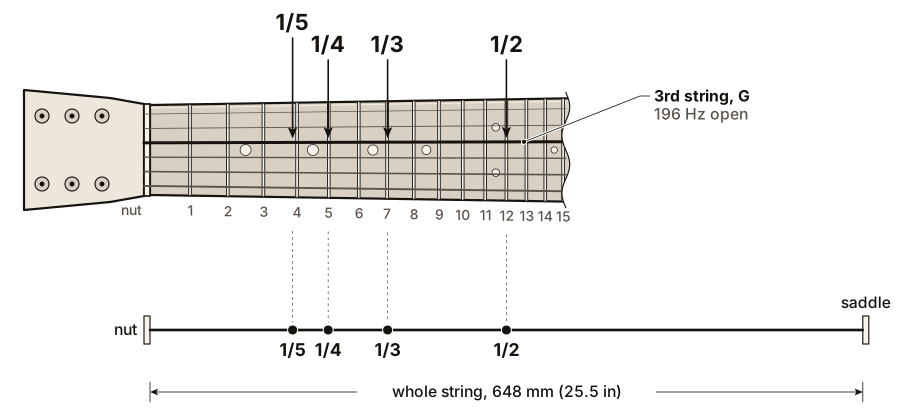
Touch over Fraction of the string Tuner reads About (open) whole G 196 Hz 12th fret 1/2 G, one octave up 392 Hz 7th fret 1/3 D 588 Hz 5th fret 1/4 G, two octaves up 784 Hz just short of the 4th fret 1/5 B 980 Hz The tuner may read the last one as slightly flat of B. Note how flat. That small disagreement will matter in Chapter 8.
If it did not work: you pressed too hard, and fretted the note instead of touching it; or you held the finger on too long, and smothered the bell; or you touched between the frets instead of over the fret wire. The touch is lighter than you expect. A feather-weight tap is right.
What just happened
Count the notes again, and look at the fractions.
Touching the string at half its length gave a note at twice the open string’s frequency: 392 against 196. Touching it at a third gave three times: 588. At a quarter, four times: 784. At a fifth, five times: 980.
The pattern is exact, and it does not depend on the guitar, the string, or the player. Touch any string at 1/n of its length and you get n times its frequency.
The fingertip is not making these notes. A finger cannot make a note; it can only stop one. What it is doing is silencing every way of vibrating that needs that point of the string to move, and leaving alone the ways that do not. The notes that survive were already there, sounding all along underneath the open G, too quiet and too blended to pick out. Chapter 3 shows exactly why, and draws the string doing all of it at once.
IN PLAIN ENGLISH: A plucked string does not play one note. It plays a whole family of notes at once, at 1, 2, 3, 4, 5 times the lowest frequency and on upward. You normally hear them blended into a single sound. A light touch at 1/2, 1/3, 1/4 or 1/5 of the string lets one family member through on its own.
The family is a chord
Now put names to the notes, the way a musician would.
The open string is a G. The note at twice the frequency is also a G, one octave higher; Chapter 2 explains why doubling a frequency gives “the same note” again. Four times is a G once more, two octaves up.
That leaves the two that are not G. Three times the frequency is a D. Five times is a B.
G, B and D are the three notes of a G major chord. Strum an ordinary open G chord and those are the only three note names in it, repeated in different octaves across six strings.
So the most common chord in Western music, the major chord, is built from the first five members of the family that every plucked string plays by itself. Its notes stand to each other in the ratios 4 : 5 : 6: the fourth, fifth and sixth members of the family, side by side.
SLOW DOWN. Check Your Understanding: The open fifth string of a guitar is an A, at 110 Hz. What notes, and what frequencies, should you get by touching it over the twelfth, seventh, fifth and fourth frets?
Answer: Multiply by 2, 3, 4 and 5. Over the twelfth fret, 220 Hz, an A. Over the seventh, 330 Hz, an E. Over the fifth, 440 Hz, an A again. Just before the fourth, 550 Hz, a C sharp. A, C sharp and E are the notes of an A major chord. Try it, and check each one on the tuner.
ON THE BENCH: The same thing on a ukulele
Tune normally and use the first string, the A nearest the floor, at 440 Hz. Touch over the twelfth, seventh and fifth fret wires, and just toward the head from the fourth. You get 880 Hz (A), 1,320 Hz (E), 1,760 Hz (A) and 2,200 Hz (C sharp): an A major chord, an octave higher than the guitar’s. The ukulele’s scale is shorter, about 330 mm (13 in) against the guitar’s 648 mm (25.5 in), so the touch points sit closer together, but the fractions are the same.
The frets were placed by a different rule
Look back at the table, and at where your finger went.
The twelfth fret sits at exactly half the string. On a guitar with a 648 mm (25.5 in) scale, that is 324 mm (12.75 in) from the nut. The seventh fret sits a third of the way along, within a fraction of a millimeter. The fifth fret sits a quarter of the way along, almost exactly.
But the fourth fret does not sit at a fifth of the string. A fifth of 648 mm is 130 mm (5.1 in). The fourth fret wire is at about 134 mm (5.3 in). That is why the instructions said to touch a little before it: the harmonic and the fret disagree by about 4 mm (0.16 in).
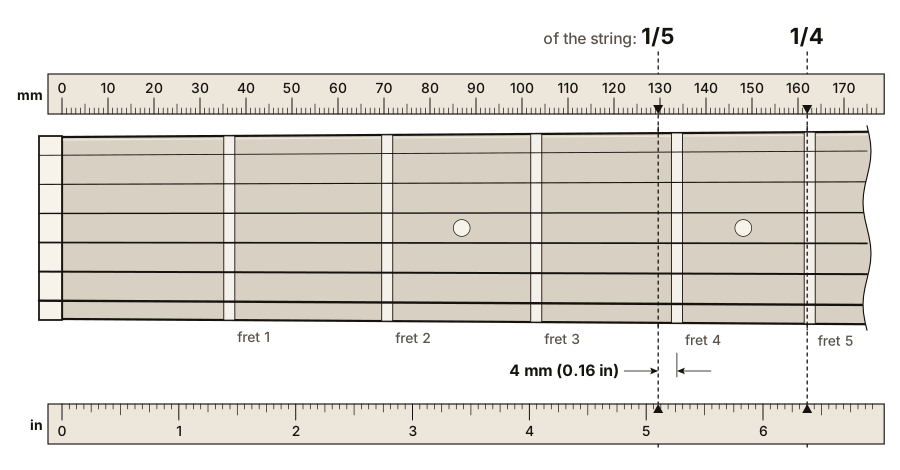
Four millimeters (a sixth of an inch) sounds like nothing. It is the difference you heard when the tuner called that last harmonic slightly flat of B. The string’s own B, the one nature puts at five times the frequency, is not quite the B the guitar’s frets give you.
That is not a fault in your guitar. The frets were placed by a rule designed to let you play in every key, and that rule had to give up the string’s exact thirds to do it. Every piano, every guitar and every electronic keyboard you have heard makes the same small compromise. Why it had to, and how musicians fought over it for two hundred years, is the subject of Chapters 8 and 9, and it is the real answer to what was “well tempered” about Bach’s Well-Tempered Clavier.
What this book will and will not do
This book will not teach you to play an instrument or to sing, and it does not pretend to. Nobody learns music from a page. What it will do is show you the machinery underneath the music you already love, one piece at a time, with an experiment for every step. You need very little equipment: a guitar or ukulele, or a homemade one-string instrument; a phone with a tuner and a tone-generator app; and a free online keyboard. Appendix A lists all of it.
By the end you should be able to sit at a keyboard and do the following:
- Play a major chord and say, in whole numbers, why it sounds smooth and why some other pairs of notes do not.
- Build a major scale out of nothing but the string’s own intervals, and say why its steps are uneven.
- Explain what Bach’s keyboard was tempered to, and why it was not tuned the way a modern piano is.
- Play a scale in one of the old church modes and say how it differs from a minor scale.
- Write a short piece of two-voice counterpoint that a sixteenth-century choirmaster would accept.
- Hear a continuous bass line under a piece of music, name it, and say within twenty years when that way of writing arrived.
- Follow a movement in sonata form and say where its second theme and its return begin.
Each of those is a test, and every chapter moves toward one of them.
The questions the string just asked
One string handed you a chord. It also handed you a list of questions, and they are the plan of this book.
Why do these particular notes sound good together? The family of notes in a string came in whole-number ratios, 2 to 1, 3 to 2, 5 to 4. Is that why a major chord sounds settled and some other combinations sound harsh? Chapters 2 to 5.
Where did the scale come from? Seven notes, then the same seven again an octave up. Who chose them, and why are the steps between them not all the same size? Chapters 6 and 7.
Why was the fourth fret in the wrong place? And what did tuners, organ builders and Bach do about it? Chapters 8 and 9.
Why does a song still sound like itself when it is sung higher or lower? Chapters 10 to 12.
How did music learn to keep time, and to put several voices together without chaos? From a monk’s chant with no beat at all to the polyphony of Victoria. Chapters 13 to 18.
When did the bass become the floor that everything else stands on? Chapter 19, and the chapters of harmony that follow from it.
How are whole pieces built? Dances, concertos and the sonata. Chapters 23 to 25.
And at the end, the instruments: the organ, the lute and guitar, the harpsichord, the violin, the piano, the winds and the brass, each one told through the rule of music it changed.
All of it starts with the four bells in one string. Before going further, it is worth knowing exactly what a note is, and why doubling its frequency gives you the same note again. That is Chapter 2.
Bench Degree
Get the degree without the diploma.
Learn the material, not how to pass the exam.