Bench Degree·NUCLEAR POWERchapter

Chapter 14: The Fuel Cycle
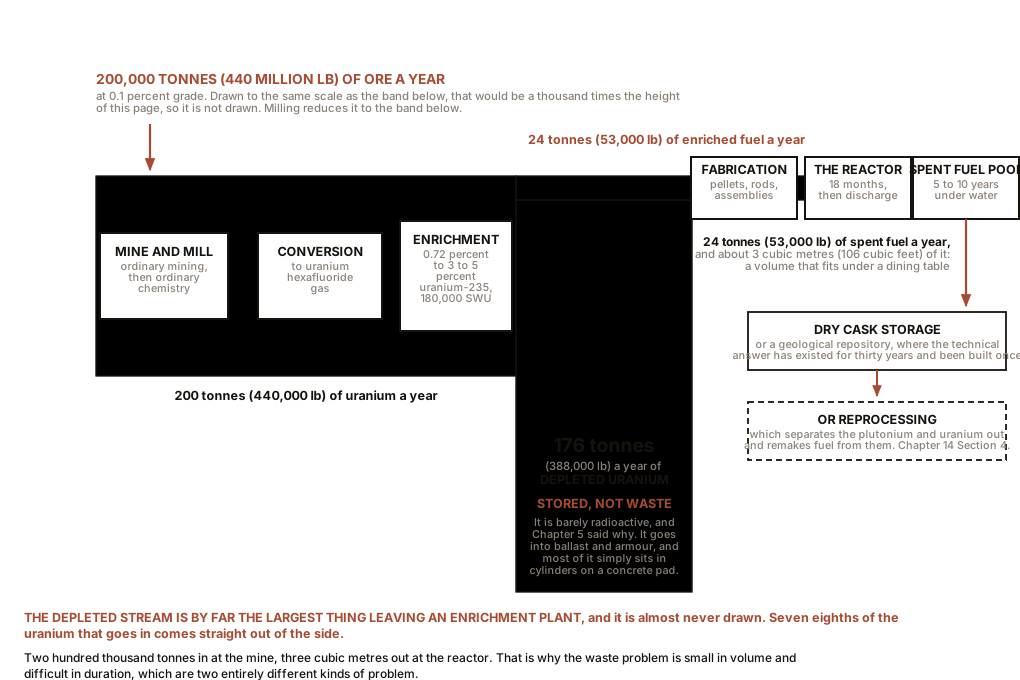
Two hundred tonnes of rock in, three cubic metres of spent fuel out, per year, for a city. The hard parts are at both ends: enrichment, which is the only step a weapons inspector cares about, and disposal, where the engineering has been solved by one country and the politics by almost none.
Six steps to get uranium into a reactor and three to deal with what comes out. The interesting thing about the list is which steps are hard, because it is not the ones people expect.
Mining is ordinary mining. Milling is ordinary chemistry. Fabrication is ceramics. Enrichment is the step that took the Manhattan Project’s largest building and is now the step that international inspection exists to watch. And disposal is the step where the technical answer has been available for thirty years and has been implemented once.
The masses, per year, for a 1,000 MWe plant:
| Step | Quantity per year |
|---|---|
| Ore mined, at 0.1 percent grade | about 200,000 tonnes (440 million lb) |
| Uranium in that ore | about 200 tonnes (440,000 lb) |
| Separative work required | about 180,000 SWU |
| Enriched uranium dioxide fuel loaded | about 24 tonnes (53,000 lb) |
| Spent fuel discharged | about 24 tonnes (53,000 lb) |
| Volume of that spent fuel | about 3 m³ (106 cubic feet) |
Read the first and last lines together. Two hundred thousand tonnes in at the mine, three cubic metres out at the reactor: a volume you could fit under a dining table. That ratio is Chapter 1’s fifty million wearing work clothes, and it is the reason the nuclear waste problem is small in volume and difficult in duration, which are two entirely different kinds of problem.
Section 1: From Rock to Gas
Mining and milling. Ore grades range from about 0.03 percent uranium in some Australian and Namibian deposits to 6 to 20 percent in the Athabasca basin in Canada, a spread of nearly three orders of magnitude that dominates the economics. About half of world production now comes from in-situ leach, where a solution is pumped through the ore body underground and the uranium comes up dissolved, with no pit and no rock brought to the surface.
Milling gives yellowcake, mostly triuranium octoxide, about 80 percent uranium by mass.
And the tailings are the part of the fuel cycle that gets least attention and deserves more. What is left after the uranium is extracted still contains the entire rest of Chapter 5’s decay chain, including radium-226 with its 1,600-year half-life, and radium-226 makes radon. The tailings pile from one year of one reactor’s fuel is thousands of times the volume of the spent fuel and is managed for a comparable length of time. It is a genuine environmental burden, it is not exotic, and it is shared with every other mining industry, which is precisely why it attracts no attention.
Conversion. Yellowcake is turned into uranium hexafluoride, and the reason is a physical accident: UF6 is the only uranium compound that becomes a gas at a convenient temperature, subliming at 56.5 °C (134 °F). Enrichment requires the uranium to be a gas, because every practical separation method works on molecules in free flight. The chemistry involves hydrogen fluoride and is one of the genuinely unpleasant industrial processes in the chain.
Section 2: Enrichment, and Why It Is the Step That Matters
Natural uranium is 0.72 percent uranium-235. A light water reactor needs 3 to 5 percent. A weapon needs about 90 percent.
The two isotopes are chemically identical. They differ only in mass, by about 0.85 percent, and every enrichment method exploits that difference and nothing else.
Gaseous diffusion, the original method, pushes UF6 through a porous barrier. Lighter molecules move slightly faster, so slightly more of them get through. The theoretical separation factor per stage is 1.0043, which is to say the process barely works at all, and reaching reactor grade takes over a thousand stages in series. The Manhattan Project’s K-25 building at Oak Ridge was one of the largest buildings in the world at the time and drew power on the scale of a small city. Gaseous diffusion consumes roughly 2,400 kWh per SWU.
Gas centrifuges spin UF6 in a rotor at 50,000 to 90,000 rpm, with tip speeds of 400 to 600 m/s (900 to 1,340 mph), so the heavier molecules concentrate slightly toward the wall. Rotors are 1 to 3 m (3 to 10 ft) of carbon fibre or maraging steel. The separation factor per machine is about 1.3, and the energy is around 50 kWh per SWU.
That is a factor of about fifty in energy and an enormous reduction in size, and it is the whole of the modern proliferation problem. A diffusion plant cannot be hidden: it is a square kilometre of building drawing gigawatts. A centrifuge cascade capable of producing weapons quantities fits in a warehouse and draws what a small factory draws. The technology did not become more dangerous. It became smaller.
IN PLAIN ENGLISH: Imagine a bucket of sand containing two grain sizes that differ by less than one percent, and a sieve so imprecise that each pass shifts the mixture by a few percent in your favour. One pass achieves nothing you could notice. The trick is to take the output of one pass and feed it into another, hundreds or thousands of times over, with the rejected material fed backwards into earlier passes so nothing is wasted. That chain is a cascade, and enrichment is nothing but a very long chain of a very bad separation.
ON THE BENCH: The separative work, and the number that matters politically
Parts: a calculator or a spreadsheet. Cost: nothing. A calculation, and it is the single most policy-relevant piece of arithmetic in this book. Time: an hour. Method. Enrichment work is measured in separative work units, and the formula, which looks worse than it is, uses a value function
V(x) = (2x - 1) x ln( x / (1 - x) )where x is the fraction of uranium-235. Then for a product P at enrichment xp, from feed at xf, leaving tails at xt:
Feed F = P x (xp - xt) / (xf - xt)Tails T = F - PSWU = P x V(xp) + T x V(xt) - F x V(xf)Take xf = 0.0072 for natural uranium and xt = 0.0025 for typical tails. Case one: 1 kg of 4.5 percent reactor fuel. You should get a feed requirement of about 9 kg (20 lb) of natural uranium and about 6.8 SWU. Case two: 1 kg of 90 percent weapons-grade material. You should get a feed requirement of about 191 kg (421 lb) and about 206 SWU. Now the question that matters. To make that 1 kg of 90 percent material, how much of the 206 SWU was spent merely getting to 4.5 percent? Work out how much 4.5 percent material you would need as an intermediate feed: about 21 kg (46 lb). At 6.8 SWU per kg, that intermediate cost about 144 SWU. 144 out of 206 is 70 percent. What you have just established. A country that can enrich to reactor grade has already done about seventy percent of the separative work required to reach weapons grade. The remaining thirty percent needs no new technology, no new physics and no new machines: it needs the same cascade rearranged and run for longer on a much smaller throughput. That single number is why enrichment is the step inspected, why the argument over any country’s enrichment programme is never really about the percentage it currently declares, and why Chapter 17 says that proliferation risk lives in enrichment and reprocessing rather than in reactors. You did not have to take anyone’s word for it. You computed it from two published formulas. And do one more case, because it cuts the other way. Recompute case two with feed at 4.5 percent already in hand rather than natural uranium, and notice how little material comes out per kilogram of feed. The reduced throughput is the reason a cascade optimised for reactor fuel cannot quietly make a weapon’s worth overnight, and it is why inspection regimes care about cascade configuration and material accountancy rather than about the machines themselves.
ON THE BENCH: Why one stage is never enough
Parts: two kinds of dried bean or lentil that differ slightly in size, about 200 g (7 oz) of each, mixed; a colander or sieve whose holes are between the two sizes but only just; two bowls. Cost: a few dollars, and it is food afterwards. Time: forty minutes. Hazards: none. Method: mix the two thoroughly and record the starting proportion. Sieve once, gently, for a fixed count of shakes. Now count a sample of a hundred from what went through and a hundred from what stayed, and work out the proportion in each. That ratio is your measured separation factor. Then take only the material that went through, sieve it again the same way, and again, four or five times, keeping the proportions each time. What you should see: one pass barely moves the proportion, perhaps from 50:50 to 55:45. Five passes in series get you to something like 80:20, and you can see the enrichment compound the way interest does. You will also notice you have thrown away most of your material, which is exactly the cascade’s real problem. The measurement to write down: your per-stage separation factor, and the number of stages you would need to go from 50:50 to 99:1. If your factor is 1.2 per stage, that is about 25 stages. Then substitute the real numbers: a separation factor of 1.0043 for gaseous diffusion means over a thousand stages for reactor fuel. You have arrived at the size of the Oak Ridge K-25 building from a colander and a bag of lentils. The honest limitation: your sieve separates by size directly, whereas real enrichment separates by mass through a physical process that barely notices the difference. The cascade arithmetic transfers exactly. The separation mechanism does not.
Section 3: Fabrication, Burnup, and What One Pellet Is Worth
Enriched UF6 is converted to uranium dioxide powder, pressed into pellets, sintered at about 1,700 °C (3,100 °F), ground to Chapter 10’s dimensions, and loaded into cladding tubes. This is a ceramics factory with unusually good quality control.
Burnup is how much energy has been taken out of a given mass of fuel, and it is quoted in gigawatt-days of heat per tonne of uranium. Older reactors ran to about 33 GWd per tonne. Modern fuel goes to 50 GWd per tonne and sometimes beyond, which is why enrichments crept from 3 percent to 5.
Higher burnup means fewer refuelling outages, less fuel bought, and less spent fuel per unit of electricity. It also means more damage to the cladding, more fission gas pressure inside the rod, and more plutonium in the discharged fuel. It is a genuine engineering trade and not a free improvement.
ON THE BENCH: One pellet against one ton of coal, with the assumptions on the table
Parts: a calculator. Cost: nothing. A calculation, and a deliberate audit of a figure this book itself used in Chapter 1. Time: twenty minutes. Method. Take a pellet of 10 g (0.35 oz) of uranium dioxide, which holds about 8.8 g (0.31 oz) of uranium. At a burnup of 50 GWd per tonne:
8.8 x 10^-6 tonnes x 50,000 MWd/tonne = 0.44 MWd = 38 GJ of heatCoal ranges from about 20 MJ per kg for sub-bituminous to 30 MJ per kg for good anthracite, with steam coal typically around 24. So:
38 GJ / 24 MJ per kg = about 1,580 kg, which is 1.58 tonnes or 3,500 lbNow redo it at the older burnup of 33 GWd per tonne and you get about 25 GJ, which is roughly 1.05 tonnes (2,300 lb) of coal, or about 1.15 US short tons. What that tells you about the figure everyone quotes. The familiar industry claim that one fuel pellet equals one ton of coal is correct for a burnup of about 33 GWd per tonne, a coal heating value near 24 MJ per kg, and a short ton. At modern burnup the same pellet is worth about half again as much. Chapter 1’s “roughly one tonne” is therefore the conservative end of a real range, and the range is set by three assumptions that are almost never stated. And one more correction that pushes the other way. If you compare electricity rather than heat, a modern coal plant converts at about 45 percent and a nuclear plant at about 33 percent, per Chapter 13. That shifts the comparison against the pellet by roughly a quarter. So depending on which of two entirely reasonable questions you are asking, the answer moves by a factor of two, and neither number is dishonest. What this box is really for. Every energy comparison you will ever read has three or four buried assumptions of exactly this kind. Having taken one apart yourself, you now know to ask which ones.
Section 4: What Comes Out, and What Is In It
A discharged fuel assembly at 50 GWd per tonne contains, roughly:
| Component | Share |
|---|---|
| Uranium-238 | about 93 percent |
| Uranium-235, unburnt | about 0.8 percent |
| Plutonium, of which about 60 percent is Pu-239 | about 1.2 percent |
| Fission products | about 4 percent |
| Minor actinides: neptunium, americium, curium | about 0.1 percent |
Ninety-five percent of it is still uranium, and its uranium-235 content of 0.8 percent is higher than natural uranium’s 0.72. That is the fact reprocessing exists to exploit.
Immediately out of the core, spent fuel is ferociously radioactive. An unshielded assembly a year out of the reactor produces a dose rate at 1 m (3 ft) measured in hundreds of sieverts per hour, which by Chapter 6’s table is fatal in under a minute. The figure depends heavily on burnup and cooling time and should be read as order of magnitude. This is also why spent fuel is not a plausible target for theft: it cannot be approached, let alone carried.
So it goes into a pool. Typically 12 m (40 ft) deep, with at least 7 m (23 ft) of water above the fuel, borated to absorb neutrons, and continuously cooled and filtered. Water is a superb shield and an adequate coolant, and the fuel is visible from a walkway above, glowing faintly blue.
After five years or more, decay heat has fallen far enough for air cooling. The fuel then goes into a dry cask: a sealed steel canister inside a steel and concrete overpack, 5.5 to 6 m (18 to 20 ft) tall, weighing 150 to 180 tonnes loaded, holding 10 to 15 tonnes of fuel. Nothing about a dry cask moves or requires power. Convection through vents in the overpack carries the heat away, and the regulatory dose limit at the site boundary is 0.25 mSv per year, which is 25 mrem, or about four percent of Chapter 6’s American average background.
The total inventory, put in physical terms. All the commercial spent fuel ever produced in the United States amounts to roughly 90,000 tonnes, or 99,000 US tons. Stacked as fuel assemblies, that occupies something like 36,000 m³ (1,300,000 cubic feet), which is the area of an American football field to a depth of about 7 m (23 ft), and rather less if packed tightly. Different sources quote depths from 7 to 10 m (23 to 33 ft) depending on their packing assumption, and the assumption is rarely stated.
Sixty years of an entire country’s nuclear electricity, in a volume you can picture. That is the honest framing, and the honest counterweight is that it will be dangerous for a very long time.
Section 5: For How Long, and Which Part Actually Matters
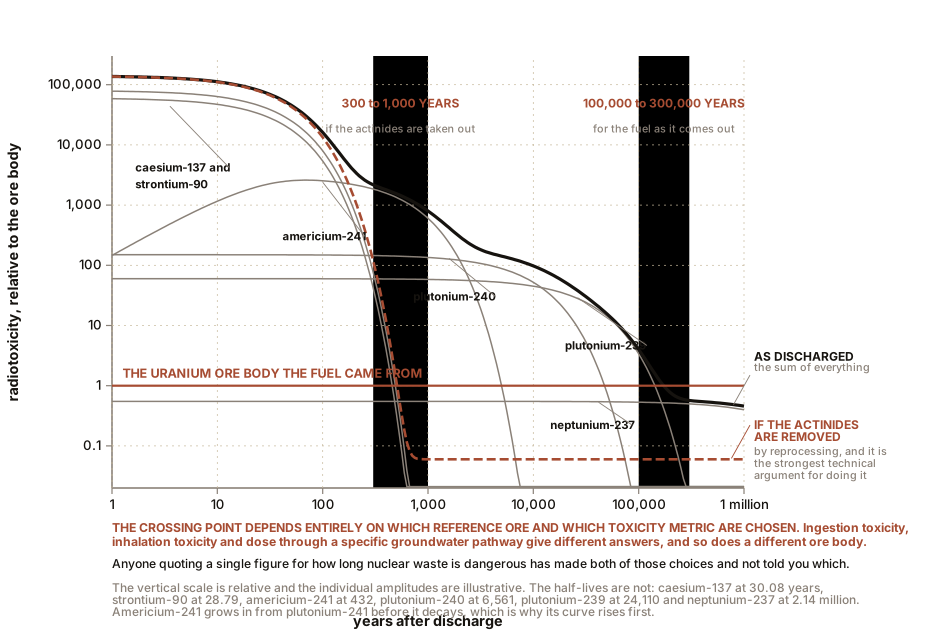
The first fifty years are dominated by caesium-137 at a 30.08-year half-life and strontium-90 at 28.79 years. These produce most of the heat and most of the gamma radiation, and they are why the fuel needs a pool and then a cask.
By 300 years, ten half-lives, those two have fallen by a factor of about a thousand, and the heat output of spent fuel has fallen by roughly a hundredfold from discharge.
Beyond about a thousand years the remaining hazard is the actinides: plutonium-239 at 24,110 years, plutonium-240 at 6,561, americium-241 at 432, neptunium-237 at 2.14 million.
Radiotoxicity falls back to the level of the original uranium ore body somewhere between about 100,000 and 300,000 years, and that range is wide because it depends entirely on which reference ore you choose and whether you measure ingestion toxicity, inhalation toxicity or dose through a specific groundwater pathway. Anyone quoting a single figure for how long nuclear waste is dangerous has chosen a metric and not told you which. If the actinides are removed by reprocessing, the same curve reaches the reference in roughly 300 to 1,000 years, and that is the strongest technical argument for reprocessing.
SLOW DOWN. Check Your Understanding: In the safety calculations for a deep geological repository, which nuclide dominates the projected radiation dose to people tens of thousands of years from now? Almost everyone answers plutonium. Decide before reading on.
It is usually iodine-129 and technetium-99, and plutonium barely features.
The reason is chemistry, not radioactivity. A repository’s dose pathway is groundwater: something has to dissolve, travel through rock, and reach a well or a river. So the nuclides that matter are the ones that are soluble and mobile, not the ones that are most toxic.
Plutonium is extraordinarily insoluble in the reducing conditions of deep groundwater and sorbs strongly onto mineral surfaces. Modelled travel distances for plutonium over a hundred thousand years are typically metres to tens of metres. It is highly toxic and it does not go anywhere.
Iodine-129, half-life 15.7 million years, and technetium-99, half-life 211,000 years, are soluble, sorb poorly, and travel with the water almost unretarded. They are much less toxic per becquerel and they are the ones that arrive. Chlorine-36 and selenium-79 join them.
Why this matters beyond the trivia. It means the intuitive framing of the waste problem, that we must contain plutonium for a quarter of a million years, is not what the safety case is actually about. It also means that separating the plutonium out, which is what reprocessing does and what the proliferation objection is about, does much less for the long-term dose than it does for the heat load and the volume. The engineering arguments and the political arguments about reprocessing are answers to different questions, and they are routinely traded against each other as though they were not.
And the general lesson: for a long-term hazard, ask what moves rather than what is worst. The same reasoning governs every buried contaminant there is, nuclear or otherwise.
Section 6: Reprocessing, and the Two Different Problems
Reprocessing dissolves spent fuel in nitric acid and chemically separates the uranium and plutonium from the fission products. The standard process is PUREX, and it works, at industrial scale, at La Hague in France and formerly at Sellafield in the United Kingdom.
What it buys. The recovered plutonium and uranium are made into mixed oxide fuel and burned again, recovering perhaps 10 to 25 percent more energy from the original uranium in a light water reactor. High-level waste volume falls by a factor of several, and removing the actinides shortens the radiotoxicity timeline dramatically. In a full closed cycle with fast reactors, the theoretical recovery is many times greater, and that is the long-term case for the technology.
What it costs. It is more expensive than buying fresh uranium at anything like current prices, so the economic case is currently negative. And PUREX produces separated plutonium, in bulk, in a form that requires no enrichment to be useful in a weapon. That is why the United States ended commercial reprocessing in 1977 and has not resumed. Proposals for processes that never fully separate the plutonium from other actinides exist for exactly this reason.
And disposal, where the split between engineering and politics is starkest.
The engineering is done. Finland’s Onkalo repository, about 450 m (1,480 ft) down in 1.9-billion-year-old granite, encapsulates spent fuel in copper canisters inside bentonite clay inside crystalline rock, and is the world’s first licensed and constructed deep geological repository for civil spent fuel. Sweden licensed a comparable facility at Forsmark in 2022. The WIPP facility in New Mexico has been emplacing defence transuranic waste 655 m (2,150 ft) down in a salt bed since 1999.
The politics is not done. The United States spent about three decades and on the order of fifteen billion dollars on Yucca Mountain and abandoned it in 2010 without emplacing any commercial fuel, and has no alternative site. The technical objections raised were real and arguable; the decisive factors were not technical.
The instructive difference is procedural rather than geological. Finland and Sweden ran consent-based siting processes in which host communities had a veto and were engaged for decades before a licence application; the United States designated a site by act of Congress in 1987 over the objection of the state. The countries that asked have repositories and the country that told does not, and no amount of further geology would have changed that.
Section 7: What to Carry Forward
Two hundred thousand tonnes of ore in and three cubic metres of spent fuel out, per reactor per year. Small volume, long duration, and those are different problems needing different answers.
Mill tailings are thousands of times the volume of the spent fuel and get a thousandth of the attention.
Enrichment works because two isotopes differ in mass by 0.85 percent, and by nothing else. Centrifuges beat diffusion by a factor of fifty in energy and by a great deal more in concealability, and that is the modern proliferation problem in one sentence.
Reaching 4.5 percent is about seventy percent of the separative work needed to reach 90 percent, and you have now calculated that yourself rather than being told it.
A fuel pellet is worth 1 to 1.6 tonnes (2,200 to 3,500 lb) of coal, depending on burnup, coal grade, and whether you compare heat or electricity. Every energy comparison has assumptions like those buried in it.
Spent fuel is 95 percent uranium and 4 percent fission products, is lethal at a metre for the first decades, and cools to air-coolable in about five years.
The long-term repository dose is dominated by iodine-129 and technetium-99, not plutonium, because mobility beats toxicity over a hundred thousand years.
And the disposal engineering has been demonstrated in Finland while the politics has not been solved almost anywhere, and the difference between those two countries’ outcomes was a siting process rather than a rock.
Next: four accidents, four different failures, read from the investigation reports rather than from the reputations.

Bench Degree
Get the degree without the diploma.
Learn the material, not how to pass the exam.