Bench Degree·NUCLEAR POWERchapter

Chapter 13: The Steam Plant
Two-thirds of the heat goes out of the cooling tower and there is no engineering that recovers most of it. Then there is the part nobody outside the industry knows: a reactor that has been scrammed, with every rod in and the chain reaction stopped dead, is still producing 220 MW of heat, and it will boil a hundred tonnes of water before breakfast.
Walk into a nuclear power station and most of what you see is a steam plant. The reactor building is one structure on the site and it is not the largest. Everything downstream of the steam generators would be recognised by an engineer from 1930, and it is bound by exactly the same limits as a coal plant, because it is the same machine.
The nuclear island makes hot water. That is its entire output. Chapter 10 built the thing that makes it and Chapter 11 explained what holds it steady. From here on there is no nuclear physics in this chapter until Section 5, where there is nothing but.
Section 1: The Circuit, and Where the Energy Goes
Two water loops in a pressurised water reactor, and they never mix.
The primary loop. Water at 15.5 MPa (2,250 psi) pumped through the core at about 20,000 kg per second, entering at 292 °C (558 °F) and leaving at 327 °C (621 °F). It never boils, and that is the whole reason for the pressure: water at 15.5 MPa does not boil until 345 °C (653 °F). It carries its heat to the steam generators, gives it up through thousands of thin tubes, and comes back.
The secondary loop. Water on the other side of those tubes, at 6.9 MPa (1,000 psi), which boils at 285 °C (545 °F). The steam produced is saturated, meaning it is at the boiling point with no margin, and slightly wet. It goes to the turbine, does work, exhausts into a condenser, turns back to water, and is pumped round again.
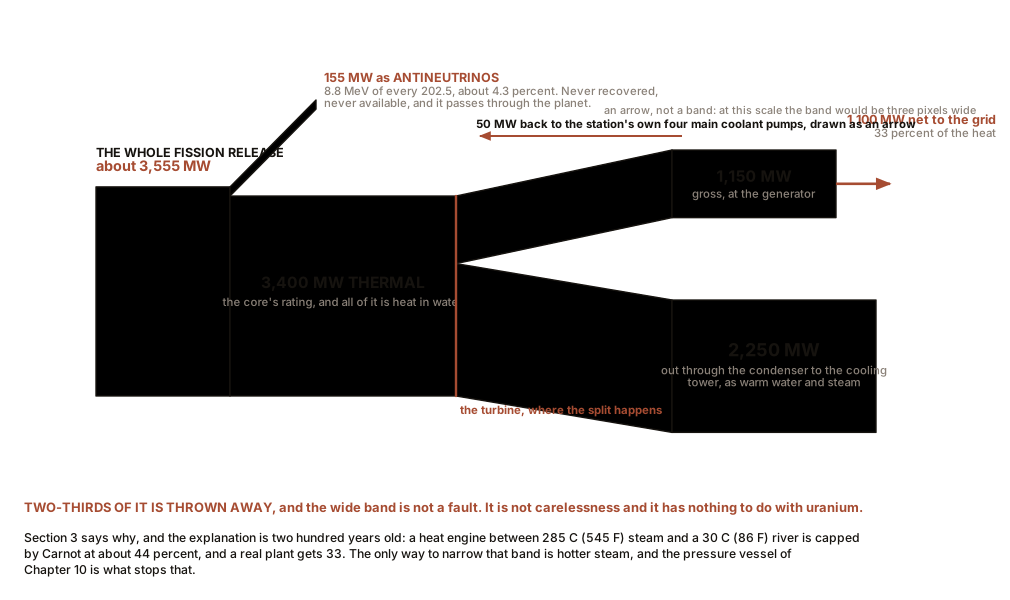
And the heat balance for a reference plant:
| Thermal power from the core | 3,400 MW |
| Gross electrical output at the generator terminals | about 1,150 MW |
| Station’s own consumption, mostly the four main coolant pumps | about 50 MW |
| Net electrical output to the grid | about 1,100 MW |
| Heat rejected to the environment | about 2,250 MW |
Two-thirds of it, thrown away. Not through carelessness, and not because of anything to do with uranium. Section 3 explains why, and the explanation is 200 years old.
Section 2: Rankine, Which Is Just Four Steps
The cycle has four stages and every steam plant ever built runs it.
Pump the water up to pressure as a liquid, which is cheap, because liquids are almost incompressible and it takes very little work.
Boil it at that pressure, which is where all the heat goes in.
Expand it through a turbine, where it does work and drops in pressure and temperature, ending up as low-pressure wet steam.
Condense it back to liquid, which is where the two-thirds leaves.
The reason the cycle is worth anything is that stage one is nearly free. Compressing a gas from condenser pressure back to boiler pressure would consume most of the work the turbine produced. Condensing it first, then pumping the liquid, costs almost nothing. Rankine’s whole trick is to do the pressure rise on the liquid side of the phase change, and the Refrigeration volume’s Chapters 3 and 9 are recommended, where the same four stages appear running backwards.
The condenser is not an afterthought and it is where most of the engineering attention goes. It holds a vacuum, typically 7 kPa absolute (1 psi), at about 40 °C (104 °F). That vacuum is what allows the steam to keep expanding and doing work well below atmospheric pressure. A condenser with fouled tubes, or with air leaking in, loses that vacuum and takes several percent of the station’s output with it, and a large fraction of routine plant performance work is about keeping it clean.
Real plants add two refinements. Reheat, where partly expanded steam is taken back to be dried and warmed before entering the low-pressure turbine, and feedwater heating, where a little steam is bled from the turbine to preheat the returning water. Both raise the average temperature at which heat is added, and both buy a few points of efficiency.
Section 3: Carnot, and the Real Reason for 33 Percent
The efficiency limit of any heat engine is set by two temperatures and nothing else:
maximum efficiency = 1 - (cold temperature / hot temperature)with both in kelvin. This is not an engineering rule of thumb. It is a consequence of the second law of thermodynamics, established by Sadi Carnot in 1824, and no arrangement of hardware has ever beaten it or ever will.
Put the reference plant’s numbers in. Steam at 285 °C (545 °F) is 558 K. The condenser at 40 °C (104 °F) is 313 K.
1 - (313 / 558) = 43.9 percentThe plant actually delivers about 33 percent, which is 75 percent of the Carnot limit, and that ratio is respectable practice for a large steam plant. The gap between 33 and 44 is engineering. The gap between 44 and 100 is physics.
Now compare a modern supercritical coal plant, with steam at 600 °C (1,112 °F) and the same condenser:
1 - (313 / 873) = 64 percentand it delivers about 45 percent in practice.
So a coal plant is meaningfully more efficient than a nuclear plant, and everybody in the industry knows it, and the reason is usually stated wrongly.
SLOW DOWN. Check Your Understanding: Both plants run the Rankine cycle and both obey Carnot. So why does the nuclear plant end up with cooler steam? Saying “because Carnot” is not an answer; Carnot only tells you what the temperatures buy you. What is stopping the reactor from producing 600 °C (1,112 °F) steam? Think before reading on.
Water. Specifically, three separate limits imposed by using water as the coolant, none of them nuclear.
Water’s saturation pressure. To keep water liquid at 327 °C (621 °F) you need about 12.9 MPa (1,870 psi), which is why the primary loop runs at 15.5 MPa (2,250 psi) with margin. Push the temperature up and the required pressure climbs steeply, and the vessel wall thickness climbs with it. And at 374 °C (705 °F) water reaches its critical point, above which there is no liquid and no boiling and the whole heat transfer regime changes character. A water-cooled reactor is boxed in below about 350 °C (662 °F) by the properties of the substance in it.
The cladding. Chapter 10’s zirconium alloy corrodes and picks up hydrogen at a rate that accelerates sharply above about 350 °C (662 °F), which independently caps the fuel surface temperature.
And the vessel. Hoop stress goes as pressure times radius over thickness, so a higher pressure means a thicker forging, and Chapter 10’s 220 mm (8.7 in) wall is already near the practical limit of what can be forged, transported and inspected.
So nuclear’s 33 percent is not a Carnot problem and not a nuclear problem. It is a water problem, and the proof is that reactors which do not use water do better. The British advanced gas-cooled reactors run carbon dioxide at high temperature and produce steam at about 540 °C (1,000 °F), reaching 41 to 42 percent. High-temperature gas reactors using helium aim at 750 to 950 °C (1,380 to 1,740 °F) and, if they are ever built at scale, would reach into the mid-40s and could drive industrial process heat as well.
The general lesson is one to carry. When a system underperforms a limit, ask which of its materials is setting the ceiling, because “it obeys the second law” is true of everything and explains nothing. The binding constraint here is the boiling point of the cheapest coolant available, and every alternative trades that away for something harder.
Section 4: Where the Two-Thirds Actually Goes
2,250 MW has to leave the site, continuously, and there are two ways.
Once-through cooling. Draw water from a river, a lake or the sea, run it through the condenser, and put it back warmer. To absorb 2,250 MW with a 10 °C (18 °F) temperature rise takes about 54 tonnes of water per second, which is 54 m³/s or roughly 1,900 cubic feet per second. That is why plants sit on large rivers and coastlines, and it is the reason a heatwave can force a plant to reduce output: intake water above a certain temperature makes the discharge limit unachievable.
Evaporative cooling towers. The condenser water is cooled by evaporating a fraction of itself. This uses far less water in total but it consumes what it uses. At a latent heat of vaporisation of about 2,260 kJ per kg, rejecting 2,250 MW mostly by evaporation takes on the order of 1,000 litres per second (260 gallons per second), which is around 86 million litres a day (23 million US gallons), permanently gone as vapour.
The natural-draught hyperbolic towers are 100 to 170 m (330 to 560 ft) tall and need no fans: the warm moist air inside is less dense than the outside air, and the chimney effect pulls the airflow through. The plume is water vapour and nothing else. It is not smoke, it is not steam from the reactor, and it does not touch the primary circuit at any point. Every photograph used to illustrate a story about nuclear power shows the least nuclear object on the site.
ON THE BENCH: The wet bulb, which sets the floor for the whole plant
Parts: two identical thermometers, a scrap of cotton, water, and a fan or a piece of card to wave. Cost: nothing. Time: fifteen minutes. Hazards: none. Method: wrap the bulb of one thermometer in wet cotton. Hold both in a moving airstream for two minutes and read them. What you should see: the wet one reads lower, by anywhere from 1 to 15 °C, which is 2 to 27 °F, depending on the humidity. On a dry day the difference is large; on a muggy day it is almost nothing. What that measures. The wet-bulb temperature is the lowest temperature evaporation alone can reach, and it is the hard floor for a cooling tower’s cold water. A tower can approach it by a few degrees and can never beat it. Now put that back into Section 3. Your condenser temperature, and therefore the cold term in the Carnot fraction, is set by the local wet-bulb temperature. Which means a nuclear plant in a hot humid climate is permanently less efficient than an identical plant on a cold coast, by one or two percentage points of output, for no reason other than the weather. Measure your own wet-bulb depression on a hot day and on a cold one and you have measured the size of that penalty.
Section 5: Decay Heat, Which Is Why Fukushima Happened
Now the part that has no analogue in any other power station, and it is the single most important operational fact about a reactor.
Chapter 8’s energy table had two lines totalling 12.8 MeV of the 202.5 MeV, about 6.3 percent, appearing as beta and gamma radiation from fission products decaying. Chapter 3 flagged it. Here is the consequence.
When the chain reaction stops, that 6 to 7 percent does not. The fission products are already in the fuel, they have their own half-lives from milliseconds to decades, and they will decay on their own schedule whatever anyone does. There is no rod, no valve, no switch and no procedure that reduces decay heat.
For the reference 3,400 MW core, the numbers are:
| Time after shutdown | Fraction of full power | Heat |
|---|---|---|
| the instant of shutdown | about 6.5% | 220 MW |
| 1 minute | about 3% | 100 MW |
| 1 hour | about 1.4% | 48 MW |
| 1 day | about 0.65% | 22 MW |
| 1 week | about 0.4% | 14 MW |
| 1 month | about 0.2% | 7 MW |
| 1 year | about 0.06% | 2 MW |
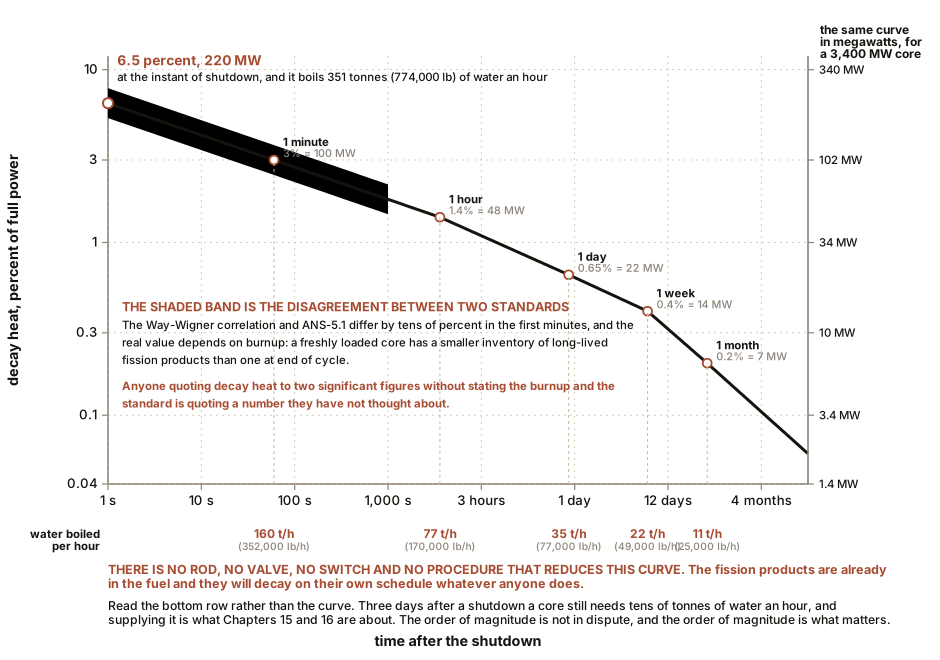
These figures are model outputs and they disagree between standards. The Way-Wigner correlation and the ANS-5.1 standard differ by tens of percent in the first minutes, and the real value depends on how long the fuel has been irradiated and to what burnup, since a freshly loaded core has a smaller inventory of long-lived fission products than one at end of cycle. Anyone quoting decay heat to two significant figures without stating the burnup and the standard is quoting a number they have not thought about. The order of magnitude, though, is not in dispute, and the order of magnitude is what matters.
Now translate it into water. Boiling water absorbs about 2.26 MJ per kg. So:
At the instant of shutdown, 220 MW is boiling about 97 kg of water every second, which is 350 tonnes an hour, or 770,000 lb.
An hour later, 48 MW is still boiling about 21 kg a second, which is 76 tonnes an hour.
A day later, 22 MW is still boiling 35 tonnes an hour.
A PWR’s primary circuit holds around 250 m³ (8,800 cubic feet) of water, which at operating temperature is roughly 175 tonnes (386,000 lb). If nothing replaces it, the reactor boils its own inventory dry in a matter of hours. After that the fuel has nothing taking heat off it, the cladding heats toward the 1,200 °C (2,190 °F) where Chapter 10’s zirconium-steam reaction begins, and from there it makes its own hydrogen and its own additional heat.
IN PLAIN ENGLISH: Think about a coal fire. Stop shovelling and the flames go out, but the grate is full of glowing embers that will keep the room warm for hours and there is nothing you can do to make them stop. Now imagine the embers are hot enough to melt the fireplace, and that the only thing keeping the fireplace intact is a bucket of water you must refill every few minutes, forever, for weeks. That is a reactor after shutdown. Scramming a reactor is not turning it off. It is taking the shovel away.
And therefore the sentence that defines nuclear safety: a reactor needs electrical power in order to be safe after it has stopped making electrical power.
That is the most awkward fact in the whole engineering discipline. Every large water reactor has, in layers: pumps on the grid supply; emergency diesel generators, usually two or three per unit, sized to run the residual heat removal pumps; batteries for the instruments and valves; and steam-driven pumps that use the reactor’s own decay heat to drive a turbine and inject water, which work with no electricity at all as long as there is pressure.
At Fukushima the earthquake took the grid, the tsunami took the diesels and their switchgear, and then the batteries ran out. Chapter 16 walks it.
The design response has been to remove the dependence rather than to add another layer. The AP1000 and similar designs hold cooling water in tanks above the reactor and let gravity do the injection, with a large tank of water on the containment roof that boils off to cool the steel shell. Their design claim is 72 hours with no operator action, no AC power and nothing running. Whether the claim survives contact with a real event is not yet known, because none has been tested by one. This book says so rather than repeating the brochure.
ON THE BENCH: Decay heat, on your hob
Parts: an electric hob or a hotplate; a pan with 500 g (18 oz) of water; a kitchen scale you can leave the pan on, or a stopwatch and a measuring jug; a timer. Cost: nothing. Time: thirty minutes. Hazards: boiling water and a hot ring. Do not put a digital scale on a hot surface; weigh before and after instead, or use a scale with a trivet. Method: bring the water to a rolling boil and hold it there. Measure the boil-off rate by mass loss over one minute, which gives you the power going in: mass in kg times 2,260 kJ per kg divided by 60 seconds gives watts. Then switch the ring off and leave the pan exactly where it is. Keep measuring the mass loss, minute by minute, for ten minutes. What you should see: the water does not stop boiling when you switch off. It carries on vigorously for a minute or two, then gently, then stops. Plot boil-off rate against time and you have a decay curve. Do the arithmetic: integrate the area under that curve, in watt-seconds, and you have measured the energy that was stored in the ring and the pan, which is being released whether you want it or not. What it is and is not. This is an honest analogue of the behaviour and not of the mechanism. The hob’s residual heat is stored thermal energy in a mass, which is finite and gone in minutes. A reactor’s residual heat is being newly created by radioactive decay and lasts for years, and the analogy fails in exactly that way, which is worth saying because it makes the reactor case worse rather than better. What the pan demonstrates properly is the thing that catches every intuition: switching off the supply and stopping the process are different events, and the second one takes its own time. The extension: repeat with a heavy cast-iron pan and with a thin aluminium one. The cast iron boils on for far longer. Thermal mass sets the timescale, which is exactly why Chapter 16’s Unit 4 at Fukushima, with no fuel in the reactor and a full spent fuel pool, still became a crisis.
ON THE BENCH: The plant’s whole cycle, at toy scale
Parts, cheap version: a “pop-pop” boat, $10 to $20, or a tin can turbine made from a drinks can, a tea light and a pinwheel. Parts, real version: a model stationary steam engine of the Mamod or Wilesco type, $150 to $350 secondhand, which has a boiler, a throttle, a piston and a flywheel. Cost: $10 to $350. Time: an afternoon. Hazards: genuine. A model boiler holds real pressure and its safety valve is not decorative. Never block it, never run the boiler dry, keep methylated spirits away from the flame while filling, and keep children clear. Burns are the hazard here. Method: weigh the fuel before and after a timed run, which gives energy in at roughly 22 MJ per kg for methylated spirits. Then measure work out: wind a thread on the flywheel shaft and lift a known mass a known height, timing it. Work is mass times 9.81 times height, in joules. What you should see: an efficiency of 1 to 3 percent, and you should expect that rather than be disappointed by it. A toy has no condenser, no feedwater heating, no reheat, terrible insulation and a boiler at barely 2 bar (29 psi). What that teaches, which is the point. Put your measured hot and cold temperatures into the Carnot expression. The toy’s Carnot limit is probably around 25 percent and it achieved 2, so it delivered under a tenth of what physics allowed, while the reference power station delivers three-quarters of what physics allows. The gap between a toy and a power station is not the physics; it is the condenser, the pressure and the scale, and having measured both ends of that gap yourself is worth more than reading the efficiency table.
Section 6: What to Carry Forward
Most of a nuclear power station is a steam plant and would be recognised by an engineer from 1930.
Rankine works because the pressure rise happens on the liquid, and the condenser’s vacuum is what lets the steam keep doing work below atmosphere.
33 percent is 75 percent of the Carnot limit for the temperatures available, and the temperatures are limited by water rather than by anything nuclear. Gas-cooled reactors reach 41 to 42 percent and prove the point.
Two-thirds of the heat leaves through the condenser, taking either 54 tonnes (119,000 lb) of river water a second or a thousand litres a second of evaporation, and the cooling tower plume is water vapour that has never been near the reactor.
The condenser’s cold temperature is set by the local wet-bulb temperature, which you can measure with two thermometers and a wet rag, and it is why the same plant is less efficient in a humid climate.
And decay heat is about 6.5 percent at shutdown, 1.4 percent an hour later, and 0.4 percent a week later. It cannot be switched off, it will boil the primary inventory dry in hours if nothing replaces the water, and a reactor needs power in order to be safe after it stops making power. That sentence is Chapter 16’s Fukushima in its entirety.
Next: where the fuel comes from, what is left of it afterwards, and which parts of the waste problem are engineering and which are politics.

Bench Degree
Get the degree without the diploma.
Learn the material, not how to pass the exam.