Bench Degree·NUCLEAR POWERchapter

Chapter 12: Nuclear Power With No Moving Parts
A lump of metal getting warm because of what it is, wrapped in a jacket that turns warmth straight into electricity. No reactor, no criticality, no control rods, no coolant and nothing that moves. One has been running since 1977 and is now about 25 billion km (15.6 billion miles) away, still transmitting.
Everything in this book so far has been about a chain reaction and about keeping it calm. This chapter is about the one nuclear power source that has no chain reaction to keep calm, and it is here because it is the only nuclear generator a reader can now fully understand from what Chapters 5 and 11 established, and because it is the most reliable machine humans have ever built.
A radioisotope thermoelectric generator has two halves and neither is complicated.
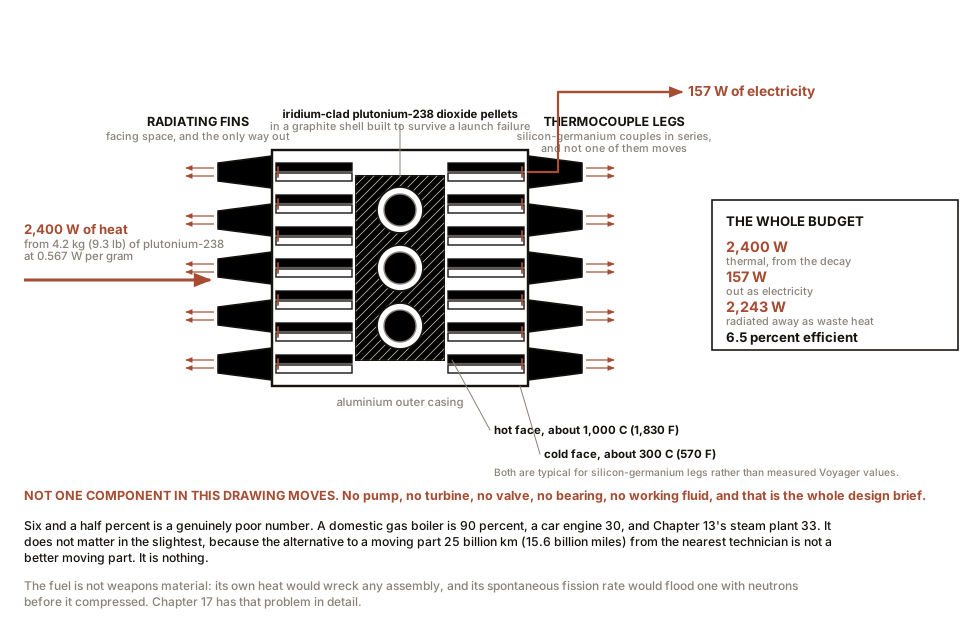
The heat source is a ceramic pellet of plutonium-238 dioxide. Plutonium-238 is an alpha emitter with a half-life of 87.7 years, and alpha decay releases 5.59 MeV per event. Enough atoms doing that in a small volume makes the pellet glow dull red on its own. Nothing initiates this and nothing can stop it.
The converter is a set of thermocouples strapped between that hot pellet and a set of radiating fins facing cold space. A temperature difference across a thermocouple produces a voltage. That is the Seebeck effect, and the Refrigeration volume’s Chapter 11 is recommended, where a ten-dollar module is run first as a cooler and then backwards as a generator.
That is the whole machine. It cannot be throttled, cannot be scrammed, cannot go critical and cannot be switched off, and those are all the same sentence: there is no chain reaction in it, so there is nothing to control.
Section 1: Why That Isotope
Plutonium-238 is not the plutonium of weapons, and the difference is one digit and a great deal of physics.
It is an intense heat source. Plutonium-238 puts out 0.567 W per gram of thermal power. Plutonium-239 puts out about 0.0019 W per gram, a factor of three hundred less, because its half-life is 24,110 years and a longer half-life means a lower activity for the same mass, exactly as Chapter 5 established.
Its radiation is easy to shield. Almost all of the output is alpha, and Chapter 5’s own bench measurement showed that alphas stop in a sheet of paper. An RTG’s fuel needs a few millimetres, a tenth of an inch, of cladding, and the assembly is designed to survive a launch failure intact, which is the actual engineering problem rather than the shielding.
And it is not fissile. Chapter 8’s rule applies directly: mass number 238 is even, all its neutrons are paired, an arriving slow neutron gets no pairing bonus, and it cannot fission it. Plutonium-238 is fissionable by fast neutrons, in the same limited sense as uranium-238, and it is useless in a weapon for two further reasons on top of that. Its own heat would wreck any assembly: ten kilograms, roughly twenty-two pounds, would be dissipating 5.7 kW inside itself, which melts things. And its spontaneous fission rate is high enough that any assembly would be flooded with neutrons and would come apart before it compressed, which is Chapter 17’s predetonation problem in its worst form.
An RTG is a heat source, and saying so plainly forestalls the obvious question. It is not a bomb precursor, it is not a reactor, and the material it runs on is actively unsuitable for weapons.
The catch is supply. Plutonium-238 does not occur in nature and is not a reactor by-product you can pick out of spent fuel. It is made deliberately: neptunium-237 targets are irradiated in a reactor, capture a neutron to become neptunium-238, which beta-decays with a 2.1-day half-life into plutonium-238. The United States stopped making it in the late 1980s and restarted at Oak Ridge in 2013 after a gap of about twenty-five years, currently producing a few hundred grams a year against a stated goal of about 1.5 kg (3.3 lb) annually. The limiting resource for outer-planet missions is not money or launch capacity. It is a few kilograms a year of one isotope.
IN PLAIN ENGLISH: Every reactor in this book is a fire that has to be tended: fed, damped, watched, and cooled long after it is put out. An RTG is not a fire at all. It is a stone that is warm because of what it is made of, and it will be warm whatever anybody does, getting very slightly less warm each year on a schedule fixed before it was launched. Strap something to it that turns warmth into electricity and you have a power station with no operator, no fuel deliveries and no off switch. Both halves of that are the same fact, and the second half is why one of them must never be left lying in a forest.
Section 2: The Arithmetic the Mission Designers Did
This is a chapter with no reactor to describe and therefore an unusually good chapter for a calculation, so here is the one that actually got done.
An MHW-RTG, the type flown on both Voyagers, produced 2,400 W of heat and 157 W of electricity at launch. Three of them gave Voyager 1 about 470 W of electrical power in September 1977.
Work backwards for the fuel mass. At 0.567 W per gram, 2,400 W of heat needs about 4.2 kg (9.3 lb) of plutonium-238. Published fuel loadings for this generator are quoted at around 4.5 kg (9.9 lb) of plutonium dioxide, and once the oxygen is subtracted those two figures are in the same range. They are not identical, and the residual gap is the sort of thing that comes from isotopic purity, since RTG fuel is not 100 percent plutonium-238, and from published figures that are rounded differently in different documents. This book flags that rather than papering over it.
Now the efficiency. 157 out of 2,400 is 6.5 percent, and that is a genuinely poor number by any standard. A domestic gas boiler is 90 percent. A car engine is 30. Chapter 13’s steam plant is 33.
And it does not matter in the slightest. The alternative to a moving part 25 billion km (15.6 billion miles) from the nearest technician is not a better moving part. It is nothing.
The other alternative is sunlight, and here the numbers are worth having. Solar flux at Jupiter is about one twenty-seventh of the value at Earth, at Saturn about one ninetieth, and at Neptune about one nine-hundredth. The Juno spacecraft did run on solar panels at Jupiter, using about 60 m² (650 square feet) of array to produce a few hundred watts. At Saturn that array would need to be three times the area for the same output, and beyond Saturn the approach stops being an engineering problem and becomes an arithmetic one.
Section 3: Voyager, Honestly
Voyager 1 launched on 5 September 1977 and is still transmitting, forty-nine years later, from beyond the heliopause. Voyager 2 launched sixteen days earlier and is also still transmitting. Neither has ever been repaired.
The power has declined, and the shape of that decline is worth getting right because it is usually described wrongly.
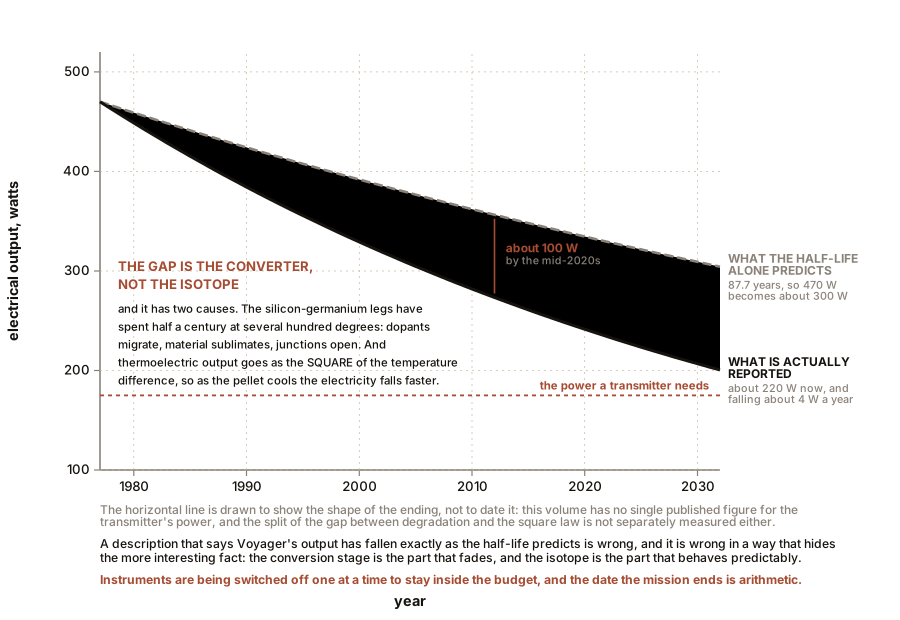
Electrical output was about 470 W at launch and is around 220 W now, a loss of roughly 53 percent.
Plutonium-238’s half-life alone does not account for that. Forty-nine years is 0.56 of a half-life, so the heat output should now be about 68 percent of its original value. Apply that to 470 W and you would predict about 320 W, not 220 W.
So about 150 W of the loss is the isotope decaying, and about 100 W is something else. Two things, in fact, and both are instructive.
SLOW DOWN. Check Your Understanding: Where did that extra 100 W go? One cause is obvious and the other is not, and the non-obvious one is a property of thermocouples rather than a failure of them. Think before reading on.
The obvious cause is degradation. The silicon-germanium thermocouple legs have spent half a century at several hundred degrees. Dopants migrate, material sublimates from the hot faces, and some junctions open up altogether. This is real, it was anticipated, and it is why the generators were sized with margin.
The non-obvious cause is that thermoelectric output scales with the square of the temperature difference, not with the heat flow. Power out of a thermoelectric generator goes roughly as ΔT², because the voltage is proportional to ΔT and the current it can drive into a matched load is also proportional to ΔT. So as the pellet cools, the temperature difference across the converters falls, and the electrical output falls faster than the heat does. Even with perfect, undamaged thermocouples, a 32 percent drop in heat would produce a considerably larger drop in electricity.
This matters because it is the difference between a machine wearing out and a machine obeying its own physics. A description that says Voyager’s output has fallen exactly as the half-life predicts is wrong, and it is wrong in a way that hides the more interesting fact: the conversion stage is the part that fades, and the isotope is the part that behaves predictably.
The practical consequence is on the spacecraft now. Voyager loses roughly 4 W a year, and instruments are being switched off one at a time to stay inside the budget. The mission will end when the power crosses the threshold to run a transmitter, and that date is arithmetic rather than speculation.
Section 4: Where Else They Are, Including the Uncomfortable Ones
Curiosity, landed 2012, and Perseverance, landed 2021, both run on a multi-mission RTG: 2,000 W of heat, 110 W of electricity, about 5.5 percent. On Mars this is a choice about dust and winter rather than about distance. Solar rovers have been ended by dust on their panels; a rover with an RTG also gets waste heat for free, which keeps its electronics alive through nights at minus 90 °C (minus 130 °F).
New Horizons, launched 2006, passed Pluto in 2015 on a generator producing about 245 W at launch.
Cassini carried three, totalling 888 W at launch, for thirteen years at Saturn.
And the Apollo surface experiment packages left on the Moon by Apollo 12, 14, 15, 16 and 17 each ran on a SNAP-27: 1,480 W of heat for 63 W of electricity. Several transmitted for years after the astronauts left.
Then the ones that are not a good story, and they belong in the chapter.
About three thousand cardiac pacemakers powered by small plutonium-238 sources were implanted in the 1970s, chosen because a nuclear battery outlasted the lithium cells of the day. Lithium chemistry improved and the practice stopped. Some are still being recovered.
And the Soviet Union built large numbers of strontium-90 RTGs to power remote lighthouses and navigation beacons across the Arctic. Strontium-90 is a beta emitter, cheap and available from spent fuel, and it is nothing like as benign as plutonium-238. After 1991 many of these units were abandoned, unguarded, and some were broken open for the metal. In 2001 three woodcutters near Lia in Georgia found two bare source cores in the forest and used them overnight for warmth. All three developed severe acute radiation syndrome and at least one died. Recovery programmes have accounted for most of these units, and the episode is the clearest possible illustration of Chapter 5’s point about which side of the skin a source is on, and Chapter 6’s point that dose without geometry is meaningless.
A device with no moving parts and no off switch is superbly reliable and permanently hazardous in the same breath. Both halves of that are the same design decision.
ON THE BENCH: The converter half, which is entirely buildable
Parts: a thermoelectric module, sold as a TEC1-12706 or similar, about $8; a pan of hot water; a bag of ice; a multimeter; a handful of resistors from about 1 to 20 ohms; two flat metal plates and a little thermal paste. Cost: about $15. Time: an hour. Hazards: hot water. Keep the module’s wires out of the water, because it is not sealed. Method: sandwich the module between two metal plates with thermal paste, put one plate on the pan lid and the ice bag on the other. Measure open-circuit voltage. Then connect resistors one at a time and measure the voltage across each, computing power as V²/R, to find the value that gives maximum power. That is impedance matching, and it will be somewhere near the module’s own internal resistance of two or three ohms. What you should see: with a temperature difference of around 70 °C (126 °F), an open-circuit voltage of roughly 2 V and a maximum power of a couple of hundred milliwatts. Then measure the efficiency, which is the part worth doing. Weigh the ice bag before and after a timed run. The mass melted, times 334 kJ per kg, which is 144 Btu per lb, gives the heat that passed through the module. Divide your electrical output by that. Expect 1 to 3 percent. And now halve the temperature difference by using warm water instead of boiling, and measure again. The power should fall by roughly a factor of four rather than a factor of two, which is the ΔT² relationship that the SLOW DOWN above turned into 100 W of Voyager’s missing output. You have measured the reason a fading heat source fades faster in electricity than in watts of heat. Better, if you buy the right part: a module sold specifically as a TEG rather than a TEC is built for this direction, tolerates higher temperatures, and will roughly double your efficiency for about $20. What this box does and does not give you. It gives you the entire conversion half of an RTG, measured, including its central limitation. It gives you nothing at all of the isotope half, which is not obtainable and not attemptable, and the next box is what this book offers instead.
ON THE BENCH: Size an RTG for a mission of your own
Parts: a calculator. Cost: nothing. A calculation, and it is the one the mission designers actually performed. Time: forty minutes. Method. Pick a spacecraft power requirement and a mission duration. Say 300 W of electricity, needed for thirty years. 1. At 6.5 percent conversion efficiency, 300 W of electricity needs about 4,600 W of heat at end of mission, not at launch. 2. Thirty years is 0.342 of a half-life, so the heat available at the end will be 2 raised to the power of minus 0.342, which is 0.789, of the launch value. So you need about 5,830 W of heat at launch. 3. At 0.567 W per gram, that is about 10.3 kg (22.7 lb) of plutonium-238. 4. Now redo step 1 with the ΔT² effect included, by assuming your converters lose a further 25 percent of their efficiency over the life. The plutonium requirement goes to about 13.7 kg (30 lb), and you have just discovered why converter degradation is the expensive term in the whole design. What you should notice: against a national production rate of about 1.5 kg (3.3 lb) a year, that single mission is nine years of the entire supply. The arithmetic that limits outer-planet exploration fits on the back of an envelope, and this is it.
Section 5: What to Carry Forward
An RTG has no chain reaction, so it has nothing to control, and that is why it has no moving parts and cannot be switched off.
Plutonium-238 is chosen for three reasons: 0.567 W per gram, alpha-only radiation that stops in millimetres, and an even mass number that makes it not fissile by Chapter 8’s rule.
The efficiency is 3 to 7 percent and it is the right design anyway, because at Saturn’s distance the competition is a solar array three times the size of Juno’s, and beyond Saturn there is no competition.
Voyager’s decline is not simply the half-life. Roughly three-fifths of it is the isotope and two-fifths is the converters, partly from genuine degradation and partly because thermoelectric output goes as the square of the temperature difference. You have measured that square with a $8 module and a bag of ice.
And a machine with no off switch is both the most reliable thing on the list and permanently dangerous, which the abandoned Soviet beacons demonstrated at the cost of at least one life.
Next: the two-thirds of a nuclear power station that has nothing nuclear about it, and the heat that keeps coming after everything is switched off.

Bench Degree
Get the degree without the diploma.
Learn the material, not how to pass the exam.