Bench Degree·NUCLEAR POWERchapter

Chapter 11: Control, and Why It Is Stable
The operator does not set the power. The turbine sets the power, and the reactor follows it without being asked, because of a property that lives in the geometry and cannot be switched off. Then there is xenon-135, which spends its whole existence making the operator’s life difficult, and which is why the control rods at Chernobyl were out.
Chapter 9 left a fresh core with about twenty percent more reactivity than it needs and asked how that gets held down. Chapter 10 named the materials. This chapter is about the moving parts, and about the much more important properties that are not moving parts at all.
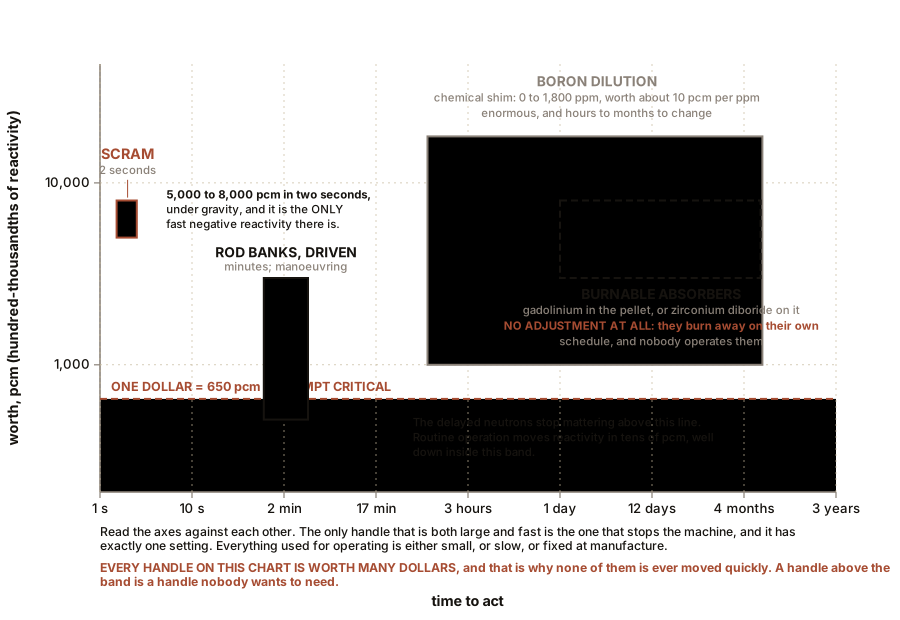
There are only three ways to change the reactivity of a reactor deliberately, and they differ in how much they are worth and how fast they act. That combination, worth against speed, is what makes each one suitable for a different job.
Section 1: The Three Handles
Control rods. Bundles of silver-indium-cadmium or boron carbide on a drive shaft, sliding into the guide tubes that Chapter 10 counted in each assembly. Grouped into banks. A single bank is worth perhaps 500 to 1,500 pcm; all the banks together, 5,000 to 8,000 pcm.
They are fast and coarse. Driven by their motors they move at a few centimetres, an inch or so, per second, taking two or three minutes for full travel. Released from their magnetic latches they fall under gravity and are fully inserted in about 2 seconds, which is a scram, and it is the only fast negative reactivity available.
Boric acid dissolved in the coolant, called chemical shim. Zero to about 1,800 ppm of boron, worth roughly 10 pcm per ppm, so the whole range is worth something like 18,000 pcm. That is enormous and it is very slow. Changing the concentration means either feeding in borated water or feeding in pure water and letting the primary system mix, which takes tens of minutes for a useful change.
So boron does the job whose timescale is months: absorbing the fresh core’s excess reactivity and being diluted away, gradually, as the fuel burns through an eighteen-month cycle.
Burnable absorbers, mixed into the fuel itself as gadolinium oxide, or coated onto the pellets as a thin layer of zirconium diboride. Worth thousands of pcm, and adjustable not at all. They are consumed by the same neutron flux that burns the fuel, so they fade out over the cycle on their own schedule. Nobody operates them. They exist so that the boron concentration at the start of a cycle does not have to be so high that Section 2’s stability property is compromised.
| Handle | Worth | Speed | What it is for |
|---|---|---|---|
| Scram | 5,000 to 8,000 pcm | 2 seconds | stopping |
| Control rod banks, driven | up to a few thousand pcm | minutes | manoeuvring, temperature control |
| Boron dilution | up to 18,000 pcm | hours to months | fuel burnup compensation |
| Burnable absorbers | thousands of pcm | fixed by design | holding down a fresh core |
Section 2: The Property That Does the Real Work
Now the part that matters more than all three handles together, and it is not a device.
A reactor’s reactivity depends on its own temperature, and in a Western design that dependence is negative. Get hotter, get less reactive. There are two separate mechanisms and they act on different timescales.
The fuel temperature coefficient, which is Doppler broadening, worth about -2 to -4 pcm per °C (-1.1 to -2.2 pcm per °F).
Chapter 8’s figure showed uranium-238’s capture resonances as a forest of tall narrow spikes. Those spikes are narrow because a nucleus sitting still absorbs only neutrons of very precisely the right energy. Heat the fuel and the nuclei move about, so a neutron of slightly the wrong energy can still meet a nucleus moving toward it at the right relative speed. The resonance gets wider and shorter.
The subtlety, which is usually skipped: a taller narrower resonance does not absorb more in a real fuel rod, because it is so absorbent at its exact peak that the outer skin of the pellet takes everything and the interior is shielded. Widening the resonance defeats that self-shielding, exposes more of the fuel to absorption, and the net capture in uranium-238 goes up.
So hotter fuel eats more neutrons. And the crucial thing about this mechanism is its speed: it is a property of the fuel’s own temperature, and the fuel heats within milliseconds of a power rise. The Doppler coefficient acts before anything else in the plant has noticed, which is why it is the reactor’s innermost defence against a fast excursion.
The moderator temperature coefficient, worth anywhere from about 0 to -80 pcm per °C (0 to -44 pcm per °F) depending on where you are in the fuel cycle.
This is Chapter 10’s undermoderation argument. Hot water is less dense, so there is less hydrogen per unit volume, so less moderation, so lower k. It is slower than the Doppler effect, because heat has to cross the pellet, the gap and the cladding before the water knows anything happened, but it is much larger.
And it is only reliably negative because the core is deliberately undermoderated and the boron concentration is deliberately limited. High boron makes this coefficient less negative, because hotter, less dense water also holds less boron. That is precisely why burnable absorbers exist: to keep beginning-of-cycle boron low enough that the moderator coefficient is never positive at power. That is a licensing requirement, not a preference.
Add them and you get the power coefficient, roughly -10 to -40 pcm per percent of full power. Which produces the behaviour in the next section.
IN PLAIN ENGLISH: Imagine a gas hob that turns itself down as the pan gets hotter, with no thermostat, no sensor and no wiring, simply because of the way the burner is shaped. Turn it up as far as you like and it settles at a temperature. Take heat away faster by putting a bigger pan on it and it turns itself up. That is a reactor. The knobs on the front are for choosing which temperature it settles at, not for deciding how much heat comes out.
Section 3: The Turbine Is in Charge
Here is the fact that surprises everyone, including engineers from other fields.
In normal operation the operator does not set the reactor’s power. The turbine does, and the reactor follows automatically.
Follow it through. The turbine’s control valve opens a little further, so more steam is drawn off the steam generators, so more heat is taken out of the primary coolant, so the coolant returning to the core is colder. Colder water is denser. Denser water moderates better. So k rises above one, and the reactor’s power climbs, on its own, with nobody touching anything, until the extra heat generated matches the extra heat being removed and the coolant temperature is back where it was.
Close the valve and the whole thing runs in reverse.
The control rods’ job during all of this is to hold the average coolant temperature on its programmed value, trimming slowly, while the reactor’s own temperature coefficient does the second-to-second work.
SLOW DOWN. Check Your Understanding: If the reactor follows the turbine automatically, why does a control room need operators at all during steady operation? Answer before reading on.
Because self-regulation holds a state; it does not choose one, and it has boundaries.
The negative power coefficient is a restoring force, exactly like a spring. A spring will hold a weight steady at whatever position balances it, and it will resist a push. It will not decide where the weight should be, it will not notice that the weight is getting heavier over time, and it will not tell you it is about to break.
So what the operators are doing is everything the coefficient cannot do. Compensating for fuel burnup, which is a steady reactivity loss of some tens of pcm a day, by diluting boron: without that, the reactor would drift down in power over weeks. Managing the axial power shape, because a core 3.66 m (12 ft) tall can burn its top harder than its bottom and the flux distribution has to be kept flat enough that no single rod exceeds its thermal limit. Managing xenon, which is Section 4 and is a genuinely difficult multi-hour problem. And watching the margins, because every one of Chapter 9’s factors is drifting all the time and the licensed limits are on the margins rather than on the power.
The general shape is worth carrying beyond reactors. A well-designed machine is stable without supervision and still needs supervision, because stability is about the response to a disturbance and operation is about where you sit and how much room you have left. A system that is self-stabilising is not thereby self-managing, and confusing the two is how people come to believe automation removes the need for expertise.
Section 4: Xenon-135, Which Is Genuinely Difficult
Chapter 8’s cross-section table had one absurd entry: xenon-135, absorption cross-section 2,650,000 barns. Four and a half thousand times uranium-235’s fission cross-section.
Xenon-135 is a fission product, and its behaviour is set by four numbers.
It is produced mostly at second hand. Only about 0.3 percent of fissions produce it directly. Most of it comes from the decay of iodine-135, which is produced with a yield of about 6.3 percent and has a half-life of 6.57 hours.
Xenon-135’s own half-life is 9.14 hours.
And it is destroyed by neutrons, because with a cross-section like that it absorbs a neutron almost the moment one comes near. In a reactor at full power, neutron absorption removes xenon far faster than decay does.
Those four facts produce a machine that misbehaves in a very specific way.
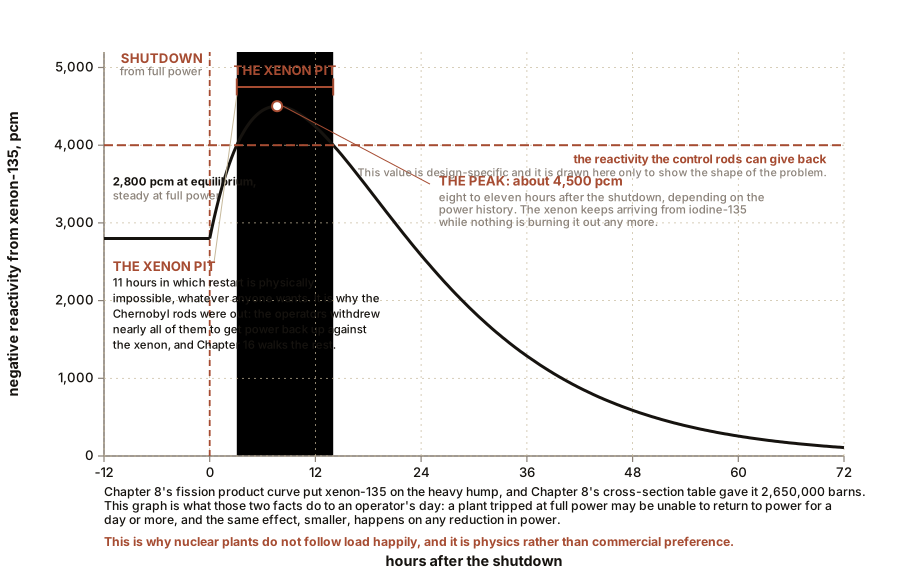
At steady full power the xenon settles at an equilibrium where production balances destruction, and it is holding down roughly 2,600 to 3,000 pcm of reactivity. The operators have simply withdrawn the rods far enough to account for it and it is invisible.
Now shut the reactor down. The neutron flux goes to zero, so the fastest destruction path stops instantly. But the iodine-135 that was already in the fuel keeps decaying into xenon on its own 6.57-hour schedule, and it does not care that the reactor is off.
So xenon builds up after shutdown, peaking about ten to eleven hours later at a total worth that can reach 4,000 to 5,000 pcm in a high-flux core, well above its full-power equilibrium value. Then it decays away over the following two to three days.
If the peak xenon worth exceeds the reactivity the control rods can give back, the reactor cannot be restarted at all until the xenon decays. That is the xenon pit, and it is a hard operational fact: a plant tripped at full power may be physically unable to return to power for a day or more, whatever anyone wants.
And the same effect, smaller, happens on any power reduction. Drop from 100 percent to 50 percent and xenon rises for several hours before falling, so the operators must withdraw rods to hold power, then push them back in later. That is the main reason nuclear plants do not follow load happily, and it is a physics constraint rather than a commercial preference, although the commercial preference points the same way: a plant whose cost is almost entirely capital loses money any hour it is not at full output.
Then there is the Chernobyl connection, which is the reason this section is not a curiosity.
The Chernobyl unit had been held at very low power for hours before the test. Low power means little neutron flux, which means little xenon destruction, which means xenon had built up substantially. To get the power back up against that xenon, the operators withdrew nearly all the control rods.
That left the reactor with almost nothing inserted, in a design where, for reasons Chapter 16 explains, the rods had graphite followers on their lower ends. The Soviet operating rules required a minimum of the equivalent of 30 rods’ worth of reactivity margin inserted at all times, and there was the equivalent of about 8.
The xenon pit did not cause Chernobyl. It caused the rods to be out, which was the condition that made everything after it possible. Chapter 16 walks the rest.
ON THE BENCH: A heater that turns itself down, and one that does not
Parts: an old-style incandescent light bulb, ideally 60 W or 100 W; a multimeter; a fluorescent tube fitting or the ballast from one, if you can look at one safely; optionally a length of self-regulating heat trace cable from a plumbing supplier. Cost: nothing to $15. Time: twenty minutes. Hazards: measure the bulb’s resistance with it unplugged and out of its socket. Do not open a fluorescent ballast or a lamp fitting; the point can be made by reading the labels. Mains electricity is the hazard in this box, not radiation. Method, part one. Measure the cold resistance of the bulb’s filament with the multimeter. For a 120 V 60 W bulb you will read something in the region of 15 to 25 ohms. Now compute what its resistance must be when running, from the rated voltage and power: 120² / 60 = 240 ohms. What you should see: the hot resistance is ten to fifteen times the cold resistance. Why that is this chapter. Tungsten’s resistance rises with temperature, so as the filament heats, current falls, and the power delivered falls. The bulb regulates its own temperature with no control system whatever, and it settles wherever heat in equals heat out. That is a negative temperature coefficient, and it is the reason a light bulb does not simply melt on switch-on. It also explains why bulbs fail at the moment you turn them on: for the first few milliseconds the filament is cold and the current is ten times its running value. Method, part two, which is the important half. Find out why a fluorescent tube or any gas discharge lamp requires a ballast in series with it. Read the fitting’s label; look up the term “negative resistance”. What you will find: a gas discharge has the opposite property. More current makes it more conductive, which admits more current. Connected straight across the mains it would destroy itself in a fraction of a second, and the ballast exists solely to impose the stability the device does not have. The point of both halves together. A machine whose response to getting hotter is to calm down needs no controller and cannot be made unsafe by a controller failing. A machine whose response is to accelerate can be operated perfectly well, but its safety now lives in an added component, and that component can fail, be bypassed, or be undersized. The bulb is a PWR. The fluorescent tube is an RBMK. This is a five-dollar demonstration of the most important distinction in reactor safety.
ON THE BENCH: Compute the xenon pit yourself
Parts: a spreadsheet. Cost: nothing. A calculation, offered because there is no bench experiment for this and there is no point pretending otherwise. Time: ninety minutes. Method. Two coupled quantities, iodine-135 and xenon-135, stepped forward in time. Take a time step of six minutes, or 0.1 hour, and use decay constants of ln2 divided by the half-lives: 0.1055 per hour for iodine and 0.0758 per hour for xenon.
iodine next = iodine + dt x ( production - 0.1055 x iodine )xenon next = xenon + dt x ( 0.1055 x iodine + small direct yield - 0.0758 x xenon - burnout )Set the burnout term proportional to the neutron flux and to the xenon present. Run at steady full power until both settle, which takes about 40 hours of simulated time. Then set the flux to zero, which is the shutdown, and keep stepping. What you should see: iodine falls away with its 6.57-hour half-life while xenon rises for the first ten to eleven hours, because iodine is still feeding it and nothing is removing it. Xenon peaks and then falls with its own 9.14-hour half-life. Your peak should land between about ten and eleven hours after shutdown regardless of the exact numbers you chose, because the peak time is set by the two half-lives and not by the flux. Then change one thing: raise the operating flux by a factor of three and rerun. The peak gets much higher relative to the pre-shutdown value, because a high-flux core was burning out a great deal of xenon that it now stops burning. That is why high power density reactors have deeper xenon pits and why naval reactors care about this more than power stations do. What you get for the effort: a curve you generated from four published constants that reproduces a real operational constraint on every large reactor on earth, and an understanding of why the timing of it cannot be changed by any design decision.
Section 5: Starting, Stopping, and the Minute After
Startup is Chapter 9’s 1/M plot, performed for real. The core sits deeply subcritical with a neutron source in it. Boron is diluted and rods are withdrawn in small steps, the count rate is allowed to settle after each, and the reciprocal is plotted against position to predict where critical will be. Criticality is reached at something like a hundred-millionth of full power, where the reactor is making no useful heat at all. Power is then raised deliberately by holding a small positive reactivity, watching the doubling time, and returning to critical at the target.
Shutdown is the reverse, or, if something is wrong, a scram: latches release, rods fall, several thousand pcm of negative reactivity arrives in about two seconds, and fission stops within a second or so.
And then the reactor is still producing 220 MW of heat.
That is Chapter 8’s late-arriving 6.3 percent, applied to a 3,400 MW core, and it is the subject of the next chapter but one. A scram stops the chain reaction and does not stop the reactor. No handle in this chapter touches decay heat. There is no handle.
Section 6: What to Carry Forward
Three handles: rods for seconds and minutes, boron for hours and months, burnable absorbers fixed at manufacture. Worth and speed are inversely related, which is why all three exist.
Reactivity falls as the reactor heats, by two mechanisms. Doppler broadening in the fuel acts in milliseconds and is small; moderator density in the water acts in seconds and is large. Together they make the machine self-stabilising.
The turbine sets the power and the reactor follows, because taking more heat out cools the coolant, which raises reactivity, which raises power until the temperature is restored. Nobody moves anything.
Self-stabilising is not self-managing. The coefficient holds a state; the operators choose the state, compensate burnup, manage power shape, and watch the margins.
Xenon-135 has a cross-section of 2.65 million barns, is fed by a 6.57-hour parent, and peaks ten to eleven hours after shutdown. It can make restart physically impossible for a day, it makes load-following painful, and at Chernobyl it is why the rods were out.
And a scram leaves 220 MW on.
Next: the one nuclear power source with no reactor, no criticality and no control at all, which has been running continuously since 1977 and is now outside the solar system.

Bench Degree
Get the degree without the diploma.
Learn the material, not how to pass the exam.