Bench Degree·NUCLEAR POWERchapter
Chapter 10: What a Reactor Is Made Of
A fuel pellet is 8 mm (0.31 in) across and there is a reason it is not 30 mm (1.2 in) across, and the reason has nothing to do with nuclear physics. It is that uranium dioxide conducts heat about as well as a brick, and you can measure that on your own hob.
Chapter 9 ended with a number: about 100 MW of heat per cubic metre, which is 2.8 MW per cubic foot. Everything in this chapter is a consequence of having to get that heat out of a solid without melting it, while not eating the neutrons that Chapter 9’s budget could not spare.
A reactor is a rock that boils water. The rock is uranium dioxide, a grey ceramic, and it is the least glamorous material in the building. Almost every design decision in the machine is about the rock’s shortcomings.
Section 1: The Fuel, From the Outside In
Start at the pellet and work outward, and notice that every dimension has a reason.
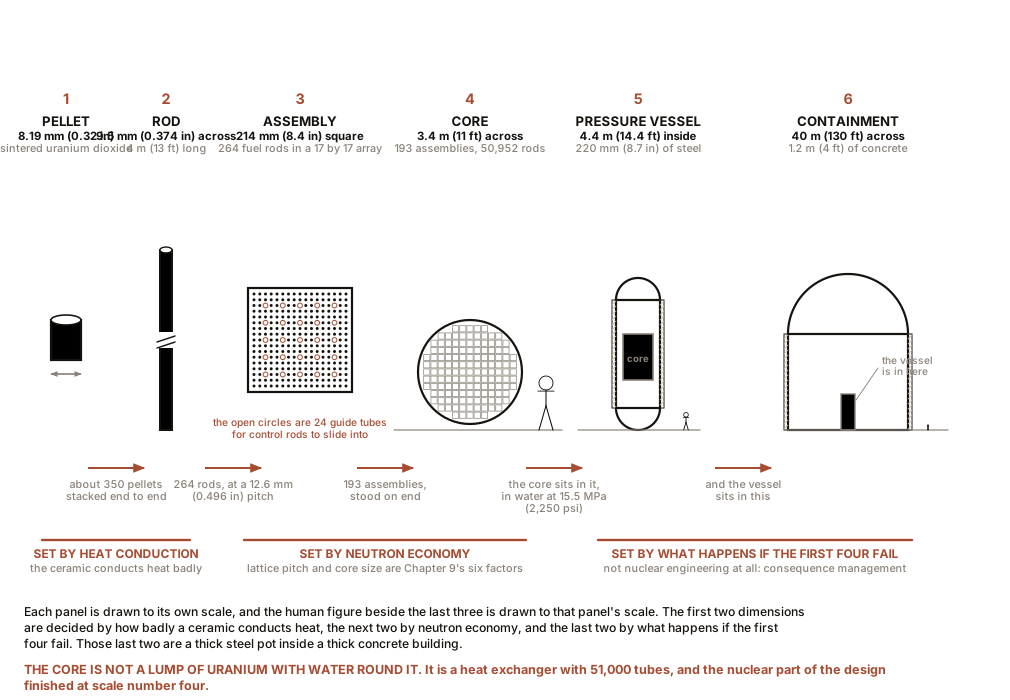
The pellet. A cylinder of sintered uranium dioxide, 8.19 mm (0.32 in) in diameter and about 9.8 mm (0.39 in) tall, weighing roughly 7 g (0.25 oz), pressed and fired like any other ceramic and ground to size. Its ends are slightly dished. It is 95 percent of theoretical density, deliberately not 100, because the pores give the fission gases somewhere to go.
Uranium dioxide rather than uranium metal, and the reasons are worth listing because they are all about staying in one piece rather than about neutrons. Metal swells under irradiation, changes crystal phase at 665 °C (1,229 °F), and reacts with water. The oxide is dimensionally stable, melts at 2,865 °C (5,189 °F), holds on to most of its fission gases, and does not react violently with hot water. The price is that it is a ceramic, and Section 2 is about what that costs.
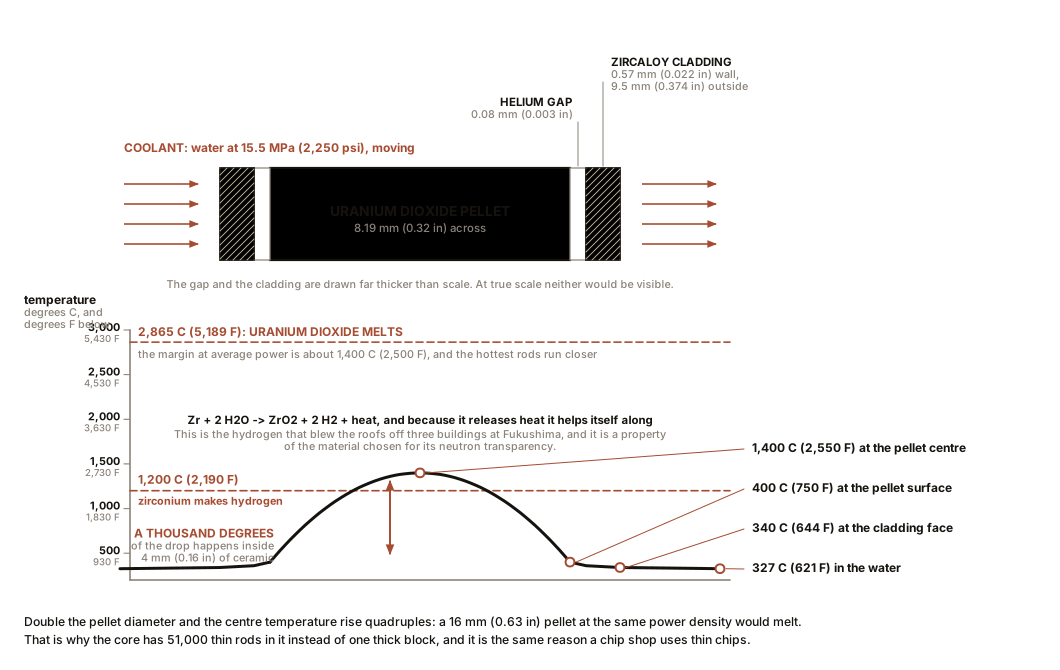
The cladding. The pellets are stacked in a tube of zirconium alloy with a wall 0.57 mm (0.022 in) thick and an outside diameter of 9.5 mm (0.374 in). There is a gap of about 0.08 mm (0.003 in) between pellet and tube, filled with helium at about 2.2 MPa (320 psi) to improve heat transfer across it, plus an empty plenum at the top with a spring in it to take up the fission gas that escapes.
Zirconium, because of Chapter 8’s table. Its neutron absorption cross-section is 0.18 barns, essentially transparent, and it resists corrosion in 330 °C (626 °F) water. Almost nothing else does both. Steel would be structurally easier and would eat too many neutrons.
And zirconium has one property that has to be stated here rather than in the accident chapter. Above about 1,200 °C (2,190 °F) it reacts with steam:
Zr + 2 H2O -> ZrO2 + 2 H2 + heatThat reaction produces hydrogen and it releases energy, so once it starts it helps itself along. It is the source of the hydrogen that blew the roofs off three buildings at Fukushima, and the reaction is a property of the material chosen for its neutron transparency. This is the central trade in reactor materials and it has not been designed away, though accident-tolerant claddings intended to reduce it are under active development.
The rod. About 3.66 m (12 ft) of stacked pellets, roughly 4 m (13 ft) overall, welded shut at both ends.
The assembly. In a pressurised water reactor, 289 rod positions in a 17 by 17 square array at a 12.6 mm (0.496 in) pitch, held by spacer grids. Of those positions, 264 hold fuel, 24 are open guide tubes for control rods to slide into, and one holds instrumentation. The assembly is about 214 mm (8.4 in) square and weighs roughly 660 kg (1,455 lb).
The core. 193 assemblies stood on end in a cylindrical array about 3.4 m (11 ft) across. That is 50,952 fuel rods and roughly 100 tonnes (110 US tons) of uranium dioxide, containing about 88 tonnes (194,000 lb) of uranium.
And the enrichment. Natural uranium is 0.72 percent uranium-235. Light water reactor fuel is 3 to 5 percent. Chapter 14 is about how that is done and why it is the proliferation-sensitive step.
Section 2: Why the Pellet Is Small
Uranium dioxide is a poor conductor of heat. Its thermal conductivity is around 3 W per metre per kelvin at operating temperature, which is roughly a hundredth of copper’s, a fiftieth of aluminium’s, and a fifteenth of steel’s. It is in the same range as firebrick.
Now put a heat source throughout the volume of a poor conductor and take heat off only at its surface, and the centre gets hot. How hot depends on the square of the radius, which is the whole reason for the pellet’s dimension.
At average power in a reference PWR, a rod produces about 17.5 kW per metre (5.3 kW per foot) of length. The temperature profile across the rod at that rating comes out roughly:
| Location | Temperature |
|---|---|
| Pellet centreline | about 1,400 °C (2,550 °F) |
| Pellet surface | about 400 °C (750 °F) |
| Cladding outer surface | about 340 °C (644 °F) |
| Bulk coolant | 327 °C (621 °F) |
A thousand degrees of the total drop happens inside 4 mm (0.16 in) of ceramic. The pellet’s melting point is 2,865 °C (5,189 °F), so there is a margin of about 1,400 °C (2,500 °F) at average power, and the hottest rods in the core run considerably closer to the limit.
Double the pellet diameter and the centre temperature rise quadruples. A 16 mm (0.63 in) pellet at the same power per unit volume would melt. So the pellet is thin because the ceramic is bad at conducting, and the core has 51,000 rods in it because thin pellets have very little surface area each and you need an enormous amount of surface to move 3,400 MW.
The core is therefore not a lump of uranium with water round it. It is a heat exchanger with 51,000 tubes, and the nuclear part of the design finished several sections ago.
IN PLAIN ENGLISH: Think about a baked potato. The oven heats it from the outside and the middle takes an hour, because a potato is a poor conductor. Now imagine the heat being generated inside the potato instead, and imagine you must keep the middle below a certain temperature or the whole thing is ruined. There is only one thing you can do: make the potatoes smaller and cook more of them. That is why a reactor core contains fifty thousand thin rods instead of one thick block, and it is the same reason a chip shop uses thin chips.
ON THE BENCH: Feel the difference between a ceramic and a metal
Parts: an unglazed ceramic floor tile about 8 mm (0.31 in) thick; a piece of aluminium plate or a thick aluminium baking tray of similar thickness; a pan of boiling water; two identical thermometers or a cheap infrared thermometer; a timer. Cost: nothing to about $15. Time: thirty minutes. Hazards: boiling water and hot metal. Use tongs and oven gloves. The aluminium will reach 100 °C (212 °F) and will burn you. Method: stand the tile and the aluminium plate on edge, half submerged in the boiling water, with the top edge of each in air. Every thirty seconds measure the temperature of the dry top edge of each. What you should see: the aluminium’s top edge reaches near boiling within a couple of minutes. The tile’s top edge is still cool after ten, and if the tile is thick enough it may never get there while the water lasts. What that establishes: aluminium’s conductivity is around 200 W per metre per kelvin and the tile’s is around 1 to 3, the same range as uranium dioxide. A factor of a hundred in conductivity is not a detail, it is the reason a fuel pellet is 8 mm (0.31 in) across. The extension worth doing: repeat with the same materials cut to twice the thickness and time it again. The time to heat through scales roughly with the square of the thickness, which is the same square that puts 1,000 °C (1,800 °F) inside 4 mm (0.16 in) of pellet.
Section 3: The Moderator, and What Each Choice Commits You To
Chapter 8 said a moderator slows neutrons by mass matching, and that hydrogen is best at slowing and worst at not absorbing. The figure that combines both is the moderating ratio: how good a substance is at slowing neutrons divided by how much it absorbs them.
| Moderator | Moderating ratio | Consequence |
|---|---|---|
| Ordinary water | about 62 | fuel must be enriched |
| Heavy water | about 4,800 | natural uranium works |
| Graphite | about 216 | natural uranium works, with care |
| Beryllium | about 130 | excellent, toxic, expensive |
That table decides the nationality of a reactor programme, and this is not an exaggeration.
Choose ordinary water and you have the cheapest, most familiar, best-understood coolant in engineering, and you have committed to an enrichment industry, because water absorbs too many neutrons for natural uranium to go critical in it. Enrichment plants are expensive and are the thing weapons inspectors care about.
Choose heavy water and natural uranium works, so you need no enrichment plant at all, and you have committed to a heavy water plant instead, which is a large industrial separation of its own for a substance present at one part in 6,400 in ordinary water.
Choose graphite and natural uranium works, and you have committed to a very large core, because graphite needs 114 collisions to a neutron rather than 18 and the neutrons have to travel correspondingly further. Graphite also burns, holds Wigner energy from irradiation damage, and shrinks and then swells over decades.
Countries that wanted nuclear power without an enrichment plant built heavy water or graphite reactors. Countries that had enrichment plants, generally because they had weapons programmes, built water reactors. The technology followed the industrial base, and the industrial base followed the weapons.
Section 4: The Lattice, and the Choice That Makes Western Reactors Stable
In a light water reactor, water is both moderator and coolant. That means the amount of water is set by two requirements at once, and they do not agree.
Work out how much water there is. In a PWR lattice, each rod sits in a square cell 12.6 mm (0.496 in) on a side, so the cell area is 158.8 mm². The rod occupies π × 4.75², which is 70.9 mm². The fuel pellet inside it occupies 52.7 mm². So the water area per cell is about 87.9 mm² and the fuel area 52.7 mm², a moderator-to-fuel volume ratio of about 1.7, rising toward 2 across the core once the water in the guide tubes and between assemblies is counted.
Now the important part. Plot k against the moderator-to-fuel ratio and you get a curve with a peak. Too little water and the neutrons never slow down enough. Too much water and the water starts absorbing them and the fuel is too dilute. There is an optimum, and it is at a ratio somewhat higher than 1.7.
Western light water reactors are deliberately built on the low side of that peak. They are undermoderated, on purpose, and they give up a few percent of neutron economy to be there.
SLOW DOWN. Check Your Understanding: Being undermoderated means the core is deliberately built away from its own optimum, at a real cost in fuel. Why would anyone do that? Think about what happens to the water when the reactor gets hotter, before reading on.
Because on the undermoderated side of the peak, losing water reduces k, and that turns the machine into something that stabilises itself.
Water expands when it is heated, and boils if it is heated enough. Either way, a hotter core contains less water per unit volume. If you are sitting on the undermoderated side of the curve, less water means less moderation means fewer thermal neutrons means lower k means less power means the core cools down. The reactor pushes back against its own excursion, with no operator, no instrument and no signal involved. It is a property of the geometry.
Sit on the overmoderated side and the identical event runs the other way: hotter means less water means better neutron economy means more power means hotter. That is a runaway, and it is available in a machine that is otherwise identical.
This is the single most consequential design decision in the whole of nuclear power, and it is why the four accidents of Chapters 15 and 16 include only one power excursion. The RBMK at Chernobyl used graphite as its moderator and water only as coolant, which means its water was a net absorber of neutrons rather than a moderator. Boiling it away therefore removed an absorber and raised reactivity. Its void coefficient was positive, by roughly the equivalent of four and a half dollars at low power, and that is not an operator error or a maintenance failure. It was in the lattice geometry from the day it was drawn.
The general lesson is the one worth keeping: the best safety features are not systems, they are shapes. A negative void coefficient cannot fail, cannot be switched off, needs no power supply, and does not depend on anybody noticing anything. Chapter 11 is about the family of such properties.
Section 5: Everything Else in the Building
Control materials, which are chosen from Chapter 8’s cross-section table by looking for the largest numbers. Control rods in a PWR are usually an alloy of silver, indium and cadmium, roughly 80, 15 and 5 percent, or boron carbide. Naval reactors use hafnium, which is expensive and mechanically excellent. Gadolinium and erbium are mixed into some fuel pellets as burnable absorbers, designed to be consumed at about the same rate as the fuel so that they hold down a fresh core’s excess reactivity and then get out of the way.
And boric acid dissolved in the coolant, called chemical shim, typically 0 to about 1,800 ppm of boron, worth around 10 pcm per ppm. That is the slow-acting reactivity control that handles the 20 percent excess of a fresh core, and it is diluted gradually over eighteen months as the fuel burns.
The reflector. Anything around the core that bounces escaping neutrons back in improves P_FNL from Chapter 9’s formula. In a PWR the water itself and the steel baffles around the core do the job. In a graphite reactor, an extra thickness of graphite. Chapter 9’s critical mass table showed a reflector cutting plutonium’s critical mass by more than half, and the same effect buys a few percent of reactivity in a power core.
The pressure vessel. A forged low-alloy steel cylinder, about 4.4 m (14.4 ft) inside diameter, 13 m (43 ft) tall, with a wall around 220 mm (8.7 in) thick and a thin stainless steel cladding on the inside. It weighs 330 to 400 tonnes (360 to 440 US tons) and holds 15.5 MPa (2,250 psi).
The hoop stress arithmetic is worth doing because it is one line. Stress equals pressure times radius over thickness:
15.5 MPa x 2,200 mm / 220 mm = 155 MPa (22,500 psi)against a yield strength for the steel of around 350 MPa (51,000 psi). A factor of a bit over two on yield, which is ordinary pressure vessel practice, and the vessel’s real design problem is not this number. It is that decades of neutron bombardment make steel more brittle, raising the temperature below which it would fail suddenly rather than stretching, and that embrittlement is the principal thing limiting how long a plant can be licensed to operate. Surveillance coupons of the vessel steel are hung inside the vessel from the start and pulled out periodically to be broken and measured.
The containment. A prestressed concrete building around the whole primary system, typically 1.0 to 1.3 m (3.3 to 4.3 ft) thick with a welded steel liner, enclosing 50,000 to 80,000 m³ (1.8 to 2.8 million cubic feet) and designed to hold 0.4 to 0.5 MPa (60 to 70 psi), which is what the primary coolant would produce if all of it flashed to steam at once. The RBMK at Chernobyl did not have one. Neither did the Windscale piles. That single omission is most of the difference between the consequences of those two accidents and the consequences of Three Mile Island, where roughly half the core melted and the public dose was one millirem.
ON THE BENCH: The lattice, worked out from two dimensions
Parts: a pencil, and a ruler if you want to draw it. Cost: nothing. This is a calculation. Time: forty minutes. Method: take the pitch as 12.6 mm (0.496 in), the rod outside diameter as 9.5 mm (0.374 in) and the pellet diameter as 8.19 mm (0.32 in). 1. Cell area, rod area, pellet area, water area. Get the 1.7 ratio above. 2. Now vary the pitch. Work out the water-to-fuel ratio at 11, 12, 13, 14 and 15 mm, which is 0.43 to 0.59 in. Notice how fast it moves: a 20 percent change in pitch nearly doubles the water fraction. 3. Compute the wetted surface per rod per metre, π × 9.5 mm, and multiply by 50,952 rods and 3.66 m of length. You should get something over 5,500 m², which is about 60,000 square feet, roughly the area of a football pitch, all of it inside a cylinder 3.4 m (11 ft) across. 4. Divide 3,400 MW by that area. You get about 600 kW per square metre, or 56 kW per square foot. Compare that with a domestic hob element at about 30 kW per square metre. What you should conclude: the fuel surface is running at roughly twenty times the heat flux of a cooker ring, over an area the size of a football pitch, folded into a van-sized space. That is why the coolant is at 15.5 MPa (2,250 psi): the pressure exists to keep the water from boiling at 327 °C (621 °F), because once it boils the surface heat transfer changes character and the numbers above stop holding. Chapter 13 takes that up.
Section 6: The Family Tree
Reactor types are usually presented as a list to be memorised. They are better understood by asking three questions in order, because the answers determine almost everything else.
What moderates? What cools? Are those the same substance?
| Type | Moderator | Coolant | Same? | Fuel | Void coefficient |
|---|---|---|---|---|---|
| PWR | light water | light water | yes | 3 to 5% enriched | negative |
| BWR | light water | light water, boiling | yes | 3 to 5% enriched | negative |
| CANDU | heavy water | heavy water | yes, separate circuits | natural | slightly positive |
| RBMK | graphite | light water | no | 2% enriched | strongly positive |
| Magnox and AGR | graphite | carbon dioxide | no | natural or 3% | small |
| High-temperature gas | graphite | helium | no | TRISO particles | negative |
| Sodium fast reactor | none | liquid sodium | n/a | 15 to 20% | design-dependent |
Read the “same?” column against the void coefficient column. Where the coolant is also the moderator, losing coolant loses moderation and reactivity falls. Where they are different substances, losing the coolant leaves the moderator in place, and whether reactivity rises or falls depends on whether the coolant was a net absorber. The RBMK’s fatal property is visible in a two-column table.
Brief notes on the ones the rest of this book uses.
PWR. The commonest type by a wide margin. Water at 15.5 MPa (2,250 psi) never boils in the core; it carries heat to steam generators where a separate, non-radioactive water circuit boils. Two loops means the turbine hall is clean.
BWR. The water boils in the core and the steam goes straight to the turbine. Simpler, no steam generators, lower pressure at 7.0 MPa (1,020 psi), and the turbine is inside the radiological boundary. Power is adjusted partly by varying the recirculation flow, which changes the amount of boiling.
CANDU. Heavy water moderator in a large unpressurised tank, with the fuel in horizontal pressure tubes running through it. Runs on natural uranium, refuels while operating, and needs no large pressure vessel forging, which meant it could be built by a country without heavy-forging capacity.
RBMK. Graphite blocks with vertical pressure tubes through them, boiling light water, refuelled online, and built without a containment building. Chapter 16.
Fast reactors. No moderator at all, so the neutrons stay fast, which changes every cross-section in the machine and allows the reactor to breed more fuel than it consumes. Liquid sodium coolant, because it conducts heat superbly and does not moderate, and because it also burns in air and reacts violently with water. A small number have operated for decades; none has yet been commercially routine.
Section 7: What to Carry Forward
Almost every dimension in a reactor is set by heat, not by neutrons. The pellet is 8 mm (0.31 in) across because uranium dioxide conducts like a brick, and the core has 51,000 rods because thin pellets have to be numerous.
Zirconium was chosen because it is transparent to neutrons, and it makes hydrogen with steam above 1,200 °C (2,190 °F). That trade is unresolved and it is Fukushima’s explosions.
The moderating ratio decides whether you need an enrichment plant, and that decided which countries built which reactors.
A light water reactor is deliberately undermoderated, which makes losing water reduce reactivity, which makes the machine self-stabilising. This is a shape, not a system, and shapes cannot fail.
Ask what moderates, what cools, and whether they are the same substance. Those three answers place any reactor on the family tree and predict the sign of its void coefficient.
And the containment building is what makes a bad day local. Two of the four accidents in Chapters 15 and 16 happened in reactors that did not have one, and those are the two that contaminated a landscape.
Next: how an operator actually moves this machine, and the properties that hold it steady when nobody does anything at all.

Bench Degree
Get the degree without the diploma.
Learn the material, not how to pass the exam.