Bench Degree·NUCLEAR POWERchapter
Chapter 9: Criticality
Six numbers multiplied together decide whether a pile of uranium is a power station or a pile of uranium. All six are on one line, none of them is hard, and by the end of this chapter you will have worked the line for a real core and found out why it is 3.4 m (11 ft) across when criticality only needs half that.
Everything in this chapter is arithmetic. There is no experiment that reaches criticality and there never will be for a reader, which Chapter 1 said plainly. What is available instead is the actual intellectual content of reactor design, which is a neutron budget, done with a pencil, exactly as it is done at every facility in the world before any code is run.
Two bench experiments here are analogues rather than the thing itself, and they are labelled as such. The third is the calculation, and it is the important one.
Section 1: k, and the Only Three States There Are
Follow one generation of neutrons. Some cause fission and produce a new generation. Some are absorbed without fissioning. Some escape the core entirely.
k-effective is the ratio of one generation’s size to the previous one’s. That is the whole definition.
k below 1: subcritical. Each generation is smaller. Left alone, the chain dies out.
k exactly 1: critical. Each generation is the same size. The reaction sustains itself indefinitely at whatever power it happens to be at.
k above 1: supercritical. Each generation is larger and the power climbs.
A power reactor spends its entire operating life at k exactly 1. Chapter 3’s SLOW DOWN made this point and it bears repeating because the word does so much damage: critical means steady. An operator raises power by going very slightly supercritical, waiting, and then returning to exactly critical to hold the new power. Power is the integral of the time spent above one, not a consequence of how far above one you went.
Reactivity is the more convenient quantity for talking about small departures from critical:
rho = (k - 1) / kAt k = 1.001, reactivity is about 0.001, which is quoted either as 100 pcm, meaning parts per hundred thousand, or as 0.15 dollars, where one dollar is the delayed neutron fraction β of 0.0065 from Chapter 8. The dollar is the more informative unit because it says how close you are to losing the delayed neutrons’ protection. Anything under about ten cents is routine operation. One dollar is prompt critical and the reactor is no longer a machine anyone is operating.
Section 2: The Six Factors, One at a Time
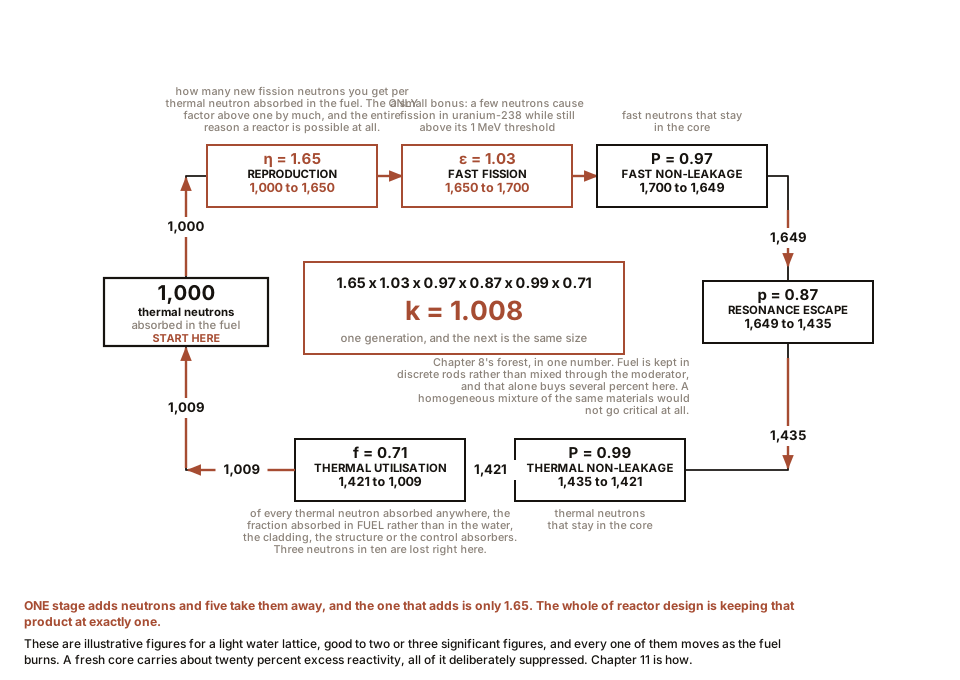
Take one thermal neutron that has just been absorbed in the fuel, and follow the generation it produces around the whole loop. Six things happen to it, and each one multiplies the count by a factor. Multiply all six and you have k.
η, the reproduction factor. How many new fission neutrons you get per thermal neutron absorbed in the fuel. Not 2.43, because not every absorption in the fuel causes a fission: Chapter 8’s table gives 585 barns for fission against 99 for capture in uranium-235, and there is uranium-238 in there soaking up neutrons too. For a light water lattice with fuel at 3 to 4 percent enrichment, η is about 1.65.
This is the only factor above one by much, and it is the entire reason a reactor is possible. Everything else in the chain takes neutrons away.
f, the thermal utilisation factor. Of all the thermal neutrons absorbed anywhere in the core, what fraction were absorbed in the fuel rather than in the water, the cladding, the structure or the control absorbers. About 0.71. Nearly three neutrons in ten are lost to things that are not fuel, and Chapter 8’s zirconium and water cross-sections are why that number is as good as 0.71 rather than far worse.
p, the resonance escape probability. A neutron born fast must slow all the way to thermal, and on the way down it passes through the energy range from about 6 eV to 200 eV where uranium-238 has that forest of enormous capture resonances. The fraction that gets through without being caught is about 0.87.
This factor is the reason for one of the least obvious features of reactor design. Fuel is kept in discrete rods rather than mixed evenly with the moderator. A neutron slowing down inside a rod is surrounded by uranium-238 and will be caught; a neutron that leaves the rod, slows down out in the water, and comes back is safe, because by then it is below the resonance range. Lumping the fuel gives the neutrons somewhere to slow down that is not full of uranium-238, and it buys several percent on p. A homogeneous mixture of the same materials would not go critical at all.
ε, the fast fission factor. A small bonus. A few neutrons cause fission in uranium-238 while still above its 1 MeV threshold, before they slow down. About 1.03.
P_FNL and P_TNL, the non-leakage probabilities. The fraction of neutrons that stay in the core while fast, and the fraction that stay in while thermal. For a full-size power reactor core, about 0.97 and 0.99.
Multiply the lot:
k = 1.65 x 0.71 x 0.87 x 1.03 x 0.97 x 0.99 = 1.008Two honest notes. These factor values are illustrative figures for a light water lattice, they are quoted to two or three significant figures at best, and every one of them changes through a fuel cycle as fuel burns, plutonium builds and fission products accumulate. A real design calculation solves neutron transport in hundreds or thousands of energy groups on a detailed geometry, and the six-factor formula is a teaching tool and a sanity check rather than a design method. It is still the right thing to learn first, because it tells you which knob does what.
And: k of 1.008 is not what a running reactor sits at. A fresh core has far more reactivity than 0.8 percent, because it has to have enough fuel to run for eighteen months or more. Beginning-of-cycle excess reactivity in a modern PWR is of order 20 percent, and the whole of that surplus is deliberately suppressed, with boron dissolved in the coolant and burnable absorbers in the fuel, so that k comes out at exactly 1. Chapter 11 is about how.
IN PLAIN ENGLISH: Think of a leaky bucket being filled from a tap. The tap is the fuel producing neutrons and the leaks are everything that takes them away: absorption in the water, absorption in the steel, capture on the way down in energy, and escape out of the sides. The level in the bucket holds steady when the tap exactly matches the leaks, and that is what critical means. Open the tap a hair and the level rises, slowly and controllably; close it a hair and the level falls. Nothing about a steady level is precarious. What matters is that you know how big every leak is, because the tap is only just big enough.
Section 3: Critical Mass, and Why Shape Matters as Much as Amount
Critical mass is not a property of a material. It is a property of a material in a particular shape, at a particular density, with particular things around it. Quoting a critical mass without the geometry is like quoting a temperature without a scale.
For a bare sphere of metal in air, with nothing around it:
| Material | Critical mass | Diameter |
|---|---|---|
| Uranium-235 | 52 kg (115 lb) | 17 cm (6.7 in) |
| Plutonium-239 | 10 kg (22 lb) | 10 cm (3.9 in) |
Change the surroundings and those numbers move a long way. A beryllium or tungsten reflector, which bounces escaping neutrons back in, cuts the plutonium figure to about 4 kg (8.8 lb). Dissolve fissile material in water, where the water both moderates and reflects, and criticality can occur with under 1 kg (2.2 lb) in the right vessel.
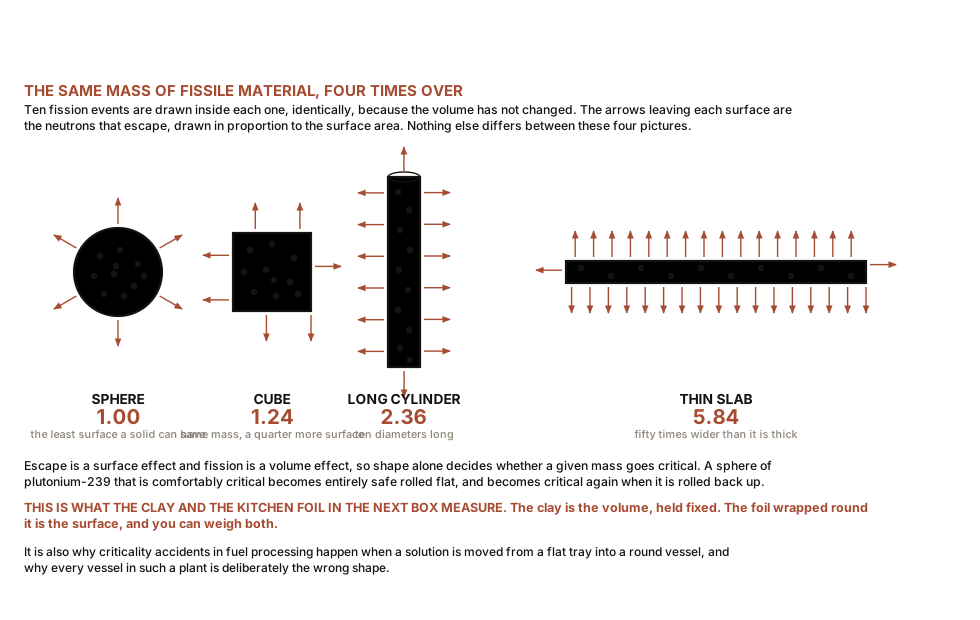
And a sphere is the best possible shape, which means every other shape needs more.
The reason is surface area. Neutrons leak out through the surface and are produced throughout the volume, so the quantity that matters is the surface-to-volume ratio, and a sphere has the lowest of any shape. Spread the same mass into a slab and its surface area multiplies several times over, so its leakage multiplies too, and it will not go critical at any mass.
This is the single most important safety principle in fuel handling, and it is why criticality accidents almost never happen in reactors and quite often happen in chemical plants. Fuel processing equipment is designed with geometric safety: pipes of a diameter that cannot go critical whatever is in them, tanks with neutron-absorbing internal partitions, floors sloped so that a spill spreads thin rather than pooling. The engineering controls the shape rather than the amount, because shape is easier to guarantee.
ON THE BENCH: Geometry, with a lump of clay
Parts: 500 g (18 oz) of modelling clay or plasticine; kitchen aluminium foil; a kitchen scale that reads to 0.1 g (0.004 oz); a ruler. Cost: about $5. Time: thirty minutes. Hazards: none. Method, and the measuring trick is the good part. Form the clay into a sphere. Now wrap it completely in a single layer of foil, trim to exactly cover it with no overlap, peel the foil off, flatten it and weigh it. Foil has a fixed mass per unit area, so its weight is a measurement of surface area, and you can calibrate by weighing a square 100 x 100 mm (4 x 4 in) piece. Then reshape the same clay, without losing any, into: a cube, a cylinder as long as your ruler, and a flat slab about 5 mm (0.2 in) thick. Wrap and weigh each. What you should see: the sphere has the least surface by a clear margin. The cube is about 24 percent more. The long cylinder is several times more, and the thin slab is five to seven times the sphere’s surface for exactly the same mass. What that means: if the clay were fissile, the sphere might be critical and the slab could not be at any mass, because it is losing neutrons through five or six times the area while producing them in the same volume. You have measured the entire physical basis of criticality safety in fuel handling. And the limitation, stated because this book states them. This is an analogue, not a model. Real leakage depends on how far a neutron travels before it is absorbed, which sets a length scale of a few centimetres, an inch or two, and a shape only matters through its relation to that length. The clay gives you the geometry argument correctly and tells you nothing quantitative about neutrons.
Section 4: So Why Is the Core That Big?
Here is the question the outline of this book set as its test, and it has a two-part answer that almost nothing states.
The minimum size is set by leakage. Neutron production scales with volume, leakage with surface, so below a certain size no arrangement of fuel and moderator can be critical. For a light water lattice at ordinary enrichment, diffusion theory puts that minimum somewhere around 1.5 to 2 m (5 to 6.5 ft) across. This is an approximate figure from a simple model and it depends heavily on enrichment and on what surrounds the core, but the order of magnitude is right, and it is confirmed by the fact that small modular reactor cores are built at roughly that size.
The actual size is set by heat removal, and it is about twice as big as criticality needs.
A reference four-loop pressurised water reactor makes 3,400 MW of heat in a core about 3.4 m (11 ft) across and 3.66 m (12 ft) of active fuel height, which is a volume of about 33 m³ (1,170 cubic feet). That is a power density of about 100 MW per cubic metre, or 2.8 MW per cubic foot, which is a startling number: a volume roughly that of a small van, producing the heat of three million domestic kettles.
Shrink that core to the leakage-limited minimum, around 7 m³ (250 cubic feet), and the same 3,400 MW would need a power density of 460 MW per cubic metre. Nothing survives that. Chapter 10 works out the pellet-to-coolant temperature drop and shows why.
So the answer is: the core is as small as the cooling allows, and the cooling allows something roughly twice the size that criticality would allow. The gap between those two numbers is where the entire thermal design lives, and it is why reactor engineering is mostly heat transfer rather than nuclear physics.
ON THE BENCH: The neutron balance for a real core, by hand
Parts: a pencil, and the table of factors in Section 2. Cost: nothing. Time: an hour, and it is worth every minute. Hazards: none. This is a calculation and not an experiment, and it is the one this chapter offers instead, exactly as Chapter 1 promised. Method. Start with 1,000 thermal neutrons absorbed in the fuel and walk them around the loop, writing the running total at each of the six stages, as in the figure. Get 1,009 at the end. Then, and this is the part that teaches, change one factor at a time by ten percent and see what happens to k. - Drop f from 0.71 to 0.64, which is what inserting control rods does. k falls to 0.91. Deeply subcritical from a seven-point change in one factor. - Drop p from 0.87 to 0.78, which is what heating the fuel does, because hot uranium-238’s resonances broaden and catch more neutrons. k falls to 0.90. That is the negative temperature coefficient of Chapter 11, and you have just derived it. - Drop the thermal non-leakage from 0.99 to 0.90, which is what happens if the core is made small. k falls to 0.92. - Raise η from 1.65 to 1.80, which is what higher enrichment does. k rises to 1.10. What you should conclude: the product of six numbers all near one is extraordinarily sensitive. A one percent change in any single factor moves k by one percent, which is 1,000 pcm, which is a hundred and fifty times a routine control movement. That sensitivity is the reason reactors are controllable at all, and it is also the reason the margins have to be watched. Then do the reverse. Ask what f would have to be for k to come out at exactly 1.000, and you get 0.7043. The difference from 0.71 is the amount of absorber the operator has to keep in the core, and that is what a control rod position and a boron concentration actually are.
Section 5: Starting Up, and Why a Subcritical Reactor Is Not Quiet
A subcritical reactor with a neutron source in it does not have zero neutrons. It has a steady population, and the population is larger than the source, because each source neutron starts a chain that dies out after several generations.
Add up the generations and the multiplication is
M = 1 / (1 - k)At k = 0.5, the core produces twice the source’s neutrons. At k = 0.9, ten times. At k = 0.99, a hundred times. At k = 0.999, a thousand.
This is called subcritical multiplication and it is how a reactor is brought critical safely. The operator withdraws rods a little, waits for the count rate to settle, and plots the reciprocal of the count rate against rod position. Since count rate is proportional to 1/(1 - k), its reciprocal falls linearly toward zero, and the point where the line reaches zero is where k reaches 1. Extend the line, read off the rod position, and you know where critical is before you get there.
That is exactly what Fermi did under the squash court, one rod step at a time, computing where the next step would land. The technique is still standard practice and is still called the 1/M plot.
ON THE BENCH: A chain reaction in coins, and the surprise at the end
Parts: a large bag of dried beans, or coins, or anything countable; two dice; a notebook. Cost: nothing. Time: an hour. Hazards: none. A calculation again, dressed as a game. Method. Represent a generation of neutrons as a pile of beans. For each bean in the current generation, roll a die and use a rule that gives your chosen average number of offspring. To model k = 1.0: a roll of 1 or 2 gives no offspring, 3 or 4 gives one, 5 or 6 gives two. The average is exactly 1. Build the next generation’s pile from the offspring and repeat. Start with 100 beans and run twenty generations. Then run it three more times. What you should see, and it is not what you expect. With k set to exactly 1.0, the population does not hold steady at 100. It wanders: 100, 112, 96, 88, 103, and quite often it wanders down to zero and stops, permanently. A critical system with a small number of neutrons in it dies out, by chance, quite frequently. Why that matters enormously. A real reactor at k = 1 does not die out, because it has something like 10¹⁴ neutrons in each generation and the statistical wander is one part in ten million. Criticality is a statement about averages and it only behaves like a steady state when the population is huge. Which is precisely why a reactor being started from cold has a startup neutron source installed: at low power the population is small enough for statistics to matter, the count rate is erratic, and the instruments need something reliable to measure. Fermi’s pile had cosmic rays and spontaneous fission to seed it; modern plants use an antimony-beryllium or californium source. Then run it at k = 0.95 and k = 1.05, by shifting the die rule, and watch the first die reliably and the second run away. Plot the log of the population against generation number and both give straight lines, up and down. You have just built the entire behaviour of a reactor out of two dice.
SLOW DOWN. Check Your Understanding: More than sixty criticality accidents have occurred since 1945, killing about twenty-one people. Almost none of them happened in a reactor. Where did they happen, and what does that tell you about which quantity is dangerous? Answer before reading on.
They happened in fuel handling and chemical processing, in solutions and in slurries, and the quantities involved were often small. The best-documented recent case is Tokai-mura in Japan in 1999, where workers at a fuel fabrication plant poured uranyl nitrate solution into a precipitation tank by hand, using buckets, because it was quicker. The tank was the wrong shape and the solution was water, which moderates and reflects. It went critical with far less material than any handbook critical mass, glowed blue, and ran on and off for about twenty hours. Two of the three workers died.
The lesson is that the dangerous variable is geometry and moderation, not amount. A reactor is the one place fissile material is in a shape that has been analysed to death, is monitored continuously, and is surrounded by instrumentation whose whole purpose is to notice k moving. A bucket is not.
And there is a second lesson, which is the reason this SLOW DOWN is here rather than in Chapters 15 and 16. Every one of these accidents involved a procedure that had been simplified by the people doing it, for good local reasons, in a way that changed a geometry someone else had guaranteed. The safety was in the shape of the equipment, and the shape was bypassed by using different equipment. That failure mode is not nuclear. It is available in every industry there is.
Section 6: What to Carry Forward
k is the ratio of one neutron generation to the last, and critical means k = 1, which means steady.
Six factors multiplied together give k, only one of which is above one. η produces the neutrons; f, p and the two leakage terms take them away; ε gives a small bonus back.
You have worked that balance by hand and found that a one percent change in any factor moves k by 1,000 pcm, which is why the machine is both controllable and worth watching.
Critical mass is a property of a shape, not of a material, and a sphere is the best case. Fuel handling is made safe by controlling geometry, because geometry can be guaranteed and quantity cannot.
The core’s minimum size is set by neutron leakage at roughly 1.5 to 2 m (5 to 6.5 ft) across. Its actual size, about 3.4 m (11 ft), is set by the need to get 3,400 MW of heat out of it. Criticality is the cheaper constraint.
Subcritical multiplication is 1/(1 - k), which is how an approach to critical is done safely and predictably.
And criticality is a statistical statement. It behaves like a steady state only because there are 10¹⁴ neutrons per generation, which your dice demonstrated by failing to.
Next: the parts. What a reactor is actually made of, and what each material choice commits you to for the life of the machine.

Bench Degree
Get the degree without the diploma.
Learn the material, not how to pass the exam.