Bench Degree·NUCLEAR POWERchapter
Chapter 8: Fission in Detail
Slowing a neutron down by a factor of eighty million makes it far more likely to split a nucleus, which is backwards from every intuition anyone has about projectiles. And 0.65 percent of the neutrons arrive late, which is the only reason a reactor can be operated by a human being. Both of those get a bench experiment.
Chapter 3 established that fission happens and releases about 200 MeV. This chapter is about the details that decide whether a machine can be built out of it, and there are four: which nuclides split, how likely a given neutron is to split one, how many neutrons come back out, and when.
The last of those is the one almost no popular account mentions, and nothing about reactor control makes sense without it.
Section 1: Fissile, Fissionable, Fertile
Three words that get used interchangeably and mean quite different things.
Fissionable means the nucleus can be split by a neutron of some energy. Most heavy nuclei qualify.
Fissile means it can be split by a slow neutron, one carrying essentially no kinetic energy. This is a much shorter list: uranium-233, uranium-235, plutonium-239 and plutonium-241 are the ones that matter.
Fertile means it is not fissile, but absorbing a neutron converts it into something that is. Uranium-238 becomes plutonium-239. Thorium-232 becomes uranium-233.
And there is a beautiful reason for that list, which almost nothing explains and which takes two paragraphs.
Look at the mass numbers of the fissile nuclides: 233, 235, 239, 241. All odd. Now look at uranium-238, which is fissionable but not fissile. Even.
Chapter 4’s last term was the pairing effect: nuclei prefer their protons and their neutrons to come in even numbers. Uranium-235 has 143 neutrons, an odd number, so it has one unpaired neutron. When it absorbs a neutron, that neutron finds a partner, and the pairing energy released is a bonus of roughly 1 MeV on top of the neutron’s binding energy. The resulting uranium-236 is left excited by about 6.5 MeV, and the energy needed to deform it past the point of no return, its fission barrier, is about 6.2 MeV. The bonus is enough. It splits with no help at all.
Uranium-238 has 146 neutrons, an even number, all paired. An arriving neutron gets no pairing bonus. The excitation comes to about 4.8 MeV against a barrier of about 6.3 MeV, so it falls short by roughly 1.5 MeV, and that shortfall has to be supplied as kinetic energy by the incoming neutron. Hence uranium-238 fissions only above about 1 MeV, and below that it simply captures.
The entire enrichment industry exists because of an even number. Natural uranium is 99.27 percent uranium-238 and 0.72 percent uranium-235, and the 0.72 percent is the part that will respond to a slow neutron.
Section 2: The Barn, and What a Cross-Section Is Not
To say how likely a neutron is to do something to a nucleus, you quote an effective target area, exactly as Rutherford did in Chapter 2. The unit is the barn, which is 10⁻²⁸ m², named by two physicists at Purdue in 1942 who wanted something innocuous for a classified report and observed that on this scale a uranium nucleus is as big as a barn.
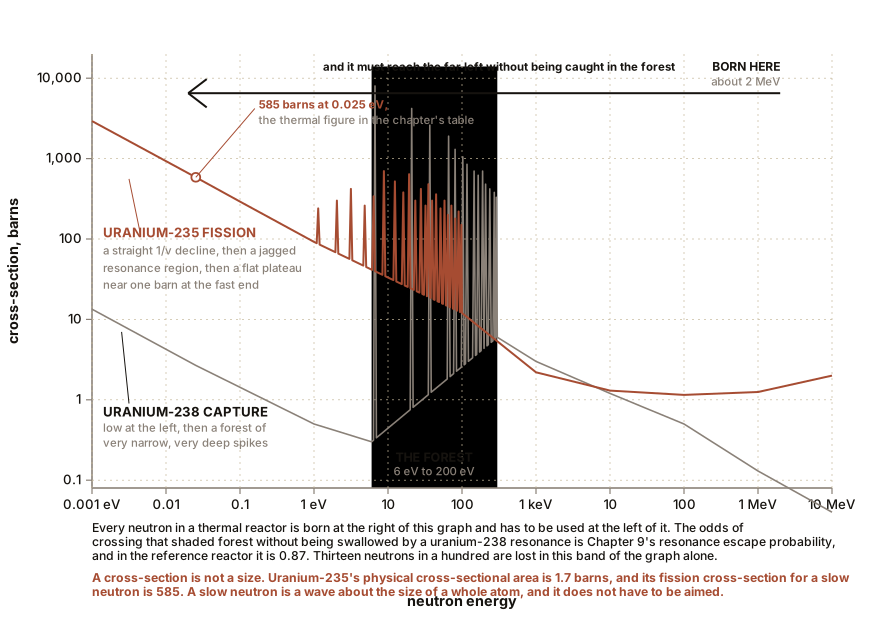
The numbers that matter, all for a slow neutron at 0.025 eV:
| Reaction | Cross-section (barns) |
|---|---|
| U-235 fission | 585 |
| U-235 capture without fission | 99 |
| U-238 capture | 2.68 |
| Pu-239 fission | 748 |
| Boron-10 absorption | 3,840 |
| Cadmium-113 absorption | 20,600 |
| Gadolinium-157 absorption | 254,000 |
| Xenon-135 absorption | 2,650,000 |
| Zirconium absorption | 0.18 |
| Water, per hydrogen atom, absorption | 0.33 |
Read the top two lines together. A slow neutron entering uranium-235 has about a 585 in 684 chance of causing fission and an 84 in 684 chance of being captured and producing uranium-236 instead. That ratio, about 6 to 1, is a permanent tax on the neutron economy and Chapter 9 has to pay it.
Read the bottom two lines too. Zirconium and water barely absorb neutrons at all, which is exactly why fuel cladding is made of zirconium alloy and why water can be both coolant and moderator. Those two small numbers decide the whole architecture of a light water reactor.
And read the xenon line and remember it. Two and a half million barns. Chapter 11 is largely about what that number does to an operator’s day.
SLOW DOWN. Check Your Understanding: A uranium-235 nucleus is about 7.4 fm across, which makes its physical cross-sectional area about 1.7 barns. Its fission cross-section for a slow neutron is 585 barns, which is roughly 350 times larger. How can a target be hundreds of times bigger than itself? Think before reading on.
Because a cross-section is a probability wearing the costume of an area, and it is not a size. It is defined as whatever area, if the nucleus were a solid disc and the neutron a bullet, would give the observed reaction rate. Nothing requires that area to match the object.
The physical reason it comes out larger is that a slow neutron is not a bullet, it is a wave. Its de Broglie wavelength at 0.025 eV is about 1.8 × 10⁻¹⁰ m, which is roughly the size of a whole atom and about twenty thousand times the diameter of the nucleus. A wave that large does not have to be aimed. It overlaps the nucleus from a long way off, and the interaction probability is set by the overlap rather than by geometry.
Which also explains why slowing a neutron down increases the cross-section. Slower means longer wavelength, so a bigger overlap. It also means the neutron spends more time in the neighbourhood of the nucleus, and at low energies the cross-section for absorption goes as one over the velocity, the 1/v law, for exactly that reason.
So the counterintuitive fact of this chapter is not a quirk. It is what happens when a projectile is also a wave, and it is worth noticing that this is the same reason a green laser focuses to a smaller spot than a red one, from the Lasers volume’s Chapter 6. Wavelength sets the scale over which a wave can be localised, in both directions.
Section 3: Slowing Down, and How Many Hits It Takes
A neutron is born in fission with an average kinetic energy around 2 MeV. A neutron in thermal equilibrium with room-temperature matter carries about 0.025 eV. That is a factor of eighty million, and a reactor’s job in the first microsecond of a neutron’s life is to make it lose all of that without absorbing it.
The only mechanism available is billiards. Elastic scattering, where the neutron bounces off a nucleus and hands over some of its kinetic energy. And how much it hands over depends almost entirely on one thing: whether the target weighs about the same as the neutron does.
For a head-on elastic collision, the fraction of energy transferred is
4 m M / (m + M)²where m and M are the two masses. Put in equal masses and you get 1, meaning the whole lot. Put in a neutron against carbon-12 and you get 0.284. Against uranium-238 you get 0.017.
Which gives the table that decides what a moderator is made of, showing the average number of collisions needed to take a 2 MeV neutron down to 0.025 eV:
| Moderator | Collisions to thermalise | Absorbs neutrons? |
|---|---|---|
| Hydrogen, as ordinary water | 18 | yes, noticeably |
| Deuterium, as heavy water | 25 | almost not at all |
| Beryllium | 86 | very little |
| Carbon, as graphite | 114 | very little |
| Uranium-238 | about 2,200 | disastrously |
Hydrogen is the best slower-down and the worst preserver, because the proton it collides with will sometimes simply keep the neutron and become deuterium. Deuterium and carbon are worse at slowing but far better at not absorbing, which is why heavy water and graphite reactors can run on natural, unenriched uranium and an ordinary water reactor cannot. That single trade decides reactor nationality. Chapter 10 follows it through.
ON THE BENCH: Moderation, with marbles
Parts: six identical glass marbles; one steel ball bearing 20 mm (0.8 in) or larger; one ping-pong ball; a length of aluminium or plastic channel, or two rulers taped into a V, to make a straight track about 600 mm (24 in) long; a slight tilt. Cost: under $10, and most households have all of it. Time: twenty minutes. Hazards: none. Marbles on a hard floor are a slip risk, so sweep up. Method: roll one marble down the track into a stationary target, three times over. 1. Target: an identical marble. 2. Target: the steel ball. 3. Target: the ping-pong ball. What you should see, and it is unmistakable. 1. The rolling marble stops dead and the target goes off with essentially all the speed. Equal masses transfer everything in one hit. 2. The marble bounces back, nearly as fast as it arrived, and the steel ball barely moves. Almost no energy was transferred. 3. The marble carries straight on, hardly slowed, and the ping-pong ball is flicked away fast but carries very little energy because it weighs nothing. What you have just established: to take the energy off a moving object in the fewest hits, hit something that weighs the same as it does. A neutron weighs the same as a proton, and a proton is a hydrogen nucleus. So hydrogen is the best moderator there is, and one collision in eighteen is all it takes, against 114 for carbon. Case 2 is the neutron bouncing around inside uranium-238 losing almost nothing, which is why a lump of natural uranium on its own does nothing at all. Better, if you have one: a set of Newton’s-cradle balls of graduated size makes the same point in one sweep, and a slow-motion phone video of case 1 shows the incoming ball stopping in a single frame, which is worth seeing.
Section 4: What Comes Out
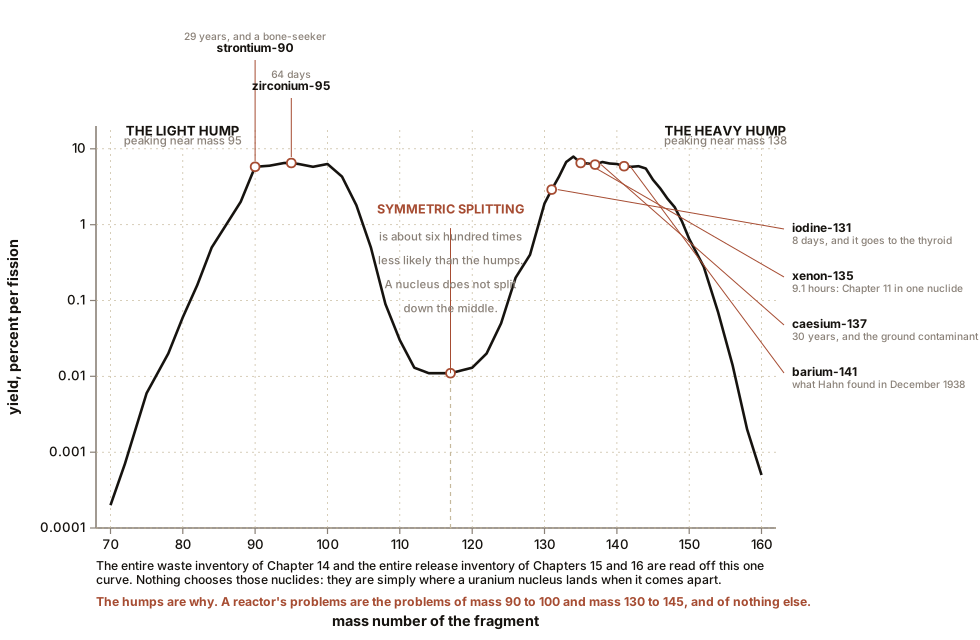
The fragments. Fission does not split a nucleus in half. Plot the yield of each mass number for thermal fission of uranium-235 and you get a double hump: one peak around mass 95, in the zirconium and molybdenum region, and another around mass 138, among the barium, xenon and caesium isotopes. The symmetric split, around mass 118, is roughly six hundred times less likely than the peaks.
The full explanation involves shell structure in the deforming nucleus as it approaches the pinch, and it is still an area of active work. The empirical fact is solid and the mechanism is not fully settled, which is worth saying because the double hump is often presented as though it were obvious.
The practical consequences are large. That first hump contains strontium-90, half-life 28.8 years. The second contains caesium-137 at 30.1 years, iodine-131 at 8.02 days, and xenon-135. The specific list of nuclides a reactor makes, and therefore the entire waste and accident story of Chapters 14, 15 and 16, is set by the shape of that curve.
The neutrons. An average of 2.43 per thermal fission of uranium-235, and about 2.87 for plutonium-239. Not exactly two or three: an average, because individual fissions release zero, one, two, three, four or occasionally five.
And the energy, itemised. This is the table that Chapter 3’s arithmetic was heading toward.
| Where the energy goes | MeV | Recovered as heat? |
|---|---|---|
| Kinetic energy of the two fragments | 169.1 | yes, immediately, in the fuel |
| Prompt gamma rays | 7.0 | yes, mostly in the fuel and structures |
| Kinetic energy of the prompt neutrons | 4.8 | yes, in the moderator |
| Beta particles from fission product decay | 6.5 | yes, but later |
| Gamma rays from fission product decay | 6.3 | yes, but later |
| Antineutrinos | 8.8 | no, ever |
| Total released | 202.5 | |
| Total recoverable | about 193 |
Three things to take from that table.
About 84 percent of the energy appears as fragment kinetic energy inside the fuel pellet itself, within about 10 µm (0.0004 in) of where the fission happened. That is why a fuel pellet’s centre runs so much hotter than its edge, which Chapter 10 turns into a dimension.
8.8 MeV, about 4.3 percent, leaves the site at the speed of light and is never recovered. Antineutrinos pass through the planet. A reactor is permanently 4 percent less efficient than its fission rate suggests, for reasons no engineering can address. Incidentally they are also detectable, and neutrino detectors have been used to verify reactor operation from outside the fence.
And 12.8 MeV, about 6.3 percent, arrives late. That is the beta and gamma from fission products decaying, and it is the reason a reactor produces heat after it is shut down. The number you want in your head is that about 6 to 7 percent of a reactor’s thermal power at the moment of shutdown is decay heat that cannot be turned off. Chapter 13 is largely about it.
Section 5: Prompt and Delayed, Which Is the Whole of Control
Of the 2.43 neutrons from a fission of uranium-235:
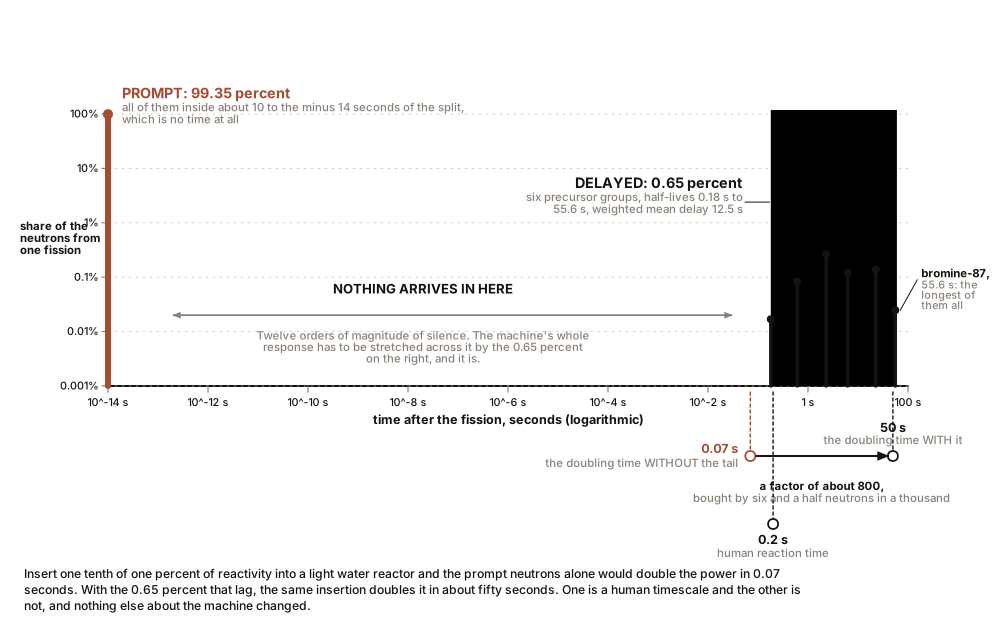
About 99.35 percent appear within roughly 10⁻¹⁴ seconds of the split. These are prompt neutrons.
About 0.65 percent do not exist yet. They come from a handful of specific fission products that beta-decay into an excited state which then emits a neutron. Bromine-87, with a half-life of 55.6 seconds, is the longest-lived of the significant precursors. There are six conventional groups with half-lives from about 0.18 to 55.6 seconds, and the population-weighted mean delay works out at about 12.5 seconds.
That fraction has a symbol, β, and for uranium-235 it is 0.0065. Six and a half neutrons in a thousand.
Now the arithmetic that shows why 0.65 percent decides everything.
In a light water reactor, a prompt neutron’s whole life, from birth through slowing down to causing the next fission, lasts about 10⁻⁴ seconds. Call that the generation time.
Suppose you insert a small amount of extra reactivity, 0.1 percent, which is a modest and entirely routine control rod movement.
With prompt neutrons only, the power grows with a time constant of the generation time divided by the reactivity: 10⁻⁴ / 0.001 = 0.1 s. The power doubles in about 0.07 seconds. No human, and no mechanical control rod drive, can act on that. The machine would be uncontrollable, and any small perturbation would take it to destruction before anyone knew.
With the delayed neutrons included, the effective average neutron lifetime becomes dominated by the 0.65 percent that take 12.5 seconds:
(0.9935 x 0.0001) + (0.0065 x 12.5) = about 0.081 sA factor of 800 longer. Work the growth rate through properly and the same 0.1 percent reactivity insertion now gives a doubling time of around 50 seconds instead of 0.07 seconds.
Fifty seconds is a human timescale. Seventy milliseconds is not. That is the entire difference, and it is bought by six and a half neutrons in a thousand.
IN PLAIN ENGLISH: Imagine a car in which 99 percent of the accelerator’s effect arrives instantly and the last one percent arrives twelve seconds later. That sounds like a small detail. It is not, because the engine cannot rev up faster than the slowest part of the loop allows, so the car’s whole response gets stretched out to something you can steer with. Take the twelve-second component away and the car goes from idle to full power faster than you can lift your foot. Every reactor on earth is driveable because of the one percent that lags.
There is a limit on it, and it has a name. If you insert reactivity greater than β itself, the prompt neutrons alone are enough to sustain growth, the delayed ones stop mattering, and you are back to the 10⁻⁴ second timescale. That condition is prompt critical, reactivity is conventionally measured in units of β called dollars, and prompt critical is one dollar.
Everything a reactor’s safety case does is keep the available reactivity well under one dollar. Chernobyl in Chapter 16 went prompt critical. So did the SL-1 experimental reactor in Idaho in 1961, which killed its three operators. In both cases the power rose by four orders of magnitude in well under a second, and in both cases nothing anyone could have done in the room would have mattered.
And one uncomfortable detail. β for plutonium-239 is 0.0021, about a third of uranium-235’s. As a reactor burns through a fuel cycle it breeds plutonium, an increasing share of its fissions are plutonium fissions, and its delayed neutron fraction falls. An old core has less margin to prompt critical than a fresh one. This is accounted for in every operating limit, and it is a good illustration of why reactor limits change through a fuel cycle rather than being fixed.
ON THE BENCH: Why a delay is what makes a thing controllable
Parts: a metre rule or a broom, and a pencil. Then a shower. Cost: nothing. Time: five minutes. Hazards: none, unless you fall over. Method, part one. Balance the broom upright on your palm, brush end up. Keep it there. Now balance the metre rule the same way. Now try the pencil. What you should see: the broom is easy, the rule takes concentration, and the pencil is flatly impossible no matter how good your reflexes are. Why, and it is the same arithmetic as this chapter. An inverted pendulum falls with a time constant of the square root of its length divided by gravity. For a 1 m (39 in) rule that is about 0.32 s. For a 150 mm (6 in) pencil it is about 0.12 s. Human visual reaction time is around 0.2 s. When the thing you are controlling responds faster than you can respond to it, the loop is unstable and no amount of skill helps. When it responds slower, control is easy. That is exactly the delayed neutron argument. Prompt-only, the reactor’s time constant is 0.07 s, which is the pencil. With delayed neutrons it is 50 s, which is a broom the length of a house. The physics did not get easier. The clock got slower. Method, part two, and do this one too. Go to a shower with a single mixer control and a long pipe run. Set it too cold and correct it. The lag between turning the tap and feeling the change makes you overshoot, then overcorrect, and oscillate. Then do the same at a basin where the water changes instantly, and notice you get it right first time. What that adds: delay is not simply good. A delay in the sensing path makes control harder; a delay in the response path makes it easier. Delayed neutrons slow the reactor’s response, which helps. A thermocouple that takes a minute to read the temperature slows the operator’s information, which is the shower, and hurts. Chapter 15’s Three Mile Island is an entire accident built out of the second kind.
Section 6: What to Carry Forward
Fissile means splittable by a slow neutron, and the fissile nuclides all have odd mass numbers, because an arriving neutron finds a partner and the pairing energy pays the fission barrier.
A cross-section is a probability expressed as an area and can far exceed the physical size of the nucleus, because a slow neutron is a wave about the size of an atom.
Slow neutrons fission uranium-235 far more readily than fast ones, which is why reactors contain a moderator, and moderators work by mass matching, which you have now demonstrated with three marbles.
Fission products come in two humps, and that curve determines the entire waste and accident inventory.
Of about 202.5 MeV released, about 193 is recoverable, 8.8 leaves as antineutrinos and never comes back, and about 12.8 arrives late as decay heat.
And 0.65 percent of the neutrons arrive seconds to minutes late, which stretches the reactor’s response time by a factor of 800 and is the sole reason a human can operate one. One dollar of reactivity is the point where that protection stops applying.
Next: the accounting that decides whether the whole thing sustains itself, done by hand.
Bench Degree
Get the degree without the diploma.
Learn the material, not how to pass the exam.