Bench Degree·NUCLEAR POWERchapter

Chapter 1: Seeing the Invisible
You are going to sit and watch subatomic particles cross a box, one at a time, with your own eyes, using about thirty dollars of hardware. Some of them will have started their journey in the upper atmosphere. All of them are also passing through you.
This is the only volume in the series where the machine itself is out of reach. Nobody reading this is going to build a reactor, and this book will not pretend otherwise. That boundary is stated plainly at the end of this chapter, and it is honoured throughout.
What is entirely within reach, and what almost nobody has actually done, is seeing radioactivity happen. Not reading about it. Not looking at a diagram. Watching individual particles draw lines through a box in front of you, continuously, for as long as you care to sit there.
Here is how.
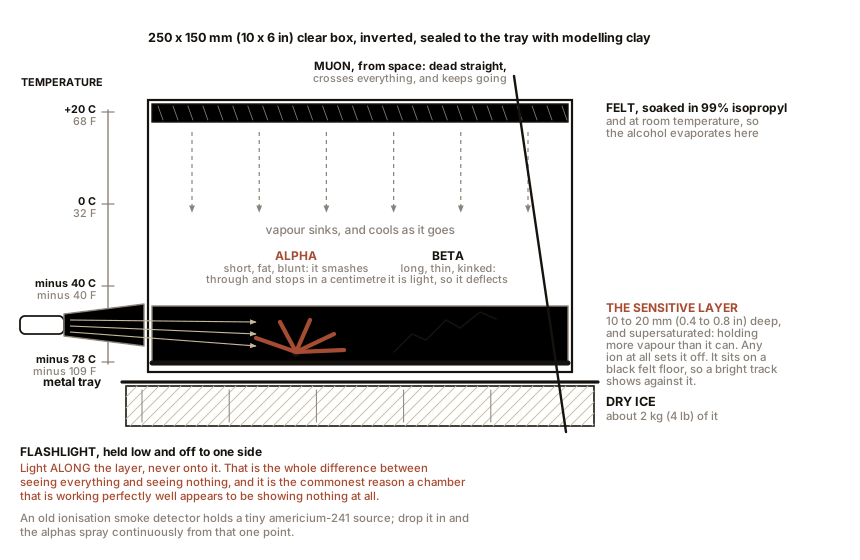
Take a clear plastic container, roughly a shoebox in size, and turn it upside down so the open side faces down. Glue a strip of black felt inside what is now the ceiling. Get a slab of dry ice and set it on a tray. Soak the felt thoroughly with isopropyl alcohol, the strongest you can buy, ninety percent or better. Set the container mouth-down onto the dry ice so the base of the chamber is being chilled hard while the felt above stays at room temperature. Darken the room. Shine a bright flashlight in from the side, low, skimming just above the cold floor of the chamber.
Wait two or three minutes while alcohol evaporates from the warm felt, drifts down, and becomes bitterly cold near the bottom. The air down there becomes supersaturated with alcohol vapour, meaning it is holding more than it can, and it is desperate for anything at all to condense onto.
Then watch.
Thin white lines begin to appear out of nowhere, hang for a second, and dissolve.
Each line is the wake of a single subatomic particle. It tore through the vapour, knocked electrons off the molecules along its path, and those charged fragments gave the supersaturated alcohol exactly the excuse it needed. Droplets condensed along the track. You are not seeing the particle. You are seeing its contrail, exactly as you see an aircraft you cannot make out.
Keep watching and you will notice the tracks are not all alike.
- Short, fat, blunt stubs, a centimetre or two long, often slightly wandering. These are alpha particles, which are helium nuclei. They are heavy and doubly charged, so they smash their way through, lose energy fast and stop quickly.
- Long, thin, wandering lines, sometimes kinked. These are beta particles, which are fast electrons. They are light, so they get deflected easily, which is why the path is crooked.
- Dead straight streaks that cross the entire chamber without deviating at all. These are the ones worth waiting for. They are mostly muons, and they are not from anything in your house. A cosmic ray, usually a proton flung out of some distant astrophysical event, struck a nucleus high in the atmosphere and produced a shower of secondary particles. Some of those reached the ground, went through your roof, went through your ceiling, crossed your chamber, and kept going down through the floor.
About one muon per square centimetre per minute is arriving at sea level, all the time, everywhere. Roughly one every second through the palm of your hand. Through your chest, hundreds a second. It has been happening for your entire life, and it was happening before there was anyone to notice.
ON THE BENCH: The cloud chamber
Parts: clear plastic container about 250 x 150 x 150 mm (10 x 6 x 6 in); black felt; 99% isopropyl alcohol; dry ice, about 2 kg (4 lb); a metal tray; a bright flashlight or a phone torch; modelling clay to seal edges. Everything else: every part this book asks for is listed once, at the back, in Appendix A: The Bench. Nothing is specified by brand, so it can be ordered from anyone. You do not need any of it yet. Cost: about $30, of which the dry ice is most of it and does not keep. Time: 45 minutes to build, then as long as you like. Hazards, and these are real. Dry ice is minus 78 °C (minus 109 °F) and will cause a serious cold burn on contact. Handle it with gloves and tongs, never bare hands. It sublimates into carbon dioxide gas, so work in a ventilated room and never in a sealed car or a closet. Isopropyl alcohol is flammable; keep it away from any flame and do not use a hot lamp as your light source. What you should see: first tracks within two to five minutes. Once it settles, several tracks a minute. Patience matters more than technique. To make it spectacular: an old ionisation-type smoke detector contains a tiny americium-241 source. Placed inside the chamber it produces a continuous spray of alpha tracks radiating from one point, and it is one of the finest things in amateur science. A thoriated camping lantern mantle does the same. Neither is dangerous to handle briefly; both should be kept out of the reach of children and not taken apart further. If you see nothing: the commonest cause is not enough alcohol, followed by not enough temperature difference, followed by too much light in the room. The second commonest is impatience.
Section 1: The Second Demonstration, Which Changes What the Word Means
Now get a Geiger counter. A usable one costs sixty to a hundred dollars, and it is the second-best instrument purchase in this book.
Turn it on and leave it somewhere in the middle of a room. It clicks. Not constantly, but every second or so, irregularly. That is background radiation, and it has always been there.
Now walk it around.
- A basement, particularly on granite or shale, will often read two or three times the ground-floor figure. That is radon, seeping up out of the rock.
- A granite countertop will usually read noticeably above the room it is in.
- A bag of low-sodium salt substitute clicks distinctly. It is potassium chloride, and about one potassium atom in ten thousand is potassium-40, which is radioactive with a half-life of 1.25 billion years. This is also true of every banana and every avocado, and of you.
- A handful of Brazil nuts reads above background, because the trees concentrate radium from the soil.
- An old ionisation smoke detector clicks hard when the counter is put against it.
- On an aeroplane at cruising altitude the count rate will be twenty to forty times what it was in your kitchen, because you have left most of the atmosphere below you and the cosmic rays that made those straight tracks arrive far less obstructed.
Ordinary places differ by a factor of ten, and none of them is dangerous.
That is the single most useful fact to hold before opening any discussion of nuclear power, and it is why this demonstration comes on page one rather than in Chapter 6. Radiation is not a category of thing that either is present or is absent. It is a quantity, it varies enormously in ordinary life, your own body contains a measurable amount of it, and the question is never whether but how much compared with what.
ON THE BENCH: Walking the background
Parts: a Geiger-Müller counter, $60 to $100. A model with a data output and a wide-window tube is worth the extra. Cost: $60 to $100, and it lasts for life. Time: an afternoon, plus opportunistic readings whenever you travel. Hazards: none. Every item listed above is harmless and legal. Method: log counts per minute over a five-minute average in each location, always the same averaging time. Write down the place, the surface, and the number. What you should see: a range of roughly 10 to 100 counts per minute in ordinary domestic settings, and several hundred at altitude. Keep the table. Chapter 6 turns those counts into dose, which is a different quantity and the one that actually matters to a body, and having your own numbers to work with makes that chapter land far harder than any textbook figure would.
Section 2: A Different Kind of Fire
Now the vocabulary, and the one comparison that explains why any of this is worth doing.
When coal burns, electrons are rearranged between atoms. Carbon lets go of some electrons, oxygen takes them, and the atoms end up in a lower-energy arrangement. The energy released per event is a few electron-volts, abbreviated eV, which is the natural unit for chemistry.
When a uranium-235 nucleus splits, the nucleus itself comes apart, and the energy released is about 200 million electron-volts per event.
That is a factor of roughly fifty million.
It is worth converting that into something physical. A single fuel pellet of uranium dioxide, about the size of a pencil eraser and weighing around 10 grams (0.35 oz), holds usable energy comparable to roughly one tonne of coal or about 480 cubic metres (17,000 cubic feet) of natural gas. One pellet. You could hold it in your palm, and in fresh unirradiated form it is safe to do so, being barely more radioactive than the granite countertop you measured earlier.
IN PLAIN ENGLISH: Chemical energy comes from rearranging electrons on the outside of atoms. Nuclear energy comes from rearranging the nucleus itself. The nucleus is bound together far more tightly, so taking it apart releases something like fifty million times more energy per event. Everything peculiar about nuclear power, good and bad, follows from that ratio.
That ratio is why a nuclear plant refuels every eighteen to twenty-four months instead of receiving a coal train every day. It is also why the waste is a very small volume of very concentrated material rather than an enormous volume of dilute material, which turns a problem of quantity into a problem of duration. Both halves of that trade come from the same number.
And where the energy actually comes from
The fission fragments, added up, weigh measurably less than the original nucleus did. Not a little less in some figurative sense. Measurably less, on a mass spectrometer.
The missing mass is the energy, and the exchange rate is the most famous equation in physics:
E = mc²This is the only place in this series where that equation does real work rather than decorating a page. Chapter 3 recomputes the arithmetic that Lise Meitner did over Christmas 1938, sitting in exile in Sweden with a scrap of paper, when she worked out that a nucleus had split and calculated how much energy that would release. You will get her number. She is the woman on the cover of this book.
Section 3: What the Bench Can and Cannot Do
Stated plainly, because the honesty is worth more than the ambition.
Out of reach, permanently, and this book will not pretend otherwise. You cannot build a reactor, achieve criticality, handle fuel, enrich anything, or do any experiment involving a self-sustaining chain reaction. That requires a licence, a facility and a supply chain, and it is not a matter of ingenuity or budget.
Within reach, and more than most readers expect:
- Seeing individual particle tracks, which you have now done.
- Measuring background radiation and its variation, which you have now done.
- Measuring a real half-life and fitting the decay curve, using a lantern mantle or a smoke detector source.
- Verifying the inverse square law with a check source and a tape measure.
- Measuring shielding attenuation through paper, aluminium and lead, and discovering that alpha stops in centimetres of air while gamma needs lead.
- Doing the neutron economy and critical mass arithmetic on paper. This is not a consolation prize. It is the actual intellectual content of reactor physics, and it is done with a pencil at every real facility too.
- Building the entire secondary side of a nuclear plant, because that side is a steam engine. A boiler, a turbine and a condenser behave identically whether the heat came from uranium or from firewood.
That last point is worth flagging now because it is the most consistently surprising fact in the whole subject. Most of a nuclear power station is not nuclear. The reactor makes hot water. Everything downstream is a steam plant of a kind that has existed since the nineteenth century, it is bound by exactly the same efficiency limits as a coal plant, and roughly two-thirds of the heat produced goes out through the cooling towers no matter how good the engineering is. Chapter 13 works through why, and the answer has nothing to do with nuclear physics at all.
Where a chapter cannot offer an experiment, it will offer a calculation, and it will say which of the two it is giving you.
Section 4: Where This Book Is Going
By the last page you will be able to look at a reactor’s basic specifications and do the following.
- Say why the core is the size it is, in terms of neutron economy rather than in terms of power.
- Explain what physically keeps it stable second to second, without an operator touching anything, and name the property that does it.
- Explain what would make it unstable, and why one particular reactor design in one particular country had that property built in.
- Say why about two-thirds of the thermal energy is rejected as waste heat, and why no amount of engineering will recover most of it.
- Explain why a power reactor cannot detonate, in terms of enrichment, geometry and timing.
- Read the numbers in a dose report and say whether they matter, by comparing them against the background table you built in Section 1.
- Explain, from the investigation reports rather than from reputation, what actually happened at Three Mile Island, Chernobyl and Fukushima, and why each one taught the industry something different.
One commitment about how that last point is handled. This subject sits between two loud constituencies, and the credibility of this book depends on refusing both of them. A claim is not true because an institution repeats it, and it is not false because an institution repeats it either. Where the science is genuinely unsettled, this book will say so and say who disagrees. Where it is settled, it will cite the document rather than the consensus.
Everything is built in order. Nothing arrives that has not been assembled from something earlier. If a chapter loses you, the fault is upstream, and the fix is to go back one section rather than to push on.
Keep the chamber. It costs a few dollars of dry ice to run again, and in Chapter 5 you will use it to tell alpha from beta by their tracks alone, and be right.

Bench Degree
Get the degree without the diploma.
Learn the material, not how to pass the exam.