Bench Degree·NUCLEAR POWERchapter

Chapter 2: Discovering the Invisible
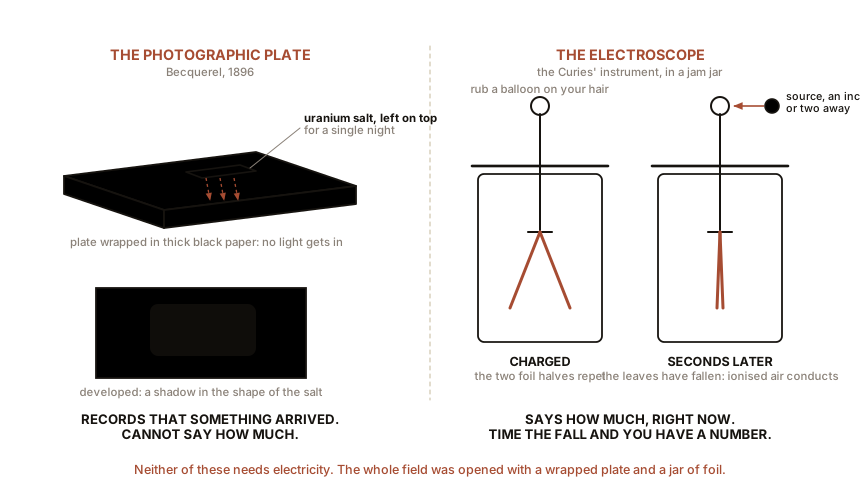
Every one of these discoveries was made by someone noticing that a photographic plate had fogged, or that a charged wire had gone flat, when it should not have. The whole subject was opened with two instruments a reader can build this weekend, and one of them costs nothing.
The physics of the nucleus was not deduced. It was stumbled into, five times, by people looking at something else, using instruments so simple that the entire opening act of the field is reproducible on a kitchen table.
There are two of those instruments. A photographic plate, which records that something ionising arrived while nobody was watching. And an electroscope, which records that something ionising is arriving now. Everything in this chapter was found with one or the other. The modern subject looks like it needs a national laboratory. The discoveries did not.
Section 1: An Accident in Würzburg, 1895
Wilhelm Röntgen was working with a Crookes tube, a partly evacuated glass tube with a high voltage across it, and ordinary laboratory equipment at the time.
On 8 November 1895 he had the tube wrapped in black card and noticed that a screen coated with barium platinocyanide lying 1 m (3 ft) away was glowing anyway. Something was getting out through the card. Seven weeks later, on 22 December, he made the photograph everybody has seen: his wife’s hand, the bones dark against the flesh, the ring on her finger a hard black ellipse. He published on 28 December 1895.
Within three months X-rays were in clinical use on three continents. Nothing in physics has been adopted that fast since, and the reason is that it needed no new hardware. Every physics department already owned the tube. The news was not an invention. It was a permission.
Röntgen had a form of light too energetic to see, made when fast electrons slam into a metal target. It is not radioactivity, and nothing in his tube was radioactive. That distinction did not exist yet, and the confusion it caused is Section 6.
Section 2: Becquerel’s Fogged Plates, 1896
Henri Becquerel had a hypothesis, it was wrong, and it worked anyway.
He suspected that phosphorescent materials, the ones that glow after a spell in sunlight, might be emitting Röntgen’s new rays. So he wrapped a photographic plate in black paper, put a crust of a uranium salt on top, and left it in the sun. When he developed the plate, the outline of the crust was there.
Then Paris clouded over for a week.
He left the wrapped plate and its uranium in a dark drawer, expecting a faint result at best, and developed it on 1 March 1896 out of something between diligence and boredom. The image was as strong as before. The sunlight had contributed nothing. The uranium was doing it by itself, continuously, needing no input at all.
That is the moment radioactivity was discovered, and it consisted of a man developing a plate that had no business being exposed.
ON THE BENCH: Becquerel’s plate, repeated exactly
Parts: a sheet of black-and-white photographic paper or a dental X-ray film packet, about $1 to $3 each; an old thoriated camping lantern mantle, or a piece of uranium glass, or a 500 g (18 oz) bag of low-sodium salt substitute; a light-tight box or a changing bag; access to a darkroom or a friend who does film. Cost: $10 to $25, most of it the paper. Time: twenty minutes of work, then two to four weeks of waiting. Hazards: none. A lantern mantle is sold over the counter, a piece of uranium glass is a drinking vessel, and salt substitute is food. Do not shred a mantle, because thorium is a problem if inhaled and no problem at all if left in one piece. Method: in the dark, lay the source on the emulsion side of the paper, weight it flat, seal the assembly light-tight, and leave it somewhere cool. Develop after two weeks, then repeat with four. What you should see: a soft grey shadow roughly the shape of the source, denser than the paper around it. It will be faint. Becquerel’s uranium salt was far stronger than a mantle and he still needed hours. If you see nothing: insufficient time, usually. A light leak is the other cause and shows as a gradient from one edge rather than a shape. Better, if you have one: a digital camera with a removable lens. Tape the sensor cavity light-tight with several layers of black electrical tape, set the longest exposure and highest sensitivity available, and lay a source on the tape. Individual particles appear as single white pixels and short streaks, in minutes rather than weeks.
Section 3: The Curies, and the Instrument That Actually Did the Work
Marie Curie’s contribution is usually told as a story about labour, and the labour was real: roughly 10 tonnes (22,000 lb) of pitchblende residue from a mine in Bohemia, processed in a shed, by hand, for about 0.1 g (0.0035 oz) of radium chloride by 1902.
But the reason she could do it at all was an instrument, and Pierre built it. Becquerel’s plates told you that something had happened. They could not tell you how much. Pierre had discovered piezoelectricity, and he built a piezoelectric electrometer: a known weight squeezing a quartz crystal generates a known charge, which is balanced against the charge collected from an ionised air gap. Radiation ionises the air, the ionised air conducts, and the current is proportional to the intensity.
That turned radioactivity from a phenomenon into a measurement, and the measurement is what made the chemistry possible. Marie could take a fraction from a separation, measure it, and know whether the activity had followed. Without a number, extracting radium from ten tonnes of rock is not difficult, it is impossible.
Two results came out of that method, and both were shocking. Pitchblende was more active than its uranium content could explain, which is how polonium was found in July 1898 and radium in December. And the activity of a given element was fixed, regardless of temperature, chemical combination, or whether the sample was a metal or a salt. Chemistry could not touch it. Whatever was doing this was happening inside the atom, in a place chemistry did not reach, and in 1898 the atom was still officially indivisible.
ON THE BENCH: An electroscope, which is how the measurement was invented
Parts: a glass jar with a plastic lid; a bare copper wire; aluminium kitchen foil; a plastic comb or a balloon; a lantern mantle or the source from an old ionisation smoke detector. Cost: nothing you do not have. Time: thirty minutes. Hazards: none. Method: push the wire through the lid, hook the inside end, and hang over it a strip of foil about 5 mm (0.2 in) wide folded in half so the halves hang side by side. Loop the outside end. Charge it by rubbing the balloon on your hair and touching it to the loop. The two foil halves repel and stand apart. Time how long they take to fall. What you should see: on a dry day, the leaves hold for several minutes. Bring the source within a few centimetres, an inch or two, of the loop and the leaves collapse in seconds. The radiation is ionising the air, the ionised air conducts the charge away, and this is the effect Pierre Curie built his career’s instrument around. If it does not work: humidity, every time. A damp room leaks charge faster than any source can. Do it on a dry winter day, or warm the jar first. What to notice: you have measured radiation with no counter, no electronics, and nothing that was not already in the house. This is the ancestor of every ion chamber in every reactor building in the world, and the smoke detector in your hallway is the same device with an amplifier bolted on.
Section 4: Rutherford Finds the Nucleus
Ernest Rutherford spent the years after 1898 sorting the emissions by how hard they were to stop. Alpha, stopped by a sheet of paper. Beta, stopped by a few millimetres, a tenth of an inch, of aluminium. Paul Villard found a third and more penetrating kind in 1900 and Rutherford named it gamma in 1903. Those are the three track types in your cloud chamber, and Chapter 5 says what each one is.
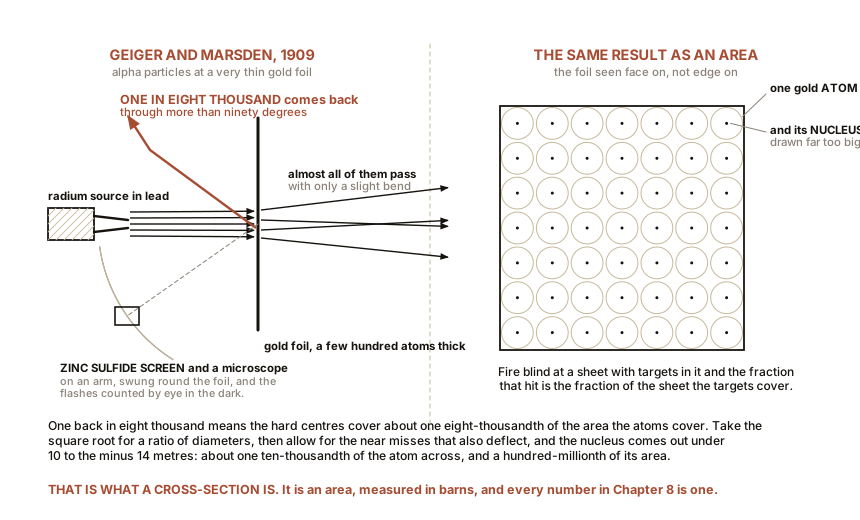
Then in 1909 he had Hans Geiger and Ernest Marsden fire alpha particles at a very thin gold foil and count where they went. Nearly all went straight through with a small deflection, which is what an atom imagined as a diffuse pudding of charge would do. But about one in eight thousand came back toward the source, deflected through more than ninety degrees.
Rutherford’s remark about it has survived because it is accurate: as surprising as firing a fifteen-inch shell at tissue paper and having it bounce back.
By 1911 he had the interpretation. The atom’s positive charge and nearly all of its mass sit in a nucleus so small that an alpha particle almost always misses it, and the rare violent bounces are the head-on hits.
SLOW DOWN. Check Your Understanding: Rutherford concluded that the nucleus is roughly ten thousand times smaller than the atom. He got that from the fact that only one alpha in eight thousand bounced back. How does a rarity turn into a size? Work it out before reading on.
Because a rarity is a cross-section, and a cross-section is an area. Fire projectiles blind at a sheet with targets in it and the fraction that hit is the fraction of the sheet’s area the targets occupy. Rutherford knew the number of gold atoms per unit area of his foil, from its thickness and the density of gold. One hit in eight thousand means the hard scattering centres cover roughly one eight-thousandth of the area the atoms cover; take the square root for the ratio of diameters, and once he accounted for near-misses deflecting too, the nucleus came out under 10⁻¹⁴ m, about one ten-thousandth of the atom’s diameter.
This is the most important experimental idea in the subject. Every number in reactor physics is a cross-section: an effective target area, quoted in a unit called the barn, which Chapter 8 introduces. Rutherford in 1909 was doing exactly what every neutronics calculation does now. A probability, measured carefully, is a measurement of size. You cannot see the target, and you do not have to.
Rutherford also did the first deliberate transmutation, in 1917, turning nitrogen into oxygen with alpha particles. One element into another, which is what alchemy had wanted for eight hundred years, and it made no money whatever.
Section 5: Chadwick and the Key, 1932
One piece was still missing, and without it nothing after this chapter can happen.
The nucleus held positive charge, and it weighed roughly twice what its charge accounted for. The standard patch was to assume it also held electrons, cancelling some of the protons, and that patch had problems nobody could fix.
In 1930 Walther Bothe and Herbert Becker fired alpha particles at beryllium and got out something very penetrating that carried no charge. They called it a gamma ray, because that was the neutral thing available.
In 1932 Irène Curie and Frédéric Joliot, Marie’s daughter and son-in-law, put paraffin wax in the path of that radiation and found it knocked protons out hard. They also called it a gamma ray. They were one calculation away from the discovery and they did not do the calculation.
James Chadwick did it, in about a fortnight in February 1932. A gamma ray able to knock protons out that hard would need more energy than the reaction could possibly supply. He measured the recoil energies of protons and of nitrogen nuclei, applied conservation of energy and momentum to a collision between an unknown neutral particle and each target in turn, and solved for the unknown mass.
It came out at about the mass of a proton, with no charge. The neutron.
That is the key to everything that follows, and the reason has nothing to do with mass. A neutron has no charge, so the electrostatic repulsion that keeps a proton or an alpha particle out of a nucleus does not apply to it. It can walk in. Every other projectile must be accelerated hard enough to climb the charge barrier; a neutron ambling along at the speed of a gas molecule can enter a heavy nucleus and be captured. Chapter 8 shows that a slow one is better at it than a fast one, which is the most counterintuitive fact in reactor physics.
Six years after Chadwick, the neutron split uranium.
IN PLAIN ENGLISH: A nucleus is positively charged, so it pushes away anything else positively charged. Trying to hit one with a proton is like trying to push two magnets together the wrong way round: possible, but it takes force. A neutron is electrically invisible, so the nucleus never sees it coming and does nothing to keep it out. That is the whole reason reactors are possible and it is why nothing happened between 1911 and 1932.
Section 6: The Wrong Turns, Kept In
Two, and both are more instructive than the successes.
Fermi’s transuranics. In 1934, in Rome, Enrico Fermi’s group bombarded almost every element in the periodic table with neutrons and found that uranium produced a confusing spray of new radioactive species. They read these as elements beyond uranium, 93 and 94, and proposed the names ausenium and hesperium. Fermi’s 1938 Nobel citation mentions them.
They were fission products. Uranium had been splitting in Rome since 1934 and nobody had considered it.
The interesting part is that somebody had. In 1934 the German chemist Ida Noddack published a paper pointing out that the products should be checked against all the known elements, not merely the neighbours of uranium, because the nucleus might have broken into large pieces. She was right, in print, four years early, and she was ignored. Historians point to her lack of a university post, a separate disputed claim that had damaged her reputation, and the fact that the theory of the day offered no mechanism for a nucleus breaking in half. Nobody suppressed her. The idea had nowhere to attach, which is a commoner failure and a harder one to guard against.
And the radium era. From about 1900 to the 1930s radioactivity was sold as a tonic: radium water, toothpaste, face cream, chocolate. A patent medicine called Radithor was radium dissolved in water, and an industrialist named Eben Byers drank something like 1,400 bottles of it and died in 1932 with his jaw disintegrating.
The radium dial painters matter more, because they were workers rather than customers. Young women painting luminous watch faces were taught to point their brushes with their lips. Radium behaves chemically like calcium, so it goes into bone and stays, and its alpha particles do their damage from the inside where no shielding can reach. Necrosis of the jaw, anaemia, bone sarcoma. Their lawsuits from 1927 onward established in American law that an employer can be liable for an occupational disease with a decades-long latency, which is the legal foundation industrial radiation protection was built on.
Two lessons, and this book needs both.
Radiation harm is dose-dependent and often delayed by decades, which is precisely the combination human judgement handles worst. That is why Chapters 6 and 7 are built out of numbers rather than reassurance.
And the era of enthusiastic misuse and the era of exaggerated fear are the same failure, which is treating radiation as a kind of thing rather than a quantity. The dial painters were harmed by a real dose. The customers of radium face cream mostly were not. Neither group had a number.
Section 7: What to Carry Forward
The observable is ionisation. Radiation is detected by the charge it liberates: on a photographic emulsion, in the air gap of an electroscope, in the gas of a Geiger tube, in the supersaturated vapour of your cloud chamber. Every detector in this book counts liberated electrons.
A probability is a size. One alpha in eight thousand bouncing back is a measurement of the nucleus. The barn, in Chapter 8, is that idea with a unit attached.
The nucleus is tiny and it is where the energy is, at about one ten-thousandth of the atom’s diameter, holding essentially all its mass, and untouched by chemistry.
And the neutron is the key, because it has no charge and can therefore get in.
Next: what happened when somebody finally checked the chemistry.

Bench Degree
Get the degree without the diploma.
Learn the material, not how to pass the exam.