Bench Degree·NUCLEAR POWERchapter
Chapter 3: Fission, and the Winter of 1938
A chemist in Berlin found barium in a bottle that should have contained radium, and said in print that he could not explain it. His exiled colleague, walking in the snow near Gothenburg with her nephew over Christmas, explained it on a scrap of paper in about two hours. You are going to do her arithmetic and get her number.
By late 1938 the neutron had been available for six years and everybody was firing them at everything. Fermi in Rome, Joliot and Curie in Paris, Hahn and Meitner in Berlin. Uranium produced a mess of radioactive products nobody could sort out, and the field’s assumption, from Chapter 2 Section 6, was that these were new elements just past uranium.
Then Lise Meitner had to leave Germany. She was Jewish, she had held her Berlin post through the 1930s on the strength of her Austrian citizenship, and the annexation of Austria in March 1938 removed that protection. She escaped to the Netherlands in July with ten marks in her purse and settled in Stockholm, in a laboratory that gave her almost nothing to work with. She and Otto Hahn kept writing.
Section 1: Barium Where Barium Should Not Be
Hahn and Fritz Strassmann were radiochemists, and radiochemistry is a specific skill: the quantities are far too small to see or weigh, so you identify an unknown radioactive species by making it travel with a known carrier through a chemical separation. Whatever the activity follows, the activity chemically is.
They were hunting radium among the uranium products, because radium is two steps down from uranium by alpha decay and was a reasonable thing to expect. Radium sits directly below barium in the periodic table, so barium is the standard carrier for radium: precipitate the barium and the radium comes with it. The activity came down with the barium, as expected.
Then they tried to separate the two by fractional crystallisation, the technique that had separated radium from barium since the Curies. The activity would not leave the barium. Every test they could devise said the substance was not radium behaving like barium. It was barium.
Which was impossible. Barium is element 56, uranium is element 92, and nothing known could take thirty-six protons off a nucleus.
Their paper, submitted on 22 December 1938, says exactly that. They report the chemistry, state that as chemists they must conclude the products are barium, and add that as nuclear physicists they cannot bring themselves to announce a result so at odds with everything known. That sentence is why the paper is admired. They published a fact they could not explain rather than an explanation they could not support. Hahn had already written to Meitner on 19 December, asking whether she could think of anything.
Section 2: Kungälv, Christmas 1938
Meitner spent Christmas at Kungälv, north of Gothenburg, with her nephew Otto Frisch, a physicist working in Copenhagen. Frisch had brought skis. Meitner had brought Hahn’s letter.
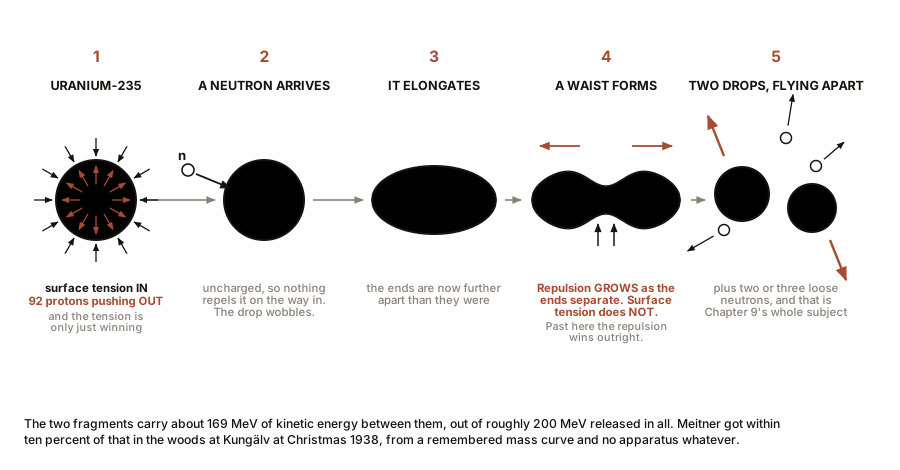
They walked into the woods and argued about it, and the tool they reached for was the liquid drop model of the nucleus, Niels Bohr’s and Carl Friedrich von Weizsäcker’s picture: a droplet held together by something like surface tension, working against the electrostatic repulsion of all those protons crammed together.
In a heavy nucleus that repulsion has nearly won already. Uranium has 92 protons pushing each other apart, and the surface tension holding the drop together barely wins. Add a neutron and the drop wobbles. Wobble it into an elongated shape and the two ends are further apart, so the repulsion between them grows while the surface tension pulling them back weakens. Past a certain deformation the repulsion wins outright, the waist pinches off, and the drop becomes two drops that fly violently apart.
That was the mechanism. Then Meitner did the part that mattered. She recalled the empirical curve of nuclear masses, the one Chapter 4 builds properly, and worked out that two medium-sized nuclei together weigh less than the uranium nucleus they came from, by something like one-fifth of a proton mass. She converted that with Einstein’s exchange rate and got roughly 200 MeV per event.
Frisch, back in Copenhagen, then did the experiment: an ionisation chamber set up to catch the enormous pulse two heavily charged fragments flying apart with 200 MeV between them would produce. The pulses were there. He asked an American biologist, William Arnold, what cell biologists call it when a cell divides in two, and used the word. Fission.
They published in Nature, submitted 16 January 1939. Five weeks from Hahn’s letter to a named, measured, quantified new nuclear process.
IN PLAIN ENGLISH: Picture a water droplet hanging on a tap, wobbling. It holds together because its surface pulls it into a ball. Now imagine that every part of the droplet also pushes every other part away, hard, and that the droplet is only just winning. Nudge it and it stretches; stretched, the two ends push each other apart more strongly than the surface can pull them back; and it snaps into two droplets that hurl themselves in opposite directions. A uranium nucleus is that droplet, the pushing apart is 92 protons all repelling each other, and the nudge is one neutron arriving.
Section 3: Doing Her Arithmetic
This is the calculation the whole book rests on, it takes ten minutes, and there is nothing in it harder than subtraction.
Uranium-235 absorbs a neutron and splits. Fission does not produce one fixed pair of products; it produces a distribution, which Chapter 8 shows has two humps. Take one representative split:
U-235 + n -> Ba-141 + Kr-92 + 3nNow the masses, in atomic mass units, from any published nuclide table:
| Species | Mass (u) |
|---|---|
| U-235 | 235.043930 |
| neutron | 1.008665 |
| Ba-141 | 140.914411 |
| Kr-92 | 91.926156 |
Before: 235.043930 + 1.008665 = 236.052595 u
After: 140.914411 + 91.926156 + (3 × 1.008665) = 235.866562 u
Missing: 0.186033 u
The exchange rate is 1 u = 931.494 MeV, so:
0.186033 × 931.494 = 173.3 MeV
That mass is gone. It is not hiding somewhere as a smaller piece; it has ceased to be mass and is now kinetic energy, mostly in the two fragments hurling themselves apart.
Two honest notes about that number, because they matter more than the number does.
It is 173 MeV, not 200. The 173 MeV is the prompt energy of this particular split. The fragments are left neutron-rich and unstable, and over the following seconds, hours and years they beta-decay their way toward stability, releasing roughly another 30 MeV as they go. Add that and you reach the familiar figure of about 200 MeV per fission from Chapter 1. Chapter 8 gives the full breakdown, and Chapter 13 makes the crucial point that the delayed portion is the reason a reactor cannot be switched off. The fuel keeps releasing that residual energy whether anyone wants it to or not.
And Meitner did not have this table. In 1938 the mass of Ba-141 was not tabulated to six decimal places. She used the general trend of nuclear masses and got about a fifth of a proton mass, which is about 0.2 u, which is about 190 MeV. She was working from a curve and she landed within ten percent of the modern value for the total. That is what a good physicist can do with a curve and a pencil.
One more line, and it is the one that reframes the subject. Divide the missing mass by the mass you started with: 0.186 / 236.05 = 0.079 percent. Less than a tenth of one percent of the matter present was converted, and it yielded fifty million times what a chemical reaction manages. Nothing in nuclear engineering converts an appreciable fraction of anything into energy. The leverage comes from c² being an enormous number, not from converting much.
ON THE BENCH: Meitner’s calculation, and then twenty more
Parts: a published table of nuclide masses, free from any national standards body or nuclear data centre; a pencil, or a spreadsheet. Cost: nothing. Time: ten minutes for the first, an hour for the set. Hazards: none. This is a calculation, and this chapter says so plainly because much of this book will have to. Method: reproduce the arithmetic above. Then repeat for other product pairs: Xe-140 with Sr-94, Cs-137 with Rb-96, Ba-144 with Kr-89, adjusting the loose neutron count so protons and neutrons balance on both sides. Then try Pu-239 as the target instead of U-235. What you should see: every fission of a heavy nucleus lands between roughly 160 and 190 MeV of prompt energy, and no arrangement of products moves that by more than about fifteen percent. The energy is a property of where you sit on the mass curve, not of which pair you happen to get. That is Chapter 4’s argument, arrived at by hand before the chapter makes it. Then a control: do the same subtraction for burning carbon, C + O₂ giving CO₂. The mass change is about 4 eV worth, roughly one part in ten billion, and no mass table quotes enough digits to show it. Chemistry was never found to convert mass because the effect is real and unmeasurable. Nuclear reactions are not a different law of physics; they are the same law at a scale where you can see it.
Section 4: The Prize
Otto Hahn received the 1944 Nobel Prize in Chemistry for the discovery of fission. Alone. Meitner was nominated forty-eight times across physics and chemistry over her career and never received it, and neither did Frisch or Strassmann.
The picture the historians give is not a single villain. The committees of the period were badly equipped to award work spanning chemistry and physics; the war had cut Swedish deliberations off from wider discussion; the chemistry committee held that the discovery was chemical and Meitner’s part merely interpretation; and there is plain sexism and plain nationalism on the record.
She also refused to work on the bomb, declining the British effort and saying afterwards that she wished she had never been part of the science that made it possible. Element 109 is named meitnerium, which is the compromise the twentieth century arrived at, and it is not nothing.
Section 5: The Idea That Turned Physics Into Engineering
Fission on its own is a curiosity. It became a technology because of one further idea, and that idea preceded the discovery by five years.
In September 1933 Leó Szilárd was in London, waiting at a traffic light on Southampton Row, having just read a report of Rutherford dismissing the prospect of useful energy from the atom. It occurred to him that a nuclear reaction which consumed one neutron and released more than one could sustain and multiply itself. He patented the concept in 1934 and assigned it to the British Admiralty in 1936 to keep it out of print.
He had no reaction that did it. Fission does it. Each fission of U-235 releases an average of about 2.43 neutrons, comfortably more than the one that started it.
That average is what the rest of this book is about. Above one, with margin for losses, you have a machine. Below one you have a curiosity. Chapter 9 does the accounting.
Szilard also drafted the letter Albert Einstein signed on 2 August 1939, warning Roosevelt that a chain reaction in uranium could produce extremely powerful bombs. Einstein contributed his signature and his reputation; the physics was Szilard’s.
Section 6: Under the Squash Court
On 2 December 1942, in a doubles squash court beneath the disused west stands of Stagg Field at the University of Chicago, the first self-sustaining nuclear chain reaction was achieved.
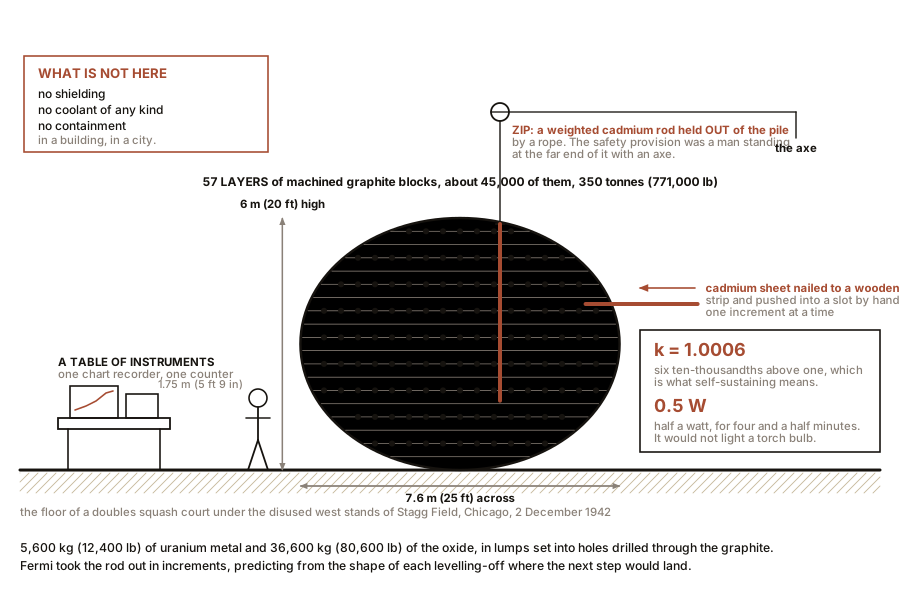
The machine was called Chicago Pile-1 because that is what it was: a pile. About 350 tonnes (771,000 lb) of machined graphite blocks, roughly 45,000 of them, stacked fifty-seven layers high into a flattened ellipsoid some 6 m (20 ft) high and 7.6 m (25 ft) across, with lumps of uranium metal and uranium oxide set into holes drilled in the graphite: 5,600 kg (12,400 lb) of uranium metal and 36,600 kg (80,600 lb) of the oxide. Control was by cadmium sheets nailed to wooden strips and pushed into slots by hand.
There was no shielding, no cooling and no containment, in a building in a city, and everyone involved knew it. The safety provisions were a rope-held rod that could be dropped by cutting the rope with an axe, and three men on a platform with buckets of cadmium salt solution to pour into the pile if that failed.
Enrico Fermi ran it, the way a good experimentalist runs anything: one step at a time, with the answer predicted before each step. The rod came out in increments. At each position the neutron count was allowed to level off, and Fermi computed from the shape of the levelling-off where the next step would put him. When the count stopped levelling and began a steady climb, the pile was critical. He let it run about four and a half minutes and had the rod dropped.
The power was about half a watt.
Enrico Fermi is on the cover of this book, and the reason is that sentence about predicting each step. He was one of the last physicists who was simultaneously the best theorist and the best experimentalist in the room, and he stacked this pile with his own hands. The volume’s register suits him. A reactor is a rock that boils water, and all of the hard part is in keeping it calm; Fermi is the first man who kept one calm, with a slide rule and a rope.
SLOW DOWN. Check Your Understanding: Chicago Pile-1 produced about half a watt, which will not light a torch bulb. A modern reactor produces about 3,400 MW of heat, nearly seven billion times more. In what sense was half a watt a demonstration of anything? Answer before reading on.
Because criticality has nothing to do with power. The quantity that matters is k, the average number of new fissions each fission causes. At k below one the reaction dies out; at k equal to one it sustains itself indefinitely; above one it grows. CP-1 reached k of about 1.0006, and a chain reaction that sustains itself at half a watt is exactly as self-sustaining as one that sustains itself at 3,400 MW.
Power is set by how long you leave k above one, not by how far above one you put it. A reactor is brought to a chosen power by going slightly supercritical, waiting while the power climbs, and then returning k to exactly one to hold it there. Fermi could have taken CP-1 to a megawatt using the same rod positions and more patience; he did not, because it had no cooling and would have destroyed itself.
This is why “critical” is the most misleading word in the subject. In ordinary English it means on the edge of disaster. In reactor physics a critical reactor is one running steadily and normally, and every power station on earth spends its entire operating life critical, on purpose. Chapter 9 is built on that distinction.
ON THE BENCH: A chain reaction you can measure
Parts: 30 to 100 spring-loaded mousetraps at about $1.50 each; two ping-pong balls per trap; a large clear storage box or an aquarium with a lid; a phone that shoots slow motion. Cost: $50 to $150 for a hundred traps, reusable indefinitely. Time: an hour to set up, seconds to run, twenty minutes to reset. Hazards: a set mousetrap will hurt a finger badly and can break skin. Set them with a pencil, wear safety glasses, keep children and animals out. Nothing here is radioactive or otherwise hazardous. Method: set each trap and balance two ping-pong balls on the bail. Cover the box, drop one extra ball in through a hole in the lid, and film it. What you should see: the first ball trips one trap, which throws two balls, which trip two traps, which throw four. The box goes from one moving ball to complete chaos in well under a second, and on the slow-motion footage you can count the generations. The measurement, which is the point. Count generations against time on the video and you have the generation time. Then rerun with half the traps loaded and spread further apart, and the reaction fizzles: too many balls land where there is no trap. You have measured the difference between k above one and k below one, and you did it by changing the geometry rather than the quantity. That is Chapter 9’s central result. The honest limitation: every ball here arrives instantly. A real reactor’s controllability comes from about 0.65 percent of its neutrons arriving late, which no mousetrap can imitate. Chapter 8 explains why that tiny late fraction is the difference between a machine a human can operate and one that cannot exist.
Section 7: What to Carry Forward
Fission was found by chemists who published a result they could not explain, and explained by a physicist driven out of the laboratory that produced it.
The energy comes from missing mass, and you have computed it: about 173 MeV prompt for a representative split, about 200 MeV once the fragments finish decaying, from a mass deficit of eight hundredths of one percent.
About 30 MeV of that arrives late, over seconds to years, as the fission products decay. Remember it. That is Chapter 13’s decay heat problem and the reason Fukushima happened.
Fission releases about 2.43 neutrons and consumes one.
And critical means steady, not dangerous. CP-1 ran critical at half a watt; a power station runs critical at billions of times that. The word describes the neutron balance and says nothing about the power.
Next: why the mass goes missing, and the one graph that explains both fission and fusion.
Bench Degree
Get the degree without the diploma.
Learn the material, not how to pass the exam.