Bench Degree·NUCLEAR POWERchapter
Chapter 4: The Nucleus and Binding Energy
One graph explains fission, fusion, why stars shine, why they stop, and why nothing whatever can be got out of a lump of iron. You are going to build that graph yourself, out of a table of numbers and a $10 bag of magnets.
A nucleus contains two kinds of particle. Protons, positively charged, and neutrons, uncharged and about a tenth of a percent heavier. Together they are called nucleons, and the useful fact about them is that as far as the force holding a nucleus together is concerned, they are almost interchangeable.
The number of protons is Z, and it alone decides which element you have. Six protons is carbon and always will be. The total number of nucleons is A, the mass number. Two nuclei with the same Z and different A are isotopes of the same element: chemically identical, nuclearly quite different.
The notation puts A on top and leaves Z to the element name, so uranium-235 and uranium-238 are both element 92, both chemically uranium, and only one of them is any use in a power reactor.
A nucleus is also very small and very dense. Its radius runs roughly as the cube root of A, about 1.2 femtometres times A to the one-third, so a uranium nucleus is about 7.4 fm across, which is 7.4 × 10⁻¹⁵ m or about three ten-millionths of a thousandth of an inch. Its density comes out near 2.3 × 10¹⁷ kg per cubic metre. A cube of pure nuclear matter 10 mm (0.4 in) on a side would weigh about 230 million tonnes, which is around 500 billion lb. Everything else about matter, including all of chemistry, happens in the enormous empty space around that.
Section 1: Two Forces, One of Which Is Short-Sighted
Every proton in a nucleus repels every other proton, electrostatically, and that repulsion is not gentle. Two protons 2 fm apart push each other apart with a force of roughly 60 N, about 13 lbf, which is a startling thing for two objects that light.
Something stronger holds them. It is called, without much imagination, the strong nuclear force, and it has three properties that between them explain everything in this chapter.
It is strong. At short range it beats electrostatic repulsion easily.
It does not care about charge. Proton to proton, proton to neutron, neutron to neutron: the same attraction. This is why neutrons are useful structural material in a nucleus. They contribute binding without contributing repulsion.
And it has almost no reach. Beyond about 2 to 3 fm it is effectively zero. That is the property that matters, and it is worth stating in the form that does the work: a nucleon is bound only to its immediate neighbours, while it is repelled by every proton in the nucleus, however far away.
Hold those two clauses side by side and the whole of nuclear energy falls out of the comparison.
Attraction is local. Repulsion is global. Make a nucleus bigger and each nucleon still touches only about the same number of neighbours, so the attraction per nucleon stops improving. But the repulsion keeps accumulating, because you keep adding protons that push on everything. Past some size, growth stops paying.
IN PLAIN ENGLISH: Imagine gluing tennis balls into a ball-shaped clump, where each ball sticks only to the balls it actually touches. A ball buried in the middle touches twelve others and is held firmly. A ball on the outside touches maybe six and is half held. So a small clump, which is nearly all surface, is loosely held; a bigger clump, with more of its balls buried, is more tightly held per ball. That is the left half of this chapter’s graph. Now add the fact that every ball also pushes every other ball away a little, no matter how far off it is, and you can see that a big enough clump falls apart from the inside. That is the right half.
ON THE BENCH: Binding energy, on a table, with magnets
Parts: twelve identical neodymium disc magnets, roughly 10 mm (0.4 in) across, about $10 for a pack; a small digital kitchen scale or a fishing spring scale reading to 0.1 kg (4 oz); a strip of card. Cost: about $15 if you own neither. Time: forty minutes. Hazards: real, though minor. Neodymium magnets snap together hard enough to pinch skin badly and to shatter, sending chips flying. Handle them one at a time with a card between, wear glasses, and keep them well away from pacemakers, credit cards and hard drives. Swallowing two is a surgical emergency, so keep them from children. Method, part one. Stack two magnets and measure the force needed to pull the end one off, by hooking the scale to it. Then measure the force to pull the end one off a stack of three, four, six, and ten. What you should see: the force rises from two to three, rises less from three to four, and by six it has essentially stopped rising. The magnet on the end feels only its nearest neighbours. Adding more behind them changes almost nothing, because magnetic attraction falls off very steeply with distance. That is a short-range force, measured with a fishing scale. Method, part two, and this is the one worth doing. Lay seven magnets flat on the table in a close-packed hexagon: one in the middle, six around it. Now measure the sideways force needed to drag out a corner magnet, then the force to drag out the centre magnet. What you should see: the centre one takes far more, because it has six neighbours while an edge one has three. You have just measured the surface term of the liquid drop model. Nucleons on the outside of a nucleus are held by fewer neighbours, so a small nucleus, which is mostly surface, is loosely bound per nucleon, and a large one is better bound. The rising left-hand side of the binding energy curve is that fact and nothing else, and it cost ten dollars to establish. If your numbers are noisy: they will be. Pull slowly and steadily, take five readings and use the median. The trend is the result, not any single figure.
Section 2: The Mass Is the Bookkeeping
Here is the trick that makes all of this measurable, and it is the same trick as Chapter 3.
A bound nucleus weighs less than the sum of its parts. Not slightly less by convention. Measurably less, on a mass spectrometer, and the deficit is the energy that was released when the parts came together.
Take helium-4. Its constituents, weighed separately as two hydrogen atoms and two neutrons, come to 4.032980 u. The helium atom itself weighs 4.002602 u. The difference is 0.030378 u, and at 931.494 MeV per u that is 28.30 MeV.
That 28.30 MeV is the binding energy of helium-4. It is what was released when those four nucleons assembled, and it is exactly what you would have to supply to take them apart again.
Divide by the four nucleons and you get 7.07 MeV per nucleon, which is the number that goes on the graph. Binding energy per nucleon is the right quantity to plot because it is the depth of the hole each nucleon sits in, independent of how many nucleons there are.
ON THE BENCH: Build the most important graph in nuclear physics
Parts: a published table of nuclide masses, free from any nuclear data centre; a spreadsheet. Cost: nothing. Time: ninety minutes for twenty isotopes, and the graph is yours for life. Hazards: none. Stated because this is a calculation rather than an experiment, and this book says which is which. Method: for each isotope, work out Z and A. Then
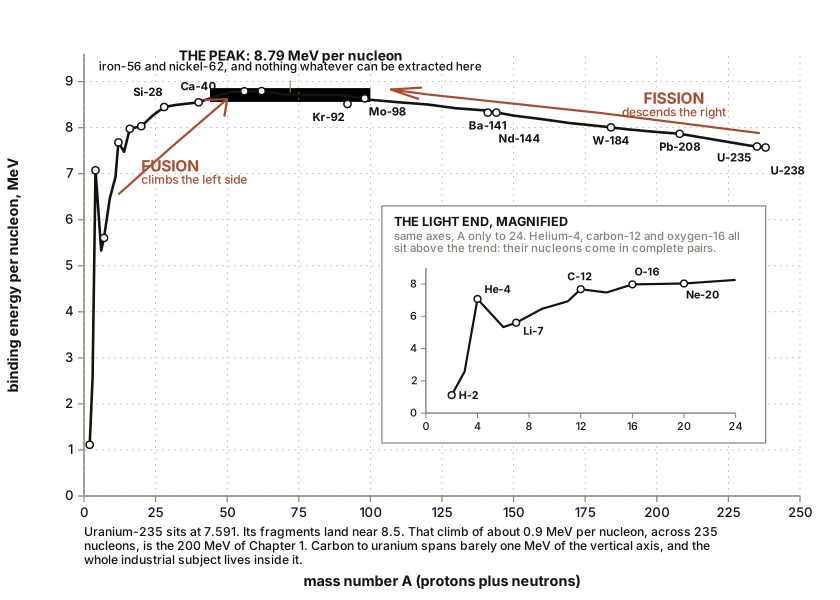
binding energy = ( Z x 1.007825 + (A - Z) x 1.008665 - atomic mass ) x 931.494in MeV, using the hydrogen atom mass of 1.007825 u rather than the bare proton, which cancels the electrons for you. Divide by A. Plot against A. Do at least these: H-2, He-4, Li-7, C-12, O-16, Ne-20, Si-28, Ca-40, Fe-56, Ni-62, Kr-92, Mo-98, Ba-141, Nd-144, W-184, Pb-208, U-235, U-238. What you should see: a curve that climbs very steeply from deuterium at 1.11 MeV per nucleon, is already at 7.07 by helium-4, reaches about 8.79 in the iron and nickel region, and then declines slowly to 7.59 at uranium-235. The whole range from carbon to uranium is only about one MeV per nucleon wide, which is worth noticing: the curve is remarkably flat, and all of nuclear engineering lives inside that one MeV. Check your arithmetic against these: He-4 7.074, C-12 7.680, Fe-56 8.790, Ni-62 8.795, U-235 7.591, U-238 7.570 MeV per nucleon. If your numbers agree to three decimals, your spreadsheet is right. And notice the outliers. Helium-4 sits well above its neighbours, and so do carbon-12 and oxygen-16. Those are the nuclei whose protons and neutrons come in complete pairs and in numbers that fill a shell, and the extra stability is real. It is why alpha particles exist as a thing that gets emitted, and it is why helium-4 is the ash of stars.
Section 3: The Whole of Nuclear Energy, Read Off One Curve
The rule is one sentence. Any change that moves nucleons upward on this curve releases energy, and the energy released is the height climbed times the number of nucleons that climbed.
Going up the left-hand side is fusion. Take four hydrogen nuclei at essentially zero binding energy per nucleon and end with a helium-4 at 7.07, and you have gained about 7 MeV per nucleon. That is the steepest part of the curve, which is why fusion releases so much per unit mass and why stars run on it. Deuterium plus tritium giving helium-4 plus a neutron releases 17.6 MeV from five nucleons, or about 3.5 MeV per nucleon.
Coming down the right-hand side is fission. Uranium-235 sits at 7.591. Its fission products sit somewhere around 8.5. That is a climb of about 0.9 MeV per nucleon, and there are 235 nucleons, so:
0.9 × 235 ≈ 211 MeV
which is the 200 MeV of Chapter 1 and Chapter 3, obtained from a graph rather than a mass table. The reason the graph slightly overshoots is that fresh fission products are neutron-rich and sit a little below the curve of stable isotopes; they climb the rest of the way over the following seconds and years by beta decay, which is exactly the delayed 30 MeV that Chapter 13 has to deal with as decay heat.
And at the peak, nothing. Iron and nickel are at the top. There is no direction to go that releases energy. You cannot fuse iron and you cannot fission it, and this is not an engineering limitation. It is the reason a large star dies. A star fuses its way up the left side of this curve, hydrogen to helium to carbon to oxygen to silicon, releasing energy at every step and using that energy to hold itself up against its own gravity. When the core reaches iron, the fuel is not exhausted in the sense of being used up. It is exhausted in the sense that there is nothing left on the curve that pays. The core stops producing energy, loses the fight with gravity in about a second, and the collapse is a supernova.
Fission and fusion are the same graph read in opposite directions. Nothing else about them is analogous, and this is why they get shelved together despite having almost no engineering in common.
SLOW DOWN. Check Your Understanding: Iron-56 is usually called the most stable nucleus, and it is at the peak of the curve you just plotted. But if you did the arithmetic carefully, nickel-62 came out higher, at 8.795 against iron’s 8.790. So which one is the most stable nucleus, and why is the universe not full of nickel? Answer before reading on.
It depends what you mean by stable, and the two obvious meanings give different answers. Nickel-62 has the highest binding energy per nucleon, so it takes the most energy per nucleon to dismantle. Iron-56 has the lowest mass per nucleon, at about 930.412 MeV, which is the quantity that actually decides which way a reaction runs. Those differ because a neutron is heavier than a proton, and nickel-62 achieves its slightly better binding by carrying a slightly less favourable mix. Both statements are true and they are answers to different questions.
As to why the universe is not full of nickel, the answer is kinetics rather than energy. Silicon burning in a massive star proceeds by repeatedly adding helium-4 nuclei, which moves in steps of four nucleons and lands on nickel-56 rather than nickel-62. Nickel-56 is not stable; it decays to cobalt-56 and then to iron-56 with a combined half-life of a few months, and the light from that decay is a large part of what makes a supernova visible for weeks afterwards. So the universe’s iron is nickel that decayed, and the reason we get iron rather than the marginally better-bound nickel-62 is that stars build in units of four and then wait.
The general lesson is worth more than the specific fact. Being the lowest-energy option is not enough; there must be a route. That distinction runs through the whole of this book: the fuel in a spent fuel pool is not at its lowest energy state either, and what keeps it where it is, for a hundred thousand years, is the absence of a route.
Section 4: Why the Curve Has That Shape
Four effects, and you have measured the first two with magnets.
Volume. Each nucleon is bound to its neighbours, and in a big nucleus most nucleons have a full complement of neighbours. This term is proportional to A and it is the reason binding energy per nucleon rises toward a constant.
Surface. Nucleons on the outside have fewer neighbours, so they are short-changed. The number of them is proportional to the surface area, which is proportional to A to the two-thirds, so the penalty per nucleon falls as the nucleus gets bigger. This is what makes the left-hand climb steep: small nuclei are almost entirely surface.
Coulomb repulsion. Every proton pushes every other, so this term grows roughly as Z², and divided across A nucleons it grows steadily worse with size. This is what turns the curve over and brings it down, and it is why the heavy end of the periodic table is unstable and why nothing beyond uranium occurs in appreciable quantity in nature.
And two quantum corrections. Nuclei prefer equal numbers of protons and neutrons, and prefer both numbers to be even. These are the reason for the sawtooth on your plot and for helium-4, carbon-12 and oxygen-16 poking above the trend.
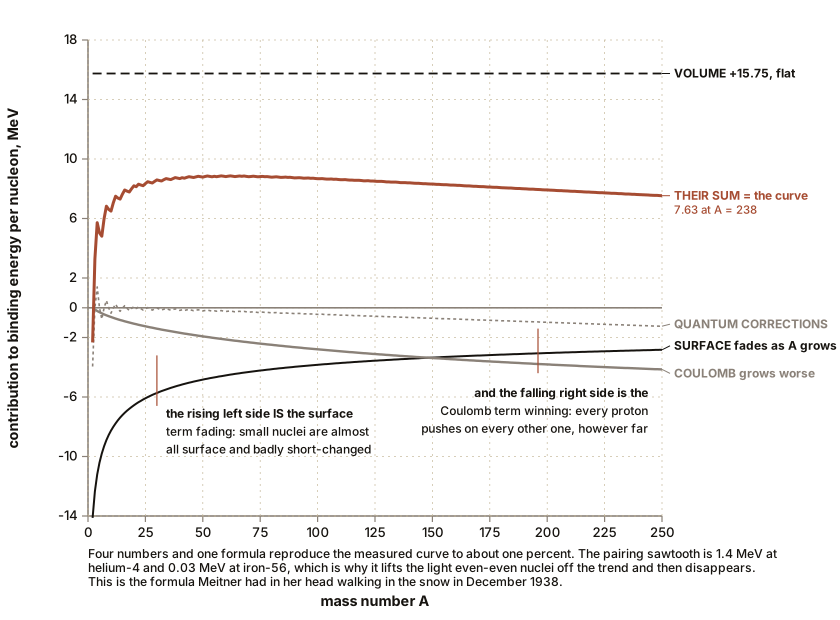
Written out with fitted coefficients, those four terms are the semi-empirical mass formula, and it reproduces the mass of nearly every nucleus to within about one percent using five numbers. Weizsäcker published it in 1935. It is the formula Meitner had in her head walking in the snow three years later, and it is why she could get within ten percent of the fission energy without a mass table.
Section 5: What to Carry Forward
Attraction is short-ranged and local, repulsion is long-ranged and global, and every feature of the curve follows from that asymmetry.
A bound nucleus weighs less than its parts, and the deficit, converted at 931.494 MeV per atomic mass unit, is the binding energy. This is measurable and routinely measured.
The curve peaks near iron at about 8.79 MeV per nucleon, rises steeply from hydrogen, and declines gently to 7.59 at uranium.
Fusion climbs the left side, fission descends the right, and both release the height they travel times the nucleons that travelled. Fission of U-235 climbs about 0.9 MeV per nucleon across 235 nucleons, which is your 200 MeV.
At the peak there is nothing to be had, which is a statement about the universe and not about engineering budgets.
And the entire industrial subject lives inside about one MeV per nucleon, on a curve that is nearly flat from carbon to uranium. It is a small effect on a graph and fifty million times chemistry.
Next: what comes out of an unstable nucleus, how fast, and the difference between how much is decaying and how much dose you get.

Bench Degree
Get the degree without the diploma.
Learn the material, not how to pass the exam.