Bench Degree·NUCLEAR POWERchapter

Chapter 5: Radioactivity and Half-Life
Three experiments in this chapter, all cheap, all safe, and all producing a number you can check against a published one. By the end you will have measured a half-life, verified an inverse-square law, and found out how much lead it takes to halve a gamma beam. Get the cloud chamber out again first.
Chapter 4’s curve says which nuclei are unstable. It does not say what they do about it, or how fast, and both are measurable on a kitchen table.
Start with why a nucleus decays at all. Plot every known nuclide with protons on one axis and neutrons on the other and the stable ones form a narrow band, curving away from the equal-numbers line as they get heavier because extra neutrons are needed to dilute the proton repulsion. Everything off that band is unstable, and each decay mode is a way of moving toward it. Too many neutrons: convert one to a proton. Too many protons: convert one to a neutron. Far too many of both: eject a chunk.
Section 1: Three Emissions, and What Each One Does
Alpha. A helium-4 nucleus: two protons and two neutrons, ejected as a unit. It comes out because helium-4 is unusually tightly bound, as your own plot in Chapter 4 showed, so a heavy nucleus can shed one and end up better off. Typical energy 4 to 6 MeV, and every alpha from a given nuclide comes out at very nearly the same energy, which is why alpha tracks in a cloud chamber are all the same length.
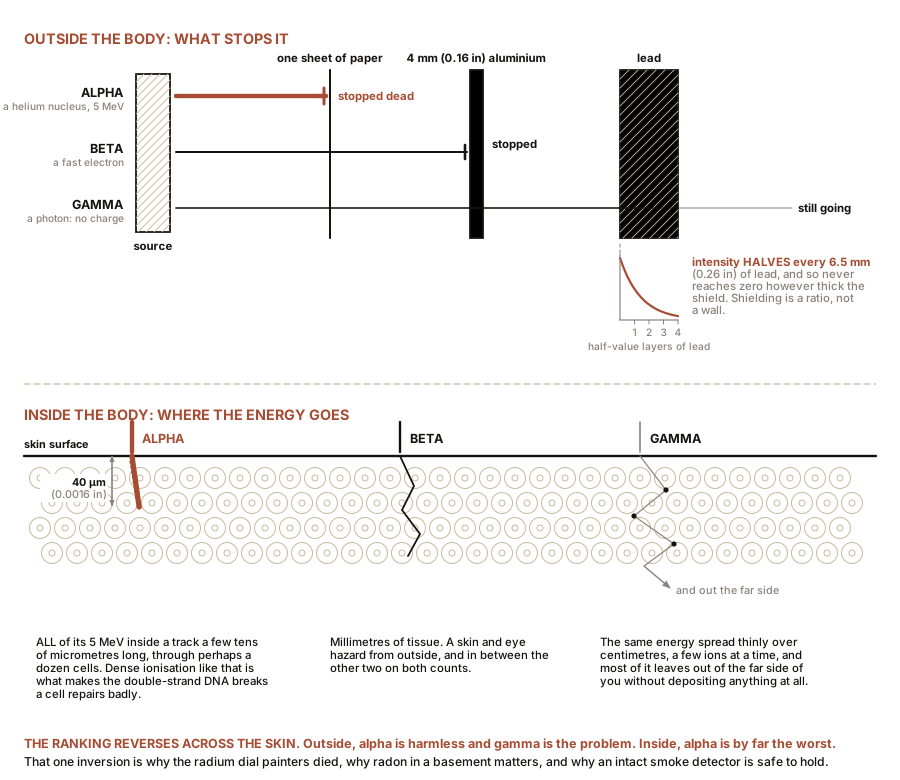
It is doubly charged and heavy, so it ionises ferociously and stops almost at once. A 5 MeV alpha travels about 4 cm (1.6 in) in air and is stopped by a sheet of paper, by the dead outer layer of your skin, or by about 40 µm (0.0016 in) of tissue.
Beta minus. A neutron in the nucleus turns into a proton, emitting an electron and an antineutrino. The electron is the beta particle. Unlike alphas, betas from a given nuclide come out with a spread of energies from nearly zero up to a maximum, because the antineutrino takes an unpredictable share. That spread is why beta tracks in your cloud chamber vary in length and why they wander: an electron is light enough to be knocked off course by the atoms it passes.
A 1 MeV beta travels a few metres, ten feet or so, in air, and is stopped by about 4 mm (0.16 in) of aluminium.
There is also beta plus, in which a proton becomes a neutron and emits a positron, and electron capture, which does the same conversion by swallowing one of the atom’s own electrons. Both are how proton-rich nuclei get back to the band, and positron emission is what a PET scanner detects.
Gamma. Not a particle in the ordinary sense: a photon, the same stuff as light, at energies of tens of keV to several MeV. A nucleus left in an excited state after an alpha or beta decay drops to its ground state and emits the difference as a gamma ray. It carries no charge and no mass, so it interacts only occasionally, and this is the one that gets out of things.
Gamma is not stopped, it is attenuated. The intensity falls exponentially with thickness, so there is no thickness that is enough and no thickness that is useless. You quote it as a half-value layer: the thickness that halves the beam. For the 662 keV gammas of caesium-137 that is about 6.5 mm (0.26 in) of lead, 48 mm (1.9 in) of concrete, or 88 mm (3.5 in) of water. Two half-value layers give a quarter, ten give about a thousandth.
And the ranking of danger reverses depending on which side of your skin the source is on, which is the single most misunderstood thing in radiation protection.
Outside the body, alpha is harmless, because it cannot get through the dead skin. Beta is a skin and eye hazard. Gamma is the problem, because gamma goes all the way through you.
Inside the body, that inverts completely. Alpha becomes by far the worst, because all of its 5 MeV is deposited inside a track a few tens of micrometres long, through perhaps a dozen cells, and dense ionisation like that produces the double-strand DNA breaks that cells repair badly. A gamma of the same energy scatters its damage thinly over centimetres and mostly leaves.
That inversion is why the radium dial painters of Chapter 2 died: radium went into their bones, and there is no shielding on the inside. It is why radon in a basement matters, and why an unopened smoke detector is safe to hold and a shredded one is not.
IN PLAIN ENGLISH: Think of it as water. A gamma ray is a fine mist blowing through a room: it wets everything a little and most of it goes out the far window. An alpha particle is a full glass thrown at one square inch of wall. The same amount of water, and the wall is much more damaged in the second case. Now put the wall inside a raincoat, which is your skin: the mist still gets through, and the thrown glass does not. Which one hurts you depends entirely on whether it started inside the coat.
Section 2: Chains, and the Gas in the Middle of One
Decay usually does not reach stability in one step.
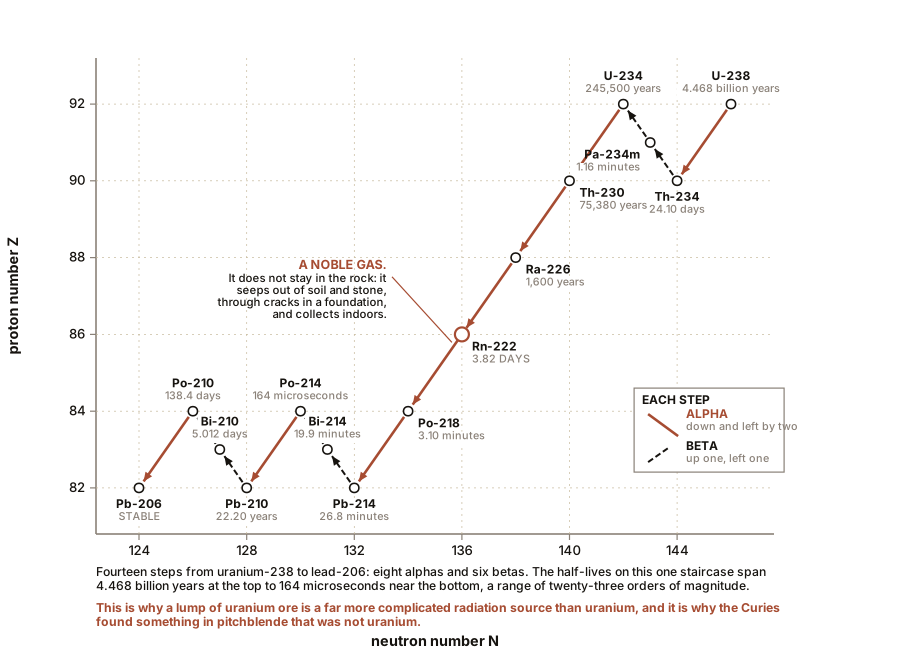
Uranium-238 takes fourteen steps to become lead-206: eight alphas and six betas. Thorium-232 takes ten to reach lead-208. These chains are why a lump of uranium ore is a far more complicated radiation source than uranium, and why the Curies found something in pitchblende that was not uranium.
One member of the uranium-238 chain deserves its own paragraph, because it is the largest single component of most people’s radiation dose.
Radon-222 is a gas. Halfway down the chain, between radium-226 and polonium-218, the element is a noble gas with a half-life of 3.82 days. Being a gas, it does not stay in the rock. It seeps out of soil and stone, through cracks in a foundation, and accumulates indoors, and being noble it is not retained by the body: you breathe it in and out again.
The problem is its daughters. Polonium-218, lead-214, bismuth-214 and polonium-214 are all solids, all short-lived, and all alpha or beta emitters. They form while the radon is in your lungs, or they form in the air, attach to dust and are inhaled. Then they sit in lung tissue and emit alphas, on the wrong side of the skin.
Radon is the second leading cause of lung cancer after smoking in most countries that have looked, and the epidemiology is unusually good because indoor concentrations vary by more than a factor of a hundred between houses. Chapter 6 gives the numbers, the action levels and what to do, and it is the one part of this book that might change a reader’s health.
Section 3: Half-Life, and the Only Equation in the Chapter
A nucleus does not age. It has no mechanism for knowing how long it has been sitting there, so its chance of decaying in the next second is the same as it was a billion years ago. That single fact forces the mathematics: a fixed probability per second per nucleus means the number decaying per second is proportional to the number present, and a quantity whose rate of decrease is proportional to itself decays exponentially. The half-life is the time for half of them to go, and it is a property of the nuclide, unalterable by temperature, pressure, chemistry or effort.
Half-lives span an absurd range. Uranium-238: 4.468 billion years. Radium-226: 1,600 years. Radon-222: 3.82 days. Polonium-214: 164 microseconds. Same chain.
Activity is decays per second. Its unit is the becquerel, one decay per second, which is a very small unit, and the older unit is the curie, defined as 3.7 × 10¹⁰ Bq, which was the activity of a gram of radium-226 and is a very large one. A smoke detector holds about 33 kBq, which is 0.9 µCi.
The relation you need is that activity is inversely proportional to half-life for a given number of atoms. A short half-life means a furious activity that is gone quickly; a long one means a feeble activity that lasts forever. Uranium-238 is barely radioactive at all per gram, which is why fresh fuel can be handled, and why depleted uranium is used as ballast and armour.
ON THE BENCH: Measure a half-life, using the air in your own basement
Parts: a Geiger counter, ideally one that logs; a balloon; a basement or ground-floor room, the more radon the better; a timer. Cost: nothing beyond the counter. Time: three hours, mostly waiting, and you can read a book through it. Hazards: none whatever. You are collecting a dust that is already in the room and then watching it disappear. Method: inflate a balloon, rub it on your hair or a wool jumper to charge it heavily, and hang it in the middle of the room for two to three hours. The charged surface attracts the radon daughter atoms, which are electrically charged when they form. Then take the balloon to the counter, hold it against the tube, and log counts per minute every five minutes for two to three hours. Keep a background reading from before you started and subtract it from every point. What you should see: an initial reading well above background, often five to twenty times it, decaying away to nothing over about three hours. Plot the log of net counts against time and the slope gives you a half-life of roughly 30 to 45 minutes. And now the interesting part, which is why this experiment is worth more than a textbook figure. No nuclide in the chain has a half-life of 40 minutes. You have collected a mixture: polonium-218 at 3.1 minutes, lead-214 at 26.8 minutes and bismuth-214 at 19.9 minutes, feeding into each other. What you measured is a composite, and the number you got is not the half-life of anything. Look at your own plot again and you will see it is not quite a straight line: it is steeper at the start. That curvature is the short-lived polonium burning off. A real decay measurement almost always looks like this, and learning to see more than one component in a curve is the actual skill. If you get nothing above background: your room is low in radon, which is good news of a different kind. A damp balloon also loses its charge. Try a dry day, a lower room, and a longer collection. And before you trust any point on that plot, count the counts. Decay is random, so counts follow a Poisson distribution and the standard deviation of a count of N is the square root of N. A five-minute reading totalling 25 counts has a standard deviation of 5, which is twenty percent, and it will not support a conclusion about a ten percent change. Relative precision is one over the square root of N, so ten percent needs 100 counts and one percent needs 10,000. Count for longer at the tail of the curve than at the start, where the rate is high. This arithmetic governs every measurement in this book and every epidemiological study in Chapters 6 and 7, and it is why small effects need enormous samples.
ON THE BENCH: The inverse square law, and where it stops being true
Parts: a Geiger counter; a small check source, which can be a thoriated lantern mantle, a piece of uranium glass, or the sealed americium button from an old ionisation smoke detector; a tape measure; a clamp or a stack of books. Cost: nothing you do not already have from Chapter 1. Time: an hour. Hazards: none, provided the source stays intact. Do not grind, dissolve or heat a mantle, and do not prise apart the americium button. Handled whole and put back in a drawer, all of these are less of a hazard than the stairs you carried them down. Method: clamp the source. Measure counts per minute at 20, 30, 40, 60, 80, 120 and 160 mm, which is roughly 0.8 to 6.3 in. Count for at least three minutes at each distance and longer at the far ones. Subtract background. What you should see: counts falling as one over distance squared. Double the distance, quarter the rate. Plot net rate against 1/r² and you should get a straight line through the origin. Where it fails, and this is the lesson. Very close in, the readings come out lower than the law predicts, and the reason is that the law is for a point source seen by a point detector. Up close, neither is a point: your tube has a window several centimetres, an inch or more, across, and the geometry stops being simple. Inverse square is a consequence of area growing as radius squared, not a law of radiation, and any measurement made where the source and detector are comparable in size to their separation will disobey it. Why you care: distance is the cheapest shielding there is, and this is the arithmetic behind it. Three times the distance is a ninth of the dose rate, for free, and no lead required.
ON THE BENCH: How much of what stops which
Parts: the same counter and source; sheets of paper; kitchen aluminium foil and thicker aluminium sheet or plate; lead sheet from a roofing supplier or fishing weights hammered flat, $10 to $20; a caliper or a micrometer. Cost: $20 at most. Time: ninety minutes. Hazards: lead is a chemical toxin and has nothing to do with radiation. Wash your hands afterwards, do not let children handle it, and do not machine or heat it. Method: fix the source and detector at a constant modest distance. Insert absorbers between them, one layer at a time, measuring the thickness of each and counting for three minutes per point. Do a full series with paper, one with aluminium, one with lead. What you should see, with a mantle or other mixed source: the count drops sharply for the first sheet or two of paper and then almost stops. That first cliff is the alpha component, stopped entirely by a few tens of micrometres of paper. Aluminium then produces a second gentler fall as the betas go. Lead produces a slow exponential decline that never reaches zero, which is the gammas. The measurement: for the lead series, plot the log of the count against thickness. It should be a straight line, and the thickness that halves the count is your measured half-value layer. With a mantle expect a few millimetres, a tenth of an inch or so, and compare it against published values for the gamma energies thorium’s daughters emit. What this buys you: your own measured evidence for the three-way split every radiation-protection decision rests on. Paper for alpha. Millimetres of light metal for beta. Centimetres of dense metal per factor of two for gamma. And get the cloud chamber out. Chapter 1 promised you would tell alpha from beta by their tracks alone. Put a source in the chamber, watch the short fat stubs, then slide a single sheet of paper between the source and the viewing region. The stubs vanish and the long wandering lines remain. You have identified a particle by two independent methods and they agree.
Section 4: The Distinction That Everything Else Depends On
Activity and dose are different quantities, and confusing them is the commonest error in public discussion of this subject.
Activity is a property of the source. Becquerels. How many nuclei per second are coming apart. It says nothing about you.
Absorbed dose is a property of the thing being irradiated. One gray is one joule of energy deposited per kilogram of tissue. The older unit is the rad, which is 0.01 Gy.
Equivalent and effective dose adjust the gray for the fact that a joule of alpha does far more biological damage than a joule of gamma, per Section 1. Multiply the gray by a weighting factor, and the unit becomes the sievert. The factor is 1 for gamma, X-rays and beta, and 20 for alpha, with neutrons falling between 2 and 20 depending on their energy. A gray of alpha is twenty sieverts. A gray of gamma is one. The older unit is the rem, and 1 Sv = 100 rem, so a millisievert is 100 millirem, which is the form most American figures are quoted in.
Effective dose goes further and weights each organ by how susceptible it is, so a chest X-ray and a dental X-ray delivering the same gray to different tissue produce different sieverts. The sievert is a constructed, model-dependent, whole-body risk proxy rather than a physical measurement, and Chapter 6 says so out loud before it quotes a single figure.
SLOW DOWN. Check Your Understanding: Your Geiger counter reads 200 counts per minute held against a lantern mantle, and also 200 counts per minute held against a slab of granite. Are you receiving the same dose from each? Decide before reading on.
Almost certainly not, and there are four independent reasons, each of which is worth knowing.
A count is not a decay. The tube only registers what enters its window and interacts inside it. Geometry, window thickness and gas pressure mean a typical hand-held counter detects somewhere between a fraction of a percent and a few percent of the decays occurring in a nearby source, and that efficiency is completely different for alpha, beta and gamma. Two sources with equal count rates can have wildly different activities.
A count carries no energy information. A Geiger tube produces the same size pulse for a 60 keV gamma as for a 1.3 MeV one. Dose is deposited energy, so a counter that cannot distinguish them cannot measure dose. This is the fundamental limitation of the instrument, and it is why a Geiger counter is a superb comparator and a poor dosimeter. Instruments that do measure dose, such as scintillators with pulse-height analysis, cost several times more.
The weighting factors differ. If the mantle’s counts are mostly alpha and the granite’s are mostly gamma, then per unit of absorbed energy inside tissue the mantle’s radiation is twenty times as damaging. Except that the mantle’s alphas cannot reach living tissue at all through your skin, so in the external geometry you are actually in, they contribute essentially nothing.
And geometry differs. The mantle is a point source a centimetre, half an inch, from the tube; the countertop is a broad plane you might sit beside for years. Equal instantaneous rates, wildly unequal exposures.
The general point is the one to keep. A number from an instrument is a number about the instrument until you have said what it is measuring, over what geometry, of what radiation. Every disputed radiation figure in public life fails on one of those three, and usually the second.
Section 5: What to Carry Forward
Decay moves a nucleus toward the stable band, and the mode chosen is whichever way it needs to go.
Alpha is stopped by paper and is the worst thing you can inhale. Gamma cannot be stopped, only attenuated, and it is what shielding is for. The ranking inverts across your skin, and you have now confirmed the alpha half of it twice, once with paper and once in a cloud chamber.
Decay is exponential because a nucleus has no memory, and you have measured a real decay curve and found it to be a mixture of three nuclides rather than one.
Activity is inversely proportional to half-life. Short-lived means intense and brief; long-lived means feeble and permanent.
Becquerels are the source, grays are the energy you absorbed, and sieverts are a weighted risk estimate built on top of the grays, the last being a model rather than a measurement.
And distance is free shielding, at one over the square of it, within the limits you measured yourself.
Next: what those sieverts do to a person, which is the chapter this book has to get right.

Bench Degree
Get the degree without the diploma.
Learn the material, not how to pass the exam.