Bench Degree·NUCLEAR POWERchapter

Chapter 17: Weapons, and Why a Power Reactor Is Not One
Addressed directly, because the reader will wonder and because a book that dodges it forfeits the right to be believed on anything else. The answer is a factor of about ten thousand in one number and a factor of twenty in another, and both are calculable in an afternoon.
A nuclear weapon and a power reactor run the same reaction and are otherwise almost nothing alike. Three things are needed for an explosion, and a power reactor fails all three, not narrowly but by orders of magnitude.
Material at high enough enrichment that a fast, unmoderated chain reaction can sustain itself.
Geometry compact enough that the neutrons do not leak out before they do anything.
And speed. The whole reaction must finish before the assembly destroys itself, which means it must be assembled in a time measured in microseconds.
The third one is the interesting one, and this chapter is mostly about it.
Section 1: Why Only 1.4 Percent
The Hiroshima weapon contained about 64 kg (141 lb) of highly enriched uranium at roughly 80 percent uranium-235, and produced a yield of about 15 kilotonnes of TNT equivalent.
Work out how much of that uranium actually fissioned. One kilotonne is 4.184 TJ, so 15 kt is 6.3 × 10¹³ J. At about 200 MeV per fission, which is 3.2 × 10⁻¹¹ J, that requires about 2 × 10²⁴ fissions, which is about 770 g (27 oz) of uranium-235.
Out of 64 kg, less than a kilogram fissioned. About 1.4 percent. The rest was blown across Hiroshima as uranium.
SLOW DOWN. Check Your Understanding: Why did 98.6 percent of the fissile material fail to fission, in a device designed by the best physicists available with unlimited money? Work out what stops it before reading on.
The explosion stops it. And that is not a joke; it is the governing constraint of weapon design and the reason a reactor cannot detonate.
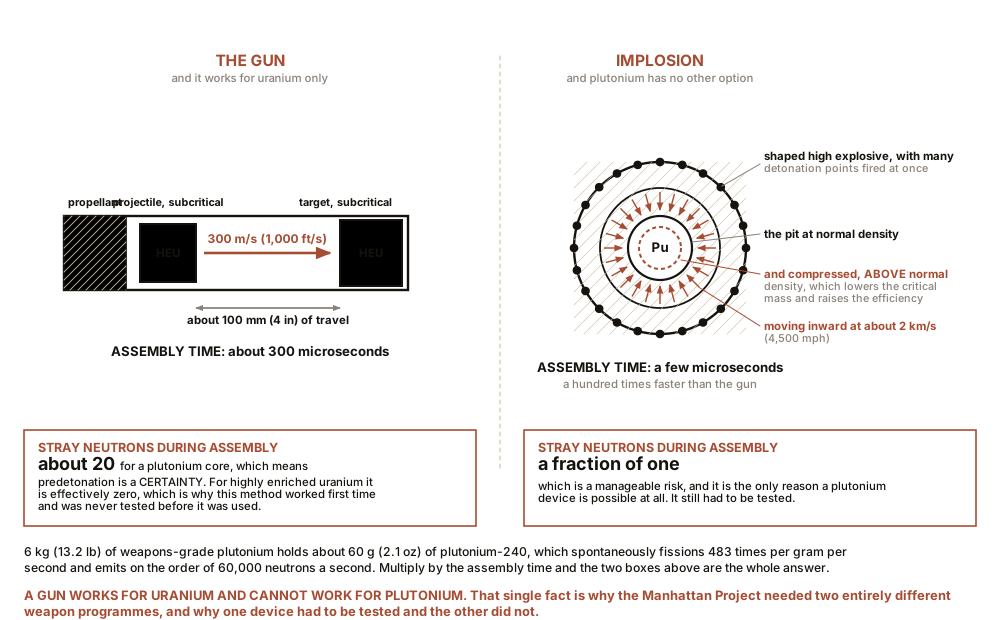
Do the timescale. In a compact mass of uranium metal with no moderator, a fission neutron’s mean free path is a few centimetres, an inch or so, and it is travelling at about 2 × 10⁷ m/s. So one generation, from a fission to the next fission it causes, takes something like 10 nanoseconds.
Starting from a single neutron and needing 2 × 10²⁴ fissions, at a multiplication of roughly two per generation, you need about 81 generations. At 10 ns each that is under a microsecond for the entire event.
Now ask what the material is doing during that microsecond. By the time about one percent of it has fissioned, the energy released has heated it to millions of degrees and pressures of millions of atmospheres, and it starts to expand. Expanding means less dense, which means more leakage, which means k falls below one, which means the chain reaction stops. The device disassembles itself and the reaction ends. Essentially all of the energy release happens in the last few generations, which is to say in the last few tens of nanoseconds, and then it is over.
So the entire craft of weapon design is a race between assembly and disassembly, and the yield is decided by how many generations you can get in before the material gets out of its own way.
And that is the argument this whole chapter rests on. A reactor core is a thousand times less compact than a weapon, its neutrons are moderated so its generation time is ten thousand times longer, and it is full of water and metal that will flash and burst long before anything approaching a weapon’s energy density is reached. A reactor cannot win a race it is running ten thousand times too slowly. Chernobyl proved that by losing it: it disassembled, exactly as this paragraph says it must, at about one thousandth of a small weapon’s energy.
Section 2: Gun and Implosion, and Why Plutonium Needs the Hard One
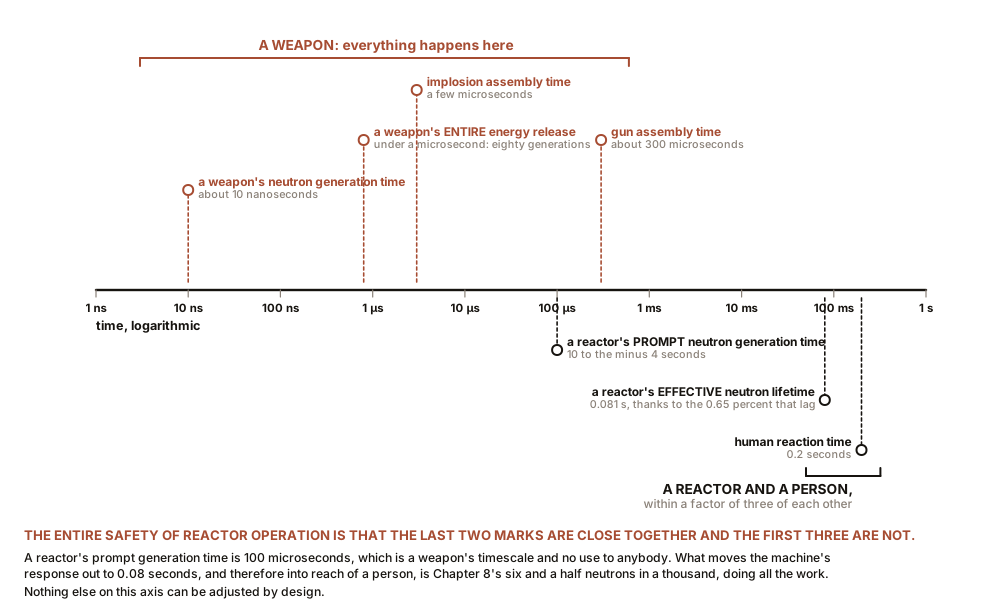
The gun method. Two subcritical pieces of highly enriched uranium, one fired into the other down a short barrel at around 300 m/s (1,000 ft/s). Simple, robust, and it worked first time without a test. Assembly takes something like 300 microseconds.
The implosion method. A subcritical shell or sphere of plutonium surrounded by shaped high explosive, detonated simultaneously from many points to compress it inward. Assembly takes a few microseconds, a hundred times faster than the gun, and it also compresses the material to above normal density, which reduces the critical mass and makes the reaction more efficient. Fat Man used about 6.2 kg (13.7 lb) of plutonium and fissioned close to twenty percent of it for roughly 21 kt.
And here is why plutonium cannot use a gun.
Chapter 14 noted that reactor plutonium is not pure plutonium-239. It always contains plutonium-240, and plutonium-240 undergoes spontaneous fission: about 483 fissions per gram per second, all on its own, with no neutron needed.
Those spontaneous fissions emit neutrons. If a neutron appears while the pieces are still coming together and the assembly is only barely critical, the chain starts early, the material heats, it expands, and it disassembles before full assembly. The result is a fizzle: an explosion, but a small and unpredictable one.
The arithmetic decides it. Weapons-grade plutonium is about one percent plutonium-240, so a 6 kg (13.2 lb) core holds about 60 g (2.1 oz) of it, emitting on the order of 60,000 neutrons per second. Over a gun’s 300-microsecond assembly, that is about 20 stray neutrons, which means predetonation is a certainty. Over an implosion’s few microseconds it is a fraction of one, which is a manageable risk.
A gun works for uranium and cannot work for plutonium, and that single fact is why the Manhattan Project needed two entirely different weapon programmes and why the plutonium device had to be tested and the uranium one did not.
Section 3: Reactor-Grade Plutonium, Stated Honestly
This is where partisan accounts on both sides go wrong, so here is the position that follows from the arithmetic.
High-burnup power reactor plutonium is roughly 55 to 60 percent plutonium-239 and about 25 percent plutonium-240, with plutonium-241 and 242 making up most of the rest. Compare weapons-grade at about 93 percent plutonium-239 and under 7 percent plutonium-240.
Redo Section 2’s calculation with 25 percent plutonium-240. A 6 kg (13.2 lb) core holds 1,500 g (3.3 lb) of it, emitting on the order of 1.6 million neutrons per second. Over even a three-microsecond implosion that is about five stray neutrons, so predetonation is again essentially certain, and the yield is low and unpredictable.
But not zero, and this is the honest part. The United States demonstrated in a 1962 test that a device using reactor-grade plutonium will produce a nuclear explosion. The yield was low. So the correct statement is that reactor-grade plutonium is a poor weapons material and not a useless one, and either half of that sentence on its own is misleading.
There are two further practical obstacles that are rarely mentioned and are real. Reactor-grade plutonium runs hot, at around 15 W per kg against about 2.3 for weapons-grade, from the decay of plutonium-238 and 241, which is Chapter 12’s specific-power arithmetic in an unwelcome place. That heat degrades high explosive and stresses electronics. And its higher radiation field makes handling and fabrication considerably harder.
And then the empirical fact, which is worth more than any of the arithmetic. No nuclear weapon in any arsenal has been built from plutonium produced by a commercial power reactor on a normal fuel cycle. Every programme that has succeeded used a dedicated production reactor operated on a very short fuel cycle to keep the plutonium-240 down, a research reactor, or enrichment. That is a statement about the historical record rather than about physics, and it is checkable.
ON THE BENCH: The predetonation budget
Parts: a calculator. Cost: nothing. A calculation, for the same reason as the last one. Time: twenty minutes. Method. Plutonium-240 undergoes about 483 spontaneous fissions per gram per second, each releasing about 2.2 neutrons, so take roughly 1,060 neutrons per gram per second. For a 6 kg (13.2 lb) core, work out the expected number of stray neutrons appearing during the assembly time, for each combination below.
Material Pu-240 content Assembly time Expected stray neutrons weapons-grade, gun 1% 300 µs about 20 weapons-grade, implosion 1% 3 µs about 0.2 reactor-grade, gun 25% 300 µs about 500 reactor-grade, implosion 25% 3 µs about 5 What you should conclude. A stray neutron during assembly starts the chain early and the device fizzles, so the figures above are, in effect, the number of chances to fail per attempt. A value well below one is a design. A value well above one is a certainty of failure. Read the table and the entire history of weapon design falls out of it: uranium can use the simple method, weapons-grade plutonium must use the fast one, and reactor-grade plutonium is a poor bet even with the fast one. Then do one more line. Repeat the top row for uranium-235, whose spontaneous fission rate is about 0.0003 fissions per gram per second, some six orders of magnitude lower. You get a number so small the gun method is entirely safe from this effect, which is why the Hiroshima device was never tested and the Nagasaki device had to be. And what this box is really demonstrating is that the boundary between what is and is not a weapons material is set by a spontaneous decay rate and an assembly time, both of which are published numbers. None of the reasoning here is secret, and none of it needs to be, because knowing why something is hard is not the same as being able to do it.
Section 4: Why This Particular Machine Cannot Detonate
Four independent reasons, each sufficient on its own.
Enrichment. Power reactor fuel is 3 to 5 percent uranium-235. In a fast, unmoderated spectrum, no arrangement of 5 percent material of any mass or shape can be critical, because uranium-238’s fast fission threshold and its scattering dominate the neutron balance. Practical weapons use above 80 percent, and even the lowest enrichment at which a fast critical assembly is conceivable is well above 20 percent, which is why 20 percent is the international dividing line between low and high enriched uranium.
Moderation, which cuts both ways. With the water present, the reactor can go critical, and its neutrons are thermal, so its generation time is around 10⁻⁴ seconds. That is ten thousand times too slow to outrun disassembly. Remove the water to get a fast spectrum and, per the previous paragraph, the fuel cannot go critical at all. There is no configuration in which the fuel is both fast and critical.
Geometry. Chapter 10’s core is 50,952 thin rods spread through water over 3.4 m (11 ft), which by Chapter 9’s surface-to-volume argument is close to the worst possible shape for criticality and the exact opposite of a compact sphere. Nothing in the plant can compress it, and Chapter 9’s clay experiment says why that matters.
And disassembly. A reactor is a pressure vessel full of water with a boiling point. Any rapid power rise flashes that water to steam and bursts something long before the fuel reaches weapon energy densities. The machine’s own weakness is a safety feature, and it is the thing that limited Chernobyl.
IN PLAIN ENGLISH: A weapon has to slam together in a few millionths of a second, because it destroys itself in a millionth. A reactor’s fuel is scattered through a swimming pool in fifty thousand pencil-thin rods, its neutrons take ten thousand times longer to get anywhere, and it is surrounded by water that will burst the plumbing at the first sign of trouble. There is no accident and no act of sabotage that turns the second thing into the first, because the two are not versions of one machine. They are opposites that happen to run the same reaction.
ON THE BENCH: The assembly race, calculated
Parts: a calculator. Cost: nothing. A calculation, and there is obviously no bench experiment in this chapter. This book has said which is which throughout and it is not going to start pretending in the one chapter where it matters most. Time: forty minutes. Method. 1. Take a generation time of 10 ns and a multiplication of 2. How many generations from one neutron to 10²⁴ fissions? Take log base 2 and get about 80. Total elapsed time: 0.8 microseconds. 2. Now redo it with a reactor’s thermal generation time of 10⁻⁴ s and the same 80 generations. You get 8 milliseconds, ten thousand times longer, and during those 8 ms the water in the core has ample time to boil, expand, and remove the moderation that the chain reaction depends on. The reaction turns itself off. That is Chapter 10’s negative void coefficient, expressed as a race. 3. Then estimate a disassembly time. Take a core dimension of 3.4 m (11 ft) and a plausible expansion velocity for flashing steam of a few hundred metres per second. You get milliseconds, comparable to step 2, and Chernobyl’s four-second power rise ending in a burst pressure tube is that arithmetic happening. 4. Finally, compute what Chernobyl’s mechanical energy was worth. Published estimates for the first explosion range from tens to a couple of hundred tonnes of TNT equivalent and they are genuinely disputed. Divide by 15,000 tonnes, or 33,000,000 lb, for Hiroshima. You get somewhere between about a thousandth and a hundredth. What you should conclude. The nuclear excursion at Chernobyl was real and the explosion was steam. The chain reaction heated the fuel, the fuel flashed the water, and the water burst the channels and lifted the shield. That is a large industrial explosion and it is not a nuclear explosion in the weapons sense, and the distinction is not semantic: it is a question of which physical process delivered the mechanical energy, and the answer is measurable in the wreckage.
Section 5: Where the Risk Actually Is
Since a power reactor is not a weapon, the honest question is where proliferation risk does live. There are three places, and reactors are the least of them.
Enrichment, which is the big one. Chapter 14’s calculation gave the number: reaching 4.5 percent consumes about seventy percent of the separative work needed for 90 percent. A country with a working centrifuge cascade has done most of the technical work and needs no new science. This is why every serious international dispute about a nuclear programme is a dispute about centrifuges.
Reprocessing, which is the other one. PUREX produces separated plutonium in bulk, requiring no enrichment to be useful. That is the reason the United States ended commercial reprocessing in 1977 and it is why processes that deliberately leave the plutonium mixed with other actinides are under development.
And reactor operation, in one specific respect. A reactor is where plutonium is made, and plutonium quality depends on burnup: short irradiations produce plutonium with little plutonium-240, which is to say weapons-usable material. So the safeguards question about a reactor is not whether it exists but whether its fuel can be removed early and unobserved. A pressurised water reactor cannot be opened without a shutdown that is visible from orbit. A reactor that refuels while running, such as a CANDU or an RBMK, can in principle discharge fuel at any burnup, which is precisely why those designs receive more intensive material accountancy, and why India’s 1974 device used plutonium from a research reactor of that lineage.
Research reactors are a separate and real concern, because many were built with highly enriched uranium fuel. An international programme has been converting them to low-enriched fuel and repatriating the HEU for decades, and it is one of the less publicised and more useful things the field has done.
The instruments that address all of this are accountancy and inspection, not reactor design: measuring the material in and out to within a fraction of a percent, sealing and monitoring the equipment that could divert it, and sampling the environment for evidence of undeclared activity. The Non-Proliferation Treaty’s bargain is that this access is the price of civil nuclear technology, and the arguments that arise are arguments about access.
Section 6: What to Carry Forward
A weapon needs high enrichment, a compact geometry, and assembly in microseconds. A power reactor fails all three by orders of magnitude.
Only 1.4 percent of Hiroshima’s uranium fissioned, because the explosion terminated the reaction in under a microsecond. Weapon design is a race between assembly and disassembly, and the yield is however many generations you can win.
Plutonium cannot use a gun, because plutonium-240’s spontaneous fission would start the chain during a 300-microsecond assembly. That is why implosion exists.
Reactor-grade plutonium is a poor weapons material and not a useless one, and it runs hot enough to damage the device that would use it. No arsenal has ever been built from commercial power reactor plutonium on a normal fuel cycle.
A reactor’s neutrons are ten thousand times too slow, its fuel is too dilute to be fast-critical, its geometry is close to the worst possible, and its own coolant bursts the plumbing first. Chernobyl was that arithmetic, and its mechanical energy was of order a thousandth of a small weapon’s, delivered by steam.
And proliferation risk lives in enrichment and reprocessing, with reactor operation mattering only through burnup and the ability to refuel unobserved.
Next: the ledger.

Bench Degree
Get the degree without the diploma.
Learn the material, not how to pass the exam.