Bench Degree·NUCLEAR POWERchapter
Chapter 18: What You Now Know
The ledger. What Chapter 1 promised, whether it was delivered, what you can do on a bench that you could not do before, and what this volume left out, named plainly.
Chapter 1 was unusually specific. It listed seven things you would be able to do by the last page, and it also drew a boundary and promised to honour it. Here is that promise, checked line by line, including the one place where the honest answer turned out to be different from the one promised.
Section 1: The Promise, Tested
Say why the core is the size it is, in terms of neutron economy. Chapter 9 Section 4, and the answer has two halves rather than one, which is a correction to the promise rather than a delivery of it. Neutron economy sets the minimum: production scales with volume and leakage with surface, so below roughly 1.5 to 2 m (5 to 6.5 ft) across, no light water lattice can be critical. But the reference core is 3.4 m (11 ft) across, about twice that, and the extra size is heat transfer, not neutronics. Getting 3,400 MW out of uranium dioxide, which conducts like a brick, requires 50,952 thin rods and 5,500 m² (60,000 square feet) of wetted surface, and that is what sets the dimension. Chapter 1 asked the question in terms of neutron economy and the correct answer is that neutron economy is the cheaper of the two constraints.
Explain what physically keeps it stable second to second, and name the property. Chapters 10 and 11. The property is the negative temperature coefficient, and it has two mechanisms: Doppler broadening of uranium-238’s resonances in the fuel, acting in milliseconds and worth -2 to -4 pcm per °C, and moderator density, acting in seconds and worth up to -80 pcm per °C. The second exists only because the lattice is deliberately undermoderated, so that losing water loses reactivity. The turbine sets the power and the reactor follows it with nobody touching anything.
Explain what would make it unstable, and why one design in one country had that property built in. Chapters 10 and 16. Sit on the overmoderated side of the curve, or use a moderator that is not the coolant, and the sign flips. The RBMK moderated with graphite and cooled with light water, so its water was a net neutron absorber; boiling it away removed an absorber and raised reactivity, worth about plus four and a half dollars at low power. That was in the lattice geometry from the day it was drawn, and no operating rule could remove it.
Say why about two-thirds of the thermal energy is rejected. Chapter 13, and again the honest answer is better than the promised one. The Carnot limit for steam at 285 °C (545 °F) and a condenser at 40 °C (104 °F) is 43.9 percent, and the plant achieves 33, which is 75 percent of the limit. But the reason the limit is only 44 percent is water, not nuclear physics. Water at 327 °C (621 °F) already requires 15.5 MPa (2,250 psi), it reaches its critical point at 374 °C (705 °F), and Chapter 10’s zirconium cladding corrodes above about 350 °C (662 °F). Gas-cooled reactors, which have none of those limits, reach 41 to 42 percent. The two-thirds is real and the usual explanation for it is incomplete.
Explain why a power reactor cannot detonate, in terms of enrichment, geometry and timing. Chapter 17. Five percent enrichment cannot go critical in a fast spectrum at any mass or shape; with the water present the neutrons are thermal and the generation time is 10⁻⁴ seconds, which is ten thousand times too slow to beat disassembly; the geometry is 50,952 rods spread through water, which is close to the worst possible; and the coolant flashes to steam and bursts the plumbing first. Chernobyl demonstrated the last of those by losing the race at about a thousandth of a small weapon’s energy, delivered by steam.
Read a dose report and say whether the numbers matter. Chapters 6 and 7, and you have your own denominator from Chapter 1’s Geiger walk and Chapter 6’s radon test. Chernobyl’s liquidators averaged 120 mSv (12 rem), its evacuees 30 mSv, and 6.4 million residents 9 mSv over twenty years. Fukushima’s residents were mostly under 5 mSv in the first year. Three Mile Island’s two million neighbours averaged 0.01 mSv (1 mrem). Against an American average of 6.2 mSv (620 mrem) a year, of which 3 mSv is medical imaging, you can now place every one of those without being told what to think about them.
Explain what actually happened at Three Mile Island, Chernobyl and Fukushima, and why each taught something different. Chapters 15 and 16, plus Windscale. A valve indicator wired to a command instead of a state. A control rod that added reactivity for the first seconds of a scram, whose flaw had been measured three years earlier and not disclosed. And a seawall built to 5.7 m (19 ft) against a 13 m (43 ft) wave, at a plant whose neighbour up the coast chose 14.8 m (49 ft) and survived. Three different barriers, three different lessons, and in all four cases the mechanism was known to somebody before the event.
And the boundary was honoured. Chapter 1 said no reader would build a reactor, achieve criticality, handle fuel or enrich anything, and that where a chapter could not offer an experiment it would offer a calculation and say which. Every chapter did. Chapters 9, 12, 14, 16 and 17 each contain a box that says in its own words that it is a calculation and that there is no bench experiment for this and no point pretending.
Section 2: What You Can Actually Do Now
Not what you have read about. What you can do, on a bench, for a total outlay of a Geiger counter and about a hundred dollars of consumables.
See individual subatomic particles in a cloud chamber and sort them into alphas, betas and cosmic-ray muons by track shape alone. Then confirm the alpha identification independently by sliding one sheet of paper into the chamber.
Measure a real half-life from radon daughters collected on a charged balloon, fit the curve, and recognise from the curvature that you are looking at three nuclides rather than one.
Verify the inverse square law, and say where it stops being true and why.
Measure the half-value layer of lead for your own source, and demonstrate the three-way split of paper, aluminium and lead in one afternoon.
Reproduce Becquerel’s fogged plate with photographic paper and a lantern mantle, and Pierre Curie’s ionisation measurement with a jar, a wire and kitchen foil.
Know how long to count. Precision is one over the square root of the number of counts, so ten percent needs 100 counts and one percent needs 10,000. Most casual Geiger measurements, including your own first ones, were too short to support what was concluded from them.
Test your house for radon, interpret the result against the WHO and US action levels, and know that the fix is a pipe, a fan and $800 to $2,500.
Build your own annual dose budget and find that it is dominated by two entries, radon and medical imaging, and by nothing else.
Compute a mass defect from a nuclide table and get 173 MeV for a representative fission, then plot the binding energy curve and discover that nickel-62 sits above iron-56.
Work a six-factor neutron balance by hand, see that a one percent change in any factor moves k by 1,000 pcm, and run a 1/M approach to critical the way Fermi did.
Compute a separative work cascade and derive, from two published formulas, that reaching 4.5 percent enrichment is about seventy percent of the work needed for 90 percent. That is the single most policy-relevant number in the subject and you did not have to take anyone’s word for it.
Demonstrate neutron moderation with three marbles, and criticality geometry with 500 g (18 oz) of clay and a sheet of kitchen foil.
Build a thermoelectric generator, measure its efficiency at 1 to 3 percent, and measure the ΔT² relationship that accounts for a third of Voyager’s lost output.
Run a model steam plant, measure its efficiency against its own Carnot limit, and find it delivers a tenth of what physics allows while a real station delivers three-quarters.
Measure a wet-bulb depression with two thermometers and a wet rag, and know what the local climate costs a power station in efficiency.
Build the lying level gauge from a plastic bottle and an aquarium pump, and understand Three Mile Island as an observability problem rather than a competence problem.
And sit through an alarm flood, which is free, takes twenty minutes, and is the most immediately transferable twenty minutes in the book if you work with any monitoring system at all.
ON THE BENCH: The whole programme, in order, with the bill
Parts and total cost, if you own none of it:
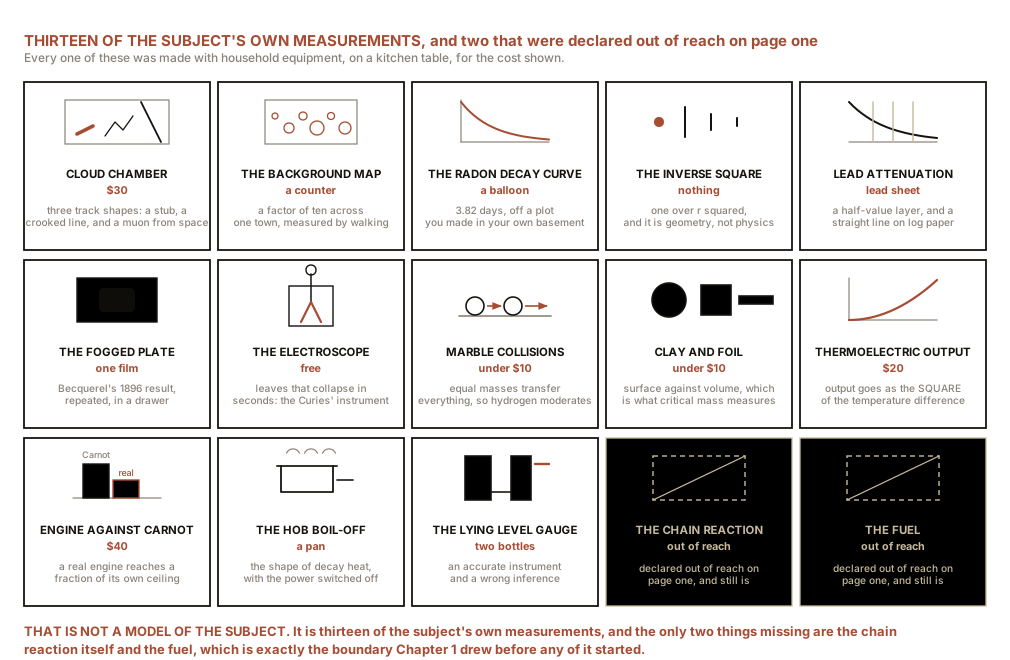
Item Cost Geiger-Müller counter with a wide window $60 to $100 Cloud chamber materials, including dry ice per session $30 Thoriated lantern mantle, uranium glass, or an old smoke detector $0 to $15 Radon test kit $15 to $30 Lead sheet, aluminium, paper $20 Neodymium magnets and a spring scale $15 Marbles, clay, foil, beans, dice, mousetraps $60 Thermoelectric module and resistors $15 Aquarium pump, tubing, bottle $15 Two thermometers $10 Total about $250 to $310 plus a model steam engine at $150 to $350 if you want Chapter 13’s whole cycle, which is the only genuinely expensive item and the only optional one. Time: six weekends, in this order. 1. Cloud chamber and the Geiger walk-around. Chapters 1 and 5. 2. Electroscope, Becquerel plate started, inverse square, shielding series. Chapters 2 and 5. 3. Radon balloon half-life, and the counting statistics exercise. Chapter 5. 4. Radon test kit deployed, dose budget computed. Chapters 6 and 7. 5. Marbles, magnets, clay, dice, mousetraps. Chapters 3, 4, 8 and 9. 6. Thermoelectric generator, wet bulb, the hob decay-heat curve, the lying level gauge. Chapters 12, 13 and 15. Then the calculations, which need only a spreadsheet: the mass defect, the binding energy curve, the six-factor balance, the xenon pit, the SWU cascade, the decay heat timeline, and the assembly race. What the whole programme is worth. At the end of it you will have measured, with your own hands, the existence of radiation, its variation, its decay, its attenuation, its geometry, its dose, the mechanism of moderation, the geometry of criticality, the efficiency of thermoelectric conversion, the Carnot limit of a heat engine, the residual heat of a switched-off source, and the failure mode of a badly placed instrument. That is not a model of the subject. It is thirteen of the subject’s own measurements, and the only things missing from the list are the chain reaction itself and the fuel, which is exactly the boundary Chapter 1 drew on page one.
ON THE BENCH: Audit a number in the news
Parts: any news article about nuclear power, radiation or waste. Cost: nothing. A calculation, and the one this book most wants you to keep doing. Time: twenty minutes per article, for the rest of your life. Method. Find the load-bearing number and ask five questions in order. 1. Is it activity, absorbed dose, or effective dose? Becquerels, grays or sieverts. These are three different quantities and only the last is a risk estimate. 2. Against what baseline? A dose with no comparator is not information. You have your own from Chapter 6. 3. Is it a count or a projection? If it is deaths, were they counted or modelled? If modelled, from what collective dose and what risk coefficient, and does the body that publishes the coefficient endorse using it that way? 4. What assumptions move it by a factor of two? Chapter 14’s pellet-against-coal box is the template: burnup, coal grade, and heat against electricity each moved the answer substantially and each was defensible. 5. Who would have to be wrong for this to be false? Which document, and can you read it? What you should find: most numbers survive two of those questions and few survive all five, in both directions. The point is not to become a sceptic. It is to be able to tell which claims you are equipped to evaluate and which you are not, which is a smaller and much more useful skill.
Section 3: The Ideas Worth Keeping
Seven, and they outlast every number in the book.
A probability is a size. One alpha in eight thousand bouncing off a gold foil measures the nucleus. Every figure in reactor physics is a cross-section, which is an effective target area, and it can exceed the physical size of the target because a slow neutron is a wave the size of an atom. You cannot see the target and you do not have to.
The best safety features are shapes, not systems. A negative void coefficient cannot fail, cannot be switched off, needs no power supply, and does not depend on anybody noticing anything. It is a consequence of a lattice pitch. A system that provides stability the machine does not have is a system that can be bypassed, undersized or unplugged, and the difference between a light bulb and a fluorescent tube is a five-dollar demonstration of it.
Delay in the response path helps and delay in the sensing path kills. Six and a half neutrons in a thousand arriving twelve seconds late stretch a reactor’s response from 0.07 seconds to 50, which is the difference between a pencil and a broom on your palm. A thermocouple that takes a minute to tell you the temperature is a shower with a long pipe, and it is an entire accident.
Switching off the supply is not stopping the process. A scrammed reactor makes 220 MW. Decay heat is 6.5 percent at shutdown and 0.4 percent a week later, no handle touches it, and a reactor needs electrical power in order to be safe after it stops making electrical power. That sentence is Fukushima entire.
Detection outruns harm by a factor of a million, and no number means anything without a baseline. “Radiation detected” is always true and never news. And collective dose multiplied by a risk coefficient is not a death toll, which is not this book’s opinion but the stated position of the body that publishes the coefficient.
Redundancy is not diversity. Three diesel generators in the same basement are, against a flood, one diesel generator. An external event converts independent systems into a single system, and the independence that defence in depth assumes is an assumption that has to be checked against the specific hazard.
And for a long-term hazard, ask what moves rather than what is worst. A repository’s projected dose in a hundred thousand years is dominated by iodine-129 and technetium-99, which are soluble and mobile, and not by plutonium, which is far more toxic and goes nowhere. Mobility beats toxicity over geological time, and that reasoning governs every buried contaminant there is.
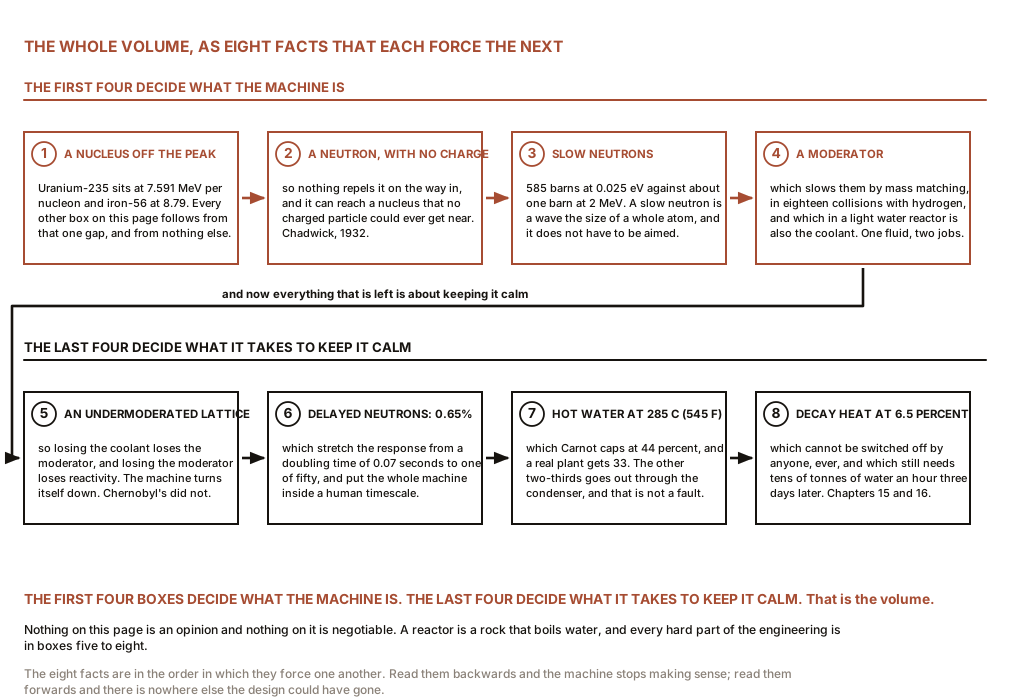
IN PLAIN ENGLISH: A reactor is a rock that boils water. The rock releases fifty million times more energy per event than burning anything does, which is why a lump the size of a pencil eraser replaces a wheelbarrow of coal. Everything difficult about the machine is in keeping the rock calm: making it release its energy steadily rather than all at once, getting the heat out of a material that conducts like a brick, and dealing with the fact that the rock stays warm for years after you stop asking it to. That is the whole subject, and the exotic part of it is much smaller than anyone expects.
SLOW DOWN. Check Your Understanding: You now know that a reactor stabilises itself without an operator, that decay heat cannot be switched off, that Chernobyl’s design flaw is absent from every Western reactor, and that Fukushima’s evacuation killed roughly a thousand times more people than its radiation. So: is nuclear power safe? Decide what you think before reading on.
This book has deliberately not answered that, and the reason is not cowardice.
“Safe” is not a property, it is a comparison, and a comparison requires the alternative. The question that can actually be answered is “safer than what, per unit of electricity, counting which harms, over what time horizon”. Answering it needs deaths per terawatt-hour for every generating technology including the mining and construction phases, an assumption about what would have been built instead, air quality modelling for the fossil counterfactual, and a treatment of harms that are not deaths.
None of that is physics, and this is a physics volume. What you have been given is the mechanism, which is the part that is settled and checkable, and the tools to evaluate the numbers when somebody offers them. What you have not been given is the comparison, because it depends on assumptions that a book about neutrons has no special authority over.
What you can now do, which is better than being handed a conclusion, is notice which kind of claim you are being offered. “A reactor’s void coefficient is negative” is a statement about a lattice and you can check the sign. “Nuclear power is safe” is a statement about a comparison, and the honest response is to ask for the denominator.
And one further thing worth saying. The strongest argument in either direction that this volume does support is narrower than either side’s usual claim. It is that the mechanism of every major accident was known to somebody before it happened, four times out of four. That is not an argument about physics at all. It is an argument about institutions, and it cuts against complacency and against fatalism in equal measure.
Section 4: What This Volume Did Not Cover
Named plainly, so you know the shape of your own remaining ignorance.
Fusion, beyond a mention. The left-hand side of Chapter 4’s curve got one paragraph. The Lasers volume’s Chapter 14 covers inertial confinement and the ignition results honestly, including the difference between target gain and wall-plug energy, and the Plasma volume’s Chapter 12 covers magnetic confinement. Neither is recommended as a prerequisite and both are recommended as a sequel.
Neutronics in earnest. Chapter 9’s six-factor formula is a teaching tool. Real design solves neutron transport in hundreds of energy groups over detailed geometry with Monte Carlo and deterministic codes, and that is a discipline of its own.
Small modular reactors in depth. They appear in Chapter 9 only as evidence that a small core can be critical. The claims made for their economics rest on factory production and learning curves that have not yet been demonstrated at scale, and this book had nothing checkable to add.
Naval propulsion. Highly enriched cores, decades between refuellings, extreme power density, and hafnium control rods. The physics is in this volume and the engineering is elsewhere and mostly classified.
Medical isotope production. Molybdenum-99 for technetium generators, and the supply crises caused by a handful of ageing research reactors. This is arguably the most directly life-saving application of the whole field and it is a subject of its own.
Thorium and molten salt. Chapter 10 named thorium-232 as fertile and left it there. The liquid-fuelled designs raise entirely different chemistry, corrosion and safeguards questions.
And the economics. Capital cost, cost of capital, construction schedules, grid integration, decommissioning liabilities and waste funding. These decide whether reactors get built and none of them is physics. A volume that pretended otherwise would have been dishonest about its own competence.
Section 5: The One to Do
If you do one thing from this volume, test your house for radon.
It costs fifteen dollars. It takes a week of doing nothing. Radon is the largest single component of the average person’s radiation dose, it is the second leading cause of lung cancer after smoking, it varies by more than a factor of a hundred between neighbouring houses, and the fix is a pipe and a fan.
Every other radiation risk in this book is somebody else’s to manage. That one is yours, it is measurable, and it is fixable.
And if you do a second thing, build the cloud chamber again and show it to somebody. It costs thirty dollars, most of which is dry ice, and there is nothing else in this series that lets a person watch the invisible for an hour and get bored of it. The particles were always there. The only thing you added was somewhere for them to leave a mark.
Bench Degree
Get the degree without the diploma.
Learn the material, not how to pass the exam.