Bench Degree·PLASMAchapter

Chapter 7: Corona, and Wind From Nothing
A sharp wire at high voltage blows a steady draught with no moving part. Turn the same device around, blow air past it, and electricity comes out. One electrode, one arrow, two machines.
Build the needle and ring from Chapter 1 again, and this time measure it.
Needle at one end, a metal ring or plate 40 mm (1.6 in) away, a few kilovolts between them, and a candle in the gap. Bring the voltage up until you hear the hiss and see the violet haze at the tip.
Now hang a small piece of tissue paper on a thread in front of the ring and watch it lift. Or put a sensitive kitchen scale under the whole assembly and watch the reading change by a fraction of a gram when you switch on.
That is thrust. It is small, it is real, and there is nothing moving.
ON THE BENCH: Measuring ionic wind
Parts: current-limited high-voltage supply, 5 to 20 kV; a sewing needle; a metal ring about 40 mm (1.6 in) across or a flat plate; a kitchen scale with 0.1 g (0.004 oz) resolution; tissue paper and thread; a candle; a milliammeter if your supply does not read current. Cost: about $40. Time: an hour. Hazards: high voltage, so Chapter 16’s rules in full. Ozone, which you will smell immediately and which is a genuine respiratory irritant, so work by an open window and do not run it for long in a closed room. And do not advance the voltage past the point of sparking: a spark makes no wind and does make a hazard. Method: mount needle and ring rigidly, needle pointing at the ring’s centre. Set the whole assembly on the scale and zero it. Raise the voltage until corona starts, then record scale reading and current together at several voltages. What you should see: a reading of a few tenths of a gram at a few hundred microamps. Also, and this is the informative part, the thrust tracks the current almost exactly and cares much less about the voltage. Section 3 explains why that is the whole story of these machines. If you get sparks instead of a hiss: blunt the needle very slightly, or open the gap. A spark means the avalanche has bridged and you have left the corona regime for good.
Section 1: Why a Sharp Point
Corona happens at points and edges and not at flat plates, and the reason is geometric rather than electrical.
The electric field at a surface depends on how tightly that surface curves. Put a given voltage on a sphere and the field at its surface is the voltage divided by its radius. Make the radius small and the field becomes enormous for the same voltage.
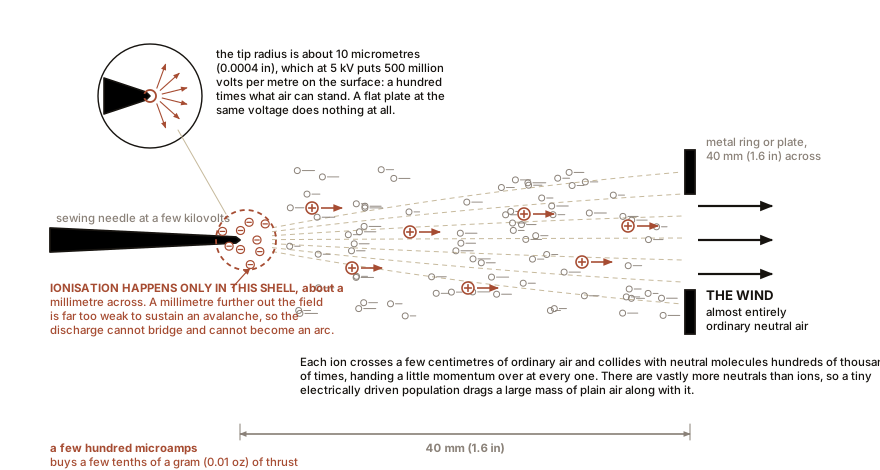
Run it for a sewing needle. The tip radius is perhaps 10 µm (0.0004 in). At 5 kV that gives a field at the tip of roughly 500 million volts per metre, which is a hundred times what it takes to break down air.
So the air immediately around the tip ionises, and the air a millimetre away does not. That is the entire trick. Ionisation is confined to a tiny shell around the point, because that is the only place the field is strong enough. Everywhere else in the gap the field is far too weak to sustain an avalanche, so the discharge cannot bridge and cannot become an arc.
IN PLAIN ENGLISH: A sharp point concentrates an electric field the way a needle concentrates a push. Corona is what you get when the field is savage in one tiny spot and mild everywhere else: violent chemistry in a volume smaller than a pinhead, surrounded by ordinary calm air.
This is also why Chapter 5’s Paschen curve does not predict corona. Paschen assumes a uniform field between parallel electrodes. A point is the opposite of uniform, which is why a pointed electrode will corona at a voltage far below the one Paschen says the gap needs, and why high-voltage engineers spend real effort rounding off every corner on a piece of equipment. A sharp edge left on a busbar is a permanent, quiet power loss and a source of radio interference.
Section 2: Where the Wind Comes From
Now the mechanism, and it has a detail in it that most explanations skip.
Inside the corona shell, new ions are created continuously. The field then pushes them away from the needle and toward the ring. On the way they travel a few centimetres through ordinary air at atmospheric pressure, and along the way each ion collides with neutral air molecules hundreds of thousands of times.
Every one of those collisions transfers a little momentum from the ion to a neutral molecule. The ions are pushed by the field; the neutrals are pushed by the ions.
And there are vastly more neutrals than ions. From Chapter 3, the ionised fraction here is minute. So the tiny number of ions being electrically driven end up dragging an enormous mass of ordinary air along with them, and the resulting flow is almost entirely neutral air.
That is the wind. It is not the ions arriving. It is the air the ions pushed on the way.
This is called electrohydrodynamic flow, or in older literature the Biefeld-Brown effect, and the name attached to it in every hobby forum is the lifter or ionocraft: a triangle of balsa, foil and thin wire that rises off a table on nothing.
Section 3: The Arithmetic, and the Bad News
The thrust from a corona thruster follows a relationship simple enough to be worth carrying:
thrust = current × gap / ion mobilityIon mobility for air ions is around 2 × 10⁻⁴ square metres per volt-second, and it is roughly a constant of nature for this purpose. So the thrust depends on the current you push and the distance you push it across, and remarkably it does not depend directly on the voltage at all.
Which means the thrust per watt gets better as the voltage gets lower, because power is voltage times current while thrust is only current. That produces the first surprise: electrohydrodynamic thrust per watt is respectable, comparable in the right conditions to a propeller.
And then the bad news, which is not about efficiency at all.
The thrust per unit of area is dreadful. The current a corona can pass through a given cross-section before it transitions to a spark is severely limited, and that ceiling is what bites. You can have good thrust per watt, but only in tiny amounts per square metre of device, so to get a useful total force you need an enormous area.
MIT flew the honest demonstration of this in 2018. A research group there built an aeroplane with no moving parts, propelled entirely by electrohydrodynamic thrust, and flew it indoors. It worked, repeatedly, and was published in Nature. It also had a 5 m (16 ft) wingspan to carry 2.45 kg (5.4 lb) a distance of about 60 m (200 ft) on 40 kV.
That is the shape of the whole technology in one aircraft. It flies. It is not going to carry you anywhere, and the limit is not cleverness, it is thrust per square metre.
Which is also why your desk fan has blades. A bladeless ionic fan is genuinely silent and has nothing to wear out, and it moves a small fraction of the air of a cheap propeller fan the same size. The trade is real and it is not close.
Section 4: Where Corona Genuinely Wins
None of which stops corona being an industrial workhorse, because there are jobs where moving air is not the point.
Electrostatic precipitators. This is the big one, and almost nobody has heard of it. Frederick Cottrell patented it in 1907. A corona discharge fills a duct with ions; those ions attach to dust and smoke particles passing through; the now-charged particles are pulled out of the gas stream onto collecting plates and periodically rapped off into hoppers. They remove better than 99% of particulate from the flue gas of coal-fired power stations, cement works and steel mills, and they have been doing it for over a century. The air over every industrial city in the world is measurably cleaner because of a corona discharge.
Photocopiers and laser printers. The charging of the drum, and in many designs the transfer of toner to paper, is done by a corona wire. If you have ever smelled that particular sharp smell from a busy copier, that was ozone from the corona wire, and it is why those machines have filters and ozone specifications.
Surface treatment. Corona treatment of plastic film immediately before printing, which is Chapter 4’s cold plasma chemistry doing what heat cannot.
Static control. Ionising bars over a moving web of plastic or paper, neutralising the static that would otherwise make it cling, jam or spark.
And the by-product you must respect
Corona in air makes ozone, unavoidably, because energetic electrons split oxygen molecules and the fragments recombine into O₃.
Ozone is useful in a water treatment plant and harmful in a room. It is a genuine respiratory irritant, occupational limits are set in the region of 0.1 ppm for an eight-hour day, and you can smell it well below the level that will do you harm, which is a useful piece of biology: if you can smell it, ventilate.
This is what killed the ionic air purifier. Those devices were sold in enormous numbers in the early 2000s on the promise of cleaning air with no filter and no noise. They did charge and drop some particulate. They also generated ozone in occupied rooms, which is a pollutant, and independent testing found they cleaned air poorly compared with a plain filter. A device sold as an air cleaner that adds a lung irritant to a bedroom is a bad device, however elegant the physics, and it is worth knowing that the physics being real is not the same as the product being good.
Section 5: The Same Machine, Backwards
Here is the part of the chapter worth the whole chapter.
Everything above puts electrical energy in at the needle and gets air movement out.
Run the arrow the other way. Put air movement in and take electrical energy out.
It works, and it is not a thought experiment. Set up a corona source that releases charge into a moving airstream, and arrange the geometry so the wind carries that charge against the electric field rather than with it. The wind is now doing work against the field, dragging charge uphill electrically, and that work appears as a rising electrical potential you can draw current from.
Delft University of Technology built one in 2013 and called it EWICON, the Electrostatic Wind Energy Converter. It has no rotor, no bearing, no gearbox and nothing that turns. It sprays charged water droplets into the wind and collects the potential.
Richard Epstein’s Solid-State Wind-Energy Transformer does the same without the water: 55 parallel aluminium wires strung between two 8.5 m (28 ft) masts, tufted so they corona, throwing ions into the passing wind.
Both are described in the Wind Power volume, Chapter 7, from the wind engineer’s side. From this side, they are this chapter’s device with the arrow reversed. Same electrode geometry, same corona physics, same ion mobility in the same equation. Voltage in, air out. Air in, voltage out.
Neither has reached a competitive cost per kilowatt-hour, and EWICON needed a water supply and would not run below freezing. But a wind machine with no bearing to fail and no blade to fatigue is worth understanding whether or not it ever pays, and understanding it costs you nothing once you have this chapter.
ON THE BENCH: A generator driven by a candle
This is the experiment to do if you only do one from this chapter, and it is not ours. Robert Murray-Smith built it and measured it: Flame-driven Electrostatic Hydrodynamic Generator, Thinking and Tinkering, video 1435, at
youtu.be/RqCuRdm3REE.A flame supplies the charge, for exactly the reason in Chapter 1: it is already a plasma, and it is already full of free ions. The rising hot gas supplies the motion. Arrange an electrode above the flame and the convection carries charge upward against the field, and a voltage appears across the terminals.
Watch him do it. Then build it and see whether you get his number.
What it ties together: Chapter 1 showed that a candle conducts. Chapter 3 showed that a pinch of salt raises its conductivity by orders of magnitude, so try it both ways. Chapter 4 explains why the gas can stay cool enough to work near. And this chapter says the machine runs backwards. One candle, four chapters, and a voltage you can read on a meter.
Section 6: What This Chapter Established
A sharp point concentrates a field enough to ionise air locally and nowhere else, which is why corona is stable and self-limiting where an arc is not.
Ions dragged through air by a field carry the neutral air with them, which is where the wind comes from, and the thrust follows current times gap over mobility.
Thrust per watt is decent and thrust per square metre is poor, which is the entire reason this technology cleans flue gas for a living instead of propelling aircraft.
And the machine is reversible. Which is the theme of this whole series, and this is the cleanest instance of it in nine volumes: the same electrode, the same physics, the same equation, one arrow.
Next: what happens when you stop trying to keep the discharge local and let it become an arc on purpose. Which is how steel is cut, welded and melted, and how a circuit breaker has to fight the very thing it created by trying to switch off.

Bench Degree
Get the degree without the diploma.
Learn the material, not how to pass the exam.