Bench Degree·PLASMAchapter
Chapter 6: The Discharge Zoo
Connect a gas discharge straight to a good power supply and one of them will die. Understanding why is the most useful practical fact in this book.
Go back to the jar, and this time set the pressure at a comfortable few Torr where it strikes easily. Then, instead of asking whether it lights, watch how it lights as you slowly raise the voltage.
You do not get one thing that gets brighter. You get a sequence of visibly different things, in a fixed order, and each one appears suddenly rather than gradually.
At the bottom, nothing visible at all, though a sensitive meter shows a current of picoamps. Raise the voltage and a faint glow appears at one electrode only, hugging it. Raise it further and the glow abruptly jumps out to fill the space between the electrodes, often with visible stripes across it. Raise it further still and the diffuse glow collapses without warning into a thin, brilliant, noisy thread.
Four regimes, and they have names: dark discharge, corona, glow, and arc. Everything in this book from a smoke detector to a steel mill is one of those four.
ON THE BENCH: Walking the zoo
Parts: the jar, the pump, the adjustable high-voltage supply, and a ballast resistor which Section 3 explains and which is not optional. Cost: nothing beyond Chapter 5. Time: an hour. Hazards: as Chapter 5, plus one new one. The transition from glow to arc is sudden and it is where equipment gets destroyed. Have the ballast resistor in circuit before you start. Method: set the pressure so the gap strikes at a voltage well within your supply’s range. Then raise the voltage in small steps from zero, pausing at each, and record what you see and what current flows. Photograph each regime in a dark room. Note the voltage and current at every transition. What you should see: the four regimes above, and this is the point of the exercise, the voltage does not rise steadily as the current does. Over one whole stretch it will fall while the current climbs. That is Section 3 and it is the thing worth the hour.
Section 1: The Four Regimes, and What Each Is For
Dark discharge. Currents from picoamps to microamps, no visible light. There are always a few free charges in any gas, produced by cosmic rays and by natural radioactivity, and a modest field simply sweeps those out to the electrodes. No multiplication, no avalanche, nothing self-sustaining. The gas is doing nothing but delivering the charges that were already there.
And it is not a curiosity. This is exactly the regime an ionisation smoke detector works in: a tiny sealed source of americium ionises the air in a small chamber, a low voltage collects the charges, and the resulting steady current is monitored. Smoke particles entering the chamber capture the ions, the current drops, and the alarm sounds. The whole device is a dark discharge with a smoke-operated switch. Chapter 3’s degree-of-ionisation table does not even reach this far down.
Corona. As the field near one electrode gets strong enough to start an avalanche there, a localised glow appears at that electrode and nowhere else. It hisses. It produces ozone. Crucially, it stays local: the rest of the gap is not participating, so the discharge does not bridge and no large current flows. This is the regime of the next chapter and it is enormously useful precisely because it is self-limiting.
Glow discharge. When the avalanche manages to bridge the whole gap, the character changes completely. Now the entire volume is ionised, the discharge fills the space, and the current jumps by orders of magnitude. The gas is cool, the electrons are hot, and the light is efficient. Every fluorescent tube and every neon sign on earth is a glow discharge, and so is the sputtering machine that coated the low-emissivity glass in a modern window.
Arc. If the current is allowed to keep climbing, the discharge collapses into a small, brilliant channel and the voltage across it falls to a few tens of volts. The mechanism at the cathode changes from ion bombardment to thermal emission: the cathode is now hot enough to boil electrons off by itself. Chapter 4’s table applies, and both temperatures are now enormous. Welding, cutting, arc furnaces and lightning.
Section 2: Inside a Glow Discharge, Which Has Structure
The stripes are worth explaining, because they are visible evidence of something the eye should not be able to see.
Look closely at a glow discharge in a long tube at low pressure and it is not uniform. Working from the cathode outward there is a thin dark layer, then a bright negative glow, then another dark space, then a long uniform positive column which is most of the length of a fluorescent tube, and finally a small glow at the anode.
Each region is a different stage in one process. Electrons leave the cathode with almost no energy, so they cannot excite anything and the gas near the cathode stays dark. They are accelerated across the cathode fall, which is where nearly all the voltage in the whole discharge is dropped, and arrive in the negative glow with enough energy to excite atoms violently, which is why it is bright. Having spent their energy they go dark again in the Faraday space, then settle into the long positive column where a gentle field keeps them topped up in a steady balance.
The positive column is the part that does the work in a lamp, and the useful thing about it is that it is essentially indifferent to length. Make the tube twice as long and you get twice as much light for very nearly the same current, which is precisely why fluorescent tubes are long thin cylinders and not compact blobs.
Sometimes the positive column breaks into regularly spaced bright bands called striations, and they are a standing wave: electrons accelerate, excite, lose their energy, accelerate again, in a repeating cycle with a fixed length. You are looking directly at the mean free path of an electron. Lower the pressure and the stripes get wider, because the electron travels further between collisions, and you can measure that with a ruler through the glass.
SLOW DOWN. Check Your Understanding: Almost all the voltage in a glow discharge is dropped across the very thin cathode fall, close to the cathode, rather than being spread evenly along the tube. Why must that be, and what does it tell you about where a tube wears out? Think before reading on.
It must be because the discharge has to keep itself supplied with electrons, and the only way to get new ones out of a cold cathode is to slam positive ions into it hard enough to knock them loose. That requires a large potential drop in a short distance immediately in front of the cathode. And it tells you exactly where the tube dies: at the ends. Continual ion bombardment sputters the electrode coating away, which is why an old fluorescent tube goes black at its ends and eventually will not strike. The middle of the tube is barely stressed at all.
Section 3: The Fact That Saves Your Equipment
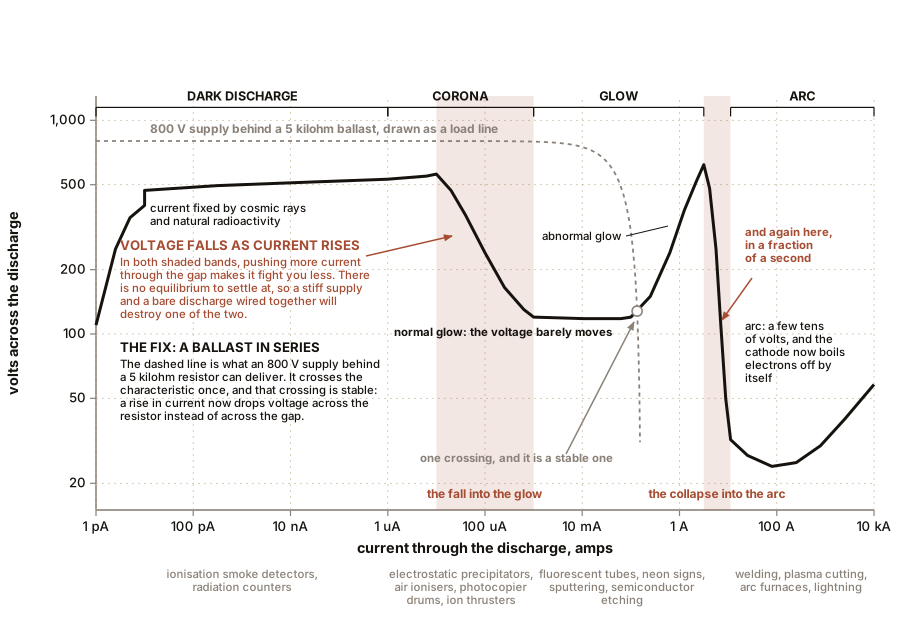
Look again at the curve in the diagram, and specifically at the two places where it falls.
Over the normal glow region, and again on the way into the arc, the voltage across the discharge decreases as the current through it increases.
That is backwards from everything else in electronics. A resistor drops more voltage when you push more current through it, which is what makes circuits stable: push harder, meet more opposition, settle down. A discharge in these regions does the opposite. Push more current and it fights you less.
This is called negative differential resistance, and it has one enormous practical consequence:
A gas discharge connected directly to a stiff voltage source is unstable, and one of the two will be destroyed.
Follow it round. A small increase in current lowers the discharge’s voltage. The supply, being stiff, holds its output up. The extra voltage now appears across the discharge as excess drive, which increases the current further, which lowers the voltage further. There is no equilibrium to settle at. The current climbs until something stops it: the discharge collapses into an arc, or the supply’s output devices fail, or a wire opens.
IN PLAIN ENGLISH: A gas discharge is not a resistor. It is closer to an appetite. Give it a fixed voltage and it will draw more and more current until something burns. It must be fed through something that limits current.
The fix is called a ballast, and every gas discharge device ever manufactured contains one.
A resistor is the simplest. Crude, wasteful of power, entirely reliable. Right answer on a bench.
An inductor was the traditional answer for mains-frequency lamps. That heavy iron-cored choke in an old fluorescent fitting is doing exactly this job, and it does it without wasting much power because its opposition to current is reactive rather than resistive. It is also why old fittings hum and weigh what they weigh.
An electronic current-limited supply is the modern answer, and it is what the ballast in a compact fluorescent or the power supply in an arc welder is: a circuit whose output current is set and whose output voltage is allowed to go wherever the load demands.
Which explains the arc welder. An arc welding supply is deliberately built as a current source rather than a voltage source, so the welder can vary the arc length by hand, which changes the arc’s voltage, without the current running away. Chapter 8 is about what that arc then does to steel.
And this is the single practical warning in this volume that will cost you money if you ignore it. Put the resistor in before you turn anything on. A few kilohms and a few watts is enough for the jar experiments, and a supply killed in the glow-to-arc transition is killed in a fraction of a second, with no warning and no chance to reach for the knob.
Section 4: One Curve, Four Industries
The value of the diagram at the top is that it puts things on one axis that are normally taught as unrelated subjects.
| Regime | Current | What it is used for |
|---|---|---|
| Dark | picoamps to microamps | ionisation smoke detectors, radiation counters |
| Corona | microamps to milliamps | electrostatic precipitators, air ionisers, ion thrusters, photocopiers |
| Glow | milliamps to amps | fluorescent tubes, neon signs, sputtering, semiconductor etching |
| Arc | amps to kiloamps | welding, plasma cutting, arc furnaces, lightning |
Nine orders of magnitude of current, one mechanism, four industries, and the transitions between them are abrupt enough that a device sits firmly in one regime rather than drifting between them.
Next: the corona regime alone, which is the one that produces wind, cleans the exhaust of coal-fired power stations, flies an aeroplane with no propeller, and, run in reverse, generates electricity from a flame.
Bench Degree
Get the degree without the diploma.
Learn the material, not how to pass the exam.