Bench Degree·PLASMAchapter

Chapter 5: Paschen’s Law
Pump the air out of a jar with a spark gap in it and the spark gets easier. Keep pumping and it gets harder again, then stops entirely. There is a bottom to that curve, and finding it yourself is the best afternoon in this book.
Set up the jar. Two electrodes inside with a fixed gap of about 5 mm (0.2 in), a high-voltage supply outside, a hand vacuum pump on the fitting, and a gauge.
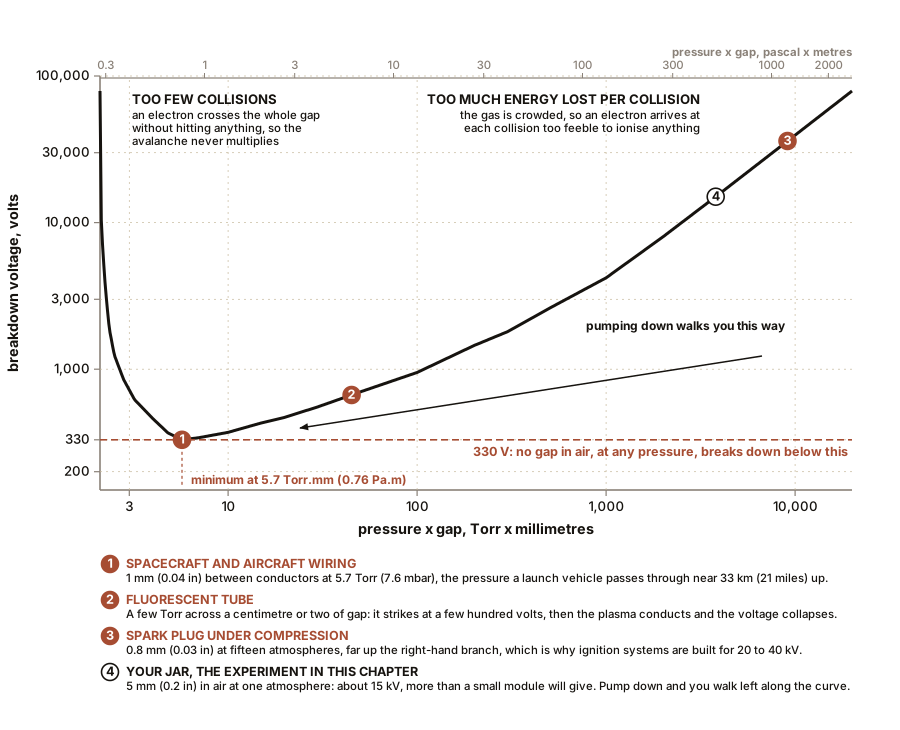
At atmospheric pressure, wind the voltage up. Nothing happens for a long time. A 5 mm (0.2 in) gap in ordinary air needs somewhere around 15 kV to break down, which is more than a small module will give you, so most likely nothing happens at all.
Now pump. Watch as the pressure falls.
At some point the gap lights up, and it lights up at a voltage far below the one that did nothing a minute ago. Keep pumping and it burns more easily still, brighter and more diffuse, filling the space rather than jumping in a thin line.
Keep pumping. Somewhere along the way, it starts getting harder again. The glow dims. Push the pump further and it goes out, and no amount of voltage your supply can produce will bring it back.
You have just walked across the whole of this chapter, and if you recorded the striking voltage against pressure as you went, you have measured one of the most useful curves in engineering.
ON THE BENCH: Finding the Paschen minimum
Parts: the vacuum-rated jar and hand pump from The Bench, which are the same brake-bleeder pump and chamber used in Refrigeration. Two electrodes through the lid, blunt-ended, 5 mm (0.2 in) apart. A current-limited high-voltage supply with an adjustable output and some way of reading its output voltage. Graph paper. Cost: about $70 if you already own the pump. Time: an afternoon, and it is worth the afternoon. Hazards: high voltage, so Chapter 16’s rules apply in full: one hand, current-limited supply only, discharge everything before touching it. Also the jar must be vacuum rated. A decorative jar can implode, and it will do so as a shower of glass. Method: at each of a dozen pressures from atmospheric down to the lowest your pump reaches, raise the voltage slowly until the gap strikes and record the voltage at which it does. Then let it up slightly and go to the next pressure. Plot striking voltage against pressure. What you should see: a curve that falls steeply, bottoms out, and rises again. The bottom is the point of the exercise. Better, if you can: repeat the whole thing with the gap set to 10 mm (0.4 in) instead of 5 mm, and plot both curves against pressure multiplied by gap rather than against pressure. The two curves will land on top of each other, which is the actual discovery and Section 2 is about why.
On getting the voltage in the first place. If you do not want to buy a supply, Robert Murray-Smith surveyed the cheap and improvised options in Old And New Sources For High Voltage (
youtu.be/Y0pFlYMFFx0), and built a working Wimshurst machine from conductive ink and disks over a four-part series beginning atyoutu.be/VeGDYLPBcIE. A Wimshurst gives tens of kilovolts at negligible current, which is the safest combination there is for this experiment, and it needs no mains connection at all.
Section 1: Why Both Ends Are Hard
Breakdown is an avalanche, and an avalanche needs two things at once. Deny it either and it will not start.
Picture one electron, somewhere in the gap, being accelerated by the field toward the positive electrode.
For the avalanche to begin, that electron must hit an atom hard enough to ionise it. From Chapter 3, hard enough means it must arrive carrying more than the atom’s ionisation energy, which for air is around 15 eV. It gains that energy from the field over the distance it travels between collisions.
And for the avalanche to grow, that must happen many times over. One ionisation gives you two electrons. Those two must each do it again to make four, and so on, enough times to fill the gap with charge.
Now look at what pressure does to those two requirements, because it does opposite things to them.
High pressure crowds the gas. An electron travels only a very short distance before hitting something, so it has almost no room to pick up energy. It arrives at each collision too feeble to ionise, bounces harmlessly, and starts again from nothing. Plenty of collisions, none of them useful. To fix it you must raise the field until even that short flight is enough, which means a high voltage.
Low pressure empties the gas. Now an electron accelerates freely and arrives with enormous energy, far more than enough. But there is almost nothing to hit. It crosses the entire gap and slams into the far electrode without having ionised anything at all. Enormous energy, no targets. The avalanche never multiplies. To fix that you must raise the voltage until the few collisions that do occur each produce a large enough cascade, and eventually no voltage will do it.
In between there is a pressure at which an electron gains just enough energy between collisions and still has enough collisions to multiply. That is the easiest possible condition for breakdown, and that is the minimum of the curve.
IN PLAIN ENGLISH: Breaking down a gas needs electrons that hit hard and hit often. Squeeze the gas and they hit often but softly. Thin it out and they hit hard but rarely. There is a pressure in the middle where both conditions are met, and that is where a spark is cheapest.
Section 2: What Friedrich Paschen Actually Found
Paschen published this in 1889, and the discovery was not the shape of the curve. It was what the curve depends on.
The breakdown voltage does not depend on pressure and gap separately. It depends on the two multiplied together.
Halve the pressure and double the gap and the breakdown voltage is unchanged. That is why the experiment above asks you to plot against pressure times gap: two different gaps give two different-looking curves against pressure, and one single curve against the product.
The reason is visible in Section 1. What actually matters to an electron is how many collisions it makes on its way across, and how much energy it gains between them. Both of those are set by the product of density and distance, not by either alone. Twice as far through half as much gas is the same journey.
For air, the bottom of the curve sits at:
about 330 V, at a pressure times gap of about 5.7 Torr·mm (0.76 Pa·m)And that constant is worth having in your head, because it is a floor. No gap in air, at any pressure, breaks down below roughly 330 V. If you are working under 300 V in air you are not going to get a spark across a gap, whatever you do to the geometry.
Section 3: Five Things This Explains
The value of this curve is that it explains a set of facts that otherwise look unrelated and arbitrary.
A hard vacuum is an outstanding insulator. Far out on the left branch there is nothing to ionise, so there is no avalanche and no breakdown. This is not a theoretical nicety: high-voltage circuit breakers in substations are built as vacuum interrupters for exactly this reason, pulling their contacts apart inside an evacuated bottle so that the arc has nothing to sustain it and dies. Chapter 8 returns to it.
A soft vacuum is a menace, and this one kills hardware. Near the minimum, a few hundred volts will jump gaps that would hold kilovolts at sea level. Aircraft and spacecraft wiring passes through exactly that pressure range on the way up. Equipment that is perfectly safe on the bench arcs at altitude, and the standards that govern aerospace wiring separation exist because of this curve. A satellite’s high-voltage systems must survive the trip through the Paschen minimum during launch, and more than one has not.
A spark plug needs tens of kilovolts for a gap you could jump with a few hundred volts on the bench. A plug gap is around 0.8 mm (0.03 in). On a workbench at atmospheric pressure that needs a few kilovolts. But it fires at the top of the compression stroke, where the pressure in the cylinder is fifteen or twenty times atmospheric, which pushes the plug far up the right-hand branch. Hence 20 to 40 kV ignition systems for a gap under a millimetre. It also explains why a plug that fires happily out of the engine can misfire under load: raise the boost and you have moved further right along the curve.
A fluorescent tube needs a kick to start and then runs on much less. Cold, the tube is a long gap at low pressure and needs a high voltage to strike. Once struck, the plasma itself is conducting and the voltage collapses. This is why the old tubes flickered and clicked while a starter built up a pulse, and why they then settled down and ran quietly.
Micro-gaps behave strangely. Push the gap small enough at atmospheric pressure and you come back down the left branch: below about 7.5 µm (0.0003 in) in air, the breakdown voltage starts rising again as the gap gets smaller. Anyone designing very fine-pitch connectors or microelectromechanical devices meets this, and it surprises them.
SLOW DOWN. Check Your Understanding: You have a piece of high-voltage equipment that works reliably at sea level and fails by arcing when taken up a mountain to 3,000 m (10,000 ft). A colleague suggests sealing the enclosure to keep the mountain air out. Will that work, and what is the trap? Think before reading on.
Sealing it will work, and it works well, provided the enclosure was sealed at sea-level pressure and stays sealed. That is the standard fix and it is why aerospace boxes are often pressurised. The trap is a slow leak. A box that leaks down over months does not fail at the new low pressure; it fails on the way there, when it passes through the minimum, and it may pass through the minimum months after installation with nobody connecting the failure to the altitude. The dangerous condition is not low pressure. It is the pressure on the way to low.
Section 4: What the Curve Does Not Cover
Two honest limits, because a law applied outside its range is worse than no law.
Paschen’s law describes breakdown between parallel, reasonably smooth electrodes in a uniform field. A sharp point does not produce a uniform field: the field at the tip is enormously higher than the average across the gap, so ionisation starts there at a much lower applied voltage and stays local. That is corona, it is Chapter 7’s subject, and it is not what this curve predicts.
And the surfaces matter more than the theory admits. The material of the cathode, its cleanliness, and whether it has been arced across before all shift the numbers, sometimes by tens of percent, because the avalanche needs a supply of starting electrons and the cathode is where they come from. Your measured minimum will probably not be exactly 330 V, and that is not an error in your experiment. Record what you get and note the electrode material, which is what the original experimenters did.
Section 5: The Handle This Gives You
One product, pressure times gap, and one curve with a bottom in it, and you can now predict where a discharge will be easy and where it will be impossible. That covers everything from a spark plug to a vacuum interrupter to a satellite.
But the experiment showed something the curve does not describe. As you pumped down, the discharge did not merely get easier. It changed character, from a thin bright thread jumping the gap to a broad soft glow filling the whole jar, sometimes with visible stripes in it.
Those are different regimes of discharge, they come in a definite order, and each is good for something different. That is next, and it includes the single most important practical fact in this volume: a discharge, left to itself, will destroy either itself or your power supply, and knowing why is what keeps your equipment alive.

Bench Degree
Get the degree without the diploma.
Learn the material, not how to pass the exam.