Bench Degree·PLASMAchapter

Chapter 4: Two Temperatures
The tube above your desk contains electrons hotter than the surface of the sun, and you can unscrew it with bare hands. Both of those are true, and the reason is the most useful idea in the subject.
Find a working fluorescent tube or a compact fluorescent lamp that has been on for an hour. Touch the glass.
It is warm. Perhaps 40 to 50 °C (104 to 122 °F) near the ends where the electrodes are, cooler in the middle. Warm enough to notice, nothing like hot enough to hurt you. You can unscrew it and carry it across the room.
Chapter 3 ended with the claim that the electrons inside that tube are at about 11,600 K, which is roughly twice the temperature of the sun’s surface.
Both of those are measured facts. Neither is an approximation or a figure of speech. The tube genuinely contains electrons at solar temperatures and is genuinely cool to the touch, and until that stops sounding like a contradiction, nothing else in this subject will sit properly.
ON THE BENCH: Two thermometers on one lamp
Parts: a fluorescent tube or CFL in a fixture; an infrared thermometer; a compass or a strong magnet; a small AM radio. Cost: nothing beyond the infrared thermometer already bought for other volumes. Time: 15 minutes. Method: run the lamp for an hour. Read the glass temperature at the middle and near each end with the infrared thermometer. Then hold an AM radio, tuned between stations, close to the tube. What you should see: glass in the region of 35 to 55 °C (95 to 131 °F), varying along its length. And a loud buzz from the radio, which is the discharge inside radiating at radio frequencies because the electrons in it are being violently shaken a hundred and twenty times a second. What it proves: the container is at kitchen temperatures while something inside it is energetic enough to broadcast. One object, two temperatures, and an ordinary radio can hear the hot one.
Section 1: Temperature Is Not One Number Here
Start with what temperature means, because the everyday meaning quietly assumes something that is false inside a plasma.
Temperature is a measure of the average random kinetic energy of the particles in a substance. Hot means the particles are jiggling fast. Cold means they are jiggling slowly. That is all it is.
Now, in ordinary matter, everything jiggles at the same average energy, and there is a reason. The particles collide constantly, and every collision shares energy out. A fast one hitting a slow one gives some away. Left alone for even a moment, everything arrives at a common average. That state is called thermal equilibrium, and it is so universal in everyday experience that we do not notice we are assuming it. It is why one thermometer in a cup of tea tells you about the whole cup.
A plasma contains two populations that are radically different from each other: light, fast electrons, and heavy, slow ions and neutral atoms. And in many plasmas, those two populations never come to a common temperature, because the sharing mechanism barely works.
Section 2: Why the Sharing Fails
This is the mechanical heart of the chapter, and it is a billiards problem.
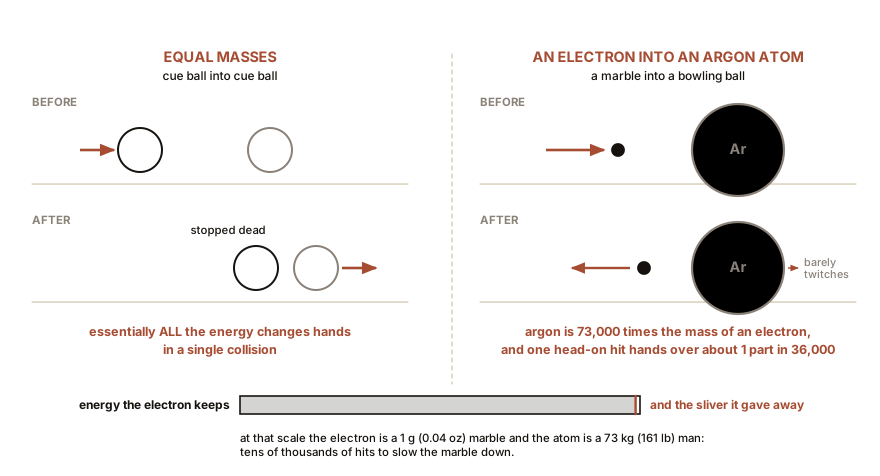
Roll a cue ball at another cue ball, dead on. The moving one stops and the struck one moves off with essentially all the energy. Equal masses transfer energy beautifully.
Now roll a marble at a bowling ball. The marble bounces straight back at almost its original speed, and the bowling ball barely twitches. Almost no energy changed hands, because the masses are wildly mismatched.
An electron hitting an argon atom is the marble and the bowling ball, and the mismatch is much worse than that comparison suggests. An argon atom is about 73,000 times the mass of an electron.
The fraction of energy an electron can hand over in one head-on elastic collision works out at roughly twice the mass ratio, which for argon is about 1 part in 36,000.
Sit with that number. An electron must collide with argon atoms tens of thousands of times to give up its energy to the gas. One collision achieves essentially nothing.
IN PLAIN ENGLISH: An electron bouncing off a gas atom is a fly hitting a truck. The fly changes direction, the truck does not change speed. So electrons can be violently energetic while the gas they are flying through stays cool, because they have almost no way of handing their energy over.
Section 3: The Field Keeps Paying
There is a second half, and without it the first half would not matter.
Between collisions, the electric field driving the discharge is accelerating the electron. It gains energy on every free flight. Then it collides, changes direction, loses almost nothing, and gets accelerated again.
So the electron is being paid continuously and can barely spend. Its energy climbs until something else limits it, and what limits it is not elastic collisions but the occasional collision energetic enough to excite or ionise an atom, which does take a real bite. Those are the collisions that produce the light and sustain the plasma, and they are how the electron population finally dumps its energy: not into gas motion, but into light and into new ionisation.
Which is why a fluorescent tube is efficient. The electricity goes into hot electrons, the hot electrons go into ultraviolet light, and the ultraviolet goes into the phosphor coating and comes out visible. Heating the gas is a loss, and the physics of Section 2 keeps that loss small almost for free. Chapter 9 finishes this argument.
Section 4: The One Knob That Decides Everything
Now the payoff, and it is a single control.
How far apart the two temperatures end up depends on how often the electrons collide, which is set by pressure.
Low pressure: few collisions. An electron flies a long way between hits, picks up a great deal of energy from the field on each flight, and hands almost none of it to the gas. Result: electrons very hot, gas near room temperature. The two temperatures are far apart. This is called a non-thermal or cold plasma, and the word cold refers to the gas, which is the part you can touch.
High pressure: many collisions. An electron flies a tiny distance between hits, so it cannot accumulate much energy, and it hits so often that even a transfer of 1 part in 36,000 adds up. Result: everything converges on a common temperature, which is high. This is a thermal or equilibrium plasma.
That single sentence organises the entire field:
| Plasma | Pressure | Electron temp | Gas temp | Which kind |
|---|---|---|---|---|
| Fluorescent tube | about 1/300 atm | 11,600 K (1 eV) | 320 K, 47 °C (117 °F) | non-thermal |
| Neon sign | about 1/100 atm | 23,000 K (2 eV) | 350 K, 77 °C (171 °F) | non-thermal |
| Corona at a needle tip | 1 atm, but tiny region | around 23,000 K | near ambient | non-thermal |
| Welding arc | 1 atm | 12,000 K | 12,000 K | thermal |
| Plasma cutter | 1 atm | 20,000 K | 20,000 K | thermal |
| Lightning | 1 atm | 30,000 K | 30,000 K | thermal |
Read down the gas temperature column and the whole subject sorts itself. The devices you can hold are in the top half. The devices that cut steel are in the bottom half. Same physics, one knob.
SLOW DOWN. Check Your Understanding: A corona discharge at a needle tip is at full atmospheric pressure, yet the table lists it as non-thermal with a gas temperature near ambient. That seems to break the rule. Why does it not? Think about where the corona actually is before reading on.
Because the region that is ionised is extremely small. The field is only strong enough to accelerate electrons usefully within a fraction of a millimetre of the tip, so the hot electrons exist in a tiny volume surrounded by an enormous reservoir of cool air that carries heat away as fast as it arrives. The rule is about collisions per electron, and it holds. What saves the corona is that the heated volume is negligible compared with what it can dump heat into. This is exactly why a corona-based device can sit on a desk and a welding arc cannot, despite both being at one atmosphere.
Section 5: What Non-Thermal Plasma Is Good For
Here is where the chapter stops being an explanation and becomes an industry.
If you can produce a plasma whose electrons are at 20,000 K while its gas stays at 40 °C (104 °F), then you have a source of extremely energetic chemistry that will not burn what you point it at.
That is a strange and valuable combination, and the applications are not obscure:
Sterilising things that cannot be autoclaved. Cold plasma kills bacteria and viruses by chemistry rather than by heat, so it can be used on plastics, electronics, and heat-sensitive medical instruments that steam would destroy.
Treating living tissue. There is a genuine and growing clinical field here, in wound care and dentistry, for the same reason: the reactive species do the work and the tissue is never heated past comfort.
Surface preparation. A few seconds of cold plasma on a plastic surface changes its chemistry enough that paint, glue and ink will stick to it where before they beaded up and fell off. Most printed plastic packaging has been through this.
Making every integrated circuit in your house. Chapter 10 is about this, and it is the largest application by economic value on earth. Silicon wafers cannot be heated to arc temperatures without destroying the devices being built on them, so the etching is done by a plasma whose gas stays cool while its ions and radicals do violent chemistry. The whole semiconductor industry rests on the mass ratio in Section 2.
Ozone generation and air treatment. Which is also a caution rather than only an application, and Chapter 7 gives the other side of it.
IN PLAIN ENGLISH: Cold plasma lets you do fierce chemistry to something without cooking it. That is why it is used on wounds, on food packaging, on aircraft composites and on silicon wafers, and it is available only because an electron cannot warm up a gas efficiently.
Section 6: A Precision, So You Can Read the Literature
Two small points that will otherwise trip you up.
Electron temperature describes a spread, not a single speed. When a source says the electron temperature is 2 eV, it means the electrons have a distribution of energies whose characteristic scale is 2 eV. Some are much slower and, importantly, some are much faster. Those rare fast ones do most of the ionising, which is why a discharge can sustain itself on 2 eV electrons in a gas that costs 15.8 eV to ionise. The average electron cannot do it. The tail of the distribution can.
And the average energy is not the same number as the temperature. For the usual distribution, average energy is one and a half times the temperature expressed in the same units. So 2 eV of temperature means about 3 eV of average energy. Papers are usually careful about which they quote and popular accounts usually are not, and a factor of one and a half will not change any conclusion in this book, but knowing the difference exists will stop you thinking two sources disagree when they do not.
Section 7: What You Now Have
Chapter 2 said what a plasma is: a material whose charged particles are numerous and free enough to behave as a crowd.
This chapter says the thing that makes the subject usable: that crowd can be at a completely different temperature from the gas it lives in, and the pressure decides how different.
Between them, those two ideas dissolve most of the confusion that surrounds this topic. A fluorescent tube and a welding arc are no longer two unrelated phenomena that both happen to glow. They are the same mechanism at two pressures, and you can predict which one you get.
And you can now answer the question that got us here. The electrons in the tube are at solar temperatures because nothing lets them share that energy with the glass. The glass is warm because the small amount that does leak through has to go somewhere. Both facts, one mechanism.
Next: the most counterintuitive result in the subject, and the one with the most immediate practical consequences. A hard vacuum is an excellent insulator. A soft vacuum is the easiest thing in the world to arc across. There is a curve behind that, it has a minimum, and you can measure it on your own bench with the jar and the pump.

Bench Degree
Get the degree without the diploma.
Learn the material, not how to pass the exam.