Bench Degree·PLASMAchapter

Chapter 3: How Little Ionisation It Takes
Throw a pinch of table salt into a candle flame and the current through it jumps by a factor of a hundred. You have just done what engineers do to a megawatt generator.
Do this one before reading further, because it is thirty seconds of work and it settles the chapter.
Set up the flame and the two wires from Chapter 1 again, with the meter reading the small current through the flame. Note the number. Then wet a fingertip, dip it in table salt, and flick a few grains into the base of the flame.
The flame goes bright yellow, and the current jumps. Not by a few percent. On a candle flame with a 10 mm (0.4 in) gap you will commonly see it go up by a factor of ten to a hundred, and it stays up for as long as the salt lasts.
Nothing got hotter. The flame is the same temperature it was; a few grains of salt cannot change that. What changed is how easily the atoms in the flame give up an electron, because you introduced an element that gives one up far more readily than anything that was there before.
ON THE BENCH: Salting a flame
Parts: everything from Chapter 1’s flame experiment, plus table salt. Cost: nothing. Time: 5 minutes. Hazards: the same open flame. Salt spits slightly. Method: establish and record the baseline current through the clean flame. Introduce a few grains of salt at the base of the flame, not into the wire gap. Record again. Repeat with a pinch of salt substitute, which is potassium chloride, if you have it. What you should see: a large, obvious, repeatable jump in current, accompanied by the bright yellow colour. Potassium chloride gives a similar jump with a paler lilac tint that is hard to see against the yellow of the flame itself. What it proves: the conductivity of a plasma is not set by its temperature alone. It is set by how much of it is ionised, and different substances ionise at wildly different costs.
Section 1: The Scale, Which Is Not What You Would Guess
The fraction of atoms that have lost an electron is called the degree of ionisation, and this table is the reason the chapter exists.
| Plasma | Roughly what fraction is ionised |
|---|---|
| Candle flame | 1 in 10,000,000,000 |
| Candle flame with salt in it | 1 in 100,000,000 |
| Fluorescent tube | 1 in 100,000 |
| Neon sign | 1 in 100,000 |
| Welding arc | 1 in 100 |
| Plasma cutter jet | 1 in 10 |
| Lightning channel | most of it |
| Fusion plasma | all of it |
Every single entry above the last three is overwhelmingly neutral gas. A fluorescent tube, which conducts current continuously, produces useful light, and is unquestionably a plasma by all three of Chapter 2’s criteria, is 99.999% ordinary un-ionised argon and mercury vapour.
That is the fact to internalise, and it is worth asking why it works.
Because the neutral atoms are not what carries the current. They are ballast. They sit there being pushed around by collisions and contributing nothing electrically, and they are irrelevant to the question of whether the material conducts. Only the charged particles respond to the field, and there are still an enormous number of those in absolute terms.
Run the arithmetic on the fluorescent tube. At one part in a hundred thousand, at the pressure inside such a tube, that is around 10¹⁷ electrons in every cubic metre. A cubic millimetre of it contains a hundred million free electrons.
IN PLAIN ENGLISH: A tiny fraction of an enormous number is still an enormous number. That is the whole reason a gas that is 99.999% neutral behaves electrically as a plasma rather than as an insulator.
Section 2: What It Costs to Take an Electron
Every atom holds its outermost electron with a particular tightness, and the energy needed to pull it away is that atom’s ionisation energy. It is quoted in electron volts, and Section 4 explains that unit properly. For now treat it as a price.
| Substance | Price of the first electron |
|---|---|
| Caesium | 3.9 eV |
| Potassium | 4.3 eV |
| Sodium | 5.1 eV |
| Xenon | 12.1 eV |
| Oxygen molecule | 12.1 eV |
| Hydrogen | 13.6 eV |
| Krypton | 14.0 eV |
| Nitrogen molecule | 15.6 eV |
| Argon | 15.8 eV |
| Neon | 21.6 eV |
| Helium | 24.6 eV |
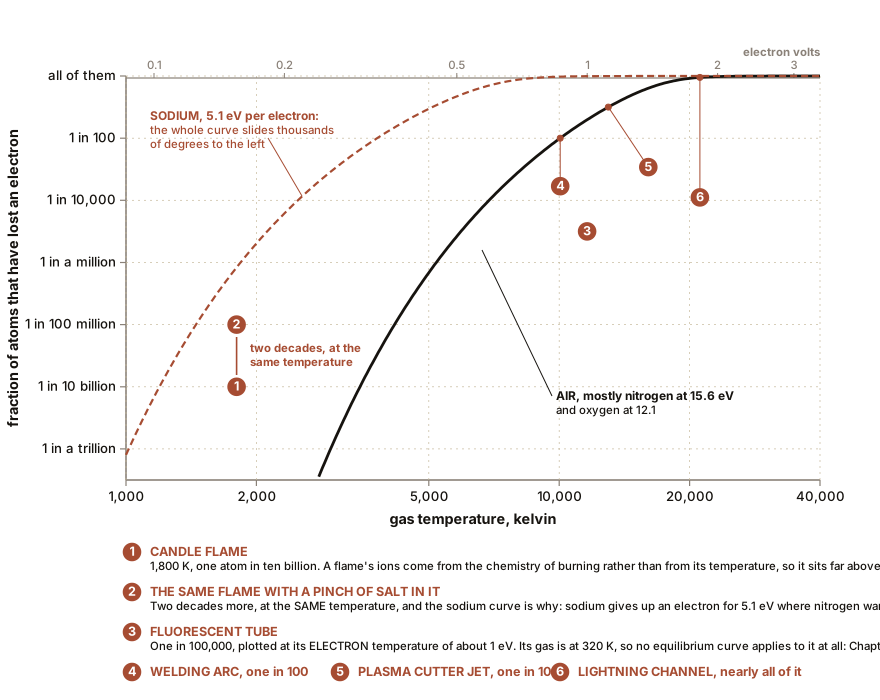
Now the salt experiment explains itself. Air is mostly nitrogen at 15.6 eV and oxygen at 12.1 eV. Sodium costs 5.1 eV, roughly a third as much. At the same flame temperature, a third of the price buys a vastly larger population, for the reason in the next section, and the current goes up accordingly.
Three practical consequences follow directly from that table, and each one is something a reader will meet.
Argon is the workshop gas. It sits at 15.8 eV, which is high enough to be hard to break down accidentally and low enough to strike reliably with an ordinary welding supply. It is chemically inert, so it will not react with hot metal. It is heavier than air, so it settles over a weld pool and stays there instead of drifting off. And it is cheap, because it is 0.93% of the atmosphere and comes out of the same air separation plants that make oxygen and nitrogen. Chapter 8 is where that matters.
Helium is the awkward one. At 24.6 eV it is the hardest common gas to ionise, which is why helium welding needs a higher arc voltage than argon for the same job, and why helium-shielded work runs hotter. It is used anyway when that extra heat is wanted.
Caesium and sodium are what you add on purpose. Introduce a trace of an element that ionises cheaply and you raise the conductivity of the whole plasma without raising its temperature. This is called seeding, and it is not a laboratory curiosity: magnetohydrodynamic generators, which extract electricity from a flowing hot gas directly, are seeded with potassium or caesium for exactly this reason, at exactly the scale of a power station. You did it with a pinch of salt and a candle.
Section 3: Why the Fraction Climbs So Steeply
Ionisation is a competition, and it is worth seeing it as one.
Heat knocks electrons off. In any hot gas, particles are flying about with a spread of energies. Most are near the average, but a few are far above it, and it is those rare energetic ones that manage to hit an atom hard enough to knock an electron loose. The hotter the gas, the more of those rare hard hits there are.
Meanwhile, recombination puts them back. A wandering electron that meets a positive ion is attracted to it, and the two can combine into a neutral atom again. That happens more often when the gas is dense, because the two are more likely to find each other.
The balance between the two is described by a result called the Saha equation, and the algebra of it is not needed here. What matters is the shape of the answer:
The ionised fraction rises steeply with temperature and falls with density, and the rise is not gentle. It is exponential in the ratio of the ionisation energy to the temperature.
That word exponential is doing real work. It means that a modest temperature rise can move the ionised fraction by orders of magnitude, and it means the transition from insulator to conductor is abrupt rather than gradual.
Which explains something a reader may already have noticed and found alarming.
An arc, once struck, tends to run away. Current heats the gas. The hotter gas ionises further. Better ionisation means lower resistance. Lower resistance means more current for the same voltage, which means more heating. Round it goes, and it goes fast. That positive feedback is why an arc is not a gentle thing that you can dial up and down, why an arc welder needs a power supply designed to limit current rather than voltage, and why interrupting a large current in a circuit breaker is the difficult engineering problem that Chapter 8 says it is.
SLOW DOWN. Check Your Understanding: The Saha result says the ionised fraction falls as density rises. But the table in Section 1 shows a lightning channel, which is at roughly atmospheric density, as almost fully ionised, while a fluorescent tube at a small fraction of atmospheric pressure is only one part in a hundred thousand. Are these in contradiction? Think before reading on.
No, because temperature is doing the heavy lifting and it enters exponentially. A lightning channel runs at something like 30,000 K, while a fluorescent tube’s gas sits near room temperature and only its electrons are hot. Density is pushing the lightning channel toward less ionisation, and losing badly, because the temperature term is enormous. When one factor is exponential and another is not, the exponential one usually wins. That is worth remembering well beyond this subject.
Section 4: The Electron Volt, and Why Everyone Uses It
The table in Section 2 was in electron volts, and this volume will use them constantly, so here is what one is.
An electron volt is the energy an electron picks up crossing a one volt potential difference. That is the entire definition. Put one volt across a gap, let an electron fall through it, and it arrives with one electron volt of energy.
The reason it is used in this subject is purely practical. The things doing the work in a plasma are electrons being accelerated by voltages, and the things being broken are atoms with binding energies. Measuring both in the same unit lets you compare them at a glance. An electron accelerated through 20 V has 20 eV, which is more than the 15.8 eV that argon costs, so it can ionise argon. An electron accelerated through 10 V cannot, no matter how many times it tries. That comparison is the design of every gas discharge device ever built, and in electron volts it is arithmetic you can do in your head.
There is also a conversion worth memorising, because it appears in every table in the literature:
1 eV of temperature = 11,604 KSo an electron temperature of 1 eV, which is typical of a fluorescent tube, means electrons at about 11,600 K, which is hotter than the surface of the sun.
That sentence should stop you, because the tube above your desk is not hot. You can unscrew it with bare hands.
Both statements are true, and reconciling them is the next chapter, which along with Chapter 2 is the reason this book exists.

Bench Degree
Get the degree without the diploma.
Learn the material, not how to pass the exam.