Bench Degree·PLASMAchapter

Chapter 2: What Makes a Plasma a Plasma
Drop a single stray charge into a plasma and the plasma hides it. That reflex, and how far it reaches, is the definition of the entire subject.
This is the most important chapter in the book. It has no experiment in it, which in a Bench Degree volume is close to an admission of defeat, so it had better be worth the pages.
Chapter 1 left you with a working definition: a gas with free charges in it. That definition got you through three demonstrations and it will get you through the next chapter. But it is not what distinguishes a plasma, and if you carry it as far as Chapter 11 it will actively fight you.
Here is the test that shows why. It is a thought experiment, but every number in it is measurable and has been measured.
Section 1: Drop In a Charge and Watch
Imagine you can place a single extra positive charge, one lone ion, at rest, somewhere in the middle of a volume of gas. Then you go and measure the electric field it produces at various distances.
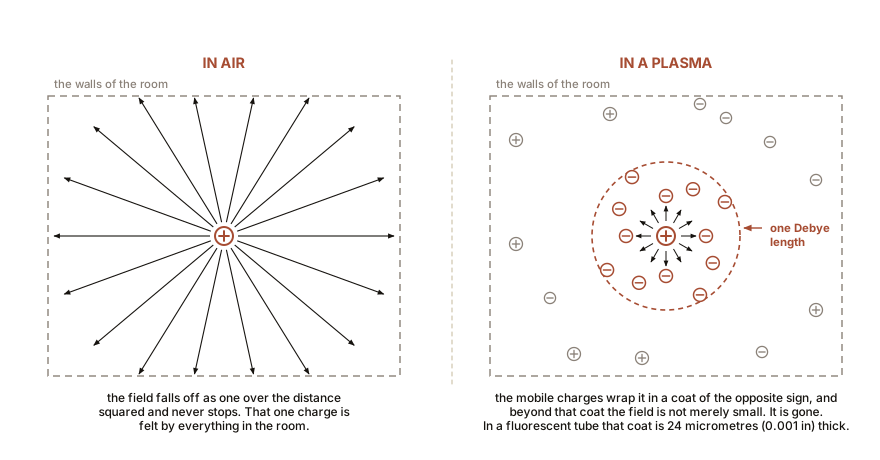
In ordinary air, the answer is the one from school. The field falls off as one over the distance squared, forever. Double the distance, quarter the field. It never stops; it just gets small. That single charge has an influence, however faint, on everything in the room.
In a plasma, something entirely different happens.
The moment that positive charge appears, the free electrons nearby feel it and are pulled in. The positive ions nearby feel it and are pushed away. Within a very short time you have a slight surplus of electrons crowded around your intruder and a slight deficit of them further out. That surplus of negative charge sits between your test charge and the rest of the world.
And it cancels it. Move far enough away and the field is not merely small, it is essentially zero, because the electron cloud that gathered around the intruder carries almost exactly the same amount of charge with the opposite sign. From outside, the two together look like nothing at all.
The plasma has screened the charge. Hidden it. Not by any mechanism anyone designed, but as an automatic consequence of having mobile charges of both signs available.
IN PLAIN ENGLISH: Put a stray charge into a plasma and the plasma immediately wraps it in a coat of opposite charge, until from a short distance away you cannot tell it is there. That reflex is the single most characteristic thing a plasma does.
Section 2: How Far the Coat Reaches
The screening is not instant in space. It takes some distance for enough opposite charge to gather to do the job. That distance has a name and a value, and it is the most useful number in the subject.
It is called the Debye length, written with the Greek letter lambda and a D under it, and it is the distance beyond which a plasma has hidden a stray charge from view.
Two things set it, and both make sense once stated.
More charges available means a shorter distance. If the plasma is dense, there are plenty of electrons close by to do the screening, so the coat is thin. Thin out the plasma and the electrons have to be recruited from further away, so the coat is thick.
Hotter electrons mean a longer distance. A cold electron is easily captured by the intruder’s pull and sits obediently where it is put. A fast, hot electron is barely deflected and keeps going, so it is a poor screener. Heat the electrons and the coat gets sloppy and thick.
That is the whole physics, and the formula says exactly that and nothing more:
Debye length  =  7433 × square root of ( electron temperature in eV
                                          / electron density per cubic metre )
giving an answer in metres. The constant is just unit bookkeeping. The two things it depends on are density and electron temperature, and you now know which way each pushes.
Some real values, and this table is worth more than the formula:
| Plasma | Electrons per m³ | Electron temp | Debye length |
|---|---|---|---|
| Candle flame | about 10¹⁴ | 0.17 eV | 0.3 mm (0.012 in) |
| Fluorescent tube | about 10¹⁷ | 1 eV | 24 µm (0.001 in) |
| Ionosphere, F layer by day | about 10¹² | 0.09 eV | 2 mm (0.08 in) |
| Fusion plasma in a tokamak | about 10²⁰ | 10,000 eV | 74 µm (0.003 in) |
Look at that last row against the second. A fusion plasma is ten thousand times hotter than a fluorescent tube and its screening distance is about the same, because it is also a thousand times denser and the two effects nearly cancel. That is the kind of thing this number is for.
Section 3: The First Real Criterion
Now the definition can be stated properly, and it is a comparison rather than a description.
A volume of ionised gas behaves as a plasma when it is much larger than its own Debye length.
Why that is the test: if the gas is smaller than the screening distance, screening never completes. A stray charge’s field reaches the walls before the gas has managed to cover it, so the gas cannot hide anything, cannot arrange itself, and behaves as a collection of independent charged particles that happen to be near each other.
Make the same gas ten thousand Debye lengths across and it behaves as one thing. It screens. It maintains its own internal neutrality. It develops structure at its edges. It carries waves.
SLOW DOWN. Check Your Understanding: A fluorescent tube has a Debye length of about 24 µm and is about 25 mm (1 in) across. Roughly how many Debye lengths wide is it, and does it qualify? Work it out before reading on.
25 mm is 25,000 µm, so the tube is about a thousand Debye lengths across. Comfortably a plasma. And this is why the answer to “is it a plasma” is almost never marginal in practice: the ratio comes out in the thousands or in single digits, rarely in between. The tube above your desk is a thousand screening lengths wide, which is why it behaves as a coherent glowing column and not as a box of loose sparks.
Section 4: The Second Criterion, and the Word That Matters
There is a second condition, and it is where the real distinction lives.
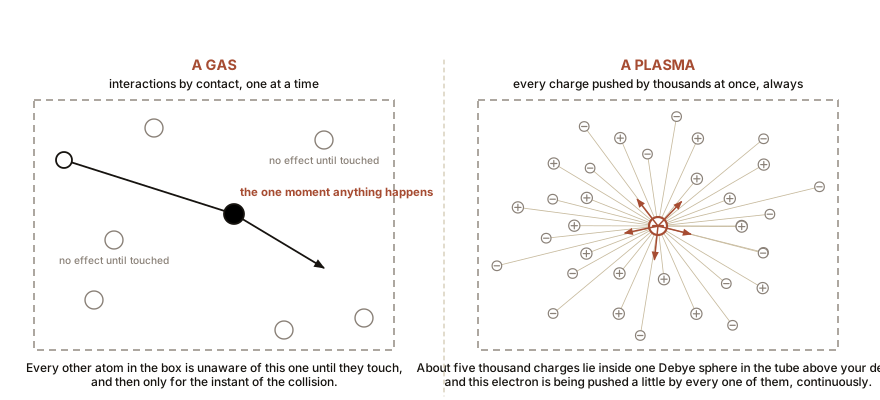
Count how many charged particles are inside a sphere one Debye length in radius. In a fluorescent tube that number is about five thousand. In the ionosphere it is around thirty thousand. In a tokamak, hundreds of thousands.
That number has to be large, and here is why it is the heart of the matter.
In an ordinary gas, a molecule goes about its business in a straight line, feeling nothing, until it physically collides with another molecule. Then it bounces and goes on. Interactions are one at a time, brief, and by contact. Everything a gas does, from pressure to viscosity to the speed of sound in it, comes out of counting collisions between pairs.
In a plasma, a given electron is inside the electrical influence of thousands of other particles simultaneously and continuously. It is never not being pushed. It is being pushed a little bit by an enormous number of neighbours at once, and the sum of all those small pushes usually matters far more than any actual collision does.
That is the difference, and it has a name: collective behaviour.
IN PLAIN ENGLISH: In a gas, particles only affect each other when they bump. In a plasma, every charged particle is being gently pushed by thousands of others all the time, at a distance, so the whole mass responds together rather than one bump at a time. A plasma is not a gas with charges added. It is a substance that behaves as a crowd rather than as a set of individuals.
This is the sentence that almost never gets said, and its absence is why the subject slides off people. Once you have it, a great deal that seemed arbitrary becomes obvious. A plasma supports waves that a gas cannot, because a crowd can ripple. A plasma organises itself into layers and filaments and jets, because a crowd can arrange itself. A plasma responds to a magnetic field as a body, because the crowd moves together. None of that is available to a gas, and none of it follows from “there are some ions in it”.
Section 5: The Third Criterion, and a Bell That Rings
The last condition introduces something the volume will use repeatedly.
Take a slab of plasma and, in your imagination, grab all the electrons in one region and shove them a small distance to one side, leaving the heavier ions where they were.
You have now made a charge imbalance: a negative region where the electrons went and a positive region where they left. That imbalance produces an electric field, and the field pulls the electrons back.
They come back. And because they have mass and momentum, they overshoot, producing an imbalance in the other direction, which pulls them back again.
The plasma rings. The electrons oscillate about their equilibrium at a definite frequency, the way a plucked string does, and for the same reason: a restoring force and an inertia.
That frequency is called the plasma frequency, and it depends on essentially one thing, the electron density:
plasma frequency in Hz = 8980 × square root of ( electrons per cubic centimetre )Denser plasma, stiffer restoring force, higher note.
The third criterion for a plasma is that this ringing has to happen faster than collisions can damp it out. If a typical electron collides with something before it can complete an oscillation, the collective ringing never establishes itself and you are back to a gas that happens to conduct.
And this number does something immediately useful. An electromagnetic wave arriving at a plasma is trying to wiggle those same electrons. If the wave’s frequency is below the plasma frequency, the electrons can keep up with it, and in keeping up they cancel it and throw it back. The wave reflects. If the wave’s frequency is above the plasma frequency, the electrons are too sluggish to respond and the wave passes straight through.
A plasma is therefore a mirror to low frequencies and a window to high ones, with a sharp edge between them at its own plasma frequency.
Put the ionosphere’s numbers in. By day the F layer runs somewhere near a million electrons per cubic centimetre, so:
8980 × square root of 1,000,000 = 8980 × 1000 = about 9 MHz
At night that density falls by roughly a factor of ten, because the sunlight that was doing the ionising has gone and recombination has been quietly winning ever since sunset. A hundred thousand per cubic centimetre gives:
8980 × square root of 100,000 = about 2.8 MHz
Which is why shortwave radio works at all. Broadcast below the plasma frequency and the ionosphere is a mirror: the signal bounces off it, comes back down hundreds or thousands of miles away, and a listener in another country hears you. Broadcast above it, at FM or television frequencies, and the signal goes straight out into space and is gone. The highest frequency that will still come back down is set by this one number, and it moves through the day as sunlight changes the electron density.
And now a warning, because this is only half the story and the half on its own gets the answer backwards.
Reflection improves with density, so by this argument daytime should be better for long-distance work than night. Every shortwave operator knows the opposite is true, and the reason is a second layer, lower down, that this chapter has not mentioned. Chapter 13 supplies it. Hold the reflection argument as correct and incomplete rather than as the whole answer, which is a useful habit well beyond radio.
That is Chapter 13’s subject, and it is being flagged here so that when you get there you recognise the number rather than being handed it.
Section 6: What the Chapter Bought You
Three conditions, and a thing must satisfy all three:
It must be much bigger than its own Debye length, so that screening completes and the material can arrange itself.
It must have many charged particles within a Debye sphere, so that each particle is influenced by many others at once rather than by collisions one at a time. This is collective behaviour, and it is what the word plasma actually denotes.
Its natural ringing must be faster than its collisions, so that the collective response survives long enough to matter.
Two useful numbers came out of it. The Debye length, which is how far the material’s influence extends before it hides itself, and which reappears in Chapter 10 as the sheath that does the cutting in every semiconductor plant on earth. And the plasma frequency, which is the note the material rings at, and which decides what radio it reflects.
IN PLAIN ENGLISH: A plasma is a material in which charged particles are numerous enough and free enough to act as a crowd. Not a gas with some ions in it. A crowd.
One consequence worth stating, because it heads off a natural question. A copper wire is full of free electrons, far more densely than any plasma in this book, and it conducts superbly. It is not a plasma, because those electrons are locked to a rigid lattice of ions that cannot move. The crowd needs both signs mobile. That is why the same three criteria admit a candle flame at one part in ten billion and exclude a copper wire at one electron per atom.
And that brings us to the question that Chapter 1 raised and did not answer. A candle flame conducts at one part in ten billion. How little ionisation is actually enough, and what decides it?

Bench Degree
Get the degree without the diploma.
Learn the material, not how to pass the exam.