Bench Degree·PLASMAchapter
Chapter 1: The Flame That Conducts
Light a candle. You have made the fourth state of matter, and you can prove it in ninety seconds with a comb.
Light a candle and let it settle. Then take an ordinary plastic comb, run it through dry hair a dozen times, and bring it slowly toward the flame from the side, stopping about 50 mm (2 in) away.
The flame leans. Not from a draught, because a comb is not moving air, and you can prove that by trying the same approach with an uncharged comb and watching nothing happen. The flame bends toward the comb, or away from it, and if you rotate the comb the lean follows it.
Something in that flame is responding to an electric field. Air does not do this. Hot air does not do this. A flame does.
Now the second demonstration, which is better because it produces a number.
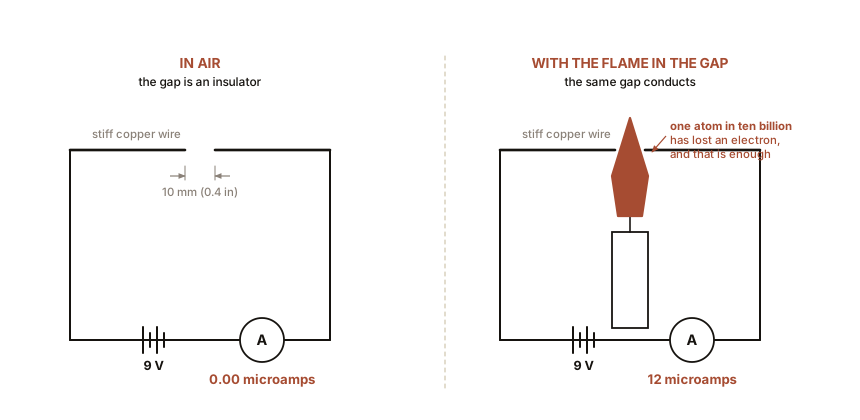
Take a 9 V battery, a multimeter set to read current, and two pieces of stiff copper wire. Hold the wires 10 mm (0.4 in) apart in open air and touch them to the battery through the meter. The meter reads zero. Air is an insulator, which is the only reason the wiring in your walls does not need to be individually boxed.
Now hold that same gap over a candle flame, so the flame sits between the two wires.
The meter comes off zero. Not much, a few microamps on a cheap meter, but it moves, and it moves every time, and it stops the moment you take the flame away.
ON THE BENCH: A flame that conducts
Parts: a candle; a plastic comb; a 9 V battery; a multimeter with a microamp range; two 150 mm (6 in) lengths of stiff bare copper wire, 1.5 mm (0.06 in) or heavier. Everything else: every part this book asks for is listed once, at the back, in Appendix A: The Bench. Nothing is specified by brand, so it can be ordered from anyone. You do not need any of it yet. Cost: under $20, and likely nothing. Time: 10 minutes. Hazards: an open flame, and the wires get hot where the flame touches them. Hold them with pliers, not fingers. Nothing electrical here is dangerous: a 9 V battery cannot hurt you. Method: meter in series with the battery and the two wires. Wires held parallel, tips 10 mm (0.4 in) apart. Read the current in air. Lower the gap into the flame, about 20 mm (0.8 in) above the wick where the flame is brightest. Read again. What you should see: zero in air. Something between 1 and 50 microamps with the flame in the gap, depending on your meter, your gap and your candle. The exact number does not matter. The fact that it is not zero is the whole chapter. If you get nothing: widen the flame’s share of the gap by moving the wires closer, to 5 mm (0.2 in). Check the meter reads on its most sensitive current range. Confirm the meter and battery work by touching the wires together.
Section 1: What Just Happened
For current to flow, something in the gap has to carry charge. In a copper wire it is electrons, loose in the metal and free to drift. In salt water it is sodium and chloride ions, drifting in opposite directions. In air, normally, nothing is free to move, so nothing flows.
In the flame, something is free to move. The heat of combustion has been violent enough to knock electrons loose from some of the atoms and molecules in the gas. Each atom that loses an electron becomes a positive ion, and the electron goes off on its own. Now the gas contains two populations of charged particles that can be pushed by a field, and a gas with free charges in it conducts.
That is the whole mechanism, and it has a name.
IN PLAIN ENGLISH: Give a gas enough of a shove and some of its atoms will drop electrons. Once there are loose electrons and loose ions wandering about in it, the gas can carry current and can be pushed by electricity and magnetism. Gas like that is called a plasma.
The comb works for the same reason. The charged comb makes an electric field. The free ions and electrons in the flame feel that field and move. Because they carry the surrounding hot gas along with them, the visible flame moves too, which is why you can see an effect at all.
Section 2: How Much of the Flame Is Actually Ionised
Here is the number that surprises everyone, and it is worth sitting with, because a great deal of confusion about this subject comes from guessing it wrong.
In a candle flame, roughly one atom in ten billion has lost an electron.
Not one in ten. Not one in a hundred. One in about 10,000,000,000, and the flame conducts anyway.
That should feel wrong. It sounds far too little to matter. Work out what it means in practice and it stops sounding wrong: a cubic millimetre of flame gas contains something like 10,000,000,000,000,000 molecules, and one part in ten billion of that is still around a million free electrons in a volume the size of a pinhead. A million charge carriers is plenty to move a microamp.
This is the first of three ideas in this volume that are simple to state and almost always stated badly. Hold on to it:
The amount of ionisation needed to change a gas’s behaviour completely is far, far smaller than intuition suggests. Chapter 3 puts a proper figure on it. For now, know that a candle flame is at the very bottom end of the scale and still does everything in this chapter.
SLOW DOWN. Check Your Understanding: If a candle flame is only one part in ten billion ionised, why does taking the flame away drop the current to exactly zero rather than to a very small value? Think about where the free electrons come from and what happens to them when the heat stops. Answer before reading on.
Because ionisation is not permanent. A free electron and a positive ion attract each other, and when they meet they recombine into a neutral atom, constantly. In the flame, heat keeps knocking new electrons loose as fast as old ones recombine, so a steady population is maintained. Remove the heat and recombination wins within microseconds, the free charges vanish, and the gas is an insulator again. A plasma is not a substance you have made. It is a balance you are maintaining, and it stops the moment you stop paying for it.
Section 3: The Grape, Which Is Harder to Believe
The candle is convincing but subtle. This one is not subtle.
Take a green grape. Cut it almost in half, leaving a bridge of skin perhaps 3 mm (0.12 in) wide holding the two halves together. Lay it on an upturned glass dish in the middle of a microwave oven, hinge upward, and run the oven for four to eight seconds with the light on and the room dark.
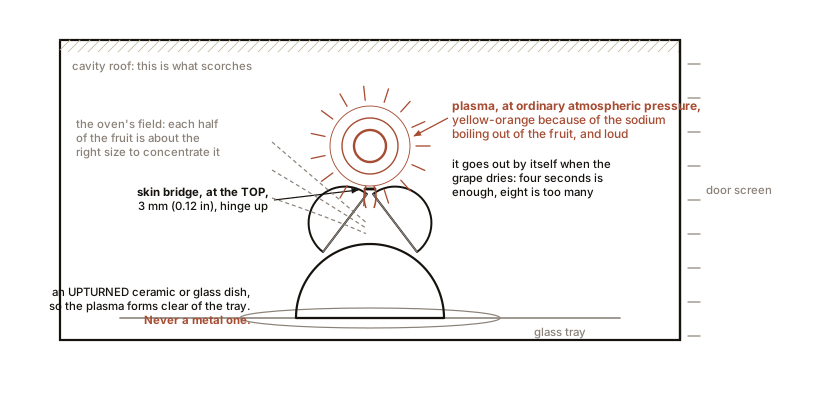
A ball of coloured light appears above the grape, and it moves, and it is loud.
That is a plasma, at atmospheric pressure, made in a kitchen appliance, and it is bright enough to photograph. What is happening is that the two halves of the grape are each roughly the right size to concentrate the oven’s microwaves, the skin bridge lets them couple, and the field at the bridge becomes strong enough to tear electrons off the water vapour and sodium boiling out of the fruit. Sodium is why it is often yellow-orange, for reasons Chapter 9 gives in full.
ON THE BENCH: The grape
Parts: one green seedless grape, or half a large red one. A microwave oven you are willing to risk. Cost: nothing. Time: 2 minutes. Hazards, and these are real. Do not run it longer than about 8 seconds. The plasma is genuinely hot and will scorch the oven roof and can crack the glass tray. Put the grape on an upturned ceramic or glass dish so the plasma forms away from the tray. Never use a metal dish. Never leave it running unattended, and never do it in a microwave you depend on. The oven’s own microwave energy is contained by the door screen and is not the hazard here; the hazard is that you have lit a small torch inside a cabinet with a plastic roof. Method: cut, leaving the skin bridge. Dark room, oven light on, watch through the door. Four seconds first. What you should see: a violent, sparking, roughly spherical glow rising off the bridge, yellow to violet, hissing. Why it stops: the grape dries out and the plasma starves. It is the same lesson as the candle. You are paying for it continuously.
Section 4: Wind With No Moving Parts
Two demonstrations have shown that a gas with free charges in it conducts and responds to fields. This third one shows the consequence that makes the subject useful, and it is the one this volume returns to more than any other.
Take a sharp point, put a few thousand volts on it, and hold your hand a short distance away.
You feel a breeze. A real, steady, directional draught of air, coming off a piece of metal that is not moving and has no fan behind it.
The mechanism will get a full chapter. Briefly: the field at a sharp point is extremely concentrated, concentrated enough to ionise the air immediately around the tip and nowhere else. Those new ions are then pushed away from the point by the same field. As they travel they collide with ordinary neutral air molecules, millions of times, and drag them along. The ions are the only thing being pushed electrically. The wind is the neutral air they hit on the way.
It is called ionic wind, or in the literature electrohydrodynamic flow, and it is the whole basis of a small family of machines with no moving parts: bladeless fans, ion thrusters that fly on real spacecraft, and, run backwards, wind generators with no blades. Chapter 7 does all of it.
There is one detail worth flagging now, because it will save a reader who tries this early. A sharp point at high voltage can produce two visibly different things, and only one of them makes wind. A soft blue-violet haze clinging to the tip, hissing, is a corona discharge, and that is the one that moves air. A bright white crackling spark jumping to something is not, and once you are getting sparks you have lost the effect and gained a hazard. The difference is Chapter 6.
ON THE BENCH: Ionic wind, and the safety rule for the rest of this book
Parts: a current-limited high-voltage supply, roughly 5 to 20 kV, of the sort sold as a cold-cathode or flyback inverter module for $15 to $30. A sewing needle. A metal ring or plate. A candle. Cost: about $30. Time: 30 minutes, most of it reading The Bench first. Hazards. Read this before buying anything. This is the first experiment in this volume that can actually hurt you, and the rule that keeps it safe is current limiting. A supply that can deliver only a fraction of a milliamp at 15 kV will sting and startle. A neon sign transformer at the same voltage can deliver tens of milliamps and can kill. Buy the small module, not the transformer, and The Bench says exactly what to look for. Never work on it with two hands. Discharge and short every capacitor before touching anything. Method: needle as one electrode, ring or plate 30 to 50 mm (1.2 to 2 in) away as the other. Bring the voltage up until you hear a faint hiss and, in the dark, see a violet glow at the needle tip only. Stop there. Do not advance to sparking. Hold a candle flame in the gap and watch it bend hard toward the plate. Put your hand there and feel the draught. What you should see: the flame deflects strongly and steadily. You will smell ozone, which is sharp and slightly like a photocopier. That smell is a by-product and a mild irritant, so ventilate.
Section 5: What Is Actually in This Book
Three experiments, all cheap, all repeatable, and between them they have established the working facts of the entire subject:
A gas with a small population of free charges in it conducts electricity. The candle.
Fields strong enough to make that population appear can be produced easily, including by a kitchen appliance and by a $20 module. The grape and the needle.
Charged particles being pushed can carry the neutral gas around them along. The ionic wind.
Everything else follows. The welding arc, the fluorescent tube above your desk, the plasma cutter, the etching machine that made every chip in your house, the aurora, the sun, and the reactors that people are trying to get fusion out of are all the same three facts at different pressures, temperatures and scales.
And that is the reason for the next chapter, which contains no experiment at all.
Because the definition you have just been given, a gas with free charges in it, is the one every popular account gives, and it is not actually what makes a plasma a plasma. It is close enough to get you through this chapter and it will mislead you badly by Chapter 11. The real definition is not harder. It is just almost never stated.
IN PLAIN ENGLISH: You have now made plasma three times and watched it conduct, glow and blow. The next chapter is about what it actually is, and it is the most important chapter in this book.
Bench Degree
Get the degree without the diploma.
Learn the material, not how to pass the exam.